Why Men Cling to Women
Yudhishthira asks the question that Panchachuda's answer left standing
The Question After the Answer
The old man on the bed of arrows had just finished repeating a speech made by an Apsara to a Rishi in the region of Brahman, and every word of it had been against women.
Bhishma had recited it because the king had asked for it. Yudhishthira had wanted to hear about the disposition of women, since women, he had heard, were said to be the root of all evil, and Bhishma had answered with the old history of Narada and Panchachuda, in which a courtezan of heaven was made to testify against her own sex and did it thoroughly. Fire is never satisfied with fuel. The ocean is never filled by the rivers. The Destroyer is never satiated with the slaying of creatures. Women are never satiated with men.
That is the kind of answer that ends a conversation. It did not end this one.
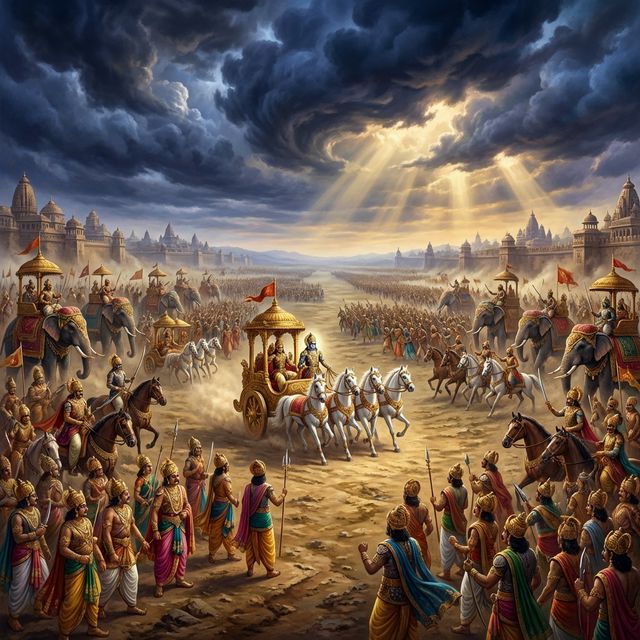
Because Yudhishthira, sitting on the field at Kurukshetra with his brothers around him and the grandsire dying slowly in front of them, had listened to the whole catalogue and had noticed the thing in it that did not fit. If women were as Panchachuda had described them, then something else needed explaining, and it was not the women.
It was the men.
"All men, O king, in this world," Yudhishthira said, "are seen to attach themselves to women, overcome by the illusion that is created by the divine Being. Similarly, women too are seen to attach themselves to men. All this is seen taking place everywhere in the world."
He put the difficulty plainly, and it is worth noticing where he put it. Not in the character of women. In the fact of attachment itself, which he had just been given every reason to think should not exist and which he could see with his own eyes existing in every household in the world.
"On this subject a doubt exists in my mind," he said. "Why, O delighter of the Kurus, when women are stained with so many faults, do men still attach themselves to women?"
The Illusion That Is Created
The phrase Yudhishthira used for it was not a complaint. It was a diagnosis, and he offered it before he offered anything else, which is how a man speaks when he already suspects the shape of the answer and wants it confirmed.
The illusion that is created by the divine Being.
That is where he placed the cause. Not in the cunning of women, which he was about to describe at length, and not in the weakness of any particular man, which he never mentions once in the whole of his question. Whatever is happening between the sexes is happening because something was arranged that way, and it is universal, and it runs in both directions. Men attach themselves to women. Women attach themselves to men. All this is seen taking place everywhere in the world.
A man who really believed that women were simply wicked would not have said the second half of that sentence.
And having said it, Yudhishthira went straight past the theology and asked the practical questions, three of them, one after another, in the voice of a king rather than a philosopher. He had a kingdom to govern and households in it.
"Who, again, are those men with whom women are highly pleased, and who are they with whom they are displeased? It behoveth thee, O chief of men, to explain to me how men are capable of protecting women."
Those are the questions of an administrator. Which men do women take to, and which do they turn from, and what is a husband or a father or a guardian actually able to do about any of it. He was not asking Bhishma for a verdict on the character of half the human race. He had already been handed one of those and it had not helped him. He was asking how the thing works, so that he might know what could be done, and whether anything could be done at all.
Then the doubt came back on him, and the tone changed.
Difficult for Him to Escape
"While men take pleasure in women and sport with them," Yudhishthira said, "women, it seems, are engaged in deceiving men."
He set the two halves of it side by side, and the asymmetry is the point of the sentence. The man in this account is enjoying himself. He is at play. He believes the whole business to be exactly what it looks like, and while he is occupied in that belief the other party is doing something quite different and doing it deliberately.
"Then, again, if a man once falls into their hands, it is difficult for him to escape from them."
Falls into their hands. It is the language used of an ambush, or of a debt, and it carries the assumption that a man in that position would leave if he could and finds that he cannot. Yudhishthira does not say that the man is held by force. He says only that escape is difficult, which is a description of appetite rather than of captivity, though from the inside the two are not easy to tell apart.
And then the image that has outlived every other line in the passage.
"Like kine ever seeking pastures new, women seek new men, one after another."
It is a herdsman's picture and it is delivered without heat. Cattle are not blamed for moving on when a field is eaten down. They do not decide to be faithless to the grass. They walk to the next pasture because there is nothing in a cow that would make her stay in a bare field, and Yudhishthira has chosen an image of blameless animal nature to describe what he is presenting as the deepest fault in the world.
The contradiction is not accidental, and he does not resolve it. He is a man arguing himself toward a question he has not yet managed to ask, and he goes on stacking evidence in front of the dying man because he does not yet know what else to do with it.
The Sum of Four Illusions
Then he began to name names, and the names he chose were all from the wars of the gods.
"That illusion which the Asura Samvara possessed," Yudhishthira said, "that illusion which the Asura Namuchi possessed, that illusion which Vali or Kumbhinasi had, the sum total thereof is possessed by women."
These are not decorative comparisons. Every one of the four is a famous specialist in maya, the power of appearing to be what one is not. Samvara was the Asura whose illusions were a byword, so that a hundred deceptions of his are counted in the old books. Namuchi was the enemy whom Indra could not kill by wet or dry, by day or by night, and who had to be destroyed at last with the foam of the sea, which is neither. Vali was the Daitya king whose arts were legendary, and Kumbhinasi belongs to the same company.
Against the gods, each of these held out by seeming. And Yudhishthira does not say that women have an illusion like theirs. He says the sum total of all four is in them, which is to say that whatever the celestials once had to defeat by strategy and by the labour of years, an ordinary householder meets across his own courtyard every morning.
Then he gave the mechanism, and the mechanism is smaller and more frightening than the mythology.
"If man laughs, women laugh. If man weeps, they weep. If the opportunity requires, they receive the man that is disagreeable to them with agreeable words."
That is the whole art, stated in three clauses. Not a spell and not a shape-changing. A mirror. The illusion of Samvara reduced to household scale is simply this, that what a man sees in front of him is the reflection of his own face, so that he is never given anything to argue with and never told a lie he could catch, and comes away certain he was understood.
And the man that is disagreeable to them is greeted, and hears only the agreeable words, and does not know that he was disagreeable.
Deeper Than the Science of Policy
Having compared women to the Asuras, Yudhishthira compared them next to the two greatest teachers in the universe, and this is the passage where his question stops being an accusation and becomes something closer to awe.
"That science of policy which the preceptor of the Asuras knew," he said, "that science of policy which the preceptor of the celestials, Brihaspati, knew, cannot be regarded to be deeper or more distinguished for subtility than what woman's intelligence naturally brings forth."
Two names stand behind that sentence. Sukra taught the Asuras, Brihaspati taught the gods, and between them they hold the whole of niti, the science by which kings are advised, alliances are made and broken, enemies are divided, and states survive. Yudhishthira had been given instruction in that science for many days by the man lying in front of him. He knew exactly how hard it is and how long it takes to learn.
And he says that what a woman's mind produces without instruction is not shallower than either.
Naturally brings forth. That is the sting of it for him. The gods and the Asuras had to be taught. He had to be taught, on a battlefield, by a grandfather who was dying while he taught him.
"Verily, how can women, therefore, be restrained by men? They make a lie appear as truth, and a truth appear as a lie. They who can do this, I ask, O hero, how can they be ruled by persons of the opposite sex?"
Then he took the thought one step further than any of the sages in the passage had taken it, and offered Bhishma a suspicion of his own.
"It seems to me that Brihaspati and other great thinkers, O slayer of foes, evolved the science of policy from observation of the understandings of women."
The preceptor of the gods, in this account, did not invent statecraft. He watched, and wrote down what he saw, and the kings of the earth have been governing by it ever since.
But Living Creatures Are Virtuous
"Whether treated by men with respect or with disdain," Yudhishthira said, "women are seen to turn the heads and agitate the hearts of men."
He had been circling that clause for some time. It closes off both roads at once. Kindness does not settle the matter and neither does harshness, and a man who has tried the one and then the other has not conducted an experiment, because there was never a third thing to try.
And then, having built the case as high as he could build it, the king stopped and stated the objection to his own argument, which is the most honest sentence in the whole of his question.
"Living creatures, O thou of mighty arms, are virtuous. Even this is what has been heard by us."
That is doctrine, and he had it from the same tradition that had just handed him Panchachuda's testimony. All living beings are righteous by nature. It is the ground on which every teaching about dharma stands, including the ones Bhishma had been giving him for days on end, and Yudhishthira could not make it agree with what he had been told about half of them.
"How then can this be consistent with fact? For treated with affection and respect or otherwise, women, forming a fair portion of living creatures, are seen to deserve censure for their conduct towards men."
Either the doctrine is wrong or the testimony is, and he does not have the standing to say which. He was not asking, in the end, to be told that women are wicked. He had been told that already, at length, by a woman, in Narada's presence, and it had left a hole in his understanding of the world rather than filling one.
"This great doubt fills my mind," he said, "that when their behaviour is such, what man is there that can restrain them within the bounds of righteousness?"
Did Anyone Ever Succeed
The last thing Yudhishthira asked was not a question about women at all. It was a question about the record.
"Do thou explain this to me, O highly blessed scion of Kuru's race. It behoves thee to tell me, O chief of Kuru's race, whether women are truly capable of being restrained within the bonds prescribed by the scriptures, or whether any one before our time did really succeed in so restraining them."
Read the two halves of that separately, because they are two different requests.
The first is theoretical. Is the thing possible in principle. Can the rule that the books lay down actually be kept, or is it one of those ordinances that stands in the text and has never once stood in a house.
The second is the request of a man who has stopped trusting principles. Did anybody ever do it. Not could it be done. Was it done, by a named person, in a place, and is there an account of it that I may hear. Yudhishthira had spent the whole of his question drawing on cattle and Asuras and the preceptors of the gods, and at the end of all that he wanted one instance. One man who had held a woman inside the bounds, and who had not been ruined for it, and whose story could be told.
He had asked the right person. Bhishma had lived in a house with a stepmother whose fisherman father had made a king of Hastinapur bargain for her, and had taken his own terrible vow for that woman's sake, and had carried three princesses out of Kashi by force and lost one of them to a curse and a rebirth and an arrow. If any man alive had reason to answer the question with something other than a proverb, it was the one on the arrows.
"It is even so as thou sayest, O thou of mighty arms," Bhishma said. "There is nothing untrue in all this that thou sayest, O thou of Kuru's race, on the subject of women."
He conceded the whole indictment in one breath. Then, instead of a rule, he offered a name.
"In this connection I shall recite to thee the old history of how, in days of yore, the high-souled Vipula had succeeded in restraining women within the bounds laid down for them."
Dharma Lesson
Yudhishthira had been handed a verdict and found that it explained nothing, because a fault in one half of the world cannot account for the helplessness of the other half. He locates the difficulty where it belongs, in the illusion that binds both sexes to each other, and then asks not for a rule but for an instance. That is the discipline of the question: a teaching that no one has ever managed to live is not yet an answer, and a man who wants to know whether a thing can be done is right to ask who has done it.