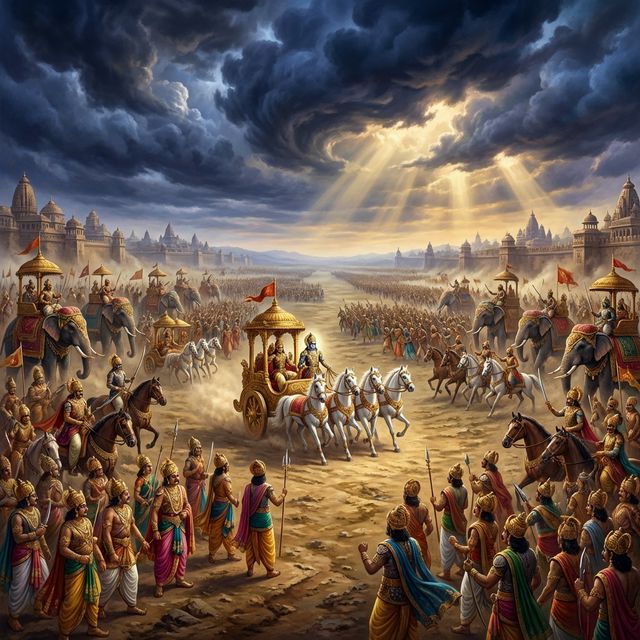
The Brahmanas Who Deserve Worship
Narada tells Krishna whom he bows to, and Bhishma tells a king what it costs to forget
The Question About Homage
By that stage the questions came one at a time and were answered at length, and nobody in the great circle on the field of Kurukshetra was in any hurry, because the old man on the bed of arrows was holding his death back until the sun turned north and there was nothing to do with the days but spend them.
"What men, O chief of Bharata's race, are worthy of reverent homage in the three worlds?" Yudhishthira said. "Tell me this in detail, verily. I am never satiated with hearing thee discourse on these topics."
"In this connection," Bhishma said, "is cited the old narrative of the discourse between Narada and Vasudeva."
Krishna was sitting there while he said it. That is worth noticing before the story begins, because the story is about a conversation Krishna himself had once had, and the grandsire recited it back to him in front of everyone without once turning his head to see whether the account was accepted.
Narada is the celestial rishi who goes everywhere, into the halls of the gods and the courts of kings and the clearings of hermits, carrying news and questions and, when it suits him, quarrels. He is not a man who is easily impressed, and he does not bow readily.
On one occasion Kesava saw him bowing. Narada was standing before a number of the foremost of the brahmanas with his hands joined at his forehead, worshipping them, and Krishna watched him do it and then asked him about it.
"Whom dost thou worship?" he said. "Whom amongst these brahmanas, O holy one, dost thou worship with so great reverence? If it is a matter that I can hear of, I wish to hear it. Do, O foremost of righteous men, tell me this."
Narada took the question seriously, and he did not answer it briefly, and the first thing he said was that there was nobody better in the world to ask it.
"Hear, O Govinda, as to who those are whom I am worshipping, O grinder of foes. Who else is there in this world that so much deserves to hear this?"
The First of the Roll
He began with the men who keep the fires burning for everyone else.
"I worship the brahmanas, O puissant one, who constantly worship Varuna and Vayu and Aditya and Parjanya and the deity of Fire, and Sthanu and Skanda and Lakshmi and Vishnu and the brahmanas, and the lord of speech, and Chandramas, and the Waters and Earth and the goddess Saraswati."
That is the whole pantheon in one breath, and the brahmanas stand on the list twice, once as the worshippers and once among those worshipped.
"O tiger of Vrishni's race, I always worship those brahmanas that are endued with penances, that are conversant with the Vedas, that are always devoted to Vedic study, and that are possessed of high worth. I bow down my head unto those persons who are freed from boastfulness, who discharge, with an empty stomach, the rites in honour of the deities, who are always contented with what they have, and who are endued with forgiveness."
Read that middle clause slowly. The offering is made before the priest eats. He stands at the fire hungry and feeds the gods first, and he does it every morning, and nobody applauds.
"I worship them, O Yadava, that are performers of sacrifices, that are of a forgiving disposition and self-restrained, that are masters of their own senses, that worship truth and righteousness, and that give away land and kine unto good brahmanas. I bow unto them that are devoted to the observance of penances, that dwell in forests, that subsist upon fruits and roots, that never store anything for the morrow, and that are observant of all the acts and rites laid down in the scriptures.
"I bow unto them that feed and cherish their servants, that are always hospitable to guests, and that eat only the remnants of what is offered to the deities. I worship them that have become irresistible by studying the Vedas, that are eloquent in discoursing on the scriptures, that are observant of the vow of Brahmacharyya, and that are always devoted to the duties of officiating at the sacrifices of others and of teaching disciples. I worship them that are endued with compassion towards all creatures, and that study the Vedas till noon, till their backs are heated by the sun."
Never store anything for the morrow. It is set down between two ordinary clauses as though it were ordinary, and it is the hardest of the vows, because a man who keeps it has given up not merely wealth but the whole apparatus of prudence.
The Practice of Pigeons
The roll grew poorer as it went.
"I bow unto them that strive to obtain the grace of their preceptors, that labour in the acquisition of the Vedas, that wait with dutiful obedience upon their seniors, and that are free from malice and envy. I bow unto them that practise taciturnity, that have knowledge of Brahman, that are firm in truth, and that are givers of libations of clarified butter.
"I bow to them that subsist upon eleemosynary alms, that are emaciated for want of adequate food and drink, that have lived in the abodes of their preceptors, that are destitute of all enjoyments, and that are poor in the goods of this Earth."
Emaciated for want of adequate food and drink. Narada does not soften it. The men he bowed to were thin because there had not been enough.
"I bow unto them that have no affection for things of this Earth, that have no quarrels to wage with others, that do not clothe themselves, that have no wants, and that are utterers of Brahma. I bow unto them that are devoted to compassion towards all creatures, that are self-restrained, and that are peaceful in their behaviour. I bow unto them that are devoted to the worship of deities and guests, that are observant of the domestic mode of life, and that follow the practice of pigeons in the matter of their subsistence."
A pigeon takes up one grain at a time and keeps no granary. A man who subsists so has a wife and a house and a fire and children, and still gathers only what the day requires.
"I always bow unto those persons whose aggregate of three exists without being weakened in all their acts, that are free from cupidity, and that are righteous in their behaviour."
The aggregate of three is Righteousness and Wealth and Pleasure, and in these men none of the three has eaten the others.
"I bow unto them, O Madhava, that subsist upon water only, or upon air alone, or upon the remnants of the food offered to deities and guests. I worship them that have no spouses, and them that have spouses and the domestic fire, that are the refuge of the Vedas and of all creatures. I bow unto those Rishis, O Krishna, that are the creators of the universe, that are its elders, that are dispellers of the darkness of ignorance, and that are the best of all persons in it.
"For these reasons, do thou also, O scion of Vrishni's race, worship every day those regenerate persons of whom I speak."
He had told Krishna to bow where he was bowing, and Krishna did not interrupt.
They Who Cross All Calamities
"Deserving as they are of reverent worship," Narada went on, "they will, when worshipped, confer happiness on thee, O sinless one. Those persons of whom I speak are always givers of happiness in this world as well as in the next. Reverenced by all, they move about in this world, and if worshipped by thee are sure to grant thee happiness."
Having named whom he worshipped, Narada named what worship does, and the second list is built out of one repeated phrase.
They who are hospitable to all persons that come to them as guests, and who are always devoted to brahmanas and kine and to truth in speech and behaviour, succeed in crossing all calamities and obstacles. They who are devoted to peacefulness of behaviour, and they who are freed from malice and envy, and they who are attentive to the study of the Vedas, succeed in crossing all calamities and obstacles.
They who bow to all the deities without showing a preference for any, they who betake themselves to one Veda as their refuge, they who are possessed of faith and are self-restrained, succeed in crossing all calamities and obstacles. They who worship the foremost of brahmanas with reverence, and are firm in the observance of excellent vows, and practise the virtue of charity, succeed in crossing all calamities and obstacles.
They who are engaged in the practice of penances, they who are always observant of the vow of celibacy, and they whose souls have been cleansed by penances, succeed in crossing all calamities and obstacles. They who are devoted to the worship of the deities and guests and dependants, as also of the Pitris, and they who eat the remnant of the food that is offered to deities, Pitris, guests and dependants, succeed in crossing all calamities and obstacles.
They who, having ignited the domestic fire, duly keep it burning and worship it with reverence, and they who have duly poured libations in Soma-sacrifices, succeed in crossing all calamities and obstacles.
And then the last item on the list, which is not a class of men at all.
They who behave as they should towards their mothers and fathers and preceptors and other seniors, even as thou, O tiger among the Vrishnis, dost behave, succeed in crossing all calamities and obstacles.
Having said these words, the celestial rishi ceased speaking. He had run through every kind of holiness he could think of, and finished by pointing at the man he was talking to and saying, that one, the way he treats his elders, put him on the roll as well.
The Pigeon in the King's Lap
"For these reasons," Bhishma said, "do thou also, O son of Kunti, always worship with reverence the deities, the Pitris, the brahmanas, and guests arrived at thy mansion, and as the consequence of such conduct thou art sure to attain to a desirable end."
Yudhishthira asked the next thing at once.
"Tell me truly, O chief of Bharata's race, what the merits are of those persons that grant protection to living creatures of the four orders when these pray for protection."
"Listen to this old history," Bhishma said, "touching the great merit of granting protection to others when protection is humbly sought."
Once a beautiful pigeon, pursued by a hawk, dropped out of the sky and landed in the lap of king Vrishadarbha of Kasi, and would not leave it. The king looked at the bird shivering against him and spoke to it as one speaks to a frightened child.
"Be comforted, O bird. Do not fear. Whence hast thou taken such great fright? Thy colour, beautiful bird, is such as to resemble that which adorns a fresh-blown lotus of the blue variety. Thy eyes are of the hue of the pomegranate or the Asoka flower. When thou hast sought refuge with me, know that no one will have the courage even to think of seizing thee. I shall for thy sake give up today the very kingdom of Kasi, and, if need be, my life too."
The hawk came down after it and made an argument, and the argument was a good one.
"This bird has been ordained to be my food. I have outcoursed him and have got him. Verily, with great effort have I got at him at last. Fierce is the thirst that is afflicting me, and hunger is gnawing my bowels. Behold, his body is bruised and torn by me with my wings and talons. Look, his breath has become very weak.
"In the exercise of that power which properly belongs to thee, thou art competent to interfere in protecting human beings when they are sought to be destroyed by human beings. Thy power may extend over thy enemies, thy servants, thy relatives, the disputes that take place between thy subjects, over every part of thy dominions, and over thy own senses. Thy power, however, does not extend over the welkin. Thy rule does not extend over the birds that range the sky. Indeed, if thou hast been desirous of earning merit by protecting this pigeon, it is thy duty to look at me also."
The king heard him out, and was filled with wonder, and did not dismiss a word of it.
Flesh Against Feathers
"Let a bovine bull or boar or deer or buffalo be dressed today for thy sake," the king said. "Do thou appease thy hunger on such food today. Never to desert one that has sought my protection is my firm vow. Behold, O bird, this bird does not leave my lap."
"I do not eat the flesh of the boar or the ox or of any of the diverse kinds of fowl," the hawk said. "What need have I of food of this or that kind? My concern is with that food which has been eternally ordained for beings of my order. Hawks feed on pigeons. This is the eternal ordinance. O sinless Usinara, if thou feelest such affection for this pigeon, do thou then give me flesh from thy own body, of weight equal to that of this pigeon."
"Great is the favour thou showest me today by speaking to me in this strain," the king said. "Yes, I shall do what thou biddest."
He called for a balance and set the pigeon in one scale, and began to cut the flesh from his own body and heap it in the other. In the inner apartments the queens heard what was being done and came out adorned with their jewels and stricken with grief, and the noise that rose from the palace was deep as the roar of clouds. The clear sky covered itself over with thick cloud on every side. The Earth began to tremble, in consequence of that act of truth which the monarch did.
He cut from his flanks, and from his arms, and from his thighs, and filled the scale, and the pigeon continued to weigh heavier.
When at last he was a skeleton of bones without any flesh and covered with blood, he understood what the balance had been asking for from the beginning, and he climbed into the scale himself.
Then the three worlds came to that place with Indra at their head to look at him. Kettle-drums that nobody could see were struck and played upon in the firmament. Nectar was poured upon the king in a shower, and garlands of celestial flowers of delicious fragrance and touch came down on him copiously and again. The deities and Gandharvas and Apsaras sang and danced around him in large bands, as they sing and dance around the Grandsire Brahma.
He mounted a car more splendid than a mansion of gold, arched with gold and gems and pillared with lapis lazuli, and the royal sage Sivi, that ruler of Kasi, went up in it to eternal heaven.
"Do thou also, O Yudhishthira, act in the same way towards those that seek thy protection."
The Foremost Act of a King
"Which act, O grandsire, is the foremost of all those that have been laid down for a king?" Yudhishthira said. "What is that act by doing which a king succeeds in enjoying both this world and the next?"
"Even this," Bhishma said, "the worship of the brahmanas, is the foremost of all those acts."
He set out the practice plainly. With bows, with comforting speeches, with gifts of all articles of enjoyment, the king is to honour every brahmana of great learning in his city or his provinces, cherishing them as he cherishes his own children and honouring the worthiest as one honours one's sires. When such men are free from all anxiety, the whole kingdom blazes forth in beauty.
Then the grandsire said what a king is really dealing with. If enraged they are capable of consuming an entire kingdom to ashes by the mere fiat of their will, or by acts of incantation. When they are angry their glances fall on men and things like a blazing flame upon a forest, and the most courageous men are struck with fear.
Some among them have the might of lions and some of tigers, some the might of boars, some of the deer, some of crocodiles. Some there are whose touch resembles that of snakes of virulent poison, and some whose bite resembles that of sharks. Some can compass by speech alone the destruction of those opposed to them, and some can destroy by a glance only of their eyes. And some are of very mild disposition.
Some among them are like wells and pits with mouths covered over by grass and creepers. Others resemble the firmament cleared of clouds and darkness. Some are of fierce disposition, as Durvasa was. Some are as mild and soft as cotton, as Gautama was. Some are cunning, as Agastya was when he devoured the Asura Vatapi. Some are devoted to penances. Some are employed in agricultural pursuits. Some keep kine, as Upamanyu did while he attended his preceptor. Some live upon alms. Some are even thieves, as Valmiki was in his early years and as Vishvamitra became during a famine. Some are fond of fomenting quarrels, which is Narada himself, and Narada is not left off the list. Some are actors and dancers. Some are competent to achieve every feat, as Agastya was when he drank up the entire ocean as if it were a palmful of water.
"The brahmanas, O chief of Bharata's race, are of diverse aspects and behaviour," Bhishma said. "One should always utter the praises of the brahmanas who are conversant with all duties, and who are seen to derive their sustenance from diverse kinds of occupations."
The Tribes That Fell
They are elder in respect of their origin, Bhishma said, than the Pitris and the deities and human beings and the Snakes and the Rakshasas. They cannot be vanquished by deities or Pitris, by Gandharvas or Rakshasas, by Asuras or Pisachas. They are competent to make a deity of him that is not a deity, and to divest of his status one that is. He becomes a king whom they wish to make a king, and he goes to the wall whom they do not love.
Then the grandsire gave the list that a king seated on a conquered earth ought to hear.
It is in consequence of the absence of brahmanas from among them that the Sakas, the Yavanas, the Kamvojas and other kshatriya tribes have become fallen and degraded into the status of Sudras. The Dravidas, the Kalingas, the Pulandas, the Usinaras, the Kolisarpas, the Mahishakas and other kshatriyas have, for the same reason, become degraded into Sudras.
These were warrior peoples with kings and chariots and a place in the world, and what is said of them is not that they were beaten. It is that nobody was left among them to say what the rites were, and within a few generations there was no way back.
"Defeat at their hands is preferable to victory over them, O foremost of victorious persons," Bhishma said. "One slaying all other living creatures in the world does not incur a sin so heinous as that of slaying a single brahmana. The great Rishis have said that brahmanicide is a heinous sin. One should never utter the dispraise or calumny of the brahmanas. Where the dispraise of brahmanas is uttered, one should sit with face hanging down, or leave that spot."
Nor is this a matter of the arm. The energy and might of kshatriyas who scorch everything with their energy and might become neutralised when they encounter the brahmanas. The Bhrigus conquered the Talajanghas. The son of Angiras conquered the Nipas. Bharadwaja conquered the Vitahavyas and the Ailas as well. All those kshatriyas were capable of using diverse kinds of arms, and the brahmanas who conquered them owned nothing for an emblem but black deer skins.
"That man has not as yet been born in this world, or will not take birth here," Bhishma said, "who has been or will be able to pass his life in happiness after quarrelling with the brahmanas. One cannot seize the wind with one's hands. One cannot touch the moon with one's hand. One cannot support the Earth on one's arms. After the same manner, O king, one is not able to vanquish the brahmanas in this world."
Vasudeva Asks the Earth
They have Soma for their king, the grandsire went on, and it is they who confer happiness and misery upon others. Nothing is higher than causing a brahmana of good birth, knowing morality, steadfast in excellent vows, to take up his residence in one's mansion. The offerings given to brahmanas reach the very deities who accept them. Aditya and Chandramas, Wind and Water and Earth and Sky and the points of the compass all enter the body of the brahmana and take what the brahmana eats. In that house where brahmanas do not eat, the Pitris refuse to eat. Like fire concealed within wood, everything that is said or heard or read in this world lies ensconced in the brahmana.
"In this connection," Bhishma said, "is cited the old history of the conversation between Vasudeva and the Earth."
Krishna, in that old history, put a question to the goddess who carries everybody.
"O mother of all creatures, O auspicious goddess, I desire to ask thee for a solution of this doubt of mine. By what act does a man leading the domestic mode of life succeed in cleansing all his sins?"
It is the householder's question, asked by a man who cannot go to the forest and has no intention of pretending otherwise.
"One should serve the brahmanas," the Earth said. "This conduct is cleansing and excellent. All the impurities are destroyed of that man who serves the brahmanas with reverence. From this arises prosperity. From this arises fame. From this springs forth intelligence, or knowledge of the soul. A kshatriya by this conduct becomes a mighty car-warrior and a scorcher of foes, and succeeds in acquiring great fame. Even this is what Narada said unto me, that one should always revere a brahmana that is well-born, of rigid vows and conversant with the scriptures, if one desires every kind of prosperity.
"That man who speaks ill of the brahmanas soon meets with discomfiture, even as a clod of unbaked earth meets with destruction when cast into the sea. Behold the dark spots on the Moon, and the salt waters of the ocean. The great Indra had at one time been marked all over with a thousand marks of his shame. It was through the power of the brahmanas that those marks became altered into as many eyes. Behold how all those things took place. Desiring fame and prosperity and diverse regions of beatitude in the next world, a person of pure behaviour and soul should live in obedience to the dictates of the brahmanas."
Hearing the words of the goddess, the slayer of Madhu said, Excellent, Excellent, and honoured her in due form.
The Verses the Creator Sang
"O blessed king," Bhishma said, "a brahmana, by birth alone, becomes an object of adoration with all creatures, and is entitled as a guest to eat the first portion of all cooked food. From them flow all the great objects of life. They are the friends of all creatures. They are the mouths of the deities."
Then he recited the verses that men conversant with ancient history repeat, which the Creator sang after he had made the brahmanas and was setting their duties before them.
A brahmana should never do anything else than what has been ordained for him. Protected, they should protect others. Conducting themselves so, they are sure to obtain Brahma-prosperity. Ye shall become the exemplars of all creatures, and reins for restraining them. A brahmana possessed of learning should never do that which is laid down for the Sudras, for by such acts he loses merit. By Vedic study he obtains prosperity and intelligence and energy and puissance competent to scorch all things, and glory of the most exalted kind. Endued with faith that is fraught with compassion towards all creatures, and devoted to self-restraint and the study of the Vedas, ye shall attain to the fruition of all your wishes. Whatever things exist in the world of men, whatever things occur in the region of the deities, can all be acquired with the aid of penances and knowledge and the observance of vows and restraints.
"Endued with supreme intelligence and wisdom, the Creator himself ordained this, through compassion for the brahmanas."
And then, once more, the grandsire named the price of forgetting them.
The Mekalas, the Dravidas, the Lathas, the Paundras, the Konwasiras, the Saundikas, the Daradas, the Darvas, the Chauras, the Savaras, the Varvaras, the Kiratas, the Yavanas and numerous other tribes of kshatriyas have become degraded into the status of Sudras through the wrath of brahmanas. Having disregarded them, the Asuras were obliged to take refuge in the depths of the ocean. Through their grace, the deities became denizens of heaven.
"The element of space is incapable of being touched. The Himavat mountains are incapable of being moved from their site. The current of Ganga is incapable of being resisted by a dam. The brahmanas are incapable of being subjugated, and kshatriyas are incapable of ruling the Earth without cultivating their good will. Do thou always worship them with gifts and obedient services, if indeed thou wishest to enjoy the sovereignty of the whole Earth with her belt of seas.
"But their energy and might, O sinless one, become abated in consequence of the acceptance of gifts. Thou shouldst protect thy race, O king, from those brahmanas that do not desire to accept gifts."
Dharma Lesson
The epic insists that reverence is owed to a whole order of men, and then spends its longest passage on how unalike those men are: some fierce, some soft as cotton, some farmers, some cowherds, some beggars, some thieves, some troublemakers, some dancers. The honour is not a prize for uniform excellence. It is paid to the people who keep the words and the rites alive, and the cost of withdrawing it is stated as plain history about whole warrior peoples who lost the thread and never found it again. Narada's answer is the more searching one. Asked whom he bows to, he lists the hungry, the unclothed and the ones who store nothing for tomorrow, and then turns and tells Krishna to bow to them as well.