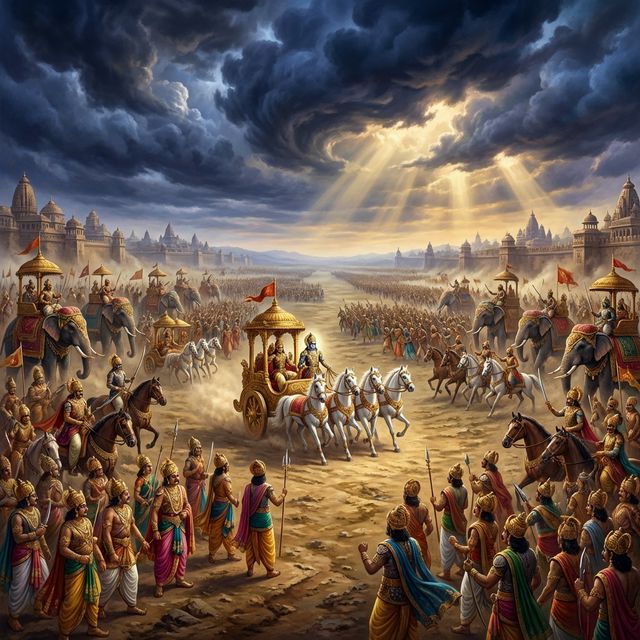
The Five Forms of Marriage
Bhishma on how a daughter is given, what a dower does not buy, and the honour owed to women
The Root of All Duties
Bhishma had been lying on the bed of arrows through a long stretch of days by then, answering whatever the king brought him, and the questions had worked their way down from kingdoms and gifts and penances to the ordinary business of a household.
"Tell me of that, grandsire," Yudhishthira said, "which is the root of all duties, which is the root of kinsmen, of home, of the Pitris and of guests. I think this should be regarded as the foremost of all duties, the marriage of one's daughter. Tell me, O king, upon what sort of a person should one bestow one's daughter?"
It is worth noticing what he had just claimed. Not sacrifice, not almsgiving, not the protection of subjects. The giving of a girl in marriage, because everything else on his list depends on it. There are no kinsmen without it, no house to keep a fire in, nobody to feed the dead fathers, and nobody at the door to receive a guest. Strike out the marriage of daughters and the whole apparatus of dharma has nothing to stand on.
Bhishma began with the answer that is the least dramatic and the most important.
"Having enquired into the conduct and disposition of the person," he said, "his learning and acquirements, his birth, and his acts, good people should then bestow their daughter upon accomplished bridegrooms. All righteous Brahmanas act in this way. This is known as the Brahma marriage."
Four things to be enquired into, and the man's wealth is not one of them. His character, his learning, his family, and what he has actually done with his life. A father who has looked into those four and is satisfied gives his daughter and takes nothing, and that is the first and highest form of the rite.
"Selecting an eligible bridegroom," Bhishma went on, "the father of the girl should cause him to marry his daughter, having, by presents of diverse kinds, induced the bridegroom to that act. This form of marriage constitutes the eternal practice of all good Kshatriyas."
The Kshatriya, in other words, pays. Not for the girl. For the man, to bring him to the wedding. The whole of the discourse that follows turns on that distinction, and the king was about to spend the rest of the morning discovering how narrow it is.
Five Forms, and Two That Are Not Righteous
Bhishma set out the rest of the list.
"When the father of the girl, disregarding his own wishes, bestows his daughter upon a person whom the daughter likes and who reciprocates the girl's sentiments, the form of marriage is called Gandharva by those that are conversant with the Vedas."
That is the third. The father has a preference and puts it aside, and the two young people have each other, and the union takes its name from the Gandharvas who are supposed to know something about love. It is set down without apology among the good forms.
"The wise have said this to be the practice of the Asuras, wedding a girl after purchasing her at a high cost and after gratifying the cupidity of her kinsmen."
That is the fourth, and the word in it is cupidity. The man buys. The kinsmen are greedy and are satisfied. Nothing in the description is about the girl at all.
"Slaying and cutting off the heads of weeping kinsmen, the bridegroom sometimes forcibly takes away the girl he would wed. Such wedding is called by the name of Rakshasa."
The fifth. Ganguli's line keeps the detail that makes it unbearable, which is that the kinsmen are weeping while their heads come off, and that this is nonetheless a recognised form of marriage with a name and a place in the books.
"Of these five, the Brahma, the Kshatra, the Gandharva, the Asura, and the Rakshasa, three are righteous and two are unrighteous. The Paisacha and the Asura forms should never be resorted to. The Brahma, Kshatra, and Gandharva forms are righteous. Pure or mixed, these forms should be resorted to, without doubt."
So the sale is condemned and the seizure is not, which is a Kshatriya's arithmetic, and Bhishma of all men had reason to know it.
Then the plain rules of how many. A Brahmana may take three wives. A Kshatriya may take two. A Vaisya should take a wife only from his own order. The children born of these wives are all to be regarded as equal. Of the three wives of a Brahmana, the one from his own order stands foremost; of the two wives of a Kshatriya, the same.
"Some say that persons belonging to the three higher orders may take, only for purposes of enjoyment and not for those of virtue, wives from the Sudra order. Others forbid the practice. The righteous condemn it. A Brahmana, by begetting children upon a Sudra woman, incurs the liability of performing an expiation."
The Age of the Bride and the Forbidden Kin
From the forms Bhishma went to the plain numbers, which he gave without commentary, as a man recites a measure.
"A person of thirty years of age should wed a girl of ten years of age, called a Nagnika. Or, a person of one and twenty years of age should wed a girl of seven years of age."
Then a prohibition that has nothing to do with age and everything to do with a father's need.
"That girl who has no brother nor father should not be wed, chief of Bharata's race, for she may be intended as Putrika of her sire."
A man with no son may appoint his daughter to stand in a son's place, so that her child will be his and will offer him water when he is dead. A girl in that position is not free to be carried off into another house, and a man who marries her without knowing it has quietly taken a line of descent out of the world. Bhishma states the rule and leaves the reason a single word wide, and the word is Putrika.
Then the case that the rules had not covered, which is the girl nobody comes for.
"After the appearance of puberty, the girl, if not married, should wait for three years. On the fourth year, she should look for a husband herself, without waiting any longer for her kinsmen to select one for her. The offspring of such a girl do not lose their respectability, nor does union with such a girl become disgraceful. If, instead of selecting a husband for herself, she acts otherwise, she incurs the reproach of Prajapati herself."
That is worth reading twice. Three years of waiting is the whole allowance made to the family that has failed her, and in the fourth year the choice passes to the girl, and the law goes ahead of the disapproval and declares in advance that neither she nor her children are to be thought less of for it. And then the sting in the tail: it is not the choosing that draws the reproach of Prajapati. It is the not choosing.
Last, the boundary of blood.
"One should wed that girl who is not a Sapinda of one's mother or of the same Gotra with one's father. Even this is the usage, consistent with the sacred law, which Manu has declared."
Not near kin on the mother's side. Not the same lineage on the father's. Between those two fences lies every marriage the discourse has been describing.
Whose Wife Does She Become
Yudhishthira had been counting cases while he listened, and he laid all five of them out at once.
"Desirous of marriage, someone actually gives a dower to the girl's kinsmen. Someone says, the girl's kinsmen consenting, that he promises to give a dower. Someone says, I shall abduct the girl by force. Someone simply displays his wealth, intending to offer a portion of it as dower for her. Someone, again, actually takes the hand of the girl with rites of wedding. I ask thee, grandsire, whose wife does the girl actually become? Unto us that are desirous of knowing the truth, thou art the eye with which to behold."
Five men and one girl, and four of them have done nothing but talk about money.
"Whatever acts of men have been approved or settled in consultation by the wise," Bhishma said, "are seen to be productive of good. False speech, however, is always sinful."
He began with the one thing genuinely at stake in a broken promise, which is not property but a lie. If the girl bestows her hand upon a person other than he whom she had promised to wed, then she, the sons born of her, and the Ritwiks and preceptors and disciples and Upadhyayas present at the marriage all become liable to expiation. The whole company at the fire is implicated in the falsehood.
"Some are of opinion that no expiation is necessary for such conduct," he added, and set the other principle beside it. "Manu does not applaud the practice of a girl living with a person whom she does not like. Living as wife with a person whom she does not like leads to disgrace and sin."
So the two rules stand facing each other, the sanctity of the given word and the misery of the unwilling wife, and Bhishma did not pretend to dissolve it. He said instead where the sin is not.
"No one incurs much sin in any of these cases that follow. In forcibly abducting for marriage a girl that is bestowed upon the abductor by the girl's kinsmen with due rites, as also a girl for whom dower has been paid and accepted, there is no great sin."
Then the point on which the whole discourse would turn. Mantras and Homa, performed for a girl whom her kinsmen have consented to give, accomplish their purpose. Performed for a girl not bestowed by her kinsmen, they do not. The engagement made by the kinsmen is binding and sacred. The engagement entered into by the wedder and the wedded, with the aid of Mantras, is very much more so, for it is that which creates a husband and a wife.
When a Better Man Comes to the Door
The king put the hardest version of the case.
"When, after the receipt of dower for a girl, the girl's sire sees a more eligible person present himself for her hand, does the sire incur reproach by rejecting the person from whom dower had been received? Either alternative seems to be fraught with fault, for to discard the person to whom the girl has been promised can never be honourable, while to reject the person that is more eligible can never be good. Of all duties this seems to demand the utmost measure of deliberation. Thou, indeed, art our eyes."
Bhishma cut the knot at the place where it was tied.
"The gift of the dower does not cause the status of wife to attach to the girl. This is well known to the person paying it. He pays it simply as the price of the girl. Then again, they that are good never bestow their daughters, led by the dowers that others may offer. When the person desirous of wedding happens to be endued with such qualities as do not go down with the girl's kinsmen, it is then that kinsmen demand dower from him."
There is the whole sociology of it in one line. A dower is what is asked of a man who is not good enough. Nobody demands a price from a bridegroom they actually want.
And then the distinction that saves the honest father. A man won over by another's accomplishments who says, do thou wed my girl, adorning her with proper ornaments of gold and gems, is not demanding a dower, and the bridegroom who complies is not giving one, for such a transaction is not a sale. The bestowal of a daughter upon acceptance of what are strictly gifts of affection is the eternal practice.
"In matters of marriage some fathers say, I shall not bestow my daughter upon such and such a person. Some say, I shall bestow my daughter upon such a one. Some again say with vehemence, I must bestow my daughter upon such an individual. These declarations do not amount to actual marriage. People are seen to solicit one another for the hands of maidens, and promise, and retreat. Till the hand is actually taken with due rites, marriage cannot be said to take place."
The answer to the king's dilemma, then, was that there had never been a marriage to break. Only the giver incurs the sin of falsehood, and the Rishis have commanded that maidens never be bestowed upon any but the most fit.
"The daughter is the root of desire and of descendants of the collateral line," Bhishma said. "Even this is what I think."
The Two Maidens I Carried Away
Then the old man on the arrows put himself into the argument as evidence.
"The practice has been known to human beings from a long time," he said, "the practice of sale and purchase of the daughter. In consequence of such familiarity with the practice, thou mayst be able, upon careful examination, to find innumerable faults in it. The gift or acceptance of dower alone could not be regarded as creating the status of husband and wife. Listen to what I say on this head."
"Formerly, having defeated all the Magadhas, the Kasis, and the Kosalas, I brought away by force two maidens for Vichitravirya."
He was speaking of the morning at Kashi, when he had taken the princesses out of the middle of their own svayamvara and fought off every king in the hall to do it, for the sake of a younger brother who would be dead before he could grow into his kingdom. Bhishma does not tell the story here. He cites it, the way a judge cites the case that went against him.
"One of those two maidens was wedded with due rites. The other maiden was not formally wedded, on the ground that she was one for whom dowry had been paid in the form of valour."
Dowry paid in the form of valour. That was the argument, and it had the shape of a good one: a man who has bought a girl with his own blood at the risk of his own life has paid more for her than any man who counted out gold.
"My uncle of Kuru's race, king Valhika, said that the maiden so brought away and not wedded with due rites should be set free. That maiden, therefore, was recommended to Vichitravirya for being married by him according to due rites."
And Bhishma, who was already famous for knowing what was right, did not accept the ruling and go away quiet. He says so.
"Doubting my father's words, I repaired to others for asking their opinion. I thought that my sire was exceedingly punctilious in matters of morality. I then went to my sire himself and addressed him these words, from desire of knowing something about the practices of righteous people. I desire, O sire, to know what in truth the practices are of righteous people. I repeated the expression of my wish several times, so great was my eagerness and curiosity."
He canvassed the elders, found they agreed with the ruling, and then went back and asked the man himself, over and over, until he had it whole.
The Answer of Prince Satyavat
"If in your opinion the status of husband and wife be taken to attach on account of the gift and acceptance of dowry, and not from the actual taking of the maiden's hand with due rites," Valhika answered him, "the father of the maiden, by permitting his daughter to go away with the giver of the dowry, would show himself the follower of a creed other than that which is derivable from the ordinary scriptures."
And then the sentences Bhishma had carried for a lifetime.
"The status of wife cannot attach to maidens through sale and purchase. They who regard such status to be due to the gift of dowry are certainly unacquainted with the scriptures. No one should bestow his daughter upon such persons. A wife should never be purchased. Nor should a father sell his daughter. Only those of sinful soul, possessed besides by cupidity, who sell and purchase female slaves for making serving women, regard the status of wife as arising from the acceptance of a dowry."
Then Valhika cited a ruling of prince Satyavat.
"On this subject some people on one occasion had asked prince Satyavat the following question. If the giver of a dowry unto the kinsmen of a maiden happens to die before marriage, can another person take the hand of that maiden in marriage? Do thou remove these doubts of ours, for thou art endued with great wisdom and art honoured by the wise."
The man they were asking was the husband Savitri chose, known for his judgment before he was known for anything else.
"The kinsmen of the maiden should bestow her upon him whom they consider eligible. There need be no scruples in this. The righteous act in this way without taking note of the giver of the dower even if he be alive. While, as regards the giver that is dead, there is not the slightest doubt."
A dead man has no claim on a living girl, because he never had one while he lived either. The money had bought nothing, so death took nothing away.
He went on to the harder corner, the virgin widow whose marriage was never consummated because her husband was absent or dead. Some say she may unite herself with her husband's younger brother. Some say she may betake herself to penances. Others maintain that the first practice, prevalent as it is, springs from desire and not from scripture.
And then the sentence that settles it. The Mantras accomplish their object of bringing about the indissoluble union at the seventh step. The maiden becomes the wife of him unto whom the gift is actually made with water, before the fire, walking the appointed circuits.
The Giver Who Went Away
"If a person, after having given dowry for a maiden, goes away," Yudhishthira asked, "how should the maiden's father or other kinsmen who are competent to bestow her act? Do tell me this, O grandsire."
Not dead this time. Gone, and possibly coming back.
"Such a maiden, if she happens to be the daughter of a sonless and rich father, should be maintained by the father, in view of the return of him who has given the dowry," Bhishma said. "Indeed, if the father does not return the dowry unto the kinsmen of the giver, the maiden should be regarded as belonging to the giver of the dowry. She may even raise offspring for the giver, during his absence, by any of those means that are laid down in the scriptures. No person, however, can be competent to wed her according to due rites."
That is the whole cost of an unreturned payment. The father who keeps the money keeps his daughter in a condition that is neither maidenhood nor marriage, and the way out of it is to hand the money back.
Then Bhishma reached for the example everyone in the discourse had been circling, and he did not soften it.
"Commanded by her sire, the princess Savitri had in days of old chosen a husband and united herself with him. This act of hers is applauded by some, but others conversant with the scriptures condemn it. Others that are righteous have not acted in this way. Others hold that the conduct of the righteous should ever be regarded as the foremost evidence of duty or morality."
The most celebrated wife in the epic, the woman who followed Yama into the forest and argued her husband's life back out of him, and Bhishma reports that the learned are divided about how she came to be married at all. He does not adjudicate it. He hands it to another man.
"Upon this subject Sukratu, the grandson of the high-souled Janaka, the ruler of the Videhas, has declared the following opinion. There is the well-known declaration of the scriptures that women are incompetent to enjoy freedom at any period of their life. If this were not the path trodden by the righteous, how could this scriptural declaration exist? The unrighteous dereliction of eternal usage is regarded as the practice of the Asuras. Such practice we never hear of in the conduct of the ancients."
And then Sukratu of Videha said the one thing in the passage that lifts above the accounting.
"The relationship of husband and wife is very subtile. It is different from the natural relationship of male and female, which consists only in the desire for sexual pleasure."
The Daughter Is Like the Son
"Upon what authority is the wealth of men inherited by others when they have daughters?" Yudhishthira asked. "In respect of her sire the daughter should be regarded the same as the son."
"The son is even as one's own self, and the daughter is like unto the son," Bhishma answered. "How, therefore, can another take the wealth when one lives in one's own self in the form of one's daughter?"
Whatever wealth is termed the Yautuka property of the mother forms the portion of the maiden daughter. If the maternal grandfather dies without leaving sons, the daughter's son should inherit it, for he offers pindas both to his own father and to his mother's father, and in justice there is no difference between the son and the daughter's son.
When a person has invested his only daughter with the status of a son, and a son is afterwards born to him, that son does not take all the wealth. He shares it with the daughter. And when such a father afterwards takes a son by adoption or purchase, the daughter is held superior to that son, for she takes three shares of her father's wealth and his share is limited to the remaining two.
Then the one case where the daughter's son inherits nothing.
"The sons born of a daughter that has been sold by her sire for a price belong exclusively to their father. Such sons can never belong, even as daughter's sons, to their maternal grandfather, who by selling their mother for a price lost all his rights in her."
And such children, Bhishma said, become full of malice, misappropriators of other people's wealth, deceitful and cunning, having sprung from that sinful form called Asura.
Here he cited lines sung of old by Yama.
"That man who acquires wealth by selling his own son, or who bestows his daughter after accepting a dower for his own livelihood, has to sink in seven terrible hells one after another, known by the name of Kalasutra. There that wretch has to feed upon sweat and urine and stools during the whole time."
And one more form, condemned as soon as it is named. In the Arsha marriage the bridegroom gives a bull and a cow and the father accepts the gift. Some call that a dowry and some do not.
"The true opinion is that a gift for such a purpose, be it of small value or large, should be regarded as dowry, and the bestowal of the daughter viewed as a sale. Even a human being with whom one has no relationship of blood should not form the subject of sale. What need then be said of one's own issue?"
The Verse of Daksha and the Song of the Videha Princess
"They that are conversant with ancient history," Bhishma said, "recite the following verse of Daksha, the son of Prachetas. That maiden, in respect of whom nothing is taken by her kinsmen in the form of dowry, cannot be said to be sold."
One line, and the whole argument stands inside it. Then he turned from the law to the practice.
"Respect and kind treatment should be given unto the maiden whose hand is taken in marriage. Her sire and brothers and father-in-law and husband's brothers should show her every respect and adorn her with ornaments. If the wife does not like her husband or fails to gladden him, from such dislike and absence of joy the husband can never have issue for increasing his race."
"Women should always be worshipped and treated with affection. There where women are treated with respect, the very deities are filled with joy. There where they are not worshipped, all acts become fruitless. If the women of a family grieve and shed tears, that family soon becomes extinct. Those houses that are cursed by women meet with ruin as if scorched by some Atharvan rite."
Manu, on the eve of his departure for Heaven, made over women to the care of men, saying that they are weak, that they fall an easy prey to the wiles of men, disposed to accept the love that is offered them, and devoted to truth; and that others among them are full of malice, covetous of honours, fierce in disposition, and impervious to reason.
"Women deserve to be honoured. Do ye men show them honour. The righteousness of men depends upon women, and all pleasures and enjoyments depend upon them. The begetting of offspring, the nursing of children already born, and the accomplishment of all acts necessary for the needs of society, all these have women for their cause."
And he ended, as he had begun, with another man's words. A princess of the house of Janaka the ruler of the Videhas had sung a verse, and Bhishma sang it now.
"Women have no sacrifices ordained for them. There are no Sraddhas which they are called upon to perform. They are not required to observe any fasts. To serve their husbands with reverence and willing obedience is their only duty. Through the discharge of that duty they succeed in conquering heaven. In childhood, the sire protects her. The husband protects her in youth. When she becomes old, her sons protect her. At no period of her life does woman deserve to be free."
"Deities of prosperity are women," Bhishma said. "By cherishing women, one cherishes the goddess of prosperity herself, and by afflicting her, one afflicts that goddess."
Dharma Lesson
Bhishma spends the whole discourse taking money out of the middle of a marriage. A dower buys nothing, a promise is not a wedding, and the union is made at the seventh step and nowhere else, because what is being joined is not a transaction but two lives. The old man knew the cost of getting this wrong from the inside: he had carried two princesses out of Kashi on the strength of his own valour and been told by his elders to let one of them go. And having settled the law, he does not stop at the law. Honour women, he says, or the house is scorched from within.