Whose Food May Be Eaten
Bhishma on the tables a man may sit at, and the expiations for the rest
The Question About the Plate
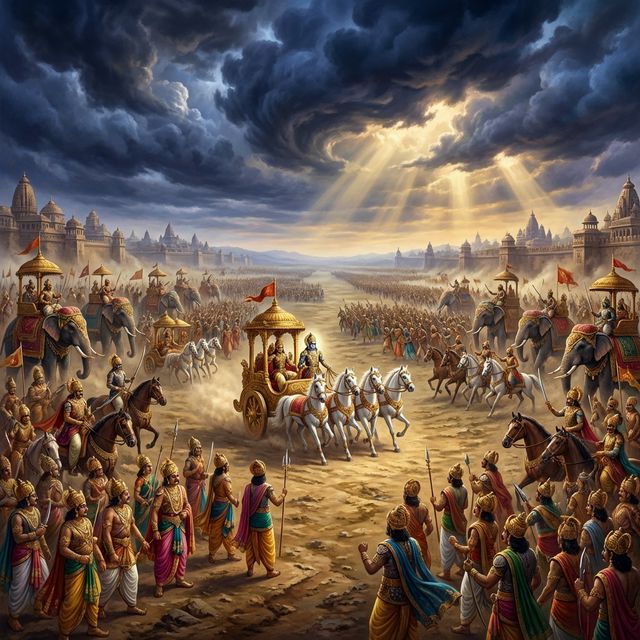
The mysteries of the gods had been told out to the end. Bhishma had just finished repeating what Skanda and Vishnu had said about the secret duties, and had added his own warning about the men to whom such knowledge should never be given, and there was a pause on the field while the grandsire rested on his arrows.
Yudhishthira had been the questioner for weeks by then. His brothers sat near him and Krishna was there, and the old man on the bed of shafts answered whatever was put to him, day after day, working down through duty and gift and penance as a man works down a list he means to finish before he dies.
The next question was not about mysteries. It was about dinner.
"Who are those persons, O Bharata," Yudhishthira said, "from whom a Brahmana in this world may accept his food? From whom may a Kshatriya, a Vaisya, and a Sudra take their food respectively?"
It is worth pausing on why a king would ask that, and ask it of a dying man, with the whole science of statecraft already behind them. Food in that world is not a private matter. A man who eats at another man's table has accepted something from him, and what he has accepted is not only the rice. The giver's conduct comes with it. The giver's trade comes with it. A householder feeds guests every day of his life and is fed by others on journeys and at funerals and at festivals, and if any of that carries a stain then the stain has been eaten and is inside him, and no amount of correct ritual performed afterwards will take it out unless he knows what to do.
So Yudhishthira asked who may be eaten from, and Bhishma, who had never in his life avoided a plain question with a soft answer, told him.
The Four Orders and the Table
He began with the ladder itself, and he went down it in order.
"A Brahmana may take his food from another Brahmana or from a Kshatriya or a Vaisya," Bhishma said, "but he must never accept food from a Sudra."
The Kshatriya has the same three doors open to him. He may eat from a Brahmana, from a Kshatriya, from a Vaisya. He is told to eschew the food given by Sudras who are addicted to evil ways and who partake of all manner of food without any scruple, which is a description of a habit rather than of a birth: the man who eats anything at all, without asking what it is or where it came from, and who therefore cannot say what is in the pot he is offering.
Then the qualification that shows the whole rule is about conduct as much as about order. Brahmanas and Kshatriyas can partake of food given by such Vaisyas as tend the sacred fire every day, as are faultless in character, and as perform the vow of Chaturmasya. Not any Vaisya. The one who keeps his fire, keeps his character, and keeps the four-month vow.
And then the sentences that no gentleness can soften, because Bhishma did not intend them to be soft.
"But the man who takes food from a Sudra swallows the very abomination of the earth, and drinks the excretions of the human body, and partakes of the filth of all the world. He partakes of the very filth of the earth who takes his food thus from a Sudra. Verily, those Brahmanas that take their food from Sudras take the dirt of the earth."
Nor is it only the plate. Service is included in the prohibition. If one engages in the service of a Sudra one is doomed to perdition, though one may duly perform all the rites of one's order. A Brahmana, a Kshatriya, or a Vaisya, so engaging, is doomed, and his devotion to the due performance of religious rites will not save him.
The rites, in other words, are not a counterweight. That is the principle the rest of the answer is built on.
The Order a Man Puts Himself Into
Having said that, Bhishma turned the rule inside out, and this is the part of the teaching that a modern reader should not read past.
He set out what each order is actually for. A Brahmana's duty consists in studying the Vedas and seeking the welfare of the human race. A Kshatriya's duty consists in protecting men. A Vaisya's duty consists in promoting their material prosperity, and he lives by distributing the fruits of his own acts and by agriculture, and the breeding of kine and trade are the legitimate work in which a Vaisya may engage without fear of censure.
Then the hinge.
"The man who abandons his own proper occupation and betakes himself to that of a Sudra should be considered as a Sudra, and on no account should any food be accepted from him."
So the category is not fixed at birth in the direction that matters here. A man walks into it by what he does with his days. And Bhishma named four kinds of men who had walked into it, and the list is startling.
Professors of the healing art. Mercenary soldiers, which is to say men who fight for wages rather than for the protection of anyone. The priest who acts as warder of the house, a Brahmana kept on the establishment as a doorkeeper. And persons who devote a whole year to study without any profit, the perpetual student who has learned nothing in twelve months.
A physician, a hired soldier, a hired priest, and an idle scholar. All to be considered as Sudras, and no food to be taken from any of them.
And those who impudently partake of food offered at ceremonials in a Sudra's house are afflicted with a terrible calamity. Bhishma described the calamity. In consequence of partaking such forbidden food they lose their family, their strength and their energy, and attain to the status of animals, descending to the position of dogs, fallen in virtue and devoid of all religious observances.
Not struck down. Reduced. The family goes, the strength goes, the fire goes, and what is left is a creature at the edge of a village hoping somebody drops something.
What the Food Tastes Like
Then came the catalogue, and Bhishma gave it in images rather than in rules, because he wanted the king to feel it.
He who takes food from a physician takes that which is no better than excrement. The food of a harlot is like urine. That of a skilled mechanic is like blood. If a Brahmana approved by the good takes the food of one who lives by his learning, sells it, makes his living out of it, he is regarded as taking the food of a Sudra, and all good men should forego such food. The food of a person who is censured by all is said to be like a draught from a pool of blood.
Then the comparison that ends the argument. The acceptance of food from a wicked person is considered as reprehensible as the slaying of a Brahmana. There is no heavier weight in the whole scale of sin, and Bhishma put a shared meal on the same pan of the balance.
There was one rule in the list that has nothing to do with the giver's trade at all. One should not accept food if one is slighted and not received with due honours by the giver. A Brahmana who does so is soon overtaken by disease, and his race soon becomes extinct. The food may be clean and the host may be faultless in every other way, and if the guest is fed grudgingly, without the honour that is owed to a guest, he should stand up and go.
The rest was consequence, stated as destination.
By accepting food from the warder of a city, one descends to the status of the lowest outcaste. If a Brahmana accepts food from one who is guilty of killing either a cow or a Brahmana, or from one who has committed adultery with his preceptor's wife, or from a drunkard, he helps to promote the race of Rakshasas. By accepting food from a eunuch, or from an ungrateful person, or from one who has misappropriated wealth entrusted to his charge, one is born in the country of the Savaras, beyond the precincts of the middle country.
"I have thus duly recited to thee the persons from whom food may be accepted and from whom it may not," Bhishma said. "Now tell me, O son of Kunti, what else thou wishest to hear from me today."
The Doubt, and the Price of Each Thing
Yudhishthira did not change the subject. He had heard a long account of ruin and had noticed that nothing in it had been about repair.
"Thou hast told me in full of those from whom food may be accepted and of those from whom it should not be taken," he said. "But I have grave doubts on one point. Do thou, O sire, enlighten me. Tell me what expiation a Brahmana should make for the sin he incurs upon accepting the different kinds of food, those especially offered in honour of the gods and the oblations made to the manes."
That is a son's question and a king's question at once. The rules had been given as though a man in a world of guests and funerals and journeys could keep all of them, and Yudhishthira, who had kept nothing perfectly in his whole life, wanted to know the way back.
"I shall tell thee, O prince," said Bhishma, "how high-souled Brahmanas may be absolved from all sin incurred by accepting food from others."
And then he priced each thing, item by item, the way a merchant prices a shelf.
For clarified butter, the expiation is made by pouring oblations on the fire and reciting the Savitri hymn. For sesamum, the same.
For meat, or honey, or salt, the Brahmana is purified by standing till the rising of the sun. One night on his feet, waiting for the light.
For gold, he is cleansed of all sins by silently reciting the Gayatri and by holding a piece of iron in his hand in the presence of the public. Not in private. Standing where he can be seen, with the base metal in his fist and the great prayer running silently behind his teeth. For money, or clothes, or women, or gold, the purification is the same.
For cooked food, or rice boiled in milk and sugar, or sugarcane juice, or sugar-cane, or oil, or any sacred thing, one becomes purified by bathing three times in the course of the day, at morn, at noon and at eve.
For paddy, flowers, fruits, water, half-ripe barley, milk, curdled milk, or anything made of meal or flour, the expiation is the Gayatri recited a hundred times. For shoes or clothes accepted at obsequial ceremonies, the same hymn, the same hundred.
For the gift of land taken at the time of an eclipse or during a period of impurity, a fast of three successive nights. For oblations offered to deceased ancestors in the course of the dark fortnight, a fast of a whole day and night.
The House Where Someone Has Died
Then Bhishma came to the hardest food of all to refuse, which is the food set out in a house of mourning.
He laid the general rule first. Without performing his ablutions a Brahmana should not say his evening prayers, nor betake himself to religious meditation, nor take his food a second time. By so doing he is purified. It is for this reason that the Sraddha of deceased ancestors has been ordained to be performed in the afternoon, so that the invited Brahmana, bidden beforehand and not gathered up off the road, may be feasted with the day still in front of him.
After that he counted the days.
The Brahmana who partakes of food at the house of a dead person on the third day after the death is purified by bathing three times daily for twelve days. When the twelve days have expired and the purification ceremonies have been duly gone through, the sin is destroyed by giving clarified butter to Brahmanas.
If a man takes any food in the house of a dead person within ten days after the death, he must go through all the expiations before mentioned, and must besides recite the Savitri hymn and perform the sin-destroying Ishti and the Kushmanda penances.
The Brahmana who takes his food in the house of a dead person for three nights becomes purified by performing his ablutions thrice daily for seven days, and thus attains all the objects of his desire, and is never troubled by misfortunes.
Three days, ten days, three nights. The same table, priced differently according to how soon after the death a man sat down at it.
The Same Plate
There was still the company at the meal, which Bhishma treated as a separate matter from the food itself. A man may eat what is entirely clean and still have eaten it in the wrong company, and that too has its price.
The Brahmana who eats in the company of Sudras is purged from all impurity by duly observing the ceremonies of purification. He who eats in the company of Vaisyas is absolved by living on alms for three successive nights. He who eats with Kshatriyas makes expiation by bathing with his clothes on.
And eating from off the same plate, which is closer still, costs each man something different. By eating from one plate with a Sudra, the Sudra loses his family respectability. The Vaisya, eating so with a Vaisya, loses his cattle and his friends. The Kshatriya loses his prosperity. The Brahmana loses his splendour and his energy. In such cases expiations should be made and propitiatory rites observed and oblations offered to the gods, the Savitri hymn recited, and the Revati rites and the Kushmanda penances gone through with the view of destroying the sin.
There was one thing left, the smallest of all, and Bhishma did not leave it out. If any of the four orders partakes of food partly eaten by a person of another class, the expiation is undoubtedly made by smearing the body with auspicious substances: Rochana, and Durva grass, and turmeric.
A little yellow paste on the skin, for the last and least of the ways a man can be made unclean by his dinner. Nothing in the whole long answer is beyond mending, and the grandsire had priced every item on the shelf before the light went.
Dharma Lesson
The teaching looks like a wall between births, and then it moves the wall. A man belongs to the order of the work he actually does, so the physician and the paid soldier and the priest kept at a door fall out of their birth and into another, and the food from their hands is refused for what they have chosen rather than for what they were born. What is being guarded is the idea that nothing is taken for nothing. To eat at a man's table is to accept a portion of his life, and Bhishma will not let his king pretend that correct ritual afterwards cancels it. The mercy is in the second half. Every stain named has a price attached, some of them as small as turmeric on the skin, and a dying man spent part of his last daylight making sure the list of remedies was as complete as the list of sins.