Whom One Should Worship
Yudhishthira asks whom a man should bow to, and Bhishma answers with the brahmanas
Four Questions and One Answer
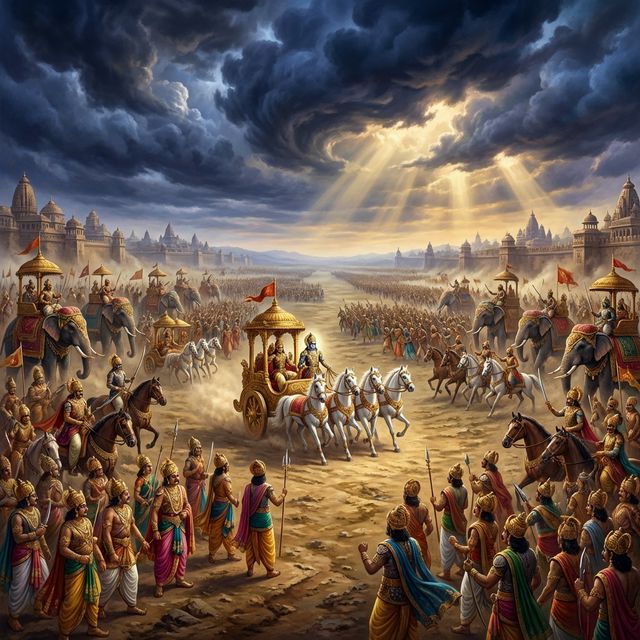
Bhishma had been lying on the bed of arrows since the tenth day of the war, waiting for the sun to turn north before he would let himself die, and every morning the Pandavas came out to the field to him with whatever they had thought of in the night. Krishna sat among them. Vyasa and Narada and the other rishis sat a little apart, on the trampled ground, and listened without interrupting.
That day Yudhishthira asked a question in four parts.
"Who deserve to be worshipped? Who are they unto whom we should bow? How, indeed, should we behave towards whom? What course of conduct, O grandsire, towards what classes of persons is regarded faultless?"
It is worth noticing what kind of question that is. He was not asking which god is the greatest, or which rite buys the most. He was asking about conduct, which is a smaller and much more awkward thing. Whom does a man take his hands from his sides for, in the course of an ordinary day? How far is he expected to go? And the last clause is the one only a king asks. What course of conduct is faultless. Show me the ground on which I cannot go wrong, because I am about to govern a country and I do not want to find out afterwards that I have been insulting somebody for forty years.
Bhishma named one class of persons and then spent the whole of that morning on it.
"The humiliation of Brahmanas would humiliate the very deities."
He put it in the negative before he put it in the positive, and the order is not accidental. He did not begin by telling Yudhishthira what honour the brahmanas were owed. He began by telling him what an insult to them was, which is that it does not stop where it lands. Slight a brahmana and it is the gods who have been slighted.
"By bowing unto Brahmanas one does not, O Yudhishthira, incur any fault. They deserve to be worshipped. They deserve to have our salutations."
And then came the sentence the king was not expecting.
"Thou shouldst behave towards them as if they are thy sons."
As If They Were Thy Sons
Bhishma let that instruction lie where it fell and went straight on, which is the surest sign that he knew exactly how odd it was.
Worship points upward. You bow to what is above you, and the whole grammar of it is distance. Sons point the other way. A man does not bow to his children. He feeds them, he shelters them, he stands between them and whatever is coming, and he forgives them a great deal that he would not forgive anybody else, and he goes on doing all of it whether or not they have earned it that week. Bhishma had just told a king to do both things at once to the same people. Bow to them like gods and keep them like children.
Then he gave the reason.
"Indeed, it is those men endued with great wisdom that uphold all the worlds. The Brahmanas are the great causeways of Righteousness in respect of all the worlds."
A causeway is a raised road built across ground that floods. It is not a pretty thing and nobody admires it, and its whole value is that it is the strip you can still walk on when everything on either side has gone under water. Bhishma used that image twice in one morning, and he had been in the water for a fortnight.
The catalogue followed, and it is short and hard and worth having in the order he gave it.
Their happiness consists in renouncing all kinds of wealth. They are devoted to the vow of restraining speech. They are agreeable to all creatures, and observant of diverse excellent vows. They are the refuge of all creatures in the universe. They are the authors of all the regulations which govern the worlds. They are possessed of great fame.
And then three lines that a king could not misunderstand, because they used his own three words.
"Penances are always their great wealth. Their power consists in speech. Their energy flows from the duties they observe."
Wealth, power, energy. The three things Yudhishthira had just spent eighteen days and an army acquiring. Here was a class of men who held all three, in a currency he could not mint, tax, or take away.
Strong Cattle on a Difficult Road
"Conversant with all duties," Bhishma went on, "they are possessed of minute vision, so that they are cognizant of the subtlest considerations."
Minute vision. It is a strange compliment and a precise one. Dharma almost never fails on the large questions, where every fool in the hall can see what is right. It fails in the small joint, in the clause nobody read, in the difference between a thing that is permitted and a thing that is merely not forbidden. What Bhishma is crediting them with is the eye for that difference.
"They are of righteous desires. They live in the observance of well-performed duties. They are the causeways of Righteousness."
The causeway again, the second time.
"The four kinds of living creatures exist, depending upon them as their refuge."
Four kinds, which is to say all of them: what is born of the womb, what is born of the egg, what is born of damp and heat, and what pushes up through the earth as a sprouting seed. Not the pious, not the twice-born, not the men of the Kuru country. Everything alive.
"They are the path or road along which all should go. They are the guides of all. They are the eternal upholders of all the sacrifices. They always uphold the heavy burdens of sires and grandsires."
That last one is not a metaphor about ancestry in general. The dead have obligations that they cannot discharge themselves, because the dead cannot pour water or set out rice, and somebody living has to stand in the gap and carry what they left. The brahmanas carry it. That is the burden being described, and the load is other people's.
Then the image Bhishma chose to end the passage on, which is not lofty at all.
"They never droop under heavy weights even when passing along difficult roads, like strong cattle."
Not eagles, not lions, not fire. Bullocks. An animal on a bad road under a load it did not choose, putting one foot after the other and not stopping, because the cart behind it belongs to somebody else and will not move if it does. A grandsire lying on a bed of arrows, who had carried his own father's promise for a lifetime and never once set it down, picked that image on purpose.
The First Portion
"They are attentive to the requirements of Pitris and deities and guests."
Three claims folded into a single line, and each of them names a party who cannot come and collect for himself. The Pitris are the fathers, the dead of the family, who are fed with rice and water at the shraddha and who have no other way of being fed. The deities are fed with the fire. The guest is the man who arrives at the door at an inconvenient hour with no introduction, and who in this country is not an interruption of the household's religion but the point of it.
The dead, the gods, and the stranger. The brahmana keeps the appointments of all three.
"They are entitled to eat the first portions of Havya and Kavya."
Havya is what is offered to the deities. Kavya is what is offered to the fathers. And the arrangement is not that the brahmana is served first out of politeness. It is that the mouth of the brahmana is the mouth the fire eats with. Food put into him is food that has arrived.
Which is why the next sentence, which ought to be absurd, is the strongest thing Bhishma had said yet.
"By the very food they eat, they rescue the three worlds from great fear."
Sit with the shape of that. Eating is the least meritorious act available to a human being. It is what everyone does, it requires no discipline, and every other passage in the books treats it as the thing an ascetic gives up. Here the eating itself is the work. The meal is a service, performed on behalf of the three worlds, by men who between meals go for days without one.
"They are, as it were, the Island for all worlds."
The causeway has become an island. Same flood, same idea. The place where the water is not.
"They are the eyes of all persons endued with sight."
Read that clause slowly, because it is doing something careful. He does not say they are the eyes of the blind. He says they are the eyes of people who can see perfectly well. Everyone in that circle on the field had working eyes, and eighteen days behind them to prove how little that had been worth.
What They Own
"The wealth they possess," said Bhishma, "consists of all the branches of knowledge known by the name of Siksha and all the Srutis."
Siksha is the discipline of sound. It is the science of where the tongue goes, which syllable lifts, how long a vowel is held, and it exists because a mantra mispronounced is not a weaker mantra but a different one, or none at all. It is an entire lifetime's study of getting a noise exactly right. To call that a man's wealth sounds like a joke told at his expense, and Bhishma meant it flatly. It is inheritable. It cannot be stolen in a raid. It is spent without diminishing. Very little in a treasury can say as much.
"Endued with great skill, they are conversant with the most subtle relations of things. They are well-acquainted with the end of all things, and their thoughts are always employed upon the science of the soul. They are endued with the knowledge of the beginning, the middle, and the end of all things, and they are persons in whom doubts no longer exist in consequence of feeling certain of their knowledge."
That last clause is unusually careful, and it repays attention. The doubts are not beaten down and they are not forbidden. They are gone because the thing was actually settled. A man who has stopped asking because he has been told to stop asking is not being described here.
"They are fully aware of the distinctions between what is superior and what is inferior. They it is who attain to the highest end. Freed from all attachments, cleansed of all sins, transcending all pairs of opposites, they are unconnected with all worldly things."
The pairs of opposites are heat and cold, pleasure and pain, happiness and misery, honour and insult. To transcend them is not to stop feeling them. Cold is still cold. It is to stop arranging a life around chasing the one and fleeing the other, which is what nearly every life is arranged around and what every war is fought about.
"Deserving of every honour, they are always held in great esteem by persons endued with knowledge and high souls."
And there is the quiet qualifier at the end of it. Held in esteem by those who know. Bhishma had not claimed that everyone honours them. He had claimed that the people worth listening to do.
Sandal Paste and Dirt
"They cast equal eyes on sandal-paste and filth or dirt, on what is food and what is not food. They see with an equal eye their brown vestments of coarse cloth and fabrics of silk and animal skins."
Take the first pair concretely, because it is not a figure of speech. Sandal paste was the luxury of that world, ground fine, cool on the skin in the hot months, expensive enough that a king gave it as a present. Filth is filth. The claim is that the face does not change between the two. Not that the man cannot tell the difference, which would make him an idiot rather than an ascetic, but that the difference has stopped commanding him.
Then cloth. The brown coarse stuff that scours the shoulders, the silk that a court wears, the skins that a forest recluse wears. All three hang in the same wardrobe as far as the wearer is concerned, and he puts on whichever is there.
"They would live for many days together without eating any food, and dry up their limbs by such abstention from all sustenance."
Set that beside what Bhishma had said only a little earlier, that these are the men entitled to the first portion of every offering to the gods and the fathers. It is the same man in both sentences. The one who has the first claim on the food of the three worlds is the one who can go a week without any. The claim is safe with him precisely because he does not want it.
"They devote themselves earnestly to the study of the Vedas, restraining their senses."
Up to this point the portrait has been of harmless men. Poor, thin, quiet, careful about vowels, useful to the dead. A king listening might reasonably have concluded that he was being asked to be generous to people who could do him no possible damage.
Then the grandsire turned the page.
"They would make gods of those that are not gods, and not gods of those that are gods."
That is the hinge of the whole teaching, and it goes past very fast. Divinity, in that sentence, is something these men confer and withdraw. Not petition. Confer. The register of the passage changes at that line and it does not change back.
The Fire Still Burning in Dandaka
"Enraged, they can create other worlds and other Regents of the worlds than those that exist."
Not overthrow the Regents. Replace them, along with the worlds they regulate, by building a second set. Bhishma said it to a man who had just fought a war over the question of who should hold one throne in one country.
And then, because a claim that large is worthless without a witness, he gave two, and both of them are things a man could go and look at.
Through those high-souled ones the ocean became so saline as to be undrinkable. That is why the sea, which surrounds everything and is the largest body of water in the world, is the one water on earth a thirsty man cannot drink. The whole ocean stands as the record of a curse.
The fire of their wrath yet burns in the forest of Dandaka, unquenched by time.
Note the tense. Not burned. Burns. Dandaka is not a story that ended long ago in a book; it is a place, with edges, and the wrath that was let loose in it has never gone out and has never been put out. Time, which cools everything, has made no impression on it at all.
"They are the gods of the gods, and the cause of all causes. They are the authority of all authorities. What man of intelligence and wisdom is there that would seek to humiliate them?"
He asked it as a question rather than issuing it as a command, which is a courtesy to Yudhishthira, and a trap. He had opened the morning with the word humiliation and now returned to it, having spent every sentence in between making the answer too obvious to need stating.
Then he told the king how they rank each other, which is where the teaching turns unexpectedly domestic.
"Amongst them the young and the old all deserve honours. They honour one another not in consequence of distinctions of age but in consequence of distinctions in respect of penances and knowledge."
A boy of nineteen who has done the work outranks a man of seventy who has not. There is no seniority in it at all.
That was said by the oldest man on the field, who was lying there dying on account of an oath about precedence that he had sworn as a young man, to an assembly in which every seat had been assigned by birth.
Fire on a Crematorium
The last stretch of it is the hardest thing in the teaching for a king to hear, and Bhishma did not soften it by so much as a syllable.
"Even the Brahmana that is destitute of knowledge is a god and is a high instrument for cleansing others. He amongst them, then, that is possessed of knowledge is a much higher god, and like unto the ocean when full to the brim."
So there are grades. Learning raises a man, and the learned one is not merely better but different in kind, an ocean at the top of its tide. What Bhishma refuses to do is lower the floor to make room for the ceiling.
"Learned or unlearned, the Brahmana is always a high deity."
Then two images, and both are chosen to be unanswerable.
"Sanctified or unsanctified with the aid of Mantras, Fire is ever a great deity. A blazing fire, even when it burns on a crematorium, is not regarded as tainted in consequence of the character of the spot whereon it burns."
Fire on a burning-ground is doing the filthiest work that exists in that world, in the one place a man does not go without washing afterwards, and nobody has ever said that the fire has been made unclean by it. It is the same element that is fed ghee on an altar by a priest in clean cloth. The ground does not get into it.
"Clarified butter looks beautiful whether kept on the sacrificial altar or in a chamber."
That second image is deliberately small and domestic after the first. Ghee in a jar on a kitchen shelf is the identical substance as ghee poured into the fire at a sacrifice. Nobody thinks the shelf has degraded it.
And then the sentence both images were built to carry.
"So, if a Brahmana be always engaged in evil acts, he is still to be regarded as deserving of honour. Indeed, know that the Brahmana is always a high deity."
Not if he is poor. Not if he is unlearned, which had already been granted twice. Always engaged in evil acts. Bhishma said that, without qualification and without an exception clause, to a man who was about to govern a country in which a good many such men were living, and who had spent eighteen days on that same field watching what came of people who knew better and did worse.
Yudhishthira did not argue with it. He asked the only question that was left, which was not whether the thing was true but what came of it: what reward, grandsire, do you see in the worship of brahmanas, that you worship them?
Dharma Lesson
Bhishma builds his whole answer on a distinction the world is bad at holding: what a man is worth and what a man is for are not the same measurement. The fire on the burning-ground is not degraded by the work it is doing or the place it is standing, and the honour paid to it is not a report on its behaviour. That is a demanding teaching, because it asks a king to keep honouring an office through people who are disgracing it, and it is offered by a man who spent his life bound to a promise that had long since stopped doing anybody any good.