The Practices That Overcome Difficulty
Bhishma on when a truthful man may lie, and the long list of habits that carry a person through
The Question Under the Word Truth
Bhishma had just finished with the three fires. The father is the Garhapatya fire, he had said, the mother is the Dakshina fire, and the preceptor is that fire upon which libations are poured, and the man who tends those three has tended everything worth tending. It was a clean answer and it closed a subject.
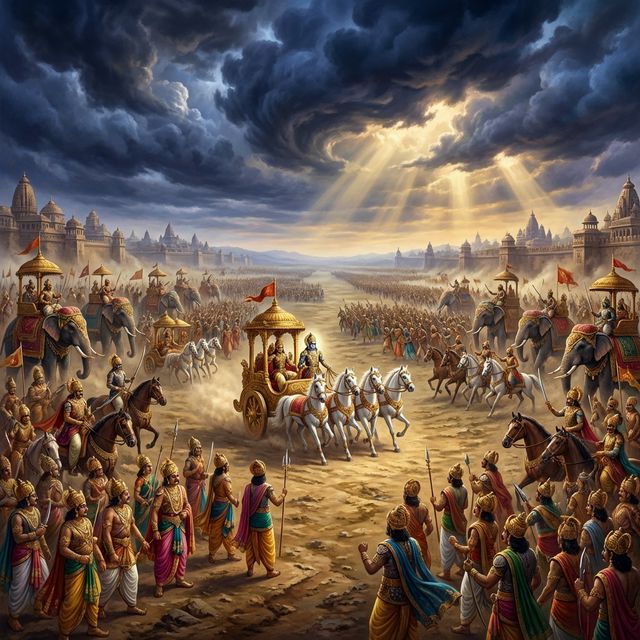
Yudhishthira did not let the quiet last long. He was sitting on the ground at Kurukshetra beside the bed of arrows, with his brothers behind him and Krishna a few feet away, and the question he asked next was not a beginner's question. It was the question of a man who has already been in a position where the right words and the true words were not the same words, and who has never stopped thinking about it.
"How, O Bharata, should a person act who desires to adhere to virtue? O bull of Bharata's race, possessed as thou art of learning, tell me this, questioned by me. Truth and falsehood exist, covering all the worlds. Which of these two, O king, should a person adopt that is firm in virtue? What again is truth? What is falsehood? What, again, is eternal virtue? On what occasions should a person tell the truth, and on what occasions should he tell an untruth?"
Read the last sentence again, because it is not the question people assume he asked. He did not ask whether a man may ever say what is untrue. He took it as settled that such occasions exist, and asked to be told which ones they were.
He was asking it of Bhishma, who had held one sentence spoken on a riverbank for sixty years and let his house go childless rather than take a word of it back. If anyone alive was going to say that truth admits of no exception, it was the man on the arrows.
Bhishma said something else.
Nothing Higher Than Truth, and Then the Exception
"To tell the truth is consistent with righteousness," Bhishma said. "There is nothing higher than truth."
That is the whole of the ordinary doctrine, and he stated it without qualification, and then he put a warning label on what was coming next.
"I shall now, O Bharata, say unto thee that which is not generally known to men."
Then the two clauses that the rest of the discourse hangs from.
"There where falsehood would assume the aspect of truth, truth should not be said. There, again, where truth would assume the aspect of falsehood, even falsehood should be said."
The test he is proposing is not applied to the sentence. It is applied to what the sentence does when it lands. A statement that corresponds exactly to the facts, spoken to a man who will use it to destroy someone, has assumed the aspect of falsehood by the time it reaches him, whatever it was when it left the mouth. And a thing that is not so, said to keep such a man from what he came for, can carry truth into the world in a way that the fact could not.
"That ignorant person incurs sin," Bhishma said, "who says truth which is dissociated from righteousness."
That is a hard line and it is meant to be. It does not say the man is unlucky, or clumsy, or badly advised. It says he sins, and it calls him ignorant while it does so, and the ignorance in question is precisely the failure to see that a fact can be a weapon and that handing it over is an act with consequences that belong to the one who hands it over.
"That person is said to be conversant with duties who can distinguish truth from falsehood."
Not the person who tells the truth. The person who can tell which is which. Bhishma had just moved the whole difficulty out of the mouth and into the judgment, where it is harder to see, harder to teach, and impossible to keep rules for. And having done that, he offered three examples, and not one of them is comfortable.
The Hunter, the Fool, and the Owl on the Ganga
The three cases came the way a lawyer cites decided matters, in a line, with the reasoning left out.
"Even a person that is disrespectable, that is of uncleansed soul, and that is very cruel, may succeed in earning great merit as the hunter Valaka by slaying the blind beast."
Valaka killed animals for a living, which is the trade of his birth and no virtue at all, and Bhishma does not pretend otherwise. He calls him cruel and of uncleansed soul in the same breath in which he awards him the merit. The creature Valaka found at the water was blind, and it was going to destroy every living thing, and the hunter who had nothing else to his name put it down. There is no penance in the account, no repentance, no long preparation. A man of no merit did one thing that looked like slaughter and was not, and it was credited to him.
Then the same coin turned over.
"How extraordinary it is that a person of foolish understanding, though desirous of acquiring merit by austere penances, still committed a sinful act."
The wanting was right and the doing was wrong. Bhishma marks it as extraordinary and moves on, because for his purposes the two cases only need to be set beside each other: intention pointing down and the act coming out clean, intention pointing up and the act coming out foul.
Then the third, and it is one line.
"An owl again, on the banks of the Ganges, by doing an unrighteous deed obtained great merit."
That is all of it. No name for the bird, no season, no account of what it did on that bank or to whom. The deed is called unrighteous by the grandsire himself, without softening, and the merit is called great, and the two words are allowed to stand in the same sentence without anybody being sent for to reconcile them.
He is not telling stories. He is producing evidence, and the evidence is deliberately bare, because the moment he supplied the circumstances a listener would start arguing about the circumstances instead of looking at what the cases have in common. A cruel man, a foolish man, and a bird. None of them holding a rule. All of them, in the account, judged by the thing that actually happened.
"The question thou hast asked me is a difficult one," Bhishma said.
What Righteousness Is, Since You Have Asked
He said it plainly and he said it about himself as much as anyone.
"It is difficult to say what righteousness is. It is not easy to indicate it. No one in discoursing upon righteousness can indicate it accurately."
Coming from the man who had been discoursing upon righteousness for weeks on end from a bed of arrows, that is a considerable admission, and he does not use it as an excuse to stop. He gives three definitions instead, and each one is built the same way: from what dharma was for.
The first. Righteousness was declared by Brahma for the advancement and growth of all creatures. Therefore that which leads to advancement and growth is righteousness.
The second. Righteousness was declared for restraining creatures from injuring one another. Therefore that is righteousness which prevents injury to creatures.
The third is the one that lives in the word itself. Dharma is so called because it upholds. All creatures are upheld by righteousness. Therefore that is righteousness which is capable of upholding all creatures.
Three tests, and every one of them looks forward at the result rather than back at the text. Does it make things grow. Does it keep creatures from tearing at each other. Does it hold the world up. A rule that fails all three while satisfying the letter of some instruction has not been vindicated by the instruction.
Yudhishthira might reasonably have asked at that point where the scriptures had gone, and Bhishma answered before he could.
"Some say that righteousness consists in what has been inculcated in the Srutis. Others do not agree to this. I would not censure them that say so. Everything, again, has not been laid down in the Srutis."
He declines to settle it. He will not call the second party heretics, and he will not pretend the first party has an answer for every case, and the reason he gives is the flattest sentence in the section: the books do not cover everything. Not that the books are wrong. That the world keeps producing mornings the books did not anticipate.
And on one of those mornings, Bhishma said, men come to your door and ask you a question.
The Men at the Door Asking Where the Money Is
"Sometimes men, desirous of obtaining the wealth of some one, make enquiries for facilitating the act of plunder."
Robbers, in short, standing in front of you, being polite, wanting to know where it is kept or which road the man took. Bhishma runs the case all the way through, and the ruling comes in steps, each one taken only when the step before it has failed.
First: one should never answer such enquiries. That is a settled duty, and he uses the word settled, which he does not scatter about.
Second: if by maintaining silence one succeeds in escaping, one should remain silent. Silence is the preferred instrument. It costs nothing and it gives nothing.
Third: if silence at a time when one must speak rouses suspicion, then it would be better on such an occasion to say what is untrue than what is true. This too, he says, is a settled conclusion. The moment the refusal to speak becomes itself an answer, the shelter of silence is gone, and a man may say what is not so.
Fourth: if one can escape from sinful men by even a false oath, one may take it without incurring sin. The oath is the last thing a truthful man will let go of, and Bhishma lets go of it, on that occasion, for that purpose.
And then the rule that closes the door behind all of this, so that nobody mistakes the permission for softness toward the men at the door: one should not, even if one be able, give away his wealth to sinful men. Wealth given to sinful men afflicts even the giver. Buying them off is not a virtuous alternative. It is a transaction that will find its way back to you.
Against that he sets a case where the temptation runs the other way. If a creditor wants to make his debtor pay off a loan by rendering bodily service, and summons the witnesses to the contract, and they will not say what should be said, then the witnesses are all liars. Sympathy for the debtor does not license them. The pressure there is to keep quiet out of pity, and Bhishma names silence in that chair for what it is.
Then he lists the occasions themselves. When life is at risk. On occasion of marriage. To save the wealth and prosperity of others. For religious purposes. A man who seeks virtue does not commit a sin by saying an untruth on those occasions, and the list is short, and it is closed.
Deceit Answered With Deceit
Having said when a man may break his word, Bhishma spent the rest of the section on men who never intended to keep one.
Having promised to pay, he said, one becomes bound to fulfil his promise. On failure, let the man who has appropriated what is not his be forcibly enslaved until it is made good. If a person acts with impropriety without fulfilling a righteous engagement, he should certainly be afflicted with the rod of chastisement for having adopted such behaviour.
Then the portrait, and it is drawn without pity. The deceitful man falls away from all duties and abandons those of his own order, and takes up the practices of the Asuras to keep himself alive. Such sinful men think there is nothing in this world higher than wealth. That is the whole of their creed and Bhishma states it twice, because everything else about them follows from it.
They should never be tolerated. No one should eat with them. They should be regarded as having fallen in consequence of their own sins, fallen away from the condition of humanity, shut out from the grace of the gods, and living like evil genii among people who look the same as they do. Without sacrifices, without penances. Forbear from their companionship.
And there is one more line about them that is neither a threat nor a rebuke but a piece of observation. If their wealth be lost, they commit even suicide, which is exceedingly pitiable. The man who has arranged his whole soul around a number has nothing left standing when the number goes.
"Among those sinful men," Bhishma said, "there is no one to whom thou canst say, this is thy duty, let thy heart turn to it."
That is why the sentence that follows is so cold. The person that would slay such a creature would incur no sin. He who kills him kills one that has been already killed by his own acts. If slain, it is the dead that is slain. He who vows to destroy those persons of lost senses should keep his vows.
Such men, he said, are like the crow and the vulture, dependent on deceit for their living, and after the dissolution of their bodies they take rebirth as crows and vultures, so that the shape at last matches the diet.
And then, in one sentence, the principle that has been under the whole discourse from the beginning.
"One should, in any matter, behave towards another as that other behaves in that matter. He who practises deceit should be resisted with deceit, while one that is honest should be treated with honesty."
How Does a Man Get Through It
Yudhishthira's next question was not about a case. It was about the weather of being alive.
"Creatures are seen to be afflicted by diverse means and almost continually. Tell me, O grandsire, in what way can one overcome all those difficulties."
What he got back was not a story and not an argument. It was a litany, and it has a shape that a listener notices within three lines, because every single item in it ends with the same six words: succeed in overcoming all difficulties. Bhishma had been asked how a man gets through, and he answered by naming, one after another, the kinds of men who do, and letting the repetition do the work that reasoning does elsewhere.
Those members of the regenerate class that duly practise, with restrained souls, the duties laid down in the scriptures for the several modes of life, succeed in overcoming all difficulties.
They that never practise deceit, they whose behaviour is restrained by salutary restrictions, and they that control all worldly desires, succeed in overcoming all difficulties.
They that do not speak when addressed in evil language, they that do not injure others when themselves injured, they that give but do not take, succeed in overcoming all difficulties.
They that always give hospitable shelter to guests, they that do not indulge in malice, they that are constantly engaged in the study of the Vedas, succeed in overcoming all difficulties.
Those persons who, being conversant with duties, adopt that behaviour towards parents which they should, and they that abstain from sleeping during the day, succeed in overcoming all difficulties.
They that do not commit any kind of sin in thought, word, and deed, they that never injure any creature, succeed in overcoming all difficulties.
Notice what is not in the list so far. Not one item is a rite. Not one is a place of pilgrimage, or a fee, or a fast. The man who has just spent an hour explaining that a truthful sentence can be a sin is now listing the practices that carry a person through affliction, and they are almost entirely about what he does with his mouth, his temper, his sleep, and the people already inside his house.
Kings, Wives, Fire, and Fair Battle
The litany went on, and it began taking in the offices men hold.
Those kings that do not, under the influence of passion and covetousness, levy oppressive taxes, and those that protect their own dominions, succeed in overcoming all difficulties. Two duties, one negative and one positive, and Yudhishthira was newly crowned and heard both.
They that go to their own wedded wives in season without seeking the companionship of other women, they that are honest and attentive to their Agni-hotras, succeed in overcoming all difficulties.
They that are possessed of courage and that, casting away all fear of death, engage in battle desirous of victory by fair means, succeed in overcoming all difficulties. The qualifying phrase is not decoration. Courage and contempt of death are named and then fenced, and the fence is the manner of the victory, and it was said over a field where the manner of several victories would not have passed.
They that always speak truth in this world even when life is at stake, and that are exemplars for all creatures to imitate, succeed in overcoming all difficulties. He has not forgotten the earlier section. The permission to say an untruth when life is at risk was a permission, not an instruction, and here is the higher road named as the higher road.
They whose acts never deceive, whose words are always agreeable, and whose wealth is always well spent, succeed in overcoming all difficulties.
Those Brahmanas that never study the Vedas at hours not intended for study, and that practise penances with devotion, succeed in overcoming all difficulties.
Those Brahmanas that betake themselves to a life of celibacy and Brahmacharya, that perform penances, and that are cleansed by learning, Vedic knowledge, and proper vows, succeed in overcoming all difficulties.
They that have checked all the qualities that appertain to Passion and Darkness, that are possessed of high souls, and that practise the qualities that are called Good, succeed in overcoming all difficulties.
And then one that stops the ear, because it describes a condition rather than a practice.
They of whom no creature stands in fear, and those that do not fear any creature themselves, they that look upon all creatures as their own selves, succeed in overcoming all difficulties.
Nothing afraid of you. You afraid of nothing. Every creature read as yourself. Three clauses, and the third is the reason for the first two.
The Ones Who Are Not Grieved by Another Man's Luck
Those bulls among men that are good, that are never inspired with grief at the sight of other people's prosperity, and that abstain from all kinds of ignoble behaviour, succeed in overcoming all difficulties.
It is worth stopping on that one for a breath. Of all the ways a man can be afflicted, Bhishma has picked out the affliction that arrives when nothing whatever has happened to him. Somebody else did well. The grief is real, and it is named as grief, and the men who are free of it are put at the head of this stretch of the list.
They that bow to all the gods, that listen to the doctrines of all creeds, that have faith, and that are endued with tranquil souls, succeed in overcoming all difficulties. Listening to the doctrines of all creeds is set down as a practice, not a danger, in the middle of a discourse on how to keep one's footing.
They that do not desire honour for themselves, that give honours unto others, that bow down unto those that deserve their worship, succeed in overcoming all difficulties.
They that perform Sraddhas on the proper lunar days, with pure minds, from desire of offspring, succeed in overcoming all difficulties. The dead are attended to on the days that belong to them, and the reason given is the living who are still to come.
They that restrain their own wrath and pacify the wrath of others, and that never get angry with any creature, succeed in overcoming all difficulties. Two jobs there, not one. Hold your own temper down and go and put out somebody else's.
They that abstain, from their birth, from honey and meat and intoxicating drinks, succeed in overcoming all difficulties.
They that eat for only supporting life, that seek the companionship of women for the sake only of offspring, and that open their lips for only speaking what is true, succeed in overcoming all difficulties.
Three appetites in one sentence, and the same instrument applied to all three: take what the purpose requires and stop there. Food to keep the body going. Marriage to make children. The mouth opened for what is so.
That is the last of the practices. What Bhishma named next was not a practice at all, and he did not have to point far to find it.
This Krishna Here
"They that worship with devotion the god Narayana, that Supreme Lord of all creatures, that origin and destruction of the universe, succeed in overcoming all difficulties."
And then Bhishma stopped listing and used the word this.
"This Krishna here, of eyes red as the lotus, clad in yellow robes, endued with mighty arms, this Krishna who is our well-wisher, brother, friend, and relative, is Narayana of unfading glory."
He was speaking on a field where he had spent ten days trying to kill the army that man was driving for, and he named him to the king as a relative before he named him as God. The whole weight of the sentence is in the first word. Not Narayana somewhere, worshipped by somebody, in a rite performed at the right hour. Narayana on the ground beside the arrows, in yellow cloth, listening.
"He covers all the worlds like a leathern case, at his own pleasure. He is the puissant Lord, of inconceivable soul. He is Govinda, the foremost of all beings."
Then the sentence that puts him back in the family. This Krishna who is ever engaged in doing what is agreeable and beneficial to Jishnu, as also to thee, O king, is that foremost of all beings, that irresistible one, that abode of eternal felicity. Jishnu is Arjuna, and everyone in earshot had watched the foremost of all beings hold his reins for eighteen days.
"They that with devotion seek the refuge of this Narayana, called also Hari, succeed in overcoming all difficulties."
And having brought the litany home, Bhishma did one more thing with it, which was to hand it over.
"They that read these verses about the overcoming of difficulties, that recite them to others, and that speak of them unto Brahmanas, succeed in overcoming all difficulties."
The list itself is now on the list. The man who cannot yet keep his temper, or his tongue, or his hours of study, can at least carry the words to somebody else, and Bhishma counts that as a way through, which is a considerable kindness from a man who had been lying on iron since the tenth day.
"I have now, O sinless one, told thee all those acts by which men may overcome all difficulties both here and hereafter."
He called him sinless. The king who had asked, two sections earlier, when a man is permitted to say what is not so.
Dharma Lesson
Bhishma does not lower the value of truth; he says there is nothing higher than it, and then refuses to let it be handled as a rule that works by itself. A fact given to a man who came for it in order to rob has become a lie by the time it reaches him, and the sin belongs to whoever handed it over. What he puts in place of the rule is judgment, which cannot be taught in a sentence, and then a list of unremarkable habits - not answering abuse, not sleeping in the day, not grieving at another man's good fortune - as the actual means by which people survive their lives.