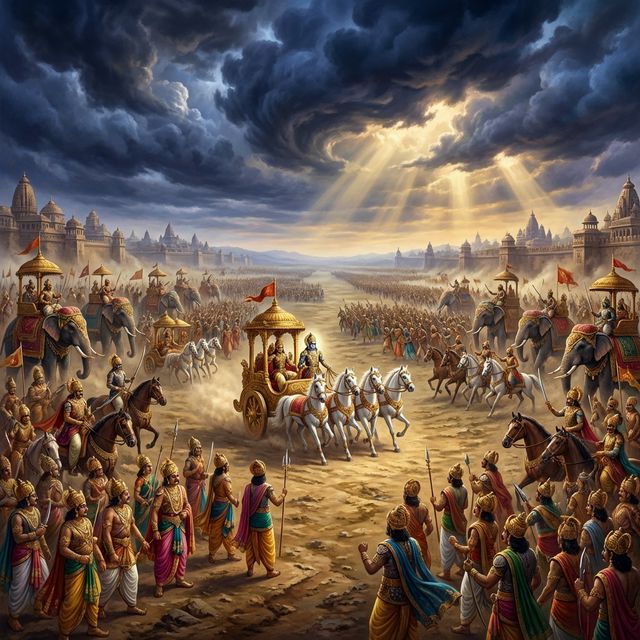
The Oath to Conquer or Die
Bhishma on marching, arraying and swearing in an army, and the men a soldier may never strike
The Question He Was Ashamed to Ask
Bhishma had been lying on the arrows for many days by then, and the questions put to him had worked their way down from the nature of kingship to the running of an army. Yudhishthira sat at the head of the bed with his brothers behind him and Krishna at his side, and the field of Kurukshetra lay quiet all round them, cleared of its dead.
The question he asked that morning was not a comfortable one.
"Tell me, O grandsire," Yudhishthira said, "how kings desirous of victory should, O bull of Bharata's race, lead their troops to battle even by offending slightly against the rules of righteousness."
He had asked how to cheat, a little. It is worth pausing on who was asking, and on the fact that he had just finished a war in which nearly every rule he now wanted advice about bending had already been broken on both sides of the field.
Bhishma did not scold him for it.
"Some say that righteousness is made stable by truth," he said. "Some, by reasoning. Some, by good behaviour. And some, by the application of means and contrivances. I shall presently tell thee what the means and contrivances, productive of immediate fruit, are."
He began with a reason for having them at all. Robbers, transgressing all wholesome bounds, very often become destroyers of property and of religious merit. It is against such men that the contrivances indicated in the scriptures exist, and a king who has none of them has left the field to them.
"Both kinds of wisdom, straight and crooked, should be within call of the king," Bhishma said. "Though acquainted with it, he should not, however, apply that wisdom which is crooked, for injuring others. He may use it for resisting the dangers that may overtake him."
Then the particular danger he had in mind.
"Enemies frequently injure a king by producing disunion among his ministers, or his troops, or his allies, or his subjects. The king, conversant with deceit, may, by the aid of deceit, counteract those enemies."
That is the whole of the licence, and it is narrower than the question had been. Know the crooked road. Do not walk it to hurt a man. Walk it only to come back at someone already walking it toward you.
Leather, Iron, and the Month of Chaitra
From the crooked road Bhishma went straight to the storehouse, because the first contrivance of a king who intends to win is that he has the things.
He named them in the order a quartermaster would. Leathern armour for protecting the bodies of elephants, and armour of the same material for bovine bulls. Bones. Thorns. Keen-pointed weapons made of iron. Coats of mail. Yak-tails. Sharp and well-tempered weapons. All kinds of armour, yellow and red. Banners and standards of diverse hues. Swords, and lances, and scimitars of great sharpness, and battle-axes, and spears, and shields.
These, he said, should be manufactured and stored in abundance.
Two instructions follow the list, and they are the ones that armies actually fail. The weapons should all be properly whetted, which is a thing that has to be done again and again to a thing already made, by men who would rather be doing something else. And the soldiers should be inspired with courage and resolution, which is not issued from a store at all.
Then the season, which Bhishma gave as plainly as a farmer would.
"It is proper to set the troops in motion in the month of Chaitra or Agrahayana," he said. "The crops ripen about that time, and water also does not become scarce. That time of the year, O Bharata, is neither very cold nor very hot. Troops should, therefore, be moved at that time."
The reasoning has nothing to do with omens. Grain in the fields is grain your men can eat. Full tanks are water your horses can drink. Weather that does not kill is weather in which men will march. An army moves when the country it is crossing can carry it, and at no other time.
Except one.
"If the enemy, however, be overtaken by distress, troops should immediately be set in motion, without waiting for such a favourable time. These two are the best occasions for the motion of troops with a view to subjugate foes."
So there are exactly two right moments to march. When your own country is at its most generous, and when the other man's is not.
The Road, the Fort, and the Sky at Your Back
Having got the army out of its quarters, Bhishma put it on a road.
"That road which has abundance of water and grass along it, which is level and easy of march, should be adopted," he said. "The regions lying near the road, on both its sides, should previously be well ascertained through spies possessed of skill and having an intimate knowledge of the woods."
Spies, here, are not men who steal letters out of a rival court. They are men who know which way a stream runs and where the cane thickets stand, sent ahead to look at the ground the column will have on its flanks before the column is in it.
"The troops must not, like animals, be marched through woody regions," Bhishma said, and the comparison is the argument. A herd goes where the trees let it. An army that does the same is a herd. "Kings desirous of victory should, therefore, adopt good roads for marching their troops. In the van should be placed a division of brave men, endued with strength and high birth."
Then the fort, described by its faults having been removed. Walls, and a trench full of water on every side, and only one entrance. That is the fort worthy of praise, and it is worthy of praise because with one entrance the defenders know where the fighting will be, and against invading foes resistance may be offered from within it.
Then the camp. Men conversant with war regard a region lying near the woods as much better than one under the open sky, and the camp should be pitched not far from such a wood. Pitching the camp at such a place, planting the foot-soldiers in a position of safety, and collision with the foe as soon as he comes: those, said Bhishma, are the means for warding off danger and distress.
And then a piece of advice about the sky.
"Keeping the constellation called Ursa Major behind them, the troops should fight, taking up their stand like hills. By this means one may vanquish even foes that are irresistible. The troops should be placed in such a position that the wind, the sun, and the planet Sukra should blow and shine from behind them."
He even ranked them, since a field rarely lets you have all three.
"As means for ensuring victory the wind is superior to the Sun, and the Sun is superior to Sukra, O Yudhishthira."
Dust first. Glare second. The star last.
Ground for Horses, Ground for Elephants
Every kind of soldier, Bhishma said, has a kind of country that belongs to him, and the whole art of choosing a field is knowing which of your four arms you are choosing it for.
Men conversant with war approve, for the operations of cavalry, of a region that is not miry, not watery, not uneven, and not abounding with bricks and stone. Horses want footing and nothing under the hoof that turns.
A field that is free from mire and holes is fitted for car-warriors. A chariot needs less than a horse does but forgives less; one hole takes a wheel.
A region that is overgrown with bushes and large trees, and that is under water, is fitted for elephant-warriors. The ground that stops everything else does not stop them.
A region that has many inaccessible spots, that is overgrown with large trees and topes of cane bushes, and a mountainous or woody tract, is well fitted for the operations of infantry. Where nothing can be ridden or driven, men walk, and the man on foot becomes the master of the place.
Then the seasons, which do the same sorting by another means. An army which has a large infantry force is regarded as very strong. An army in which cars and horsemen predominate is regarded to be very effective in a clear and unrainy day. An army in which foot-soldiers and elephants predominate becomes effective in the rainy season.
So the composition of a host decides when it should be fighting, and the ground decides where, and a commander who has attended to neither has an army that is strong only in the abstract.
"Having attended to these points," Bhishma said, meaning the characters of the different kinds of forces and the manner of marching and quartering and leading them, "the king should turn his attention to the characteristics of place and time. That king who, having attended to all these considerations, sets out under a proper constellation and on an auspicious lunation, always succeeds in obtaining victory by properly leading his troops."
The constellation comes last in that sentence, after the roads and the trenches and the mud, and it is easy to miss how far down the list it has been placed.
Whom You May Not Kill
He had been asked how to win by offending slightly against righteousness. Here is where he set the floor under the offence, and it is the longest single list in the teaching.
No one, Bhishma said, should slay those that are asleep, or thirsty, or fatigued. Nor those whose accoutrements have fallen away. Nor one that has set his heart on final emancipation. Nor one that is flying away. Nor one that is walking unprepared along a road.
Nor one engaged in drinking or eating. Nor one that is mad, or one that is insane. Nor one that has been wounded mortally, or one that has been exceedingly weakened by his wounds. Nor one that is staying trustfully, which is to say a man who has not troubled to be afraid of you, and who is therefore yours to disgrace yourself upon and nothing else.
Nor one that has begun any task without having been able to complete it. Nor one that is skilled in some especial art, a miner or a maker or a man whose hands know a thing that the world will want after the war. Nor one that is in grief.
And then the list goes down through the army until it has left the fighting men entirely behind. Not one that goes out of the camp for procuring forage or fodder. Not the men who set up camps, nor the camp-followers. Not those that wait at the gates of the king or of his ministers. Not those that do menial services unto the chiefs of the army, nor those that are chiefs of such servants.
Set them side by side and a single principle stands up out of them. A man may be killed while he is a soldier and not otherwise. Sleep is not soldiering. Neither is thirst, or grief, or a broken strap, or a mouthful of food, or a walk down a road, or fetching grass for the horses, or standing at a door because that is your work. The moment a man has stopped being able to fight you, or has never begun, he is out of the war and cannot be put back into it for your convenience.
The one who is flying away is on that list, and so is the one who is mortally wounded. The foe who is already broken is the foe you have the least right to touch.
Let Us Swear to Conquer
Then Bhishma turned to the fighting men, and began with their pay.
Those amongst thy warriors that break the rank of foes, or that rally thy retreating troops, should have their pay doubled, and be honoured by thee with food, drink, and seats equal to thy own. Those amongst them that are chiefs of ten soldiers should be made chiefs of a hundred. That heedful hero who is the chief of a hundred should be made the chief of a thousand.
Two deeds are named and no others: breaking the enemy's line, and rallying your own men when they have started to run. The second is paid as richly as the first.
Then, collecting together the principal warriors, they should be addressed. Bhishma gave Yudhishthira the words.
"Let us swear to conquer, and never to desert one another. Let those that are inspired with fear stay here. Let those also stay here that would cause their chiefs to be slain by themselves, neglecting to act heroically in the press of battle. Let such men come as would never break away from battle or cause their own comrades to be slain. Protecting their own selves as also their comrades, they are certain to slay the enemy in fight."
The oath is not to be brave. It is not to leave.
Then what waits for the man who leaves. The consequences of flying away from battle are loss of wealth, death, infamy, and reproach. Disagreeable and cutting speeches have to be heard by that man who flies from battle, who loses his lips and teeth, who throws away all his weapons, or who suffers himself to be taken as a captive by the foe.
"Let such evil consequences always overtake the warriors of our foes. Those that fly away from battle are wretches among men. They simply swell the tale of human beings on earth. For true manhood, however, they are neither here nor hereafter."
And a picture of what you would be running from: victorious foes proceeding cheerfully, praises recited the while by bards, in pursuit of the flying combatants.
"When enemies, coming to battle, tarnish the fame of a person, the misery the latter feels is more poignant, I think, than that of death itself. Know that victory is the root of religious merit and of every kind of happiness. That which is regarded as the highest misery by cowards is cheerfully borne by those that are heroes. Resolved upon acquiring heaven, we should fight, regardless of life itself, and, determined to conquer or die, attain a blessed end in heaven."
Having taken such an oath, and prepared to throw away life itself, heroes should rush against the enemy's ranks.
The Needle's Mouth and the Cow-Horns
Sworn men still have to be put somewhere, and Bhishma ended with the arrangement.
In the van should be placed a division of men armed with swords and shields. In the rear should be placed the car-division. In the space intervening should be placed the other classes of combatants. This, he said, should be the arrangement made for assailing the foe.
Those combatants in the army that are veterans should fight in the van; they would protect their comrades behind them. Those who would be regarded as foremost for strength and courage should be placed in the van, and the others should stand behind them.
Which leaves the frightened, and Bhishma did not pretend there were none.
"They that are inspired with fear should, with care, be comforted and encouraged," he said, and then gave the use to which such men are put. These weaker combatants should be placed on the field, without being withdrawn, for at least showing the number of the army to the foe.
It is a cold sentence and a merciful one at the same time. The man who is afraid is not sent home in disgrace and he is not sent to the front. He stands in the ranks and is counted, and the enemy, looking across, counts him too.
Then the shape of the line. If the troops are few, they should be drawn close together for the fight; at times, if their leader wishes, the close array may be extended wide. When a small number of troops is to fight with a great army, the array called Suchimukha should be formed, the needle's mouth, a narrow point that goes into a large body at one place rather than meeting it along its whole width.
And when a small force is engaged with a large one, Bhishma gave the leader something to say. He may shake hands with his men and utter loud cries to this effect: "The enemy has broken! The enemy has broken!" Those among them that are endued with strength should resist the enemy, calling loudly unto their comrades: "Fresh friends have arrived! Fearlessly strike at your foes!"
Both cries are untrue when they are shouted. Both are the shortest road to becoming true.
Those that are in advance of the rest, he said, should utter loud shouts and make diverse kinds of noises, and should blow and beat Krakachas, cow-horns, drums, cymbals, and kettle-drums.
That is where the teaching stops. Not on a victory, and not on a rule, but on the noise a body of men makes when it has sworn not to leave one another and has begun to move.
Dharma Lesson
Bhishma was asked how to bend the rules and answered mostly by tightening them. The crooked kind of wisdom is to be kept within call and used only against a man already using it; everything else in the teaching is grass and water and whetstones and roads. The long list of those who may not be killed is the real answer to the question, because almost every name on it is a person who has already stopped being a soldier, and the oath the warriors swear is not to be brave but never to abandon one another. A war fought that way is still a war, but the men in it remain answerable to something outside it.