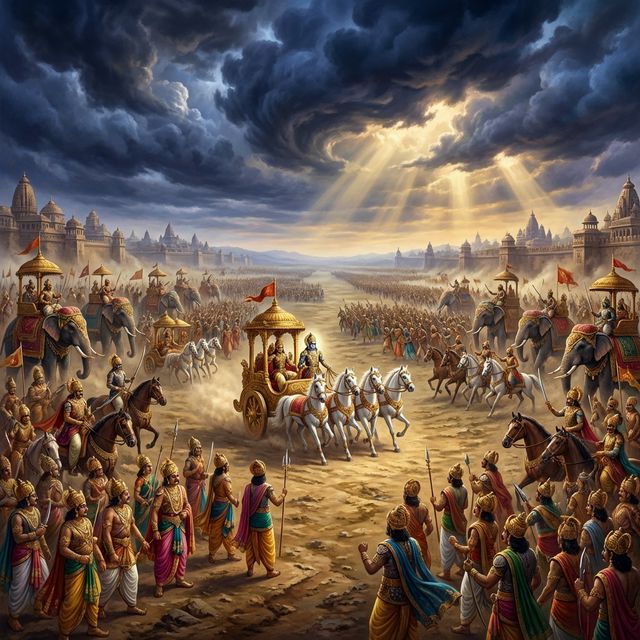
The Seventeen Hundred
Shalya's followers charge against orders, and Duryodhana's army breaks twice before he turns it round
Midday on the Eighteenth Day
Sanjaya said: "Upon the fall of that great king and mighty car-warrior, that invincible hero in battle, thy troops as also thy sons almost all turned away from the fight."
He was speaking to a blind man in a hall in Hastinapur, and the hero he meant was Shalya, ruler of the Madras, the fourth man to command the Kaurava host and the last of the four. Bhishma had gone down on the tenth day, Drona on the fifteenth, Karna on the seventeenth. Shalya had held the command for one morning. He lay now on the field with Yudhishthira's dart driven through his broad chest and into the earth behind him, and his younger brother, who had come out to pay the last dues of his house, lay near him without a head.
Sanjaya did not soften the account of what followed.
"Thy troops were like ship-wrecked merchants on the vast deep without a raft to cross it. After the fall of the Madra king, thy troops, struck with fear and mangled with arrows, were like masterless men desirous of a protector, or a herd of deer afflicted by a lion. Like bulls deprived of their horns, or elephants whose tusks have been broken, thy troops, defeated by Ajatasatru, fled away at midday."
Ajatasatru is one of Yudhishthira's names. It means the man against whom no enemy has been born. Sanjaya used it deliberately, of the mildest of the five brothers, who had spent that morning killing men in hundreds and thousands with his own hands.
"That fear, O king, and that grief, which had been ours upon the fall of Bhishma, of Drona, and of the Suta's son, now became ours once more."
And then the sentence that mattered most, because everything in the rest of that afternoon was an argument against it.
"After the fall of Shalya, none amongst thy troops set his heart on either rallying the army or displaying his prowess."
None of them yet. The sun was only at the top of the sky.
Two Men of the Vrishnis
Satyaki went after the runners.
He was the grandson of Sini, a Vrishni of Krishna's own clan, and he had come to Kurukshetra as the one Vrishni fighting on the Pandava side. Shooting his shafts, he proceeded against the frightened Kauravas while they were flying away, and one man turned round and stopped him.
Hridika's son Kritavarma was also a Vrishni. He had gone to Dwaraka's council and come away with the army, and had brought it here, to this side of the field, and for eighteen days these two kinsmen had been fighting under opposite standards. Now, quickly and fearlessly, he received that invincible warrior as he advanced against the beaten army.
Sanjaya said they encountered each other like two furious lions. Both resembled the sun in effulgence, and they covered each other with arrows of blazing splendour that resembled the rays of the sun. The shafts of those two lions of Vrishni's race, shot forcibly from their bows, looked from a distance like swiftly coursing insects in the sky.
Kritavarma had the better of the opening. He pierced Satyaki with ten arrows and his steeds with three, and then with one straight shaft cut his bow at the grip.
Satyaki laid aside that best of bows which had been cut and quietly took up another that was tougher than the first. It was the whole of his answer, and he gave it without a word. Having taken up that foremost of bows, he put ten arrows into the centre of Kritavarma's chest. Then he cut the car apart and the shaft of the car with well-shot arrows, killed the four horses, and killed the two Parshni drivers, the men who ride at either flank of a chariot to guard its wheels while the charioteer keeps his eyes forward.
Kritavarma stood on a wreck in the middle of a rout with nothing under him and nothing to drive.
Then Kripa, the son of Saradwat, who had taught both armies their weapons when they were boys, came alongside and took him up on his own car and bore him away.
One Man Standing in the Dust
Upon the slaughter of the king of the Madras and upon Kritavarma having been made carless, the entire army of Duryodhana once more turned its face from the battle.
The dust came up so thickly that Sanjaya, who had been given the sight to see everything on that field, could see nothing at all. "We could not see anything," he said. "The greater portion of thy army fell. They who remained alive had turned away their faces from battle." Then the cloud of earthy dust settled, and Sanjaya named what settled it: the diverse streams of blood that drenched it on every side.
When the air cleared there was one car standing between the Pandavas and the backs of the men running away.
Duryodhana, seeing from a near point that his army was broken, alone resisted all the Parthas as they came on furiously. He saw the Pandavas on their cars, and Dhrishtadyumna the son of Prishata, and the invincible chief of the Anartas, Satyaki, and he covered all of them with sharp arrows. The enemy at that time approached him not, said Sanjaya, like mortal creatures fearing to approach the Destroyer standing before them.
While he held that spot, Kritavarma came back to it on another car, which was a brave thing to do twice in one hour. Yudhishthira killed his four steeds with four shafts and then put six broad-headed arrows of great force into Kripa, who had rescued him the first time. Ashwatthama drew up beside the second wreck and took Kritavarma aboard and carried him out of Yudhishthira's presence, and Kripa, going away, turned and pierced Yudhishthira with eight arrows and his horses with eight more.
"Thus, O monarch," said Sanjaya, "the embers of that battle began to glow here and there, in consequence of the evil policy of thyself and thy son."
Across the field the Parthas had understood at last what had happened at noon. They came together and blew their conchs, and they applauded Yudhishthira for the killing of Shalya even as the celestials in days of yore had applauded Indra after the slaughter of Vritra, and they beat every kind of drum they had until the earth resounded on every side with the noise.
Do Not Proceed
The Madrakas had not run.
After the slaughter of Shalya, the followers of the Madra king, numbering seventeen hundred heroic car-warriors, proceeded for battle with great energy. They were what was left of the contingent their king had brought down from his country in the north-west, and their king was lying out in front of them with a dart-hole in his chest, and they wanted the man who had made it.
Duryodhana rode across their front to stop them. He was on an elephant gigantic as a hill, with an umbrella held over his head and yak-tail fans moving on either side of him, the whole apparatus of a king in the field, and he shouted at them the plainest order he gave all day.
"Do not proceed! Do not proceed!"
Though repeatedly forbidden by Duryodhana, those heroes, desirous of slaying Yudhishthira, penetrated into the Pandava host. They were loyal to Duryodhana. Sanjaya says so in the same breath in which he says they disobeyed him. Twanging their bows loudly, they fought with the Pandavas.
Word went across the field that Shalya had been killed and that Yudhishthira was now being pressed hard by the Madraka car-warriors who were devoted to the welfare of the Madraka king, and Arjuna came, stretching his bow Gandiva and filling the earth with the rattle of his car. Bhima came, and the two sons of Madri, and Satyaki, and the five sons of Draupadi, and Dhrishtadyumna, and Shikhandi, and behind them the Pancalas and the Somakas. They took their places around the eldest brother and began to agitate the hostile force like Makaras agitating the ocean, and the Kaurava army trembled like trees in a tempest.
In the middle of that the Madrakas were heard shouting for the men they could not find.
"Where is that king Yudhishthira? Why are not his brave brothers, the Pandavas, to be seen here? What has become of the Pancalas of great energy, and of the mighty car-warrior Shikhandi? Where are Dhrishtadyumna and the grandson of Sini and those great car-warriors, the five sons of Draupadi?"
The sons of Draupadi were near enough to hear it. They came in and began to kill the men who were still shouting.
Shakuni Speaks to His Nephew
Duryodhana went on trying to call them back. Beholding the heroic Pandavas, the brave warriors of his own army, though forbidden by him, still rushed against them. He spoke softly, going along the line, seeking to prevent those warriors from fighting with the foe. No great car-warrior among them obeyed his behest.
His uncle watched him do it.
Shakuni, the son of the Gandhara king, is described here by Sanjaya with one word: possessed of eloquence. He had been the voice at Duryodhana's shoulder since the dice, and this was very nearly the last thing he ever said to him, and it is worth reading for what it takes for granted.
"How is this, that we are standing here, while the Madraka host is being slaughtered before our eyes? When thou, O Bharata, art here, this does not look well! The understanding made was that all of us should fight unitedly! Why then, O king, dost thou tolerate our foes when they are thus slaying our troops?"
Duryodhana answered him with the truth.
"Though forbidden by me before, they did not obey my behest. Unitedly have these men penetrated into the Pandava host."
It is a king admitting in the field that his orders carry no weight. Shakuni did not dispute it. He took it as a fact of the world and built the argument on top of it.
"Brave warriors, when excited with rage in battle, do not obey the command of their leaders. It does not behove thee to be angry with those men. This is not the time to stand indifferently. We shall, therefore, all of us, united together with our cars and horses and elephants, proceed, for rescuing those great bowmen, the followers of the Madra king. With great care, O king, we shall protect one another."
That was the whole of it. Nobody is to blame, and therefore everybody must go in.
Thinking after the manner of Shakuni, all the Kauravas then proceeded to that place where the Madras were. Duryodhana also, thus addressed by his maternal uncle, proceeded, encompassed by a large force, uttering leonine shouts and causing the earth to resound. Among those troops these were the words that could be heard, and Sanjaya set them down as he heard them.
"Slay, pierce, seize, strike, cut off!"
The Madrakas Are Finished
The Pandavas saw the followers of the Madra king coming at them in one body and changed their shape to meet it. They proceeded against them arraying themselves in the form called Madhyama, the middle array, which closes on a wedge from both sides at once.
What happened inside it did not take long. Fighting hand to hand, said Sanjaya, for a short while those heroic warriors, the followers of the Madra king, were seen to perish. "Then, whilst we were proceeding, the Pandavas, united together and endued with great activity, completed the slaughter of the Madrakas." The men who had disobeyed an order to save themselves were dead before the army that had been argued into rescuing them arrived, and the Pandavas, filled with delight, uttered joyous shouts.
Sanjaya described the ground afterwards, and he described it in motion, because almost nothing on it was still.
Headless forms were seen to arise all around. Large meteors seemed to fall down from the sun's disc. The earth became covered with cars and broken yokes and axles and slain car-warriors and lifeless steeds. Horses fleet as the wind, still harnessed to their yokes with no living driver to guide them, dragged car-warriors hither and thither across the field. Some horses dragged cars with broken wheels. Some ran on all sides with portions of broken cars still hanging behind them. Here and there were animals hampered in their motion by their own traces, hobbling and pulling and getting nowhere. Car-warriors falling from their cars dropped down, he said, like denizens of heaven on the exhaustion of their merits.
When the brave followers of the Madra king were slain, the great smiters of the Pandava army saw a body of horse coming towards them and rushed at it with speed, from desire of victory. They made their arrows whiz loudly. They mixed the noise of their bows with the blare of their conchs, shook the weapons over their heads, and roared like lions.
Beholding that large force of the Madra king exterminated, and seeing also their heroic king slain in battle, the entire army of Duryodhana once more turned away from the field. Struck by those firm bowmen, the Kuru army fled away on all sides, inspired with fear.
It was the second time it had broken since noon.
What the Pancalas Shouted as They Chased
Some fled on horseback, some on elephants, some on cars, and the foot-soldiers ran between them. Two thousand elephants, looking like hills and accomplished in smiting, went off the field after Shalya's fall, urged on with hooks and with the toes of the men on their necks. Afflicted with arrows, said Sanjaya, thy soldiers were seen to run on all sides, breathing hard.
The Pancalas and the Pandavas, inspired with desire of victory, pursued them hotly, and as they ran they talked. Sanjaya reported the talk to Dhritarashtra without editing it, which was its own kind of cruelty, since almost every line of it was about the man listening.
"Today king Yudhishthira, firm in truth, hath vanquished his enemies. Today Duryodhana hath been divested of his splendour and kingly prosperity. Today, hearing of his sons' death, let Dhritarashtra, that king of men, stupefied and prostrate on the earth, feel the most poignant anguish. Let him know today that the son of Kunti is possessed of great might among all bowmen. Today that sinful and wicked-hearted king will censure his own self. Let him recollect today the beneficial words of Vidura. Let him from this day wait upon the Parthas as their slave. Let that king today experience the grief that had been felt by the sons of Pandu. Let that king know today the greatness of Krishna."
Then they went through the roll of the men chasing them, and it reads like an inventory of everything the Kauravas had left to be afraid of.
Let him hear the terrible twang of Arjuna's bow. Let him know the awful might of Bhima, who did at the slaughter of Dushasana what no other man in this world could have done, and who will do the like to Duryodhana as Indra did to the Asura Vali. Hearing of the slaughter of the ruler of the Madras, who was incapable of defeat by the very gods, that king will know the prowess of the eldest son of Pandu. After the slaughter of the heroic son of Subala and all the Gandharas, he will know the strength of the two sons of Madri.
"Why will not victory be theirs that have righteousness for their refuge?"
Saying these words and filled with joy, the Srinjayas pursued the Kaurava troops, who were exceedingly mangled with shafts.
Twenty-One Thousand on Foot
Arjuna took his car against what was left of the enemy's car-division. The two sons of Madri and Satyaki went after Shakuni.
Duryodhana, watching his own men run in fear of Bhimasena, smiled, and spoke to his driver.
"Partha, stationed there with his bow, is transgressing me. Take my steeds to the rear of the whole army. Like the ocean that cannot transgress its continents, Kunti's son Dhananjaya will never venture to transgress me, if I take up my stand in the rear. Behold, O driver, this vast host that is pursued by the Pandavas. Behold this cloud of dust that has arisen on all sides. Hear those diverse leonine roars that are so awful and loud. Therefore proceed slowly, and take up thy position in the rear. If I stay in battle and fight the Pandavas, my army will rally and come back with vigour to battle."
Sanjaya called these the words of a hero and a man of honour, and the driver slowly urged those steeds in their trappings of gold to the back of a fleeing army.
But twenty-one thousand men had not gone anywhere.
They were foot-soldiers, deprived of elephants and steeds and car-warriors, and they were ready to lay down their lives. Born in diverse countries and hailing from diverse towns, they stood their ground because they wanted great fame and because there was nothing else left to want. The clash of them as they came on, filled with joy, was loud and exceedingly terrible.
Bhimasena and Dhrishtadyumna received them. Other foot-soldiers came straight at Bhima, shouting and slapping their armpits, all of them actuated by the desire of going to heaven. They surrounded him. They did not speak to one another at all. They struck him from every side and beat off anyone who came to get him out, and Bhima did not stir from where he stood, fixed like the Mainaka mountain.
Then he got down off his car and went at them on foot with the mace, and began to slay them like the Destroyer himself armed with his club.
The mighty Bhima with his mace crushed those twenty-one thousand foot-soldiers who were without cars and steeds and elephants. Having slain that strong division, he showed himself again with Dhrishtadyumna in front of him.
They lay bathed in blood, said Sanjaya, like Karnikaras with their flowery burdens laid low by a tempest. Adorned with garlands of diverse flowers and with earrings of diverse kinds, those men of diverse races who had come from diverse realms lay on the field, deprived of life, under their own banners.
There Is No Better Path
The mighty car-warriors who fought under Yudhishthira's lead all went after Duryodhana at the rear, and they could not get past him.
"Those great bowmen, beholding thy troops turn away from the battle, proceeded against Duryodhana, but they could not transgress him, even as the ocean cannot transgress its continents." Sanjaya said the prowess he saw then in the king's son was exceedingly wonderful, since all the Parthas united together could not transgress his single self. It was the thing Duryodhana had told his driver would happen, and for once it happened.
Behind him his army had stopped running, though only because it had run out of will rather than out of fear. Mangled with arrows, it had set its heart on flight and was standing still, waiting to be told. He turned round and told it.
"I do not see the spot on plain or mountain, whither, if ye fly, the Pandavas will not pursue and slay ye. What is the use then of flight? The army of the Pandavas hath been reduced in numbers. The two Krishnas are exceedingly mangled. If all of us make a stand, victory will be certainly ours. If you fly away, losing all order, the Pandavas, pursuing you, will slay you all. If, on the other hand, we make a stand, good will result to us.
"Listen, all you Kshatriyas that are assailed here. When the Destroyer always slays heroes and cowards alike, what man is there so stupid that, calling himself a Kshatriya, will not fight? Good will result to us if we stay in the front of the angry Bhimasena. Death in battle, while struggling according to Kshatriya practices, is fraught with happiness. Winning victory, one obtains happiness here. If slain, one obtains great fruits in the other world. You Kauravas, there is no better path to heaven than that offered by battle. Slain in battle, you may without delay obtain all those regions of blessedness."
The man who had spent the morning being disobeyed was obeyed now. Hearing these words of his and applauding them highly, the Kuru kings once more rushed against the Pandavas for battling with them.
And seeing them come, the Parthas, arrayed in order, skilled in smiting, excited with rage and inspired with the desire of victory, rushed to meet them. The valiant Dhananjaya, stretching his bow Gandiva that is celebrated over the three worlds, proceeded on his car against the foe. The two sons of Madri and Satyaki went once more for Shakuni.
And the rest of the Pandava heroes, said Sanjaya, rushed impetuously against your forces, smiling.
Dharma Lesson
Duryodhana gives the only sensible order of his afternoon, twice, and nobody takes it; then Shakuni tells him that angry men never obey their leaders and that the answer is to follow them, and he does, and the men he went to rescue are dead before he arrives. Loyalty and obedience are not the same virtue, and an army that has plenty of the first and none of the second is not an army any longer. What is strange is the end of it. The man who could not be heard when he was saving lives is heard at once when he offers his troops nothing but a good death, which suggests that they had stopped listening for orders long before, and were only waiting for someone to tell them the fight was worth dying in.