The King Counts His Army
Every soldier paid, examined and willing, and still losing
The King Stops the Report
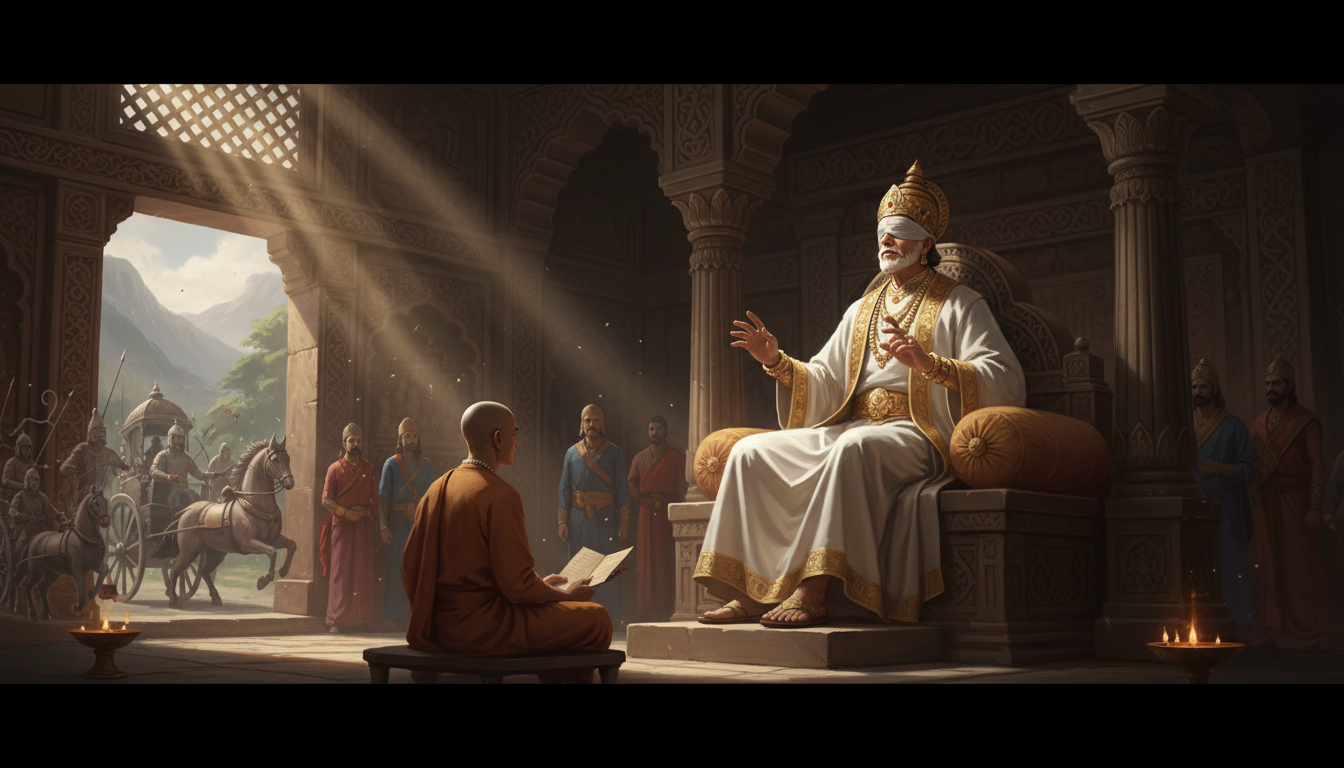
Sanjaya had got as far as Satyaki entering the Kaurava host when the blind king lifted a hand and stopped him.
They were in a room in Hastinapura with the shutters closed, as they were every evening now, and the war was four hundred miles away and entirely inside that room. Dhritarashtra sat forward with his hands on his knees, and when he spoke it was not a question. It was a defence, and it had clearly been assembled in his head over several nights while he waited to be told the next thing.
"Our army is equally possessed of many excellences," he said. "It is equally regarded as superior. It is arrayed according to the rules of the science, exactly as theirs is, and it is equally numerous. Say what you like about the other side. Mine is not less."
"I have not said it was less."
"It is always well treated by us, and it is always devoted to us. It is vast in numerical strength and it presents a wonderful aspect, and its prowess was tested before any of this began, in war, more than once, and found to be what we said it was."
Sanjaya folded his hands and let him go on, because he had been sent to this room to report and had long ago worked out that reporting was only part of the work.
It was not vanity. That was the thing about these speeches that took him longest to understand. The king was not boasting. He was auditing. Somewhere in the accounts of the last fifteen days there had to be a line that explained the loss, and he was going down the columns one at a time, aloud, in front of a witness, looking for the entry that was wrong.
Neither Very Old Nor Very Young
"Consider the men themselves," the king said. "Not the numbers. The men."
"I am listening."
"They are neither very old nor very young. I would not take a boy and I would not keep a man past his strength, and any commander who tried to pad his contingent with either was sent the boy and the old man back. They are neither lean nor corpulent. They are of active habits. Their frames are well developed and strong and they are free from disease, every one of them, because a sick man in a line is worse than a gap in it."
He was counting on his fingers now, and did not know he was doing it.
"They are cased in mail and well equipped with arms. They are devoted to every kind of armed exercise. They are adepts at mounting the backs of elephants and at getting down from them, which sounds like nothing until you have watched an untrained man try it in a hurry. They can move forward and they can step back. They can smite effectually. They can march and they can retreat, and the retreating is the harder of the two and I made them learn it. Oftentimes they have been tested in the management of elephants and of steeds and of cars, and the tests were real tests, and the ones who failed did not stay."
"That is all true," Sanjaya said.
"Then say it is true when I have finished, and not before."
Examined, and Not for Lineage
"They were examined duly," said Dhritarashtra, "and entertained on pay. Not for the sake of lineage. Not from favour. Not from relationship. Do you understand what I am telling you? A man came to my recruiters with a great name and no hands and he was refused, and his father came to me about it, and I upheld the refusal."
He struck the arm of the chair once, lightly.
"They are not a rabble that came of their own accord looking for plunder. Not one man in that host was admitted without pay. My army consists of well-born and respectable men who are contented and well fed and obedient. They are sufficiently rewarded. They are famous, and they are intelligent, and I have never in my life heard of a king who could say all four of those things about the same body of troops."
"There is none in your army," Sanjaya agreed, "who is unskilled in battle."
"None who receives less pay than he deserves. None who receives no pay at all. Each man has his assigned pay and his rations according to the character of his service, and where I have not been able to give more I have given honours and gifts and a seat, and I have done it myself, in person, to the best of my powers. And my sons follow the same conduct toward them. And my kinsmen. And my friends. There is not a man among my troops who has not had some good office done for him by this house."
In the corridor outside, a lamp was carried past. Neither of them saw it.
Protected by the Regents of the World
"And they are not led by fools," the king said. "They are protected by many of our foremost counsellors, men of righteous deeds, the best of men, who resemble the very Regents of the world in their bearing. I did not appoint them because they flattered me. I appointed them because they were the men."
"Some of them advised against this war."
"Some of them did." He did not pause over it. "And beyond them, innumerable rulers of the earth, seeking to do what is agreeable to us, have of their own will come and stood with us, with their forces and their followers, and they protect my troops as well. Nobody was dragged here. Kings came from every quarter of the world because they judged that this was the side to be on, and a man who has that many allies by their own choice has not been an unjust ruler."
Sanjaya thought of the ruler of the Sindhus, and the king of Pragjyotisha, and the Kamboja lord, and the Trigartas who had sworn an oath in a circle around a fire, and did not say any of their names, because every one of them was already dead and the king would find out in the proper order.
"Go on," he said.
The Ocean
"It is like the ocean," Dhritarashtra said, and here his voice changed, because he had been a poet before he was anything else and this was the part he had made for himself in the dark.
"Like the vast ocean filled with the waters of innumerable rivers running into it from every direction. It abounds in horses and cars which have no wings and yet resemble the winged tenants of the air. It teems with elephants adorned and decked, with the juice running down their cheeks.
"The combatants without number are its interminable waters. The horses and the other animals are its terrible waves. The swords and the maces and the darts and the arrows and the lances are the oars plied upon it. The standards and the ornaments, the pearls and the gems on the persons of the warriors, are the lotuses that deck it. The rushing horses and elephants are the winds that agitate it into fury.
"Drona is the fathomless cave of that ocean. Kritavarma is its vast vortex. Jalasandha is the alligator in it. And Karna is the rise of the moon, that makes the whole of it swell with energy and pride."
He stopped. In the silence the thing he had built stood in the room, and it was, as he had said, magnificent.
"That," he said, "is what I have made. Now tell me why it should be destroyed."
He had reached the end of his columns and every entry had come out correct. The recruiting was correct. The pay was correct. The training, the health, the equipment, the counsellors, the allies. Nothing in the list was false and Sanjaya could not have struck out a single line of it. Which left only the one thing the audit had never thought to examine, because it had never been an item in the accounts at all, and so the king said the word that men say when the arithmetic works and the answer is still wrong.
"What can it be, therefore, but Destiny, that even such an army as this should be slain?"
One Car, and Then Another
"Because a bull among the Pandavas," the king said, "on a single car, alone, has gone speedily through that army of mine, vast as it is, like a man walking through a curtain. And then the Satwata followed him through the same hole. Two cars. And I do not see the prospect of even a remnant of my troops being left alive by Savyasachin and that foremost of car-warriors of the Satwata race."
Now the questions came out of him in a rush, and Sanjaya did not interrupt any of them.
"What did the Kauravas do, impelled by fate, when they saw those two pierce the divisions in the van? When all were fighting intently, what became of them? When Arjuna stood at the front of Jayadratha and the ruler of the Sindhus was within reach of the shafts of Gandiva, what measure did my foolish son adopt? What step did Duryodhana think suitable to that occasion when Satyaki entered the host?
"I think that seeing Krishna and the bull of Sini's race both engaged for Arjuna's sake, my sons are filled with grief. I think that seeing the Kurus flying, my sons are filled with grief. Seeing their car-warriors retreat in despair and set their hearts upon getting off the field, my sons are filled with grief. Seeing huge elephants fly away afflicted with the shafts of Arjuna, and others fallen and falling, my sons are filled with grief. Seeing those two heroes pass through Drona's division unvanquished within a moment, my sons are filled with grief.
"And how could the Panchalas pierce Drona? He is the foremost of all persons. He is accomplished in weapons. He cannot be defeated in battle. Tell me. You are skilled in narration. Tell me everything about what Arjuna did to compass the slaughter of the ruler of the Sindhus."
The Answer He Asked For
"You have been overtaken," Sanjaya said, "by a calamity that is the direct result of your own fault, and you should not sit here lamenting over it like an ordinary person."
The king's head came up.
"Many of your wise well-wishers told you this, and Vidura was one of them, and what he said to you was six words long. Do not abandon the sons of Pandu. You did not heed him. The man who does not heed the counsel of well-wishing friends weeps afterwards, having fallen into great distress, exactly as you are weeping now.
"He of Dasarha's race came here himself and begged you for peace. He came into your hall and asked for five villages and stood in front of your son and was laughed at, and Krishna, whose fame is in every corner of the world, did not obtain his prayer. He had ascertained your worthlessness by then. He understood your jealousy of the Pandavas and your crooked intentions toward them, and he heard your lamentations even then, and it was after that, knowing the truth of everything in all the worlds, that he let the flame of war blaze out among the Kurus.
"This great and wholesale destruction has come upon you, brought about by your own fault. It does not become you to lay it on Duryodhana. In the development of these events no merit of yours is to be seen at the beginning, or in the middle, or at the end. This defeat is entirely owing to you."
He waited. The king did not speak.
"So be quiet," said Sanjaya, "and hear how the battle went. You asked what your army did. It did everything you say it was trained to do. Listen."
One Man Holding a Breach
After the grandson of Sini had gone into the host, the Parthas headed by Bhimasena came in behind him with everything they had, in fury, with all their followers, at the gap.
One man closed it. Kritavarma, the son of Hridika, alone, put his car across that ground and resisted them, and as a continent resists the surging of the sea, so did he resist the whole weight of the Pandava army. The prowess we beheld in him was a wonderful thing. The united Parthas could not get past his single self.
They came at him in the order of their rank, and each one made his mark on him.
Bhima pierced him with three shafts and blew his conch, and every Pandava on that side of the field was gladdened by the sound. Sahadeva pierced him with twenty. Yudhishthira the just with five. Nakula with a hundred. The sons of Draupadi with seventy-three between them. Ghatotkacha with seven. Virata pierced him with five, and Drupada with five, and Drupada's son Dhrishtadyumna with five. And Shikhandi pierced him with five, and then, smiling, with twenty-five more.
Count it. That is nine of the greatest warriors alive, working on one man in one place at one time, and at the end of it the man was still standing in his car and the gap was still shut.
Then Kritavarma answered. Five shafts into every one of those great car-warriors, and seven into Bhima on top of it.
The Dart with the Golden Staff
He took Bhima's bow off him, and the standard with it, both cut down off the car in one exchange. Then, with great speed and in a temper, he put seventy keen shafts into the chest of a man who had nothing left to shoot back with, and Bhimasena stood on his own car and trembled like a mountain in an earthquake.
The Parthas saw it. Yudhishthira brought them round him in a ring of chariots and they poured arrows into Kritavarma to buy the Wind-god's son a breath, cheerfully, the way men work when they are frightened for someone.
Bhima came back to himself, and reached down, and took up a dart made of steel with a golden staff to it, and threw it from his own car at Kritavarma's with the whole of his strength behind it. It went across that ground like a snake come out of its slough, blazing, with the look of the fire at the end of an age.
The son of Hridika cut it in two with two arrows.
The dart, decked with gold, broke and fell, and lit up the ten points of the compass on the way down, like a large meteor coming out of the sky, and buried itself in the earth.
Bhima blazed up. He took another bow, tougher than the last, with a louder twang to it, and came at him again, and struck him with five shafts in the centre of the chest. And Kritavarma, mangled in every limb, went on standing there, and in the light he looked like a red Asoka tree covered all over with flowers.
The Question Returned
Shikhandi tried him last, and it was Shikhandi who was carried off.
Kritavarma cut his bow away with a razor-faced shaft, smiling while he did it. Shikhandi threw down the useless stave and took up a sword and a bright shield decked with a hundred moons, whirled the shield once for the weight of it, and sent the sword flying at the enemy's car. It cut Kritavarma's bow in half with the arrow still fixed on the string and fell on the ground beyond, like a bright star loosened out of the sky.
He cast off the broken bow and took another and pierced Shikhandi with three, and then five. And the man who had been the cause of Bhishma's fall sat down on the terrace of his own car in pain, threw his bow and arrows aside, and fainted, and his charioteer took him out of the battle at speed.
Your troops, said Sanjaya, worshipped the son of Hridika then, and waved their garments in the air over their heads.
And he was not finished. Having beaten the Parthas he beat the Chedis, and after the Chedis the Panchalas, and after them the Srinjayas and the Kekayas, all of whom are men of great prowess, and the forces of the Pandavas began to run in every direction because they could not stand coolly in front of him. He stayed there afterwards in the middle of it all like a fire that has been left burning, and those mighty car-warriors, afflicted and routed, did not venture to look at him again.
"So there is your army," Sanjaya said into the dark of the shuttered room. "Examined, paid, fed, willing, and not lacking one thing you named. One man of it held nine of theirs and broke four nations before dark. You asked me what could destroy such an army except destiny. Nothing could. Nothing has. What is being destroyed is not your army, and you have known its name since the day Vidura told you not to abandon them."
Dharma Lesson
A man can do every single thing correctly and still be ruined by the one thing he refused to examine. Dhritarashtra's audit of his army was accurate in every line, and the line that mattered was not in the accounts, because it was not a question of soldiers but of a nephew he would not restrain and five nephews he would not restore. When the arithmetic is perfect and the answer is still wrong, the missing term is usually the one a man has decided is not his business.