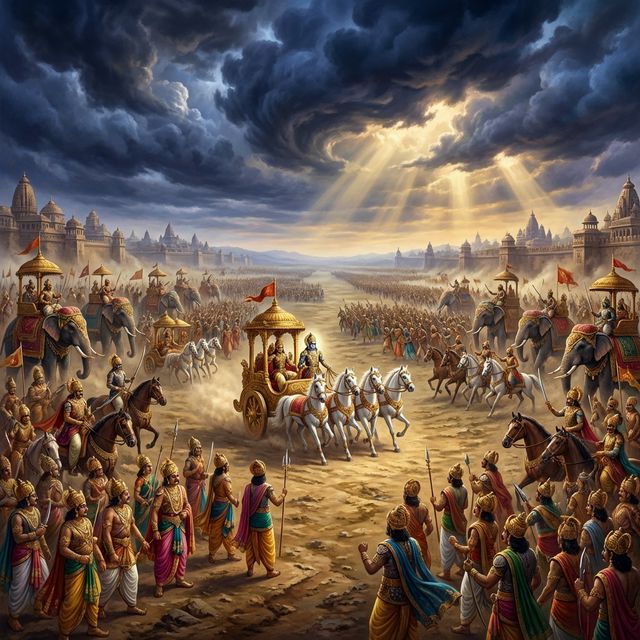
The Field Krishna Showed Him
Arjuna is driven at a walk over the ground he has won, and Yudhishthira answers with a hymn
The Question About Bhima
Dhritarashtra had heard how the ruler of the Sindhus was killed. What he wanted now was the part of the afternoon he had not been told.
"When such was the condition of the battle," he said, "between those heroes of their side and mine, what did Bhima then do? Tell me all, O Sanjaya."
Sanjaya said: "After Bhimasena had been made carless, that hero, afflicted with the wordy darts of Karna and filled with rage, went to Phalguna."
It was still the fourteenth day, and the light was going. Bhima had no chariot under him. He had beaten Karna off the field more than once that afternoon and had been beaten in his turn, and at the end of it Karna had stood over him with the horn of his bow and made a speech about eunuchs and gluttons in front of two armies. Wounds close. That did not.
So he came to his brother and asked for the only remedy there was.
"In thy very sight, O Dhananjaya, Karna hath repeatedly said to me: eunuch, fool, glutton, unskilled in weapons, do not fight, child, unable to bear the burden of battle. He that would tell me so would be slain by me. Karna hath told me those words, O Bharata. O mighty-armed one, thou knowest the vow which I have made jointly with thee. Remember the words that were then spoken by me. O foremost of men, act in such a way that that vow of mine, O son of Kunti, as also thy own vow, may not be falsified. Do that by which that vow of mine may be made true."
Arjuna had killed Jayadratha inside the hour. He had a bow in his hand and a god driving his horses and the sun almost down, and his brother was asking him for something that could not be given with a weapon, only with a witness.
He turned the car and went to find Karna.
Said Aloud, Where the Troops Could Hear
He did not shoot. He got near enough to be heard, and spoke.
"O Karna, thou art of false fight. O son of a Suta, thou applaudest thy own self. Of wicked understanding, listen now to what I tell thee. Heroes meet with either of these two things in battle, victory or defeat. Both of these are uncertain, O son of Radha. The case is not otherwise when Indra himself is engaged in battle."
Then he reminded the man of the hour he had just lived through. Satyaki, the grandson of Sini, had smashed Karna's car to pieces earlier that same evening and had let him walk away from the wreck.
"Made carless by Yuyudhana, with thy senses no longer under thy control, thou wert almost at the point of death. Remembering, however, that I had vowed to slay thee, that hero dismissed thee without taking thy life. It is true thou hadst succeeded in depriving Bhimasena of his car. Thy abuse, however, O son of Radha, of that hero was sinful. Those bulls among men that are truly righteous and brave, having vanquished a foe, never boast, nor speak ill of anybody. Thy knowledge, however, is little. It is for this, O son of a Suta, that thou indulgest in such speeches.
"In the very sight of all the troops, of Kesava, as also of myself, thou wert many a time made carless by Bhimasena in battle. That son of Pandu, however, did not call thee a single harsh word."
That was the whole of what Bhima had wanted, and it was said where the armies could hear it. Arjuna did not stop there.
"Since thou hast addressed Vrikodara in many harsh speeches, and since thou with others hast slain the son of Subhadra out of my sight, therefore this very day obtain the fruit of those offences of thine. It was for thy own destruction, O wicked wight, that thou didst then cut off Abhimanyu's bow. I will slay Vrishasena in thy very sight in battle. I say this truly, laying my hand on my weapon."
Vrishasena was Karna's son, and he had been one of the six who closed on Abhimanyu inside the wheel array. A father had just been told the day and the manner.
A loud and tremendous uproar went up from the car-warriors of both armies. And at that frightful time, when confusion was everywhere, the thousand-rayed sun dimmed his rays and entered the hill of the west.
By Good Luck, O Jishnu
Krishna halted the chariot in the van of the battle, in front of everybody, and put his arms around Arjuna.
"By good luck, O Jishnu, thy great vow hath been accomplished. By good luck, that Vriddhakshatra hath been slain along with his son."
Vriddhakshatra was Jayadratha's father, the old king of the Sindhus, who had once laid a curse on whoever should make his son's head fall to the ground. Arjuna had shot the severed head through the air into the old man's lap where he sat at his evening prayers, and when Vriddhakshatra rose and it rolled off his knees, the curse took the man who had made it. Two Sindhu kings in one motion, and Krishna counted them both in a single breath.
"The celestial generalissimo himself, O Bharata, encountering the Dhartarashtra force, would in battle lose his senses. There is no doubt of this. Except thee, O tiger among men, I do not even in thought see the person in the three worlds that could fight with this host. Many royal warriors endued with great prowess, equal to thee or superior, have been united together at Duryodhana's command. Clad in mail, they could not approach thee, encountering thy angry self in battle. Thy energy and might are equal to that of Rudra or the Destroyer himself. None else is capable of putting forth such prowess in battle as thou, O scorcher of foes, alone and unsupported, didst today put forth."
Then he said the thing that told Arjuna the war was not over.
"Thus shall I applaud thee again after Karna of wicked soul has been slain along with his followers. Thus shall I glorify thee when that foe of thine shall have been vanquished and slain."
Arjuna gave the praise straight back.
"Through thy grace, O Madhava, this vow that even the gods could with difficulty accomplish hath been accomplished by me. Their victory is not at all a matter of wonder that have thee, O Kesava, for their lord. Through thy grace, Yudhishthira will obtain the whole earth. All this is due to thy power, O thou of Vrishni's race. This is thy victory, O lord. Our prosperity is thy care, and we are thy servants, O slayer of Madhu."
Krishna smiled softly and did not argue with him, and took up the reins, and urged the steeds slowly.
The Slow Drive
He did not take him back to the camp. He drove him over the ground.
The horses went at a walk, because there was no other pace possible on that surface, and because Krishna wanted him to see it. Arjuna had spent the whole day inside a wall of dust with a bow in his hands, shooting into whatever came, breaking three armies open to get at one man before the sun went down. He had not once looked at what was behind him.
"Desirous of victory in battle or world-wide fame," Krishna said, "many heroic kings are lying on the earth, struck with thy shafts."
That is how the description begins, and the last three words of it are the ones that matter. Not lying on the earth. Struck with thy shafts.
"Their weapons and ornaments lay scattered, and their steeds, cars and elephants are mangled and broken. With their coats of mail pierced or cut open, they have come to the greatest grief. Some of them are yet alive, and some of them are dead. Those, however, that are dead still seem to be alive, in consequence of the splendour with which they are endued."
That is the first strange thing about the field at dusk. The dead did not look dead. They were kings, and they had come out that morning dressed as kings, and the ornaments were still burning in the last of the light on men who had stopped breathing an hour before. A man riding past could not tell, without getting down, which of the shining figures on the ground still had somebody inside it.
"Behold the earth covered with their shafts equipped with golden wings, with their numerous other weapons of attack and defence, and with their animals deprived of life."
The horses walked. Krishna held the reins loose and went on naming what they were passing, and he named it the way a man reads out the contents of a treasury, item by item, because that is what it had been at sunrise.
The Inventory of the Ground
"Indeed, the earth looks resplendent with coats of mail and necklaces of gems, with their heads decked with earrings and headgears and diadems, and floral wreaths and jewels worn on crowns, and Kanthasutras and Angadas, and collars of gold, and with diverse other beautiful ornaments."
Kanthasutras are the strings worn at the throat. Angadas are the ornaments clasped on the upper arm. They were still on the arms.
"Strewn with Anuskaras and quivers, with standards and banners, with Upaskaras and Adhishthanas, with shafts and crests of cars, with broken wheels and beautiful Akshas in profusion, with yokes and trappings of steeds, with belts and bows and arrows, with elephant housings, with spiked maces and hooks of iron, with darts and short arrows, with spears and pikes, with Kundas and clubs, with Sataghnis and Bhushandis, with scimitars and axes, with short and heavy clubs and mallets, with maces and Kunapas, with whips decked with gold, O bull of Bharata's race, with the bells and diverse other ornaments of mighty elephants, with floral garlands and various kinds of decorations, and with costly robes all loosened from the bodies of men and animals, the earth shines brilliantly, like the autumnal firmament with planets and stars."
That is the whole list, and the whole list is one sentence, and it ends in the sky.
It is worth noticing the order of it. Krishna began with the ornaments men wear on their bodies and moved outward through the parts of chariots, the axles and yokes and crests and the beautiful Akshas, and then through every kind of weapon the age possessed, the Sataghni that is said to kill a hundred, the Bhushandi, the iron hook used on elephants, and then the bells that hang on an elephant's flanks, and then the garlands, and then the clothes, which had come off the bodies of men and animals both. Everything that had been fastened to something living that morning was loose on the ground by dark.
And the ground, so covered, was beautiful. He said so. Like the autumn sky when the rains have washed it and every planet and every star is out at once.
Arjuna was being asked to look at the most beautiful thing he had ever made.
Clasping the Earth Like a Dear Wife
"The lords of the earth, slain for the sake of earth, are slumbering on the earth, clasping with their limbs the earth like a dear wife."
They had come for land. They had it.
"Like mountains shedding through their caves and fissures streams of liquid chalk, these elephants, resembling Airavata himself and huge as mountains, are shedding profuse streams of blood through the openings in their bodies caused by weapons. Behold, O hero, those huge creatures afflicted with shafts, lying on the ground in convulsions. Behold also, O Partha, those riderless and driverless cars that had at one time resembled celestial vehicles or the vapoury forms in the evening sky, now lying with standards and banners and yokes cut into pieces. Foot-soldiers also, O hero, bearing bows and shields and slain in hundreds and thousands, are lying on the ground, bathed in blood and clasping the earth with every limb, and their locks smeared with dust."
Then, in the middle of it, the two words that turn the whole speech.
"Behold, O mighty-armed one, those warriors with bodies mangled with thy weapons."
Thy weapons. He had said it at the opening and he said it again here, in case the beauty of the thing had begun to do its work.
"Behold the earth, strewn with yak-tails and fans, and umbrellas and standards, and steeds and cars and elephants, and with blankets and reins and beautiful robes and costly Varuthas, looking as if overspread with embroidered tapestry. Many warriors fallen from the backs of well-equipped elephants, along with those creatures themselves that they had ridden, are looking like lions fallen from mountain summits struck down by thunder.
"Behold, O foremost of men, the surface of the earth is frightful to look at, covered as it is with large numbers of slain elephants and steeds and car-warriors, and miry with blood, fat and rotten flesh in profusion, and on which dogs and wolves and Pisachas and diverse wanderers of the night are cantering with joy."
The jackals had not waited for the war to end. They were out among the ornaments already, and they were the only creatures on that field who were happy.
"This fame-enhancing and mighty feat on the field of battle is capable of being achieved by thee only, O puissant one, or by that chief of the gods, Indra himself, who in great battle slayeth the Daityas and the Danavas."
Then Krishna took up Panchajanya and blew it over the field he had just finished describing, and the gleeful soldiers of the Pandava army blew their conches in answer, and the horses were turned toward the place where the king was.
The King Came Down From His Car
Yudhishthira, whom men called Ajatasatru because no living creature had ever been able to call itself his enemy, had spent that day at the head of a broken line, listening to rumours. Twice the shouting had made him think Arjuna was dead. He had sent Satyaki after him and then Bhima after Satyaki, and had been left standing in front of Drona with none of his best men beside him.
Now the chariot with the ape on the banner came in out of the dark, and Krishna got down and did the honours to him first, with a gladdened heart.
"By good luck, O king of kings, thy prosperity increaseth. O best of men, thy foe hath been slain. By good luck, thy younger brother hath accomplished his vow."
The king came down off his own car. He was crying and did not trouble to hide it. He embraced the two Krishnas, dark Vasudeva and his friend who was called Krishna as well for the colour of him, and he wiped his bright lotus-like face and found his voice.
"Ye mighty car-warriors, by good luck I behold both of you after ye have accomplished your task. By good luck, that sinful wretch, the ruler of the Sindhus, hath been slain. Ye Krishnas, by good luck, ye have done that which hath filled me with great happiness. By good luck, our foes have been plunged into an ocean of grief."
Four times in four sentences: by good luck. It is the phrase a man uses when he has spent all day sitting with the other possibility.
Then, still holding the two of them, he stopped speaking to his brother altogether and began to speak only to Krishna, and what came out was not thanks. It was a hymn.
"Thou art the sovereign lord of all the worlds, O slayer of Madhu. In the three worlds, they that have thee for their preceptor can have no object incapable of accomplishment. Through thy grace, O Govinda, we will conquer our foes, like Indra conquering the Danavas in days of old."
Nobody had asked him for this. He was standing on a battlefield in the dark with the smell of it around him and his brother alive in front of him, and he went on for as long as it took.
What Yudhishthira Sang
"Be it the conquest of the world, or be it the conquest of the three worlds, everything is certain, O thou of the Vrishni race, in their case with whom thou art gratified. They can have no sin, nor can they meet with defeat in battle, O giver of honours."
He began with his own case, and then went outward, and the further out he went the older his examples became.
"It is through thy grace, O Hrishikesa, that Sakra hath become the chief of the celestials, and obtained on the field of battle the sovereignty of the three worlds. It is through thy grace that the gods obtained immortality and enjoy eternal regions. Having slain thousands of Daityas, with prowess having its origin in thy grace, Sakra obtained the lordship of the celestials."
Sakra is Indra, the god of victory in battle. Yudhishthira was pointing out that the greatest warrior of the three worlds had also owed his day to somebody else.
"Through thy grace, O Hrishikesa, the mobile and immobile universe, without swerving from its ordained course, is engaged in prayers and homa. In the beginning, this universe, enveloped in darkness, had been one vast expanse of water. Through thy grace, O mighty-armed one, the universe became manifest, O best of men."
He had gone back past Indra now, past the gods altogether, to the dark water before there was anything at all.
"Thou art the creator of all the worlds, thou art the Supreme Soul, and thou art immutable. They that behold thee, O Hrishikesa, are never confounded. Thou art the Supreme God, thou art the God of gods, and thou art Eternal. They that seek refuge with thee are never confounded. Without beginning and without death, thou art Divine, and immutable. They that are devoted to thee always tide over every difficulty. Thou art Supreme, the Ancient One, and that which is the Highest of the high. Thou art sung in the four Vedas. The four Vedas sing of thee.
"Thou art the lord of winged creatures, and the lord of all human beings. Thou art the Supremest Lord of everything. I bow to thee, O best of beings. Prosperity to thee, O Madhava. O thou of large eyes, O Universal Soul, thou art the origin of all things."
And having climbed to the origin of all things, he came down in one step to the only thing he had been thinking about since morning.
"He, again, that is a friend of Dhananjaya, or is engaged in Dhananjaya's good, obtaineth thee, that art the preceptor of Dhananjaya, and attaineth to happiness."
The whole hymn had been about his brother coming back.
It Was Thy Wrath That Did It
Thus addressed, the two of them answered him together, and they turned his argument round and handed it back to him.
"The sinful king Jayadratha hath been consumed by the fire of thy wrath."
Not by Gandiva. By the anger of a man who had not been within a mile of the killing.
"O puissant one, although the Dhartarashtra host is vast and swelleth with pride, yet, O Bharata, struck and slain, it is being exterminated. O slayer of foes, it is in consequence of thy wrath that the Kauravas are being destroyed. Having angered thee, who canst slay with thy eyes alone, the wicked-minded Suyodhana, with his friends and kinsmen, will have to lay down his life in battle."
Then they named the proof, and the proof was lying four days behind them at the edge of the field, where it had fallen on the tenth evening.
"Slain before in consequence of thy ire, and struck down also by the gods themselves, the invincible Bhishma, the grandsire of the Kurus, lieth now on a bed of arrows. O slayer of foes, victory in battle is unattainable by them, and death also waiteth for them, that have thee for their foe. Kingdom, life, dear ones, children, and diverse kinds of bliss will soon be lost by him with whom thou, O scorcher of foes, hast been angry. I regard the Kauravas to be lost, with their sons and kinsmen, when thou, that art observant of the duties of a king, hast been angry with them."
This is a strange thing to say to Yudhishthira, and they said it deliberately. He was the one who had not wanted the war. He had asked for five villages. Of every man on that field he was the least likely to be described as a fire, and here were the two greatest bowmen in the world telling him that all of the last fourteen days had been his doing, because he was the king, and because a king who has been wronged and does not forgive is a slower and more complete weapon than any archer.
He had just spent a hymn insisting that nothing was his.
They spent their answer insisting that all of it was.
Neither side of that exchange was flattery. It is simply how those three men understood the war.
The Two Who Came Back Out of the Sea
Then two more men came in out of the dark, and both of them were cut to pieces.
Bhima and Satyaki had been sent across the whole Kaurava army that morning, one after the other, to reach Arjuna, and had been fighting ever since without knowing whether he lived. They saluted their senior, and then those two mighty bowmen sat down on the ground, mangled with shafts, and the Panchalas gathered round them.
Yudhishthira looked at the pair of them in the dirt with their hands joined, and he found the same phrase again.
"By good luck it is that I see you both, ye heroes, escaped with life from that sea of hostile troops, that sea in which Drona acted the part of an invincible alligator and the son of Hridika that of a fierce shark."
Kritavarma, the son of Hridika, was the Vrishni who had taken Duryodhana's side while his own kinsman Satyaki fought for the Pandavas, and it was he who had held the mouth of that formation against both of them in turn. The king went through the whole crossing as though he had watched every yard of it.
"By good luck, all the kings of the earth have been vanquished by you two. By good luck, Drona hath been vanquished in battle, and that mighty car-warrior also, the son of Hridika. By good luck, Karna hath been vanquished with barbed shafts. By good luck, Salya also was obliged to turn away from the field by you both, ye bulls among men. By good luck, I behold you come back safe and sound, ye that are foremost of car-warriors and well skilled in battle.
"By good luck I behold you again, ye heroes, that have forded that sea of troops in obedience to my command, ye that went to battle impelled by the desire of honouring me."
That is the sentence that cost him something. He had sent them, over the objection of the man he gave the order to, and had spent every hour since not knowing what it had bought.
"Ye are heroes delighting in battle. Ye are to me as life. By good luck, I see you both."
Having said this, the son of Pandu embraced both Yuyudhana and Vrikodara, those tigers among men, and shed tears of joy.
Then the entire host of the Pandavas became cheerful and filled with joy. And all of them once more set their hearts on battle.
It was full night by then. The fourteenth day had ended long ago by the sun, and nobody on either side had left the field.
Dharma Lesson
Krishna does not hide the field from Arjuna and he does not apologise for it. He drives him across it at a walk, names every ornament and every broken thing on it, calls the whole ruin as beautiful as the autumn sky, and twice in the middle of that beauty says that these are men his listener's own shafts brought down. A victory a man cannot bear to look at afterwards was not worth the winning, and a man who refuses to look at his is not yet done with it. Yudhishthira's hymn is the other half of the same lesson: having got everything he wanted that day, he stood in the dark and gave the credit away, and the two who had done the killing turned round and gave it straight back to him.