What Drupada Said About Duryodhana
Five kings die in front of Drona in one afternoon, and Drupada names the man who is not on the field
The Afternoon of the Fourteenth Day
"In the afternoon of that day, O king, a dreadful battle, characterised by roars deep as those of the clouds, once more occurred between Drona and the Somakas."
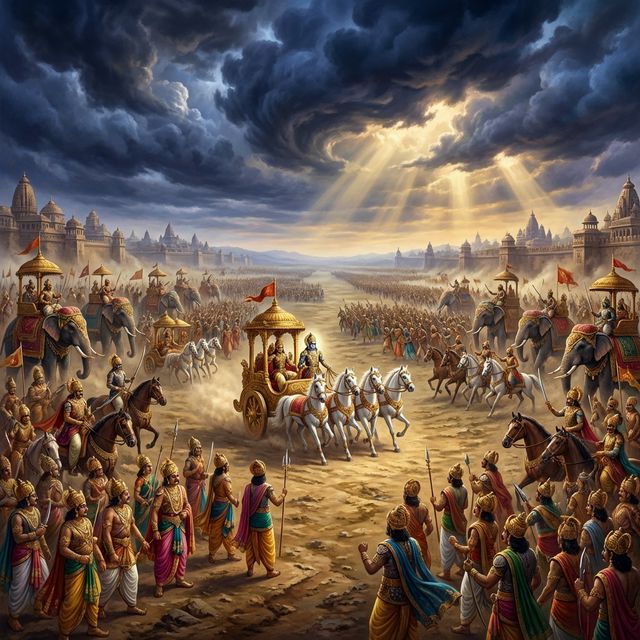
That is how Sanjaya took up the account, sitting in a hall in Hastinapura and describing to a blind man a field that the blind man's sons were dying on. The day was the fourteenth. Arjuna was somewhere far off in the dust with Krishna driving him, hunting the ruler of the Sindhus before sunset. Satyaki had crossed the whole Kaurava host to reach him. And here, at the gate of the array, the old teacher was still standing where the morning had left him, holding a line by himself.
Drona was mounted on his car of red steeds. He came against the Pandavas intent on battle, and Sanjaya set down the one detail that describes the whole afternoon: he came at moderate speed. There was no hurry in the man. The valiant son of Bharadwaja, that great bowman endued with mighty strength, that hero born in an excellent pot, struck down many foremost of warriors with his whetted arrows equipped with beautiful wings, and seemed, Sanjaya said, to sport in that battle.
The Somakas were the men of Drupada's country and their allies, the Panchalas whose prince Dhrishtadyumna had been born out of a sacrificial fire for the express purpose of killing this Brahmana. Behind them stood the Chedis and the Srinjayas, the Kasis and the Kosalas, most of the eastern and southern strength of Yudhishthira's alliance. They had been throwing themselves at Drona since the war began, and they went on doing it now because there was nothing else to do. The one road to Arjuna ran through him.
What Sanjaya gives next is a list. It is the roll of the men who went at Drona that afternoon, one after another, each of them a king or a king's son, each with a name and a father and a reason for coming. He does not hurry through it either.
It begins with a prince of the Kekayas.
The Prince Who Answered the Brahma Weapon
Vrihatkshatra was the eldest of five brothers, a mighty car-warrior of the Kekayas, and irresistible in battle. The Kekayas were a hill people of the northwest, and five of their princes had come south to fight for the Pandavas while five of their kinsmen fought on the other side. He rushed at Drona shooting keen shafts, and he afflicted the preceptor greatly, like a mighty mass of clouds pouring torrents of rain on the mountain of Gandhamadana.
Drona, excited with wrath, sped at him five and ten shafts whetted on stone and equipped with wings of gold. The prince of the Kekayas cut off every one of them with five shafts of his own, and he did it cheerfully. They came at him like angry snakes of virulent poison and he took them out of the air as a man swats flies off a table.
That bull among Brahmanas, beholding such lightness of hand, sent eight straight shafts. Vrihatkshatra resisted them with as many sharp shafts of his own. The Kaurava troops, watching, were filled with amazement, and Sanjaya says so plainly: thy troops, O king, were filled with amazement. They had been watching Drona kill men all day and here was somebody meeting him arrow for arrow.
Then Drona applauded him. That is in the text and it should be read slowly. The preceptor praised the man in front of him, and then invoked into existence the irresistible and celestial weapon called Brahma.
And the prince of the Kekayas, seeing it shot, baffled that Brahma weapon with a Brahma weapon of his own.
Having done it, he pierced the Brahmana with sixty shafts whetted on stone and winged with gold. Drona answered with one. It was a powerful shaft, and it went through Vrihatkshatra's armour and through his body and into the ground behind him, as a black cobra pierces through an ant-hill.
He did not fall. Deeply pierced, filled with rage, rolling his beautiful eyes, he put seventy arrows into Drona and one more into Drona's charioteer, in his vitals.
So Drona took the whole car apart. Four winged arrows for the four steeds. One arrow for the driver, out of his niche. Two more for the standard and the umbrella. Then a third, well shot, into the prince's chest, and Vrihatkshatra fell.
The Son of Shishupala, and His Son
There was a man watching that who could not let it stand.
Dhrishtaketu was the son of Shishupala, the ruler of the Chedis, and the Chedi throne had come to him because Krishna had cut his father's head off at Yudhishthira's Rajasuya sacrifice years before. He had brought his whole country into the war on the side of the man who had ordered that sacrifice. Filled with rage, he spoke to his charioteer.
"O charioteer, proceed to the spot where Drona stayeth, clad in armour and engaged in slaying the Kaikeya and the Panchala hosts."
The driver took him there with fleet steeds of the Kamvoja breed, and Dhrishtaketu, that bull among the Chedis, swelling with might, rushed towards Drona for his own destruction, like an insect upon a blazing fire. Sanjaya says the thing outright before it happens. He does that all afternoon.
Sixty shafts into Drona and his steeds and his car and his standard. Then many more keen shafts, like a man rousing a sleeping tiger.
Drona cut the middle out of his bow with a razor-faced arrow winged with vulturine feathers. Dhrishtaketu took up another and pierced him with shafts winged with the feathers of Kankas and peacocks. Drona killed the four horses with four shafts and then, smiling, cut the head of the charioteer from his trunk, and put five and twenty arrows into Dhrishtaketu himself.
So the prince of the Chedis jumped down from the ruin of his car and took up a mace, and hurled it like an angry snake. It was heavy, endued with the strength of adamant, decked with gold, and it came at Drona like Death. Drona cut it apart in the air with many thousands of whetted arrows, and it fell and made the earth echo with its noise. Dhrishtaketu threw a lance. Five shafts. He threw a gold-decked dart. Five arrows. Both fell on the earth like a couple of snakes mangled and torn by Garuda.
Then the son of Bharadwaja sped one keen shaft at the man who was battling for his destruction, and it went through armour and breast and into the earth like a swan diving into a lake overgrown with lotuses. As a hungry jay seizes and devours a little insect, said Sanjaya, so did Drona swallow up Dhrishtaketu in that great battle.
The dead man's son, who was conversant with the highest weapons, came forward wrathfully to bear the burthen of his sire. Drona, smiling, despatched him to the abode of Yama, like a huge tiger in the deep woods slaying an infant deer.
Arrows With His Name On Them
While the Pandavas were being thinned in this manner, the heroic son of Jarasandha rushed at Drona.
His father had been the emperor of Magadha, the man Bhima tore in two at Krishna's instigation so that the Rajasuya could go forward. The son had inherited a kingdom that owed the Pandavas nothing but a grudge, and he had brought it to fight for them anyway. Like clouds shrouding the sun, he made the mighty-armed Drona invisible with his arrowy showers.
Drona, beholding that lightness of hand, shot his shafts by hundreds and thousands. He covered that foremost of car-warriors where he stood on his car, and slew the son of Jarasandha in the very sight of all the bowmen there. Sanjaya reaches for the same image a third time. Drona, resembling the Destroyer himself, swallowed up every one who approached him, as the Destroyer swallows up creatures when their hour arrives.
And then the old man did a thing he had not done before that day. He proclaimed his name in that battle.
It is a formal act. A warrior announces himself so that the men in front of him know exactly who is killing them and cannot pretend afterwards that they did not. Drona called out his name and covered the Pandavas with many thousands of shafts, and those shafts were whetted on stone and engraved with his name, and they slew men and elephants and steeds by hundreds. Every corpse on that part of the field carried the signature of the man who made it.
Thus slaughtered, like the Asuras by Sakra, the Panchalas began to tremble like a herd of kine afflicted with cold. An awful wail of woe rose from the Pandava army. They were scorched by the sun of a long afternoon and cut down by arrows at the same time, and they became filled with anxiety, and Sanjaya finds the exact figure for what the great car-warriors among the Panchalas felt as they sat stupefied under those arrowy showers.
They felt like persons whose thighs had been seized by alligators. Still on the bank, still upright, and already being taken.
Drona Is Slain, Drona Is Slain
Then the Chedis and the Srinjayas, the Kasis and the Kosalas rushed cheerfully against the son of Bharadwaja from a desire of battle, and as they came they told one another a thing that was not true.
"Drona is slain! Drona is slain!"
Saying these words they rushed at that hero. It is one of the strangest lines in the whole day. Nobody had killed him. Nobody had come near it. The cry went up and down the ranks because it was the only thing that could get men to run in that direction, and they ran shouting it at a living man who was standing in front of them with a bow, and all those tigers among men fell on the illustrious Drona with their utmost might, desirous of despatching him to the abode of Yama.
He despatched them instead, and Sanjaya notes that the forest tribes among the Chedis suffered worst, sent in a body into the presence of the King of the dead. After the foremost of the Chedis had been exterminated, the Panchalas, afflicted with his shafts, began to tremble again.
Then they called out to Bhimasena and Dhrishtadyumna, and what they said was not a report on the battle. It was an argument about what kind of thing they were fighting.
"This Brahmana hath, without doubt, practised the austerest of penances and acquired great ascetic merit. Inflamed with rage in battle, he consumeth the foremost of Kshatriyas. A Kshatriya's duty is battle; a Brahmana's, the highest asceticism. A Brahmana endued with ascetic merit and learning is capable of burning everything by his glances only. Many foremost of Kshatriyas, having approached the uncrossable and fierce fire of Drona's weapons, have been blasted and consumed. The illustrious Drona, to the measure of his might, courage, and perseverance, stupefies all creatures and slays our troops!"
They were not wrong about the arithmetic and they were badly wrong about the remedy. What they had noticed was that the order of the world had a hole in it. A Brahmana is supposed to keep the fire, not carry it into a line of chariots. This one had spent a lifetime accumulating the merit of the one order and was spending it in the work of the other, and there was no rule anybody could quote at him that would make him stop.
Dhrishtadyumna's son heard them say it.
Kshatradharman and Chekitana
Kshatradharman was the son of Dhrishtadyumna, which made him Drupada's grandson and Draupadi's nephew, and his name means the duty of a Kshatriya. He was rightly observant of it. Hearing those words, he wrathfully cut off Drona's bow with a crescent-shaped arrow while the arrow was still fixed on the string.
It was a beautiful piece of shooting and it bought him nothing at all.
Drona, that grinder of Kshatriyas, became more angry still. He took up another bright bow, tougher than the one he had laid aside, fixed on it a keen arrow destructive of hostile ranks, drew the bowstring back to his ear, and sped it at the prince. That arrow killed Kshatradharman and entered the earth. His breast pierced through, he fell down from his vehicle.
The boy who had been named for the duty of his order had performed it exactly, in front of a man who had thrown the duties of his own order away, and the man who had thrown them away won.
Upon the slaughter of Dhrishtadyumna's son the Pandava troops began to tremble.
Then the mighty Chekitana fell upon Drona. He was a Vrishni, one of Krishna's own people, and he had been named a great car-warrior at the reckoning before the war. He pierced Drona with ten arrows and then with one more in the centre of the chest, and put four arrows into the charioteer and four into the four horses.
The preceptor answered him with sixteen arrows into the right arm, sixteen into the standard, and seven into the driver, and the driver died. Chekitana's horses, with nobody holding them, bolted and dragged the car away across the field with the man still in it.
The Panchalas and the Pandavas watched that car go. Sanjaya says they were filled with great fear, and the fear was reasonable. They had just seen a great car-warrior removed from a battle without being touched.
Drona then, routing on all sides the Panchalas and the Srinjayas united together, looked exceedingly resplendent.
What Drupada Said
The venerable Drona was full five and eighty years of age. He was dark in hue, and his white locks descended to his ears, and he careered in that battle like a youth of sixteen. His enemies, watching him go fearlessly up and down the line, regarded him as none else than Indra himself armed with the thunder.
Drupada was watching him too.
They had been boys together in Bharadwaja's hermitage. They had promised each other everything, and then Drupada had become a king and told the Brahmana at his door that friendship between unequals was impossible, and Drona had come back years later with an army of students and taken half the kingdom for it. Drupada had gone into the woods and got himself a son out of a fire to kill Drona and a daughter out of the same fire who married the Pandavas and made this war possible. Every reason a man could have for hating another man, Drupada had, personally, in writing, for forty years.
He did not use one of them. He looked at the old man killing kings in the afternoon light and he named somebody else.
"This one is slaying the Kshatriyas like a hungry tiger slaying smaller animals. The sinful Duryodhana of wicked soul will assuredly obtain the most miserable regions in the next world. It is through his covetousness that many foremost of the Kshatriyas, slain in battle, lay prostrate on the field, like mangled bulls, weltering in blood and becoming the food of dogs and jackals."
That is the whole of it. Three sentences from a man with an akshauhini of troops under him, spoken in the middle of a battle he was losing.
He does not say Drona is wicked. He says Drona is a hungry tiger, which is what a tiger is, and there is no more blame in it than that. The tiger is doing the thing tigers do. Somebody opened the cage. Somebody wanted the field cleared of these particular bulls and had the standing to arrange it, and that man was not on the field at all just then, and would not be lying in the blood when the dogs came, and it was his greed and nobody else's that had put Vrihatkshatra and Dhrishtaketu and Dhrishtaketu's son and Jarasandha's son and Kshatradharman on the ground within the space of one afternoon.
Then Drupada, that master of an Akshauhini of troops, placing the Parthas at his head, rushed with speed towards Drona.
Dharma Lesson
Drupada had better reason than any man alive to call Drona wicked, and he did not take it. He looked at a field full of dead kings and traced the killing past the hand that did it to the appetite that arranged it. That is a hard kind of accuracy, and it costs something, because it means giving up the satisfaction of blaming the enemy in front of you. The epic keeps insisting on it: the tiger is only being a tiger, and someone with a throne and a grudge decided which bulls would be put in the pen with him.