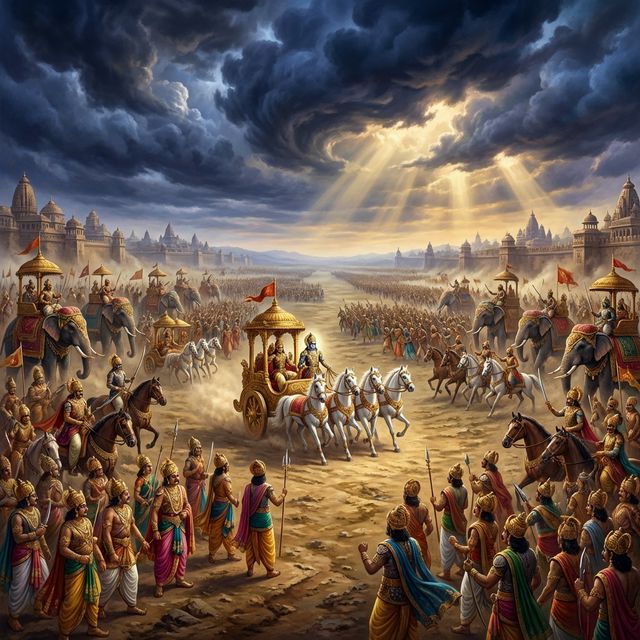
The Stones and the Golden King
Satyaki kills Sudarsana on the road to Arjuna, and cuts the mountaineers' stones out of the air
We Have But Slain the Dead
Sanjaya was still telling the fourteenth day, and the fourteenth day would not end.
Arjuna was far ahead somewhere in the dust, hunting the ruler of the Sindhus with the sun going down on his vow, and Yudhishthira, unable to bear not knowing, had sent Satyaki of the Vrishnis after him. One car. The whole Kaurava army in between.
He had gone through it. He had fought Drona at the gate of the array until the preceptor's steeds ran away with the car and traced a thousand circles on the field like a sun in motion, and Drona, seeing his array broken behind him, had let him go. He had gone past Kritavarma, the son of Hridika, and past the division of the Bhojas and the sea of Jalasandha's troops, and none of them had held him.
And having vanquished all of them, that bull among the Sinis laughed, and spoke to the man holding his reins.
"Our foes, O Suta, had already been consumed by Kesava and Phalguna. In vanquishing them again, we have only been the means. Already slain by that bull among men, the son of the celestial chief, we have but slain the dead."
It is worth stopping on that, because it is the only boast Satyaki made all afternoon that was not a boast. He had just beaten Drona. He said the men he was cutting through were corpses that Krishna and Arjuna had made before he arrived, and that his own hand was the instrument and nothing more.
Then he scattered his arrows on every side with great force and went forward like a hawk in search of prey.
The Kuru warriors attacked him from all sides and could not resist him. His steeds were white as the moon, white as a conch, and they carried him through ranks that closed and broke and closed again, and Sanjaya, who was watching for the king's sake and not for Satyaki's, said plainly that no one who fought on Dhritarashtra's side that day was able to stop him. He looked, said Sanjaya, like the autumnal sun standing in the sky.
The King in the Golden Mail
One man came out of that host to stand in front of him.
His name was Sudarsana. He was a king, and Sanjaya calls him the grandson of a prince, one of the many royal sons who had brought their fathers' levies to Duryodhana's side and whose names are heard once in the epic and never again. He was conversant with all modes of warfare. He was clad in a golden coat of mail. He was armed with bow and arrows and he was filled with rage, and he advanced against the rushing Satyaki and set himself to check his course.
Nobody else on that part of the field had tried it.
The encounter that followed was fierce in the extreme, and both armies stopped to applaud it. The Kauravas praised it and the Somakas praised it, which does not often happen in the same sentence, and the comparison the watchers reached for was the oldest one they had: Vritra and Vasava, the demon and the king of the gods, the fight at the beginning of the world.
Sudarsana was not overmatched at first. He tried to pierce that foremost of the Satwatas with hundreds of keen shafts before they could reach him, meeting the arrows in the air. Standing on his excellent car, he cut the shafts that Satyaki sped at him into two and three fragments as they came, and for a while the sky between the two chariots was full of broken arrows falling.
Then he saw that his own shafts were being baffled by the force of Satyaki's, and he changed his manner of fighting. As if to consume his enemy, he shot beautiful arrows winged with gold. Three of them, drawn to the ear, resembling fire itself, went through Satyaki's armour and into his body. Four more, blazing, took the four steeds of Satyaki that were white as silver.
He had drawn blood on a man who had just walked through Drona. For a moment, on that field, Sudarsana was winning.
The Head Graced With Earrings
Afflicted by those shafts, the grandson of Sini answered with everything he had.
He killed the steeds of Sudarsana with his keen shafts, and roared aloud. Then he took a broad-headed arrow endued with the force of Sakra's thunder and cut off the head of Sudarsana's driver, so that the king stood alone on a car with no horses and no one to turn it.
Then he took a razor-faced arrow resembling the fire that comes at the end of a Yuga, and cut the head from Sudarsana's trunk.
Sanjaya, telling this to the blind king in the hall at Hastinapura, does not hurry past the head. He describes it as it went. It was graced with earrings. It resembled the moon at full. The face on it was exceedingly radiant. This is how the epic marks a man who was nothing to the story until the moment he died in it: it makes you look at his face once, at the exact instant it is no longer attached to him.
And for the comparison Sanjaya went back to the same old war he had used a moment before. It was as the wielder of the thunder, in days of old, forcibly cut off the head of the mighty Vala in battle.
That high-souled bull among the Yadus, having slain that grandson of a prince, was filled with delight, and shone resplendent like the chief of the celestials himself.
Then he did not stay to be admired. He turned his car onto the track by which Arjuna had passed before him, which was easy to find because it was made of the dead, and he went along it checking the Kaurava troops with clouds of shafts as he went.
The warriors assembled there applauded the feat, even the ones he was killing. He consumed all foes that came within reach of his arrows, said Sanjaya, like a conflagration consuming everything in its way.
The Ocean Already Forded
Having slain Sudarsana, Satyaki spoke to his charioteer again, and what came out of him was a description of what he had just survived.
"Having forded through the almost unfordable ocean of Drona's division," he said, "teeming with cars and steeds and elephants, whose waves are constituted by arrows and darts, fishes by swords and scimitars and alligators by maces, which roars with the whiz of shafts and the clash of diverse weapons, an ocean that is fierce and destructive of life, whose touch is unpleasant and unbearable to warriors desirous of victory, and whose margin is infested with fierce cannibals represented by the force of Jalasandha, I think the portion of the array that remains may easily be forded like a poor stream of shallow water.
"Urge the steeds, therefore, without fear. I think I am very near to Savyasachin. Fear never comes to my heart even if I behold countless foes before me. These to me are like a heap of straw and grass to a blazing conflagration in the woods."
Then he told the man to look at the ground.
"Behold, the track by which the diadem-decked Arjuna has gone is rendered uneven with large bodies of foot-soldiers and steeds and car-warriors and elephants lying slain upon it. Behold, routed by that high-souled warrior, the Kaurava army is flying away. Behold, O charioteer, a dark brown dust is raised by those retreating cars and elephants and steeds."
He listened, and heard something under the dust.
"Hark. The well-known twang of Gandiva of immeasurable energy is being heard. From the character of the omens that appear to my view, I am sure that Arjuna will slay the ruler of the Sindhus before the sun sets."
That is the only prophecy Satyaki makes in the war, and he makes it out of a sound. Then he told the driver to spare the horses and go slowly, because ahead of them, waiting with their faces turned towards him, were Duryodhana and the Kambojas and the Yavanas and the Sakas and the Daradas and the Barbaras and the Tamraliptakas and countless other Mlecchas, armed with diverse weapons, inspired with the resolution of battling with him.
The Charioteer Who Was Not Afraid
Charioteers in this epic are rarely brave in their own right. This one answered like a warrior.
"O thou of Vrishni's race, fear I have none. If thou hadst before thee Jamadagni's son himself in wrath, or Drona, that foremost of car-warriors, or the ruler of the Madras, even then fear would not enter my heart, so long as I am under the shadow of thy protection. Countless Kambojas, clad in mail, of fierce deeds and difficult to defeat, have already been vanquished by thee, and many Yavanas, and Sakas and Daradas and Tamraliptakas, and many other Mlecchas armed with various weapons. Never before did I experience fear in any battle. Why shall I experience any fear in this miserable fray?
"By which way shall I take thee to where Dhananjaya is? With whom hast thou been angry, O thou of Vrishni's race? Who are they that will fly away from battle, beholding thee resembling the Destroyer himself at the end of the Yuga? Who are they of whom king Vaivaswata is thinking today?"
He was asking his master to name the men who would be dead by evening, and Satyaki named them.
"Like Vasava destroying the Danavas, I shall slay these warriors with shaved heads. By slaying these Kambojas I will fulfil my vow. Bear me thither. Today I shall show unto my preceptor, the high-souled Pandava of white steeds, the skill in weapons acquired by me from him."
That is the sentence to hold on to. Everything else he said in that speech was about Duryodhana, and he said a great deal: that Suyodhana would be inspired with grief, that Suyodhana would see the bow in his hands resemble a circle of fire, that Suyodhana would today behold two Arjunas on the field. But underneath the boasting was a pupil going to find his teacher, wanting to be seen doing well.
"Slaying thousands of kings today," he finished, "I will show my love and devotion to those high-souled ones, the royal sons of Pandu. The Kauravas will know today the measure of my might and energy, and my gratefulness."
Gratefulness. He was a Vrishni. He owed the Pandavas nothing but friendship, and he was paying it in the only currency he had.
The Shaved Heads
The charioteer urged those coursers of the hue of the moon to their utmost speed, and they went devouring the very skies, and carried Yuyudhana to the place where the Yavanas were.
The Yavanas were quick. They were many in number and endued with lightness of hands, and they came at him without retreating and covered him with showers of arrows. Satyaki cut all of it out of the air with his own straight shafts, and then began to work.
With shafts of great sharpness, winged with gold and vulture's feathers, he cut off their heads and their arms. Many of the arrows went through coats of mail made of iron and brass and buried themselves in the earth beyond. Drawing his bow to its fullest stretch, shooting in continuous lines, he began to kill five and six and seven and eight of them at a time. Thousands of Kambojas, and Sakas, and Barbaras went the same way.
Sanjaya, describing the field afterwards, does not make it beautiful. He says Satyaki made the earth impassable and miry with flesh and blood. He says the ground was strewn with the head-gears of those men and with their shaved heads, which because of their long beards looked like featherless birds.
Then, having said that, he reaches for one image that is beautiful, and it is the worst line in the passage: that the field covered with headless trunks dyed all over with blood looked lovely, like the sky covered with coppery clouds.
The small remnant of those mail-clad troops, cheerless, their lives on the point of being taken, urged their horses with goads and whips and fled in all directions.
And Satyaki, crowned with victory, having routed the invincible Kamboja host and the Yavanas and the great force of the Sakas, said one word to his driver.
"Proceed."
The Charanas and the Gandharvas in the sky above the battle applauded that feat, which no one else had ever achieved. Even the Kaurava warriors watching him, said Sanjaya, were filled with delight at his heroism, which is a strange thing to record about a man who was destroying their army, and Sanjaya records it anyway.
A Bull in a Cow-Pen
He came on towards Arjuna right through the middle of the host, and for a little while Sanjaya stops the fighting altogether to describe him, because the old man in Hastinapura could not see and had to be told.
His bow, the back of whose staff was decked with gold, was of great toughness and adorned with many golden moons, and he shook it with force as he came. His arms were decked with golden Angadas. His head-gear was adorned with gold. His body was clad in golden mail, and his standard and his bow were embellished with gold, so that he shone like the summit of Meru and looked like a second sun in autumn. He had the shoulders and the tread and the eyes of a bull, and he moved through that army, said Sanjaya, like a bull in a cow-pen.
Warriors came at him from desire of slaughter the way a tiger comes at the leader of an elephant-herd standing proudly in the middle of his herd with his temples running.
They came in numbers now. Duryodhana came, and Chitrasena and Dushasana and Vivinsati, and Shakuni and Duhsaha, and the youthful Durdharshana, and Kratha, and many other brave warriors difficult to defeat, and they followed him from behind as he went. The uproar among the troops was like that of the ocean at full tide lashed into fury by a tempest.
Satyaki looked back at all of it and smiled and told his driver to slow down.
"Proceed slowly. This Dhartarashtra force, swelling with rage and pride, teeming with elephants and steeds and cars and foot-soldiers, that is rushing towards me, filling the ten points of the compass with the deep roar of its cars and causing the earth and the welkin and the very seas to tremble, this sea of troops I will resist in great battle, like the continent resisting the ocean swelling to its utmost height at full moon. Behold, O charioteer, my prowess. I will consume this hostile force with my whetted arrows."
They came shouting as they came, "Slay, Rush, Wait, See, See!"
Of those brave warriors who said those words, Satyaki with his sharp arrows killed three hundred horsemen and four hundred elephants before they reached him.
The King's Car Taken Away
The passage at arms that followed was like the old war between the gods and the Asuras, and Sanjaya says one thing about it that he says about no other fight in the whole book.
Not an arrow of Satyaki's failed in effect.
That sea of troops, abounding in cars and elephants and steeds, with waves made of foot-soldiers, stood still as soon as it touched the Satyaki continent. The host wandered hither and thither, panic-stricken, slaughtered on all sides by shafts that he turned round and shot again, afflicted as if by the chilling blasts of winter. We saw not, said Sanjaya, a foot-soldier or a car-warrior or an elephant or a horseman or a steed that was not struck with Yuyudhana's arrows.
And then, to Dhritarashtra, who had asked all his life for one honest sentence about his sons' chances: not even Phalguna caused such a carnage there as Satyaki caused among those troops. That bull among men, with his great lightness of hand and his utmost skill, fights surpassing Arjuna himself.
The princes did what they could. Duryodhana pierced the charioteer of the Satwata with three keen shafts and his four steeds with four, and Satyaki himself with three and then with eight. Dushasana pierced him with sixteen. Shakuni with twenty-five. Chitrasena with five. Dushasana again with fifteen in the chest. Satyaki, struck by all of them, proudly pierced every one of them with three arrows each in return.
Then he cut off the bow of Suvala's son and the leathern fence that cased his hand, and put three shafts into the centre of Duryodhana's chest. A hundred arrows into Chitrasena. Ten into Duhsaha. Twenty into Dushasana. They came back at him and he took it, five arrows returned to each of them, careering on the field with the celerity of a hawk.
Duryodhana pierced Madhava with seventy-three arrows and his charioteer with three more.
And Satyaki answered by killing Duryodhana's charioteer with a single broad-headed shaft.
The man fell off the car deprived of life, and the horses, with nobody holding them, carried the king of the Kauravas out of the battle with the speed of the wind. Dhritarashtra's other sons, and the warriors with them, set their eyes on the king's car going away, and fled after it in hundreds.
The Blind King Asks
In the hall at Hastinapura the recital stopped, because Dhritarashtra could not hold his question any longer.
"Beholding the grandson of Sini proceeding towards Arjuna, grinding as he went that large force, what, indeed, O Sanjaya, did those shameless sons of mine do? How could Satyaki of world-wide renown pass through them in battle? How, when my sons were alive, could the grandson of Sini go to battle at all? This is exceedingly wonderful that I have heard from thee, this encounter between one and the many, the many being all mighty car-warriors.
"O Suta, I think Destiny is now unpropitious to my sons. My army is no match for even one warrior, Yuyudhana inflamed with wrath. Let all the Pandavas hang up these weapons. Having vanquished Drona himself, Satyaki will slay my sons like a lion slaying smaller animals. Numerous heroes, of whom Kritavarma is the first, could not slay him. Phalguna himself fought not in the manner in which the renowned grandson of Sini has fought."
Sanjaya did not comfort him.
"All this, O king, has been brought about by thy evil counsels and the acts of Duryodhana. Listen attentively to what I say."
At Duryodhana's command the Samsaptakas rallied and resolved on fighting fiercely. Three thousand bowmen headed by the king, with Sakas and Kambojas and Valhikas and Yavanas and Paradas, with Kalingas and Tanganas and Amvashtas and Pisachas and Barbaras and mountaineers, inflamed with rage and armed with stone, all rushed at the grandson of Sini like insects against a blazing fire. Five hundred more warriors rushed at him after them. Then another body: a thousand cars, a hundred great car-warriors, a thousand elephants, two thousand heroes, and countless foot-soldiers.
Dushasana urged them on, saying, "Slay him," and surrounded Satyaki with all of it.
Grand and wonderful was the conduct we then beheld of Sini's grandson, said Sanjaya, inasmuch as alone he fought fearlessly with those innumerable foes.
And he killed them. The car-warriors, the elephant force, the horsemen, all of it. Like the autumnal sky bespangled with stars, the field became strewn with broken car-wheels and shattered axles and crushed elephants and fallen standards, with coats of mail and shields scattered about, with garlands and ornaments and robes lying in the dirt among the tuskers, huge as hills, that lay there deprived of life.
The Men Who Fought With Stones
Dushasana shouted after his running men.
"Ye warriors unacquainted with morality, fight! Why do you retreat?"
They paid no heed. So he turned to the mountaineers, kshatriyas of the hills whose way of fighting was not the way of the plains, and told them something perfectly true.
"Ye are accomplished in battling with stones. Satyaki is ignorant of this mode of warfare. The Kauravas also are all unacquainted with this mode of battle. Rush ye at Satyaki. Do not fear. Satyaki will not be able to approach you."
Thus urged, those denizens of the mountain came towards Satyaki like ministers towards a king, and stood before his car with stones huge as elephants' heads uplifted in their hands.
Satyaki sent showers of keen shafts at them, and with those arrows that looked like snakes he cut the dense shower of stones to fragments in the air.
That was the flaw in Dushasana's plan. The fragments came down. Splinters of rock, looking like a swarm of blazing fire-flies, fell into the Kaurava ranks and killed many men there, and cries of oh and alas went up from the field.
Then five hundred warriors with huge stones lifted over their heads fell to the ground with their arms cut off. Then a full thousand more. Then, says Sanjaya, a hundred thousand, their arms with the stones still in their grasp shorn away before they could come near him.
Many went back and hurled stones again, and Daradas and Tanganas and Khasas and Lampakas and Pulindas threw swords and lances, and he cut those out of the air too. The noise of stones breaking overhead was so fierce that car-warriors and horses and elephants fled from it, and men struck by the flying chips felt as if bitten by wasps.
Far off, Drona heard a sound like the ocean at full tide and spoke to his own charioteer.
"That great car-warrior of the Satwata race is tearing our army into diverse fragments like the Destroyer himself. Take the car to that spot whence this furious uproar is coming. Without doubt, Yuyudhana is engaged with the mountaineers who battle with stones."
The charioteer answered like a man who had counted the odds honestly.
"The Kaurava troops are flying away, and the Panchalas and the Pandavas, united, are rushing from all sides from desire of slaughtering thee. Determine which of these tasks should first demand attention. As regards Satyaki, he is now far ahead of us."
While he was still speaking, Satyaki came suddenly into view, killing car-warriors. The troops broke and ran towards Drona's division, and the men Dushasana had brought ran with them, and the road to Arjuna was open.
Dharma Lesson
Satyaki was given a weapon he had no training against, and he did not try to answer it in kind. He answered it with the thing he was already good at, and the stones came apart over the heads of the men who threw them. Dushasana had reasoned correctly that his enemy was ignorant of that mode of war, and lost his troops anyway, because a plan built on the other man's ignorance is only as strong as his unwillingness to improvise. There is also the small thing Satyaki said before any of it began: that the foes he was cutting down had already been slain by Krishna and Arjuna, and that he was only the means. A man who can say that while winning is unlikely to be ruined by winning.