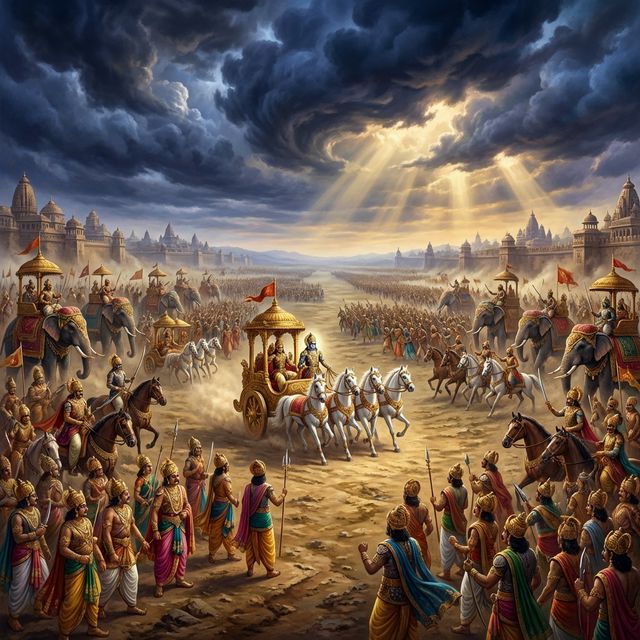
The Foundations of Righteousness
Bhishma is asked whether the eye or the scripture decides, and answers with three foundations and a long list of small rules
The Question After the Names
Vaisampayana said that when Krishna, the son of Devaki, had finished reciting the many names of Rudra, Yudhishthira turned back to the old man on the arrows and asked him a question about how a man is supposed to know anything at all.
"O thou of great intelligence," the king said, "O foremost of all persons conversant with duties, which, indeed, of the two, direct perception and the scriptures, is to be regarded as authority for arriving at a conclusion?"
"I think there is no doubt in this," Bhishma said. "Listen to me, O thou of great wisdom. I shall answer thee. The question thou hast asked is certainly proper." Then the line a man learns only near the end of a long life. "It is easy to cherish doubt. But the solution of that doubt is difficult."
Innumerable, he said, are the instances, in respect of both direct perception and audition, in which doubts may arise. So he began by describing the people who had got it wrong.
"Certain persons, who delight in the name of logicians, verily imagining themselves to be possessed of superior wisdom, affirm that direct perception is the only authority. They assert that nothing, however true, is existent which is not directly perceivable, or at least they doubt the existence of those objects."
His verdict was short. Such assertions involve an absurdity, and they who make them are of foolish understanding, whatever their pride of learning.
Then he took the king's real difficulty seriously. "If, on the other hand, thou doubtest as to how the one could be the cause," he said, meaning the indivisible Brahman that no eye has ever reported, "I answer that one would understand it only after a long course of years and with the assistance of Yoga practised without idleness."
Years, and the practice kept up without slackening, and a particular kind of man to keep it up: one that lives according to such means as present themselves, not wedded to this or that settled mode of life, and one that is devoted to the solution of the question. None else, truly, is competent for comprehending it.
"When one attains to the very end of reasons, one then attains to that excellent and all comprehending knowledge, that vast mass of effulgence which illumines all the universe."
The end of reasons. Not the abandonment of them at the start, but the place a man arrives at when he has followed them out to where they stop.
"That knowledge which is derived from inference can scarcely be said to be knowledge," Bhishma finished. "Such knowledge should be rejected. It is not defined or comprehended by the word. It should, therefore, be rejected."
Grass Over the Mouth of a Pit
Yudhishthira widened the question from two candidates to four.
"Tell me, O grandsire, which among these is most authoritative: direct perception, inference from observation, the science of Agama or the scriptures, and the diverse kinds of practices that distinguish the good."
That fourth one is the standard most people actually live by. Watch what decent men do, and do that. Bhishma answered by explaining why it fails, and his explanation is bleaker than anything the logicians had said.
"While Righteousness is sought to be destroyed by wicked persons possessed of great might," he said, "it is capable of being protected for the time being by those that are good exerting themselves with care and earnestness."
For the time being. He does not stop there.
"Such protection, however, avails not in the long run, for destruction does overtake Righteousness at the end."
Then the image. Righteousness often proves a mask for covering Unrighteousness, like grass and straw covering the mouth of a deep pit and concealing it from the view. A man walks across what looks like ground. The covering is real grass. The pit is also real, and it is under the grass, and the very greenness of the field is what hides it.
So the practices of the good are interfered with and destroyed by the wicked. Those persons who are of evil conduct, who discard the Srutis, those wicked wights who are haters of Righteousness, wreck the good course of conduct that could otherwise have been set up as a standard. Once enough people behave badly, behaviour stops being evidence.
"Hence," said Bhishma, "doubts attach to direct perception, inference, and good conduct."
Three of the four have now been struck down, and the king is left holding nothing. What Bhishma offers instead is not a fifth authority but a kind of person.
"Those among the good that are possessed of understanding born of the scriptures, and that are ever contented, are to be regarded as the foremost. Let those that are anxious and deprived of tranquillity of soul approach these. Indeed, O Yudhishthira, do thou pay court to them and seek of them the solutions of thy doubt."
Disregard pleasure and wealth, which always follow cupidity. Wake into the belief that only Righteousness should be sought. Then go and sit with such men, because their conduct never goes wrong or meets with destruction, nor do their sacrifices, nor their Vedic study, nor their rites.
"Indeed, these three, conduct as consisting of overt acts, behaviour in respect of purity of mind, and the Vedas, together constitute Righteousness."
One and Indivisible
The king's difficulty came back at once, and he said so with unusual frankness.
"O grandsire, my understanding is once more stupefied by doubt. I am on this side the ocean, employed in searching after the means of crossing it. I do not, however, behold the other shore of the ocean."
Then he stated the objection cleanly. If the Vedas, and acts that are seen, and mental purity together constitute what is to be regarded as authority, then there is a difference between them, and Righteousness becomes really of three kinds, although everyone says it is one.
"If thou thinkest, O king, that Righteousness should really be of three kinds," Bhishma said, "my reply is that thy conclusion is warranted by reason."
He conceded the logic and then set it aside. The truth is that Righteousness is one and indivisible, although it is capable of being viewed from three different points. The paths of those three that constitute its foundation have each been laid down. Act according to the instructions laid down.
"Thou shouldst never wrangle about Righteousness and then seek to have those doubts solved into which thou mayst arrive. O chief of the Bharatas, let no doubts like these ever take possession of thy mind. Do thou obey what I say without scruple of any kind. Follow me like a blind man, or like one who, without being possessed of sense himself, has to depend upon that of another."
It is a hard thing to say to a king, and the grandsire says it without softening. Then, having asked for obedience, he tells him what to obey, and it is four items long.
Abstention from injury. Truth. Absence of wrath, which is to say forgiveness. Liberality of gifts.
"These four, O king, that hast no foe, do thou practise, for these four constitute eternal Righteousness."
To these he added one more, and it is the one he always adds. Pursue that conduct towards the Brahmanas which is consistent with what has been observed towards them by thy sires and grandsires. Reverence them, treat them with hospitality, serve them always. The universe rests on them.
"That man of little intelligence who would destroy the weight of authority," Bhishma said, "by denying that to be a standard which has always been accepted as such, would himself fail to become an authority among men. Such a man becomes the cause of much grief in the world."
Two Ends
"Tell me, O grandsire," Yudhishthira said, "what the respective ends are of those that hate Righteousness and of those that adore and observe it."
Bhishma answered in two paragraphs, and the shorter one is about hell.
"Those men that hate Righteousness are said to have their hearts overwhelmed by the attributes of passion and darkness. Such men have always to go to Hell."
That is the whole of it. He does not describe the place, and he does not enumerate the torments, and he does not linger. Rajas and tamas, passion and darkness, a heart with those two settled over it like weather, and a road that goes one way.
The other end takes longer to say because there is more in it.
"Those men, on the other hand, O monarch, who always adore and observe Righteousness, those men who are devoted to truth and sincerity, are called good. They always enjoy the pleasures of heaven."
Then he named the habit that produces such men, and it is not an inward one. In consequence of their waiting upon their preceptors with reverence, their hearts always turn towards Righteousness. The turning of the heart comes second. Sitting at the feet of the old comes first.
Those who adore Righteousness attain to the regions of the deities. And those individuals, whether human beings or deities, who divest themselves of cupidity and malice, and who emaciate or afflict their bodies by the observance of austerities, succeed, in consequence of the Righteousness which then becomes theirs, in attaining to great felicity.
He ended with an image about appetite, which is a strange way to end a passage about heaven, and is the reason the passage is remembered.
"Those that are gifted with wisdom have said that the Brahmanas, who are the eldest sons of Brahma, represent Righteousness. They that are righteous always worship them, their hearts regarding them with as much love and affection as a hungry man's stomach entertains for ripe and delicious fruits."
Not as a debtor regards his creditor. As a hungry man regards fruit. The righteous man in Bhishma's account is not performing an obligation when he honours the good. He is eating.
How to Tell Them Apart
"What is the appearance presented by those that are wicked," the king asked, "and what are those acts which they that are called good are to do? Indeed, tell me what the indications are of the good and the wicked."
The wicked are disposed of in one line. They are evil in their practices, ungovernable, incapable of being kept within the restraints of rules, and foul mouthed. The good are known by their acts, and Bhishma then does something a modern reader does not expect from a dying man discussing the foundations of dharma. He gives the household rules.
They never answer the two calls of nature on the public road, or in the midst of a cow-pen, or on a field of paddy. After feeding the five, they take their own food. They never talk while eating. They never go to sleep with wet hands, but rub them dry first.
Whenever they see any of the following they walk round it to show it reverence: a blazing fire, a bull, the image of a deity, a cow-pen, a place where four roads meet, and an old and virtuous Brahmana.
They give the way, themselves standing aside, unto those that are old, those that are afflicted with burdens, ladies, those that hold high appointments in the village or town administration, Brahmanas, kine, and kings. Six kinds of person, one kind of animal, and the rule is the same for the king and for the cow: you step off the path.
The righteous man is he that protects his guests, his servants and other dependents, his own relatives, and all those that seek his protection, and he always welcomes these with the usual enquiries of politeness.
Two times have been appointed by the deities for human beings to take their food, morning and evening. During the interval one should not eat anything, and by following this rule about eating one is said to observe a fast. As the sacred fire waits for libations to be poured upon it when the hour for Homa arrives, even so a woman, when her functional period is over, expects an act of congress with her husband; and one that never approaches his spouse at any other time is said to observe the vow of Brahmacharya.
"Amrita, Brahmanas, and kine," Bhishma said, "these three are regarded as equal."
Nectar, priests, cattle. Hence one should always worship, with due rites, the Brahmanas and the cows.
The Word Twam
He went on down the list, and it grew more interior as it went.
One incurs no fault by eating the meat of animals slain in sacrifices with the aid of Tantras from the Yajur Veda. The flesh of the back-bone, and the flesh of animals not slain in sacrifice, should be avoided as one avoids the flesh of one's own son. One should never cause a guest to go without food, at home or in a foreign land.
After completing one's study, one should present the Dakshina to one's preceptor. On seeing him, one should congratulate him with reverence and, worshipping him, present him a seat. By worshipping one's preceptor a man increases the period of his life, his fame and his prosperity.
One should never censure the old, nor send them on any business, nor remain seated when any one that is old is standing. By acting in this way, Bhishma said, one protects the duration of one's own life.
One should never cast one's eyes on a naked woman, nor on a naked man, never indulge in sexual congress except in privacy, and eat also without being seen by others.
Then four short verdicts, side by side. Preceptors are the foremost of Tirthas. The heart is the foremost of all sacred objects. Knowledge is the foremost of all objects of search. Contentment is the foremost of all happiness.
Morning and evening one should listen to the grave counsels of those that are aged, for one attains to wisdom by constant waiting upon those venerable for years. While reading the Vedas, or while eating, one should use the right hand. One should keep speech, mind and senses under thorough control. With well cooked frumenty, Yavaka, Krisara and clarified butter one should worship the Pitris and the deities in the Sraddha called Ashtaka, and the same in worshipping the planets.
One should not undergo a shave without calling down a blessing upon oneself. If one sneezes, one should be blessed by those present. All that are ill or afflicted with disease should be blessed, and the extension of their lives should be prayed for.
And then, out of that catalogue of small courtesies, one rule that is stated with the violence of a law.
"One should never address an eminent person familiarly, by using the word Twam. Under even the great difficulties one should never do this. To address such a person as Twam and to slay him are equal."
Thou. The word used to a servant, an equal, or a pupil. Say it to a man above you, and persons of learning are degraded by it, and the grandsire ranks the offence with murder.
Salt in Water
The last part of the teaching is about the man who has already done wrong, and it begins with the observation that he is never as hidden as he thinks.
"The heart of the sinful man always proclaims the sins he has committed," Bhishma said. "Those men who have deliberately committed sins meet with destruction by seeking to conceal them from the good."
That is the trap. The confirmed sinner conceals, and thinks his acts are witnessed by neither men nor deities, and the concealment is itself the ruin. His sins grow while he sits on them, even as the interest a usurer charges increases from day to day, and he takes birth at last in a miserable order of being.
The remedy is put in one image that everybody has seen.
"If a quantity of water be poured upon salt, the latter immediately dissolves away. Even so, when expiation is performed, sin dissolves away."
Hence one should never conceal a sin, for concealed it is certain to increase. Having committed a sin, one should confess it in the presence of those that are good. They would destroy it immediately.
And if one does not enjoy in good time what one has stored up with hope, the consequence is that the stored wealth finds another owner after the death of the man who stored it.
Then the sentence that stands behind the entire discourse on authority. The wise have said that the mind of every creature is the true test of Righteousness. Hence all creatures in the world have an innate tendency to achieve it.
"One should achieve Righteousness alone, or single-handed," the old man said. "Verily, one should not proclaim oneself righteous and walk with the standard of Righteousness borne aloft for purpose of exhibition. They are said to be traders in Righteousness who practise it for enjoying the fruits it brings about."
Adore the deities without giving way to pride. Serve your preceptor without deceit. Make arrangements for securing to yourself that invaluable wealth in the hereafter which consists in gifts made here to deserving persons.
Unless Seeds Be Sown
Yudhishthira had one more difficulty, and it was not a scholar's. It was the complaint of a man who had watched the wrong people prosper.
"It is seen that if a person happens to be unfortunate, he fails to acquire wealth, however great his strength. If one happens to be fortunate, he comes to the possession of wealth even if he be a weakling or a fool."
He piled up the evidence. Hundreds of men achieve no result even when they exert their best, and many make acquisitions without any exertion at all. Men do evil acts continually for wealth and fail to get it; others enjoy wealth without doing any evil act whatever; others still, who keep every duty the scriptures assign them, have nothing.
He pressed it hardest on learning, the thing he had been taught to trust.
"One may be seen without any knowledge of the science of morals and policy even after he has studied all the treatises on it. One, again, may be seen appointed prime minister of a king without having studied it at all. If, by the acquisition of learning, one could acquire the happiness of wealth, then no man of learning could be found living, for the very means of his subsistence, under the protection of one destitute of learning."
And then the line that shows what the war had put into him.
"If one's time has not come, one does not die even if one be pierced with hundreds of shafts. On the other hand, one lays down one's life, if one's hour has come, even if it be a blade of grass with which one is struck."
He said it to a man lying on hundreds of shafts who had not yet died.
Bhishma did not argue with it. He answered with a farmer's sentence.
"If one, setting oneself to undertakings involving even great exertions, fails to earn wealth, one should then practise severe austerities. Unless seeds be sown, no crops appear."
It is by making gifts in this life that one acquires objects of enjoyment in the next, even as one becomes wise by waiting upon those venerable for years. The wise have said that one becomes possessed of longevity by abstention from cruelty to all creatures. Hence one should make gifts and not solicit them, and worship those individuals that are righteous, and be sweet-speeched towards all, and always do what is agreeable to others, and seek purity both mental and external, and always abstain from doing injury to any creature.
"When, in the matter of the happiness and woe of even insects and ants, their acts and Nature constitute the cause, it is meet, O Yudhishthira, that thou shouldst be tranquil."
Dharma Lesson
Bhishma takes away three of the four things a man ordinarily leans on. The eye can be argued with, inference is not knowledge, and the conduct of respectable people stops being evidence once enough of them have gone bad. What is left is not a proof but a practice, and the practice turns out to be made of very small things: standing aside on the road, drying your hands, not saying thou to a man older than you. The four that he calls eternal righteousness cost nothing and are available every hour, and the test of them is that they are done alone, with no standard carried aloft, by a man who is not trading.