The Rawest Question
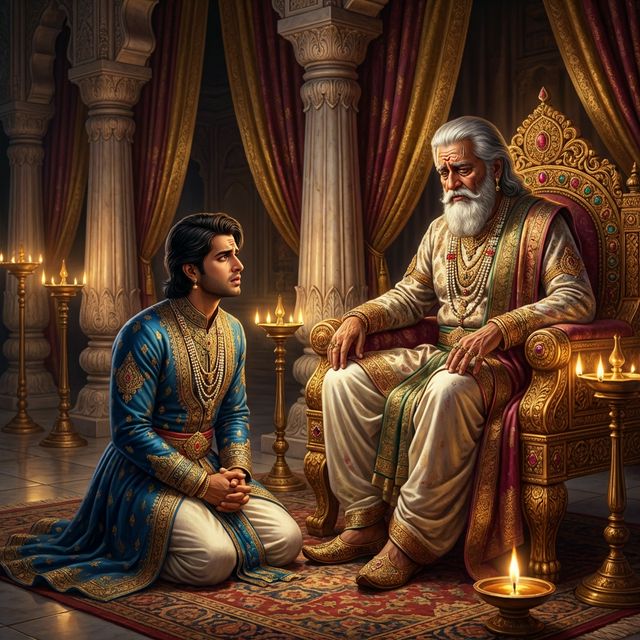
There was a question Yudhishthira had carried since before the war began and had never once asked aloud, because he feared what answer would come, and what he would owe to that answer once he had heard it. He asked it now, on a still afternoon with the grandfather's breathing gone shallow and slow, because there might not be many afternoons left in which to ask it.
'Grandfather, I must know something, and I ask you because you will not spare me a comfortable lie. Was the war fated? Was Kurukshetra written before any of us were born - before Duryodhana refused me the five villages, before the dice were thrown, before Draupadi was dragged into that hall? If the gods had already decided eighteen days of slaughter before I was old enough to choose anything, then what were my choices worth? What was any of it worth - my patience, my restraint, my thirteen years in exile bearing what I bore rather than break my word? Was I only walking a road someone else had already paved, congratulating myself on my own footsteps?'
The words came out of him faster than he meant them to, and harder, a king's grief wearing the shape of a philosopher's question because it could not bear to wear its own shape any longer. Bhishma did not answer at once. He let the silence hold, the way he had once let a silence hold before answering harder questions on other fields, and when he spoke his voice had gathered itself, as if for a teaching he had waited a long time to give to someone who was finally ready to need it.
'That is the oldest question there is, Yudhishthira, older than either of us, older than this war, older by far than this dynasty. The sages asked it of the Creator himself, once, at the beginning of things, and I will give you his answer rather than mine, because his answer has outlasted every king who has doubted it since.'
Brahma and Vasishtha
'In the first age, when the worlds were still new and men were still learning what a man was for, the sage Vasishtha went before Brahma the Creator with a question that had no comfortable side to fall on. Great Father, he asked, tell me plainly: of destiny and of human effort, which is the stronger? Which should a man trust when the two seem to point different ways? I have watched the wise plan carefully and fail, and I have watched fools stumble into fortune they did nothing to earn, and I no longer know which force rules the world, or whether I should teach my students to labor or to wait.
'Brahma did not answer with a riddle, though a lesser teacher might have. He answered with a picture, because some truths will not survive being turned into an argument - they must be shown, the way you show a child fire by letting him feel its warmth from a safe distance rather than describing heat to him.
'Consider a seed, Brahma said, and consider a field. Destiny is the seed. It is what arrives, unchosen, unearned, out of a darkness that was gathering long before you existed - your birth, your body, the age you were born into, the family whose debts and blessings you inherited without being asked. You did not choose your seed. No one chooses their seed.
'But a seed is not a harvest, Brahma said, and this is where men go wrong, thinking destiny alone decides anything. Effort is the field. It is what a man does with what arrived unchosen - whether he clears the ground, whether he waters what is planted, whether he stands guard against what would trample it before it grows. The finest seed cast on bare stone yields nothing at all, however noble the seed. And the finest field, ploughed and watered and perfect, lying empty of any seed, yields nothing either, however hard the farmer worked. Neither is sovereign alone. Both are needed, or neither bears fruit.'
A Chariot Without a Driver
Bhishma paused to let that settle, watching Yudhishthira's face the way a teacher watches to see whether a lesson has landed or only echoed.
'Brahma did not stop with the seed and the field, because Vasishtha, being a good student, pressed further. Then which comes first, Great Father, he asked - must a man wait for destiny before he acts, the way a farmer waits for the seed to arrive before he ploughs?
'And Brahma said: no. Never wait. Fate without effort is a chariot without a driver - the finest chariot ever built, harnessed to the swiftest horses in creation, and it will still sit exactly where it was left, because a chariot does not drive itself no matter how excellent its making. The horses will grow old in the traces. The gold will dull under dust. All that magnificent readiness will come to nothing for the single missing thing, which is a hand on the reins.
'Look even at the gods, Brahma said, and Vasishtha fell silent, not expecting the argument turned against heaven itself. The gods themselves did not simply arrive at their divinity and sit within it. They performed austerities. They fought the asuras across ages, and lost as often as they won before they won for good. They built their power through actions taken, not through destiny alone accepted. If effort were beneath the gods, the gods would not have needed to act at all - and yet the stories are full of nothing but their acting.
'Think of the rains and the plough, Brahma said at the last, since you are a man who understands land. The rain is fate. It comes when it comes, on no farmer's schedule, generous some years and cruel in others, and no amount of virtue makes it fall on command. But the ploughing is man's, entirely man's, owed to no one's mercy but his own back. The wise farmer does not sit watching the sky and refusing to plough until he is certain of rain. He ploughs as though the rain depends on nothing but the sky, and waters as though the harvest depends on nothing but his own hands. That is the whole of the teaching. Do not choose between the two forces. Serve both, and let them settle between themselves which one the harvest belonged to.'
Yesterday's Choice, Arriving With Interest
Yudhishthira sat with this for a long moment, turning it the way he had turned every teaching Bhishma had given him since the bed of arrows became a kind of second throne room. 'But grandfather, then what is destiny, if not some fixed thing laid down before we are born? You have made it sound almost changeable, almost made from the same substance as effort.'
'You have found the subtlest part of the teaching yourself, and most men never find it,' Bhishma said, something like approval moving under the pain in his voice. 'Here is the truth beneath the truth. What you call fate is very often nothing but yesterday's effort, grown up and arrived at your door demanding to be recognized as a stranger. A man plants a tree in his youth through long labor, and in his old age he sits in its shade and calls the shade his fortune, forgetting the digging that made it possible. A kingdom is lost through years of a king's small cowardices, and the heir who inherits the ruin calls it destiny, when it was only his father's choices, matured and delivered. Effort does not vanish once it is spent. It converts. It becomes the fate that a later day, or a later man, or a later generation inherits and cannot trace back to its root.
'This is why both errors are equally foolish, and I want you to hear that they are equal, not that one is worse than the other. The fatalist, who says nothing I do matters because all is written, will not plough, and starves nobly while blaming heaven for the empty field he himself left empty. But the arrogant man, who says nothing is written and my will alone commands the world, forgets that he did not choose his birth, his gifts, his enemies, or the hour of his death, and he will be broken by the first storm he cannot plough around. Wisdom sits between them, uncomfortable, unglamorous - act with your whole strength, and accept with your whole heart what your strength could not change, and do not waste breath deciding in advance which category tomorrow's harvest will belong to.'
Rule as a Farmer Rules a Field
'Apply it, then, to the thing you actually came to ask about,' Bhishma said, seeing that the young king still held the war itself unresolved beneath the philosophy. 'Was Kurukshetra fated? Here is the honest answer, and it will not comfort you the way a simple yes or a simple no would have, because the honest answer is never as comfortable as a lie. The dice were fate on the day Shakuni loaded them and the day your brothers' hands, generations back, bred a cousin capable of such a thing into your family's fate before either of you were born - none of you chose the world you were dropped into, the tempers you inherited, the enmity that predated your birth. That much was seed.
'But the dice became your field the moment you sat down at that board of your own free choosing. No one dragged you to that hall by the hair. You could have refused Shakuni's challenge - a king may decline a game, whatever the etiquette says, if the game reeks as that one did. You chose to sit, chose to keep playing after the first losses, chose it long past the point a wiser man would have stood and walked away regardless of what custom demanded. That was not fate arriving. That was effort, badly spent, and it grew into the fate your brothers and your wife and half of Bharata's warriors have since had to inherit and could not trace back to its root. The seed was old. The field was yours.
'So do not ask whether the war was written, Yudhishthira, as though the answer would relieve you of anything. Ask instead what kind of farmer you mean to be now, holding a field larger than any you have held before. Rule as a farmer rules land he did not choose the weather for - plough what is yours to plough, water what is yours to water, and when the rain comes or fails to come, meet either outcome without either despair or false credit. That is the whole of kingship, in the end. Not the mastery of fate. The faithful working of the field fate gave you.'
Dharma Lesson
Destiny is the seed and effort is the field; neither bears fruit without the other, and fate without effort is a chariot without a driver. What men call destiny is very often yesterday's effort, matured and arriving to be inherited. Act with your whole strength, and accept with your whole heart what your strength could not change.