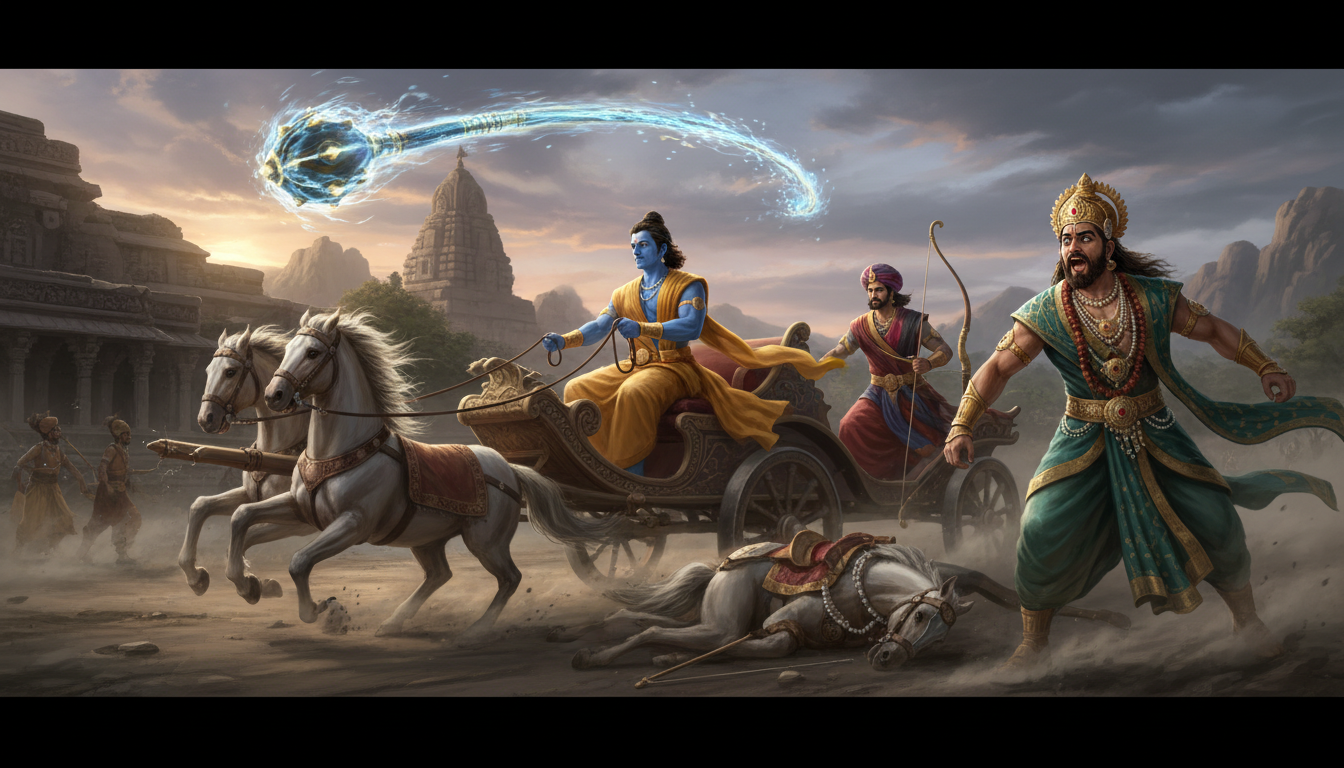
The Mace That Turned Back
Varuna's gift to a river's son, and the one rule he forgot
Held in Check by Them
He had gone round his teacher rather than through him, and now his teacher was behind him and shooting.
Drona had let Arjuna past the mouth of the array and then turned his red horses and followed, and the son of Pandu went on into the body of the host with the preceptor's arrows arriving over his shoulder, blasting the army in front of him the way a disease scorches a body, scattering his sharp shafts like the sun scattering its countless rays.
Steeds were pierced. Cars with the riders still in them were broken and mangled. Elephants went over. Umbrellas were cut off and displaced and vehicles ran on without wheels, and the men who could still move fled on all sides, exceedingly afflicted with arrows. Nothing could be distinguished. With his straight shafts Arjuna made that hostile army tremble and did not stop making it tremble.
And then, firmly devoted to truth and wanting his vow accomplished, he turned back and rushed at Drona of the red steeds anyway.
Drona struck his disciple with twenty-five straight shafts capable of reaching the vitals. Arjuna invoked the Brahma weapon and cut every one of them out of the air. What we beheld then, said Sanjaya, was exceedingly wonderful, since Arjuna, though young and struggling vigorously, could not pierce Drona with a single shaft. The Drona cloud rained on the Partha mountain and the mountain stood there and took it.
Twenty-five arrows more into Arjuna. Seventy into Vasudeva's chest and arms, and Vasudeva holding the reins through it without a word.
Arjuna smiled, resisted, and gave it up a second time. He turned the white horses aside from that invincible warrior who resembled the raging fire at the end of the yuga and stood as immovable as the Mainaka mountain, and took his car in among the Bhojas instead, between Kritavarma and Sudakshina the ruler of the Kamvojas.
The sun was going down the whole time this was happening. That was the arithmetic of the afternoon, and every man on that plain was doing it.
Do Not Show Him Any Mercy
Kritavarma, that tiger among men, pierced him coolly with ten arrows winged with kanka feathers before Arjuna had properly arrived.
Arjuna gave him a hundred back, and three more that stupefied him, and the hero of the Satwata race laughed and put twenty-five into Partha and twenty-five into Vasudeva. Arjuna cut his bow off and pierced him with twenty-one arrows resembling blazing flames of fire or angry snakes of virulent poison. Kritavarma took up another bow and put five into Arjuna's chest, and then five more.
And Krishna, at the reins, watching the light go and the ruler of the Sindhus stay six divisions away, said the thing he had been reduced to saying.
"Do not show any mercy to Kritavarman. Disregarding your relationship with him, crush him and slay him."
They were cousins. Kritavarma was a Vrishni, of Krishna's own city and Krishna's own blood, and he had brought an army to the wrong side and stood in the road, and there was no longer any time in the day for the courtesies.
Arjuna stupefied him with arrows and went on toward the Kamboja division, and left him alive.
Sanjaya was precise about that afterwards, since it mattered. That scorcher of foes, he said, did not slay Kritavarman, although he had got him within reach.
Kritavarma, filled with wrath at being passed over, took up his bow and turned on Yudhamanyu and Uttamaujas, the two Panchala princes who had followed Arjuna every day since the vow to guard his wheels. He struck Yudhamanyu with three shafts and Uttamaujas with four. They cut down his standard and his bow between them; he took another and disarmed them both. They strung two more bows and came at him again.
And while that was going on, Arjuna went forward into the army, and the two men whose whole duty was to be behind him could not get through, and he was alone.
The King Who Blocked the Road
Srutayudha saw Arjuna coming on alone and was filled with wrath, and shook his large bow, and rushed at him to stop the whole thing there.
He was a king with a good name and an ordinary place in that army, one of the many who had come because a summons had gone out and a kshatriya answers it. Nothing in the way he came out of the line suggested that anything unusual was about to happen.
He pierced Partha with three arrows and Janardana with seventy, and then, with a very sharp arrow that had a razor for a head, he struck the standard of Partha, which is to say he shot at the ape.
Arjuna, filled with wrath, pierced him deeply with ninety straight shafts, the way a rider strikes a mighty elephant with the hook.
Srutayudha could not brook that act of prowess on the part of Pandu's son. He pierced Arjuna in return with seventy-seven shafts, which was not a nominal answer and was noticed by both armies.
So Arjuna cut off his bow. Then his quiver. Then, angrily, he struck him on the chest with seven straight shafts.
That is the sequence a bowman uses on a man he intends to finish quickly and does not intend to insult: the bow first, so there is no answer; the quiver next, so there is no second bow worth taking up; then the body.
And the king, deprived of his senses by wrath, took up another bow and struck the son of Vasava with nine arrows on the arms and the chest.
That was the last time anyone was going to strike Arjuna that afternoon and be answered slowly.
Arjuna laughed, said Sanjaya, and afflicted Srutayudha with many thousands of arrows. He killed the horses. He killed the charioteer. He pierced the man himself with seventy more.
And Srutayudha, valiant, standing on a car that had nothing left to pull it, jumped down onto the ground with his mace uplifted and came at the son of Pandu on foot.
He was not being reckless. He was going for the one thing he owned that had never failed, and to understand what happened next you have to go back a long way, to a river.
A River Asks a God
Srutayudha was the son of Varuna, lord of the waters, and his mother was a river.
Parnasa was her name, a mighty river of cool water, and she had a son by the god and then did what mothers in that part of the story always do. She went to the father and asked him for something.
"Let this my son become unslayable on earth."
She asked, the text says carefully, for the sake of her son. Not for glory for him, not for a kingdom, not for a name. She had looked at the world her child had been born into and asked that he not be able to be killed in it, which is the oldest request there is.
And Varuna, gratified with her, gave her most of what she wanted and told her the truth about the rest.
"I give him a boon highly beneficial to him: a celestial weapon, by virtue of which this your son will become unslayable on earth by his foes.
"No man can have immortality. O foremost of rivers, every one who has taken birth must inevitably die. This child, however, will always be invincible by foes in battle, through the power of this weapon. Therefore let the fever of your heart be dispelled."
It is worth stopping on the exactness of it. He did not say your son will not die. He said no one can be given that, not by me, not by anybody; and then he gave what could be given, which was not a quality in the boy but an object in his hand.
Having said those words, Varuna gave him a mace, with mantras.
And obtaining that mace, Srutayudha became invincible on earth, and grew up, and took a kingdom, and reached an age at which men lead divisions in other people's wars, and carried it with him everywhere for the whole of his life, and it worked.
He would have known where it came from. A man whose mother is a river and whose father is the lord of the waters knows what he is holding, and he would have been told the terms of it early, the way children of that kind are told, at the age when a boy is first allowed to lift the thing with both hands.
The One Rule Attached to It
There was a condition. There is always a condition, and the lord of the waters stated his once, plainly, and did not repeat it.
"This mace should not be hurled at one who is not engaged in fight. If hurled at such a person, it will come back and fall upon yourself. O illustrious child, if so hurled, it will course in the opposite direction and slay the person who hurled it."
It is a strange gift when you look at it squarely. The god of the waters, who is also the god of the oath and the binding word, of the noose that catches the man who has broken his promise, gave his son a weapon that was itself an oath. Use it against a man with a weapon in his hands and you cannot be beaten. Use it against a man who cannot answer and it turns in the air and comes home.
He was not being cruel. He was describing what the thing was. A weapon that punished its holder for cowardice was, in fact, the only kind of unslayability a father could honestly hand to a son, since the other kind does not exist.
Srutayudha lived his whole life under that rule and never broke it once, in any battle, anywhere, until the fourteenth afternoon at Kurukshetra, with his bow cut and his quiver cut and his horses dead and his charioteer dead and the diadem-decked son of Kunti standing over the wreck of his car.
It would seem, said Sanjaya, that when his hour came, Srutayudha disobeyed that injunction.
That is the whole of the explanation the epic offers, and it is not really an explanation. It is a description of what a man does in the last thirty seconds of his life when the one advantage he has ever had is finally not enough.
He Chose the Man at the Reins
He came off the ruined car with the hero-slaying mace up over his shoulder, and in front of him were two men in one chariot.
One of them was Arjuna, who had a bow in his hands, and had been shooting for an hour, and was as thoroughly engaged in fight as any man on that field.
The other was holding four white horses on a rein and had not touched a weapon since the first day of the war, and had told two armies at the outset that he would not.
Srutayudha chose the second one.
With that hero-slaying mace he attacked Janardana.
He would have had reasons, if there had been time to ask him for reasons. Kill the driver and the car stops. Kill the driver and the greatest bowman alive is a man standing in a box behind four bolting horses. Every soldier on that plain had been thinking about Krishna's shoulders all afternoon, because everything Arjuna did that day went through them.
And the mace was a good mace. Mantra-charged, given by a god, in the hand of a strong man at close range.
There was also the fact that everybody on that field knew Krishna would not strike back. He had said it before the first day, in front of both armies, that he would carry no weapon in this war and would drive and counsel and nothing else, and he had kept it. A man looking for the safe target in that chariot could look at the two of them and see only one who had promised not to answer.
Which is exactly the thing the lord of the waters had legislated against, a lifetime earlier, in a sentence nobody present had heard.
The valiant Krishna received it on one of his well-formed and stout shoulders.
It failed to shake Sauri, said Sanjaya, the way the wind fails to shake the Vindhya mountain.
He did not fall. He did not let go of the reins. He did not so much as look round at the man who had thrown it. And what he did next was nothing at all, because there was nothing left for him to do.
It Came Back
The mace came off the shoulder of the man who was not fighting, turned in the air, and went back the way it had come.
It struck that brave and wrathful king standing on his car, and Sanjaya, describing it to a blind man, reached for the only comparison that fits: like an ill-accomplished act of sorcery injuring the performer himself.
It slew him, and fell down on the earth.
There was a sound from the troops at that, cries of alas and oh, from both sides at once, at the sight of Srutayudha the chastiser of foes killed by a weapon of his own.
And because, said Sanjaya, he had hurled that mace at Janardana who was not engaged in fighting, it slew the man who had hurled it, and Srutayudha perished on the field in exactly the manner that Varuna had indicated to his mother before he was old enough to hold anything.
Deprived of life, he fell down on the earth in front of the eyes of all the bowmen there. While falling he shone resplendent, that dear son of Parnasa, like a tall banian with spreading boughs broken by the wind.
Then all the troops fled, and even the principal warriors among them fled, beholding him slain.
It is worth being clear about what they had just watched, because they had not watched a miracle. Krishna performed nothing. He lifted no hand, spoke no mantra, did not call the discus, did not so much as turn his head. The whole of what happened was a condition attached to a gift a long time ago by a god who kept his word, meeting a man who had just broken his.
The boon had held for a lifetime. The rule inside it held for exactly as long.
The Prince of the Kamvojas
The road was open for about as long as it takes to say so.
Sudakshina, the son of the ruler of the Kamvojas, came out on swift horses against Phalguna the slayer of foes, and Partha sped seven shafts at him which passed clean through his body and entered the earth behind him. Deeply pierced by shafts sped from Gandiva, Sudakshina pierced Arjuna in return with ten winged with kanka feathers, and Vasudeva with three, and Arjuna again with five.
Arjuna cut off his bow and lopped off his standard and put a pair of broad-headed arrows of great sharpness into him. Sudakshina, still on his feet, pierced Partha with three more and uttered a leonine shout, and then, filled with wrath, hurled at the wielder of Gandiva a terrible dart made wholly of iron and decked with bells.
It came blazing like a large meteor and emitting sparks of fire, and it pierced that mighty car-warrior through and fell down on the earth. Deeply struck by that dart and overcome with a swoon, Arjuna stood in his car and for a moment was not in the battle at all.
He recovered soon enough. That hero of mighty energy, that son of Pandu of inconceivable feats, licked the corners of his mouth and pierced his foe together with his steeds and standard and bow and charioteer with fourteen shafts winged with kanka feathers. With other arrows, countless in number, he cut the car into fragments. Then he put one sharp arrow into Sudakshina's chest.
The brave prince of the Kamvojas, his coat of mail cut off, his limbs weakened, his diadem and his Angadas displaced, fell head downwards like a pole of Indra hurled from an engine.
He was handsome, with eyes of a coppery hue and a garland of gold on his head and the effulgence of fire about him, and he lay on the bare ground although he deserved the costliest bed, and looked, said Sanjaya, like a beautiful karnikara tree of the spring, grown gracefully on a mountain summit with beautiful branches, lying on the earth uprooted by the wind.
Then all the troops of Dhritarashtra's son fled away, beholding Srutayudha and Sudakshina both slain, and Arjuna took the white horses forward through the gap they left, with the sun already leaning over toward the west and the man in the blue turban still four divisions away.
Two kings had come out of that line in the space of an hour and both of them were on the ground. One of them had been given, before he was born, the nearest thing to safety that a god was willing to promise, and had spent it in the last minute of his life on a man who could not hit back.
Dharma Lesson
A boon is only as strong as the condition attached to it, and a weapon aimed at someone who cannot answer comes home to the hand that sent it. Varuna told a mother plainly that no one born can be given immortality, and gave instead a rule; the rule held for a lifetime and was broken once. Krishna lifts no hand here. The man is killed by his own choice of target.