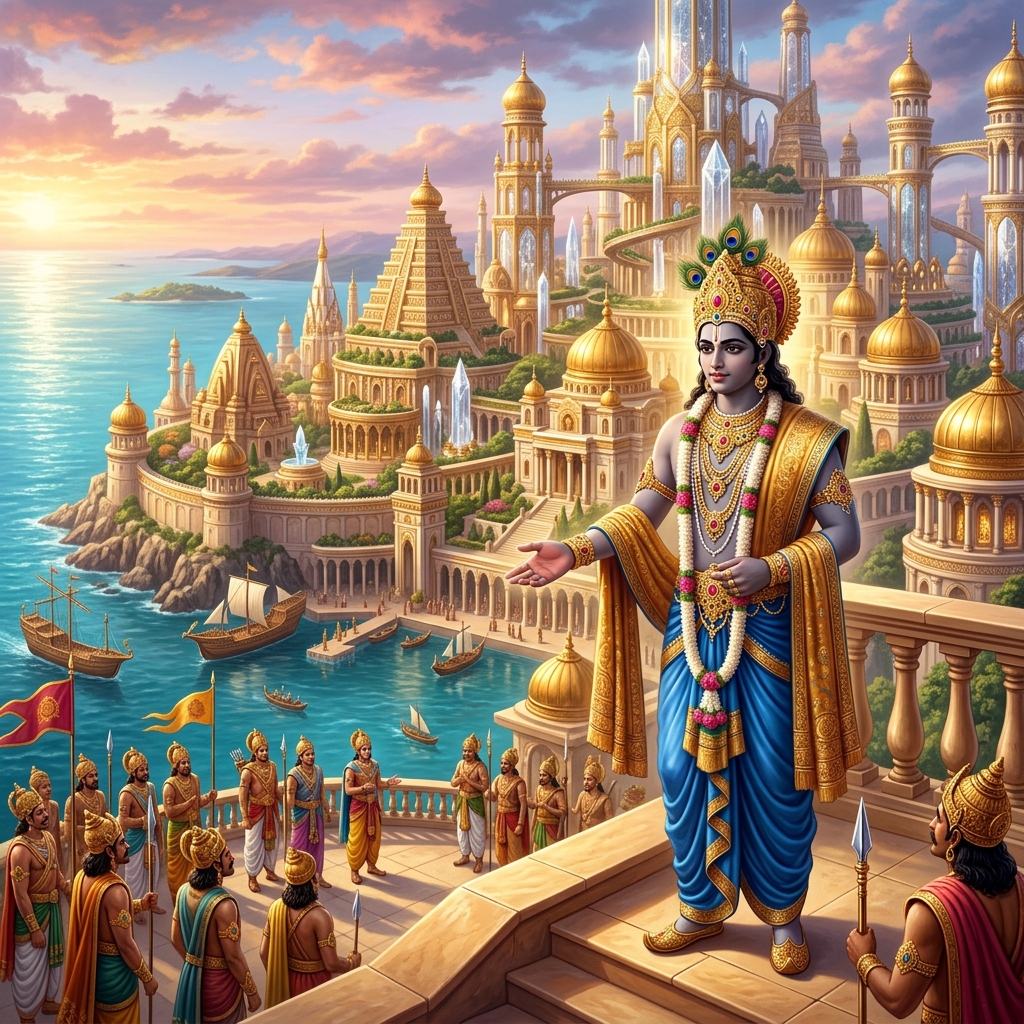
The City Built on Spite
Rukmi, prince of Vidarbha, had watched his sister Rukmini carried off by Krishna on her own wedding day, snatched from the temple steps before the groom his family had chosen for her could even be sent for. He rode after them with every soldier Kundinapura could muster, and Krishna beat him in the field the way a man defeats a boy who has never lost before and does not yet know how to lose - decisively, and in front of witnesses.
Balarama, riding with Krishna, had begged for Rukmi's life when his brother's mace was already raised over the fallen prince, and Krishna spared him, shaving his head and beard instead as a mark that would not wash off before the whole of Vidarbha saw it. Rukmi survived. His pride did not.
He swore, before he had even finished bleeding, that he would not set foot inside Kundinapura's gates again until he had defeated Krishna in open battle - a vow no living king could reasonably expect to fulfill, and one his own family understood, without saying so aloud, that he would keep exactly and forever. He built a new city on the spot of his defeat and called it Bhojakata, ruled from it in permanent, furious exile from his own capital, a kingdom of one grievance with a single subject.
Years passed. Bhojakata grew into a real city, with real armies and real wealth, but everyone who visited it, including Rukmi himself, understood what it actually was: a monument to a single afternoon he could not stop refighting in his own mind.
An Army Nobody Asked For
When the war between the cousins became inevitable, Rukmi saw in it something larger than politics: a stage large enough, finally, to answer the old defeat. He marched an entire akshauhini, one full division of chariots, elephants, cavalry and foot, to the Pandava camp before the fighting began, and asked to see Arjuna, the finest archer either side possessed.
He did not offer his army as an ally offers help. 'I have brought enough strength to win this war for you outright,' Rukmi told Arjuna, 'so that you need not risk a single arrow of your own. Accept it, and call the victory mine as much as yours.'
Arjuna only smiled at the offer, the small, unhurried smile of a man who has genuinely never needed anyone's rescue. 'I thank you for the army,' he said, 'but I did not come here to be won a war. I came to fight one. Keep your soldiers, Rukmi, or take them wherever they will be wanted.'
It was not spoken as an insult. Arjuna meant it, if anything, kindly - a plain refusal with no cruelty folded into it. But to a man who had built an entire second capital out of a single humiliation, a kind refusal cut exactly as deep as a scornful one. Rukmi withdrew from the Pandava camp already composing, in his mind, the version of the story where the mightiest archer of the age had been afraid to share the glory with him.
He rode away with his entire army still intact behind him, an offer nobody wanted trailing dust for miles, and began, before he had even cleared the camp's outer picket, to plan where else that offer might land.
Another Man's Leavings
Stung but not yet finished, Rukmi turned his army toward Hastinapura and offered the same bargain to Duryodhana: an entire akshauhini, undiminished, to be spent however the Kaurava prince wished, on the single condition that the victory be remembered as Rukmi's doing as much as his.
Duryodhana had spent his whole life being told what to think of himself by men more gifted than he was, and he recognized in Rukmi's offer something uncomfortably close to his own reflection - a proud man asking to be flattered in exchange for strength he would not actually be permitted to command on his own terms. He refused it, and did not refuse it gently.
'You went to the Pandavas first,' Duryodhana said, 'and only came to me once Arjuna had turned you away. I am not in the habit of accepting another man's leavings and calling them a gift. Take your army back to Bhojakata, Rukmi. Fight for yourself, since apparently no one else will have you fight for them.'
It was, in its way, the truer insult of the two, precisely because it was not kind. Rukmi left Hastinapura the way he had left the Pandava camp, his enormous army still entirely unused, his offer refused twice over by two men who agreed on almost nothing else in the world. He rode back to Bhojakata without having struck a single blow for either side, having proven, in the space of a season, that an army offered in the service of one's own vanity is not really an offer at all.
The Two Who Stayed Home
When the two armies finally arranged themselves at Kurukshetra, eighteen akshauhinis strong between them, the chroniclers of the war took care to note who was missing from the field, because in a quarrel this total, absence needed almost as much explaining as presence.
Balarama was missing by principle. He had taught the mace to both Bhima and Duryodhana, loved both as pupils if not equally, and refused outright to lift a weapon for either side, choosing a pilgrimage along the Sarasvati over any battlefield at all. His absence was, and was understood by everyone to be, a form of grief.
Rukmi was missing by pride. He had brought his army to both camps and been refused by both, not because either side doubted his strength but because both had correctly read what he wanted in exchange for it - not victory, but vindication. Rather than fight under any banner but his own vanity's, he sat the war out in Bhojakata, technically neutral, actually humiliated for a second time by the same two families in a single lifetime.
The epic pauses, in its long accounting of every king and every army, to set these two men beside each other: the same choice, arrived at by entirely opposite roads. One had too much love to choose a side. The other had too little humility to be chosen by one. Both sat at home while the greatest war of the age was fought without them, and history has never been quite sure which absence to pity more.
The Last Insult
Rukmi did not die at Kurukshetra, and for a man who had staked his entire adult life on proving himself in exactly that kind of contest, even his death managed to insult him one final time by arriving somewhere smaller.
Years after the war, at a wedding feast for his own daughter, Rukmi sat down to a game of dice with Balarama, the same Balarama who had once spared his life on a battlefield and shaved his head for it. Dice had never been an honest game in this family's long, unlucky history with it, and this game was no exception. Balarama caught Rukmi cheating, openly, at a table meant for celebration rather than contest, and something in him that had stayed patient through decades of Yadava politics finally gave out.
He killed Rukmi there, at the feast, with the same casual, terrible finality he brought to everything he did once he stopped forgiving it. There was no battlefield, no army, no witness worthy of the old vow Rukmi had sworn as a young man humiliated outside Kundinapura's gates. There was only a dice board, a cheat caught in the act, and an old debt of pride finally, absurdly, called due.
The story of Rukmi is not really the story of a villain. It is the story of a man so wounded by one early defeat that he could never again offer his strength to anything larger than his own vindication - not to his sister's husband, not to Arjuna, not to Duryodhana, not even, in the end, to a game of dice he might simply have played honestly and lost. An ego large enough demands its own cause, and finds, eventually, that no war was ever really about anyone but itself.
Dharma Lesson
Rukmi's pride was wounded once, at his sister's abduction, and he spent the rest of his life trying to avenge a single defeat rather than build anything new. When he finally offered his strength to a cause bigger than his grievance, both sides refused him, because an offer made to soothe one's own vanity is not really a gift. A man who cannot serve without also being flattered ends up serving no one, least of all himself.