The City on the Ganga
No city in Aryavarta claimed greater sanctity than Kashi, seated on the western bank of the Ganga where Shiva himself was said to dwell, its ghats and temples drawing pilgrims from every kingdom to wash away the accumulated weight of their lives in the river's holy current. It was old before the Kuru dynasty had a name worth remembering, and it would remain holy long after that dynasty tore itself apart on a battlefield far to the north.
Into this ancient city, in the generation before the Pandavas and Kauravas were born, came word of a swayamvara: the king of Kashi had three daughters of marriageable age, Amba, Ambika, and Ambalika, and he had summoned princes from across the land to compete for their hands. Such gatherings were common enough among the great houses, an occasion for kings to display their sons' worth and for princesses to choose, at least in name, who among the assembled suitors would become their husband.
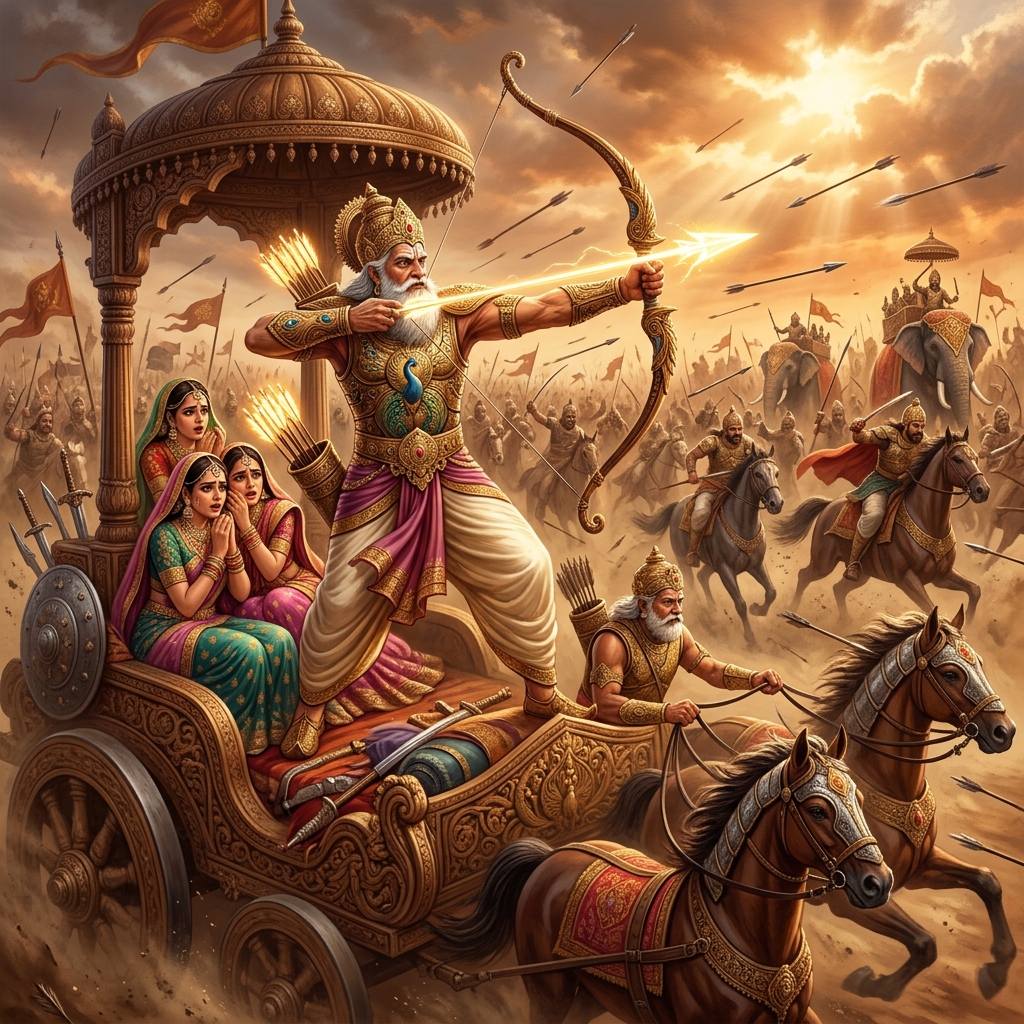
Bhishma arrived at that swayamvara uninvited, not as a suitor for himself, for he had sworn a vow of celibacy that barred him from marriage forever, but as an emissary determined to win brides for his younger half-brother Vichitravirya, the frail young king now sitting the Kuru throne. When the assembled princes objected to a mere regent claiming brides by right of arms rather than by the princesses' own choosing, Bhishma answered the challenge as his reputation demanded, defeating every rival who rose against him and carrying all three sisters back to Hastinapura in his chariot - a contest of arms remembered in its full ferocity elsewhere, but decisive here only in its outcome: three princesses of Shiva's holy city, taken from their home to become queens of a dynasty six hundred miles distant, with no voice yet permitted in the matter of their own futures.
Grandmother to Two Houses
Of the three sisters carried from Kashi, two accepted the fate Bhishma had chosen for them. Ambika and Ambalika were married to Vichitravirya, and when he died young and childless, the continuation of the entire Kuru line came to depend on them - a crisis resolved by the sage Vyasa, summoned by their mother-in-law Satyavati to father heirs on both widowed queens in her son's name, a rite of niyoga whose full circumstances and consequences belong to their own telling. What matters to Kashi's history is only the result: Ambika bore Dhritarashtra, blind from birth, and Ambalika bore Pandu, pale from the fright of the encounter, and between the two of them the entire future of the Mahabharata's central conflict was set into motion.
Kashi's blood, carried west against its daughters' will, thus became the blood of both warring sides at once. Dhritarashtra would father the hundred Kauravas; Pandu would father, by other means, the five Pandavas. Every warrior who fell at Kurukshetra a lifetime later, on either side of that field, descended in some part from a princess of Kashi who had never asked to leave her city's ghats.
The river city itself continued on unaware of the scale of what its daughters' marriages had set in motion, its temples and pilgrims indifferent to dynastic politics far to the north. But among the Kuru court, Kashi's name became permanently entwined with the House of Bharata's origin, a grandmother kingdom to a war it had never sought and would only later, in its final generation, be asked to choose a side in outright.
The One Who Was Refused
The eldest of the three sisters, Amba, had not consented even in the limited way her sisters eventually did. She confessed to Bhishma, once brought to Hastinapura, that her heart already belonged to Shalva, a king she had chosen at an earlier gathering, and Bhishma, honoring that confession, sent her back to Shalva rather than keep her among Vichitravirya's brides.
But Shalva refused her, unwilling to accept a woman who had already been carried off by another man's hand, however unwillingly on her part the taking had been. Amba returned to Bhishma and asked him to marry her himself, since his abduction had cost her every other path to marriage; Bhishma, bound by his vow of celibacy, refused as well. Turned away by the man she loved and the man who had taken her, Amba found herself with no home left that would claim her, not even Kashi, which could not undo what had already been done in its name.
She left the Kuru court and left her father's city both, carrying nothing but a fury that had nowhere else to go, and set herself toward a penance whose full course is remembered in its own right elsewhere - vows made to gods and sages alike, all bent toward a single unwavering purpose: that Bhishma, who had refused to either keep her or release her cleanly, would one day die by her doing. Kashi's part in that vow was only its origin point, the city from which a wronged princess walked out for the last time, carrying a grievance that would not rest until it found, across another lifetime, the shape it needed to be answered.
A City Chooses Its Side
Generations passed, and the throne of Kashi came to be held by a king who watched the quarrel between his kingdom's Kuru grandsons grow from court rivalry into open threat of war. When Duryodhana and Yudhishthira each began gathering allies for the conflict that both now understood was coming, Kashi did not hesitate long in its choice. The king of Kashi brought his own contingent east to stand with the Pandavas, honoring the deeper thread of kinship that ran through Pandu's mother rather than any claim Hastinapura's ruling branch might press on the strength of proximity or seniority.
It was, in its way, a fitting decision. Kashi had given the Kuru line both its warring houses without ever being asked, and if it could not undo that original taking, it could at least choose, when the moment for choosing finally came, to stand with the side its own blood had marked as wronged in the succession that followed Pandu's early death.
And Amba's old vow, sworn on leaving her father's city so long before, found its answer on that same battlefield. Reborn across a lifetime as Shikhandi, raised in another kingdom and granted, by a further mercy of the gods, the form needed to stand before Bhishma as an opponent he would not raise his weapon against, Amba's fury finally reached the man who had refused her twice - not struck down by her own hand directly, for the fuller shape of that reckoning belongs to its own story, but present, at last, exactly where her vow had always intended to place her.
The Holiest of River Cities
Long after the war's guns of arrows fell silent, Kashi's name continued to surface in the epic's quieter passages, in the long litanies of sacred fords and shrines recited to pilgrims journeying the length and breadth of the land. Wherever the Mahabharata pauses to catalogue the holy places a soul might visit to cleanse itself, Kashi is named among the very first, its ghats on the Ganga still counted the holiest waters a pilgrim could reach, its association with Shiva undimmed by anything that had happened to its royal house in the intervening generations.
Few who bathed in those waters in the centuries after the war, murmuring the names of gods and ancestors as the current carried away their offerings, would have paused to remember that this same river city had once sent three of its daughters north against their will, and that the whole vast conflict remembered in the epic's telling had, in some measure, begun with that single unconsented taking. Kashi's holiness and Kashi's grief occupied the same ground without contradiction, the way a river carries both blessing and flood within the same unbroken current.
So Kashi's inheritance in the Mahabharata is double: a grandmother city to both warring houses through Ambika and Ambalika, and the birthplace of the one grievance that outlasted a lifetime to find its answer at Kurukshetra through Amba's return as Shikhandi. Few places in the epic carry so much weight from a single swayamvara, and fewer still remain, to this day, as sacred in memory as the ghats where that story first began.
Dharma Lesson
A city can be made the origin point of a story it never chose, and Kashi bore that fate twice over: grandmother to both warring houses through daughters taken by force, and mother of a vow that waited two lifetimes to be answered. Its lesson is that consent withheld does not simply vanish; it returns, transformed, at the hour it is least expected.