The River That Came Down
Before she was the river of the Kurus she was not on the earth at all.
The sons of Sagara, sixty thousand of them, had been burned to ash in a pit under the ground by a sage they insulted, and ash is not a body, and without water poured over them by a kinsman they could not go anywhere at all. Their descendants tried for generations to release them. The water of earth was not enough. Only the river of heaven would serve, and the river of heaven had no reason whatever to come down.
Bhagiratha stood on one foot in the Himalaya with his arms above his head until the gods came to him and asked him to stop.
"Then send her," he said.
They warned him. She would fall the whole height of the sky, and where she landed she would split the earth open and carry it away in pieces. So Bhagiratha went back to his penance and asked Shiva, and Shiva stood under the falling water and took it on his head, and she went into his hair and was lost in it. She wandered there for years without finding a way out, which was precisely the point.
When he let her go she came down in seven streams and followed Bhagiratha's chariot across the plain, laughing, tearing up whatever she pleased. She ran through the sacrificial ground of the sage Jahnu, and he was so annoyed that he drank her, the whole river, and had to be argued into letting her out again through his ear, which is why the epic calls her Jahnavi, the daughter of Jahnu.
Then she reached the pit, and the water went over the ash, and sixty thousand men who had been nothing for an age stood up and went where they were meant to go.
She did not return. She stayed on the earth, and from that day she was two things at once, water running east and a woman with a mind of her own, and the house of Kuru would learn to deal with both.
The King at the Ford
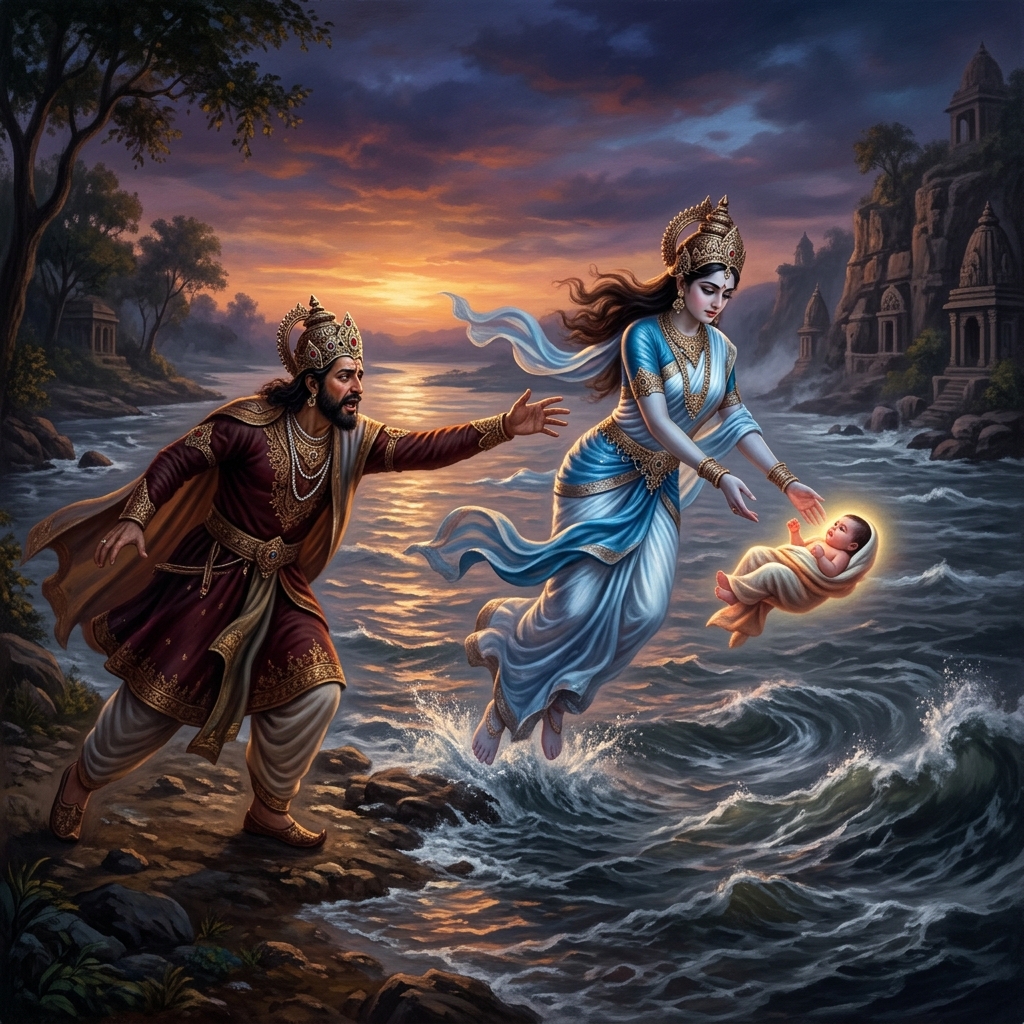
Shantanu, king of the Kurus, was hunting along the Ganga when he saw a woman standing at the edge of the water, and there was nothing in the rest of his life that was not decided in that minute.
He asked her to be his queen. She agreed, on one condition.
"You will not ask me who I am," she said, "and whatever I do, you will not stop me and you will not question me. On the day you do, I go, and I do not come back."
He gave his word, because men in that position always do.
She bore him a son, and carried it down to the river, and set it into the current, and came back up the bank smiling. She did the same the next year, and the year after that. Seven sons went into the Ganga, and seven times the king kept his word, and at the eighth his mouth would not hold it any longer.
"Who are you?" he said. "Whose daughter, that you murder your own children? Give me this one."
"You have your son," she said, "and you have lost your wife."
Then she told him what he had been watching all that time. The eight were the Vasus, gods of the elements, cursed by Vasishtha to be born as men because they had stolen his cow. They had begged her to bear them and to end each birth the moment it happened, before a human life could fasten itself on to them, and every child she carried into the water she had been releasing, not drowning. Seven were free of it now. The eighth, the one who had actually laid hands on the cow, had to serve out the whole sentence: a long life, and no wife, and no son of his own.
"He is yours," she said. "I will raise him first."
She took the boy and went, and years afterward she came back to the same ford and put a young man ashore who could dam the Ganga herself with arrows, and said, "This is Devavrata. He has learned what there was to learn. Now he is your heir." Then she stepped back into the water.
The world would come to call him Bhishma.
The Basket on the Water
The river's second great gift to the epic was carried to her in a box.
Kunti was a girl in her foster father's house at Kuntibhoja when a sage gave her a formula and told her that she could call any god she liked and he would have to come. She waited a while. Then one morning she looked at the sun coming up over the courtyard wall and said the words, to see whether they worked.
They worked.
The child was born with gold armor grown into his skin and gold rings in his ears, and she was unmarried, and she was very young, and there was no version of the next day in which she could keep him. She and her nurse made a basket of wicker, smeared the seams with wax so that it would float, laid him in it on a soft cloth, and carried it down in the dark to the Ashva.
"Whoever finds you," she said, "let them be kind to you. And may your father, whom I cannot name aloud, watch you on the water."
Then she pushed the basket out into the current and went back and washed her face and lived the rest of her life around the hole it left.
The Ashva carried him to the Charmanvati. The Charmanvati carried him to the Yamuna. The Yamuna carried him to the Ganga, and the Ganga, who had already taken seven princes of this dynasty into her current, took the eighth and did not drown him. She carried him downstream past the fields and the landings and the smoke of the villages into the country of Anga, and near Champa a charioteer of the Kuru household named Adhiratha, who had no children, saw a box turning slowly in the shallows and waded out for it.
He and his wife Radha opened it on the bank. What they found there they raised as their own, and named him Vasusena, and the world came to call him Karna.
The Ganga had moved a son from one side of the coming war to the other, and nobody would know it for fifty years.
Water for the Dead
When the eighteen days were finished, the survivors did not go home. They went to the river.
The bodies had been gathered and burned on the field in heaps, the kings with their own sandalwood and the rest by the thousand, and after the fires the whole broken company walked down to the Ganga: Dhritarashtra led by the hand, Gandhari with the cloth still bound over her eyes, Kunti, Draupadi with nothing left to lose, and the women of a hundred royal houses who had gone out onto the field to look for a husband or a son and had found what they found.
They went into the water to the waist and began to pour.
That is the rite. You take the water up in your joined hands and let it run out with the name of the dead man spoken aloud, and you do it for your father and your sons and your brothers, and no one who has died without it can settle anywhere. The names went on a long time that day. Bhishma was not among them. He was still alive on his bed of arrows a few miles off, waiting for the sun to turn north, and he would take another fifty-eight days over it.
When the offerings for the brothers were done, Kunti came and stood in front of her sons.
"Offer water also for Karna," she said.
Yudhishthira asked why he should pour for a charioteer's son who had spent his whole life against them.
"Because he was not a charioteer's son," she said. "He was mine. He was born before any of you, of Surya, and I set him on this water in a basket, and I have carried it since."
Yudhishthira stood in the Ganga with his hands full of water and could not make them move. When he could speak he cursed the whole sex of women, that no woman should ever again be able to keep a secret hidden, and then he poured for his eldest brother, and the river took that offering along with the rest.
The Goddess Rises
The sun turned north, and Bhishma, who had held his death off for fifty-eight days on a bed of arrows, gave his last instruction to Yudhishthira and let it come.
They burned him on the bank of the Ganga with sandalwood and garlands, Dhritarashtra laying the first fuel, and when the fire had done its work they went down into the river to offer him water.
And while they stood there the surface opened, and the Ganga came up out of her own current in front of all of them, weeping.
"I bore him for this," she said. "My son, who was Devavrata, who was truth itself, who never once broke a word he had given to anyone. He could have had the throne of the Kurus and he handed it away for his father's sake. He lived without a wife and without a son because I asked it of him. And he was brought down by a man standing behind another man. Is there a mother anywhere whose grief is the size of mine?"
Krishna answered her, standing in the shallows.
"Do not grieve," he said. "He was never only your son. He was Dyaus, chief among the Vasus, serving out a sentence, and the sentence is finished now. He has gone back to his own place. He chose the hour of his going himself, and no man on that field could have taken him before he consented to it. He is above you now, not below you."
She heard him out, and stopped, and went back down into the water, and the river ran east as it had always run.
That is the shape of her whole part in the epic. Every capital of the heartland was built within reach of her. Every ford in it was named and counted. Every funeral in it ended with living men standing in her to the waist. She had come down out of heaven for the ashes of one family and stayed on to carry another, and she took from the Kurus seven infants, one abandoned son, and at the last the only man among them who kept every promise he ever made.
Dharma Lesson
Ganga is the epic's clearest case of a mercy that looks like cruelty from the bank. Shantanu saw a woman carrying her newborn sons into the river, and he was right to be horrified and wrong about what he was seeing, and by the time it was explained to him she was already gone. She asks to be trusted before she can be understood, and the epic never pretends that is an easy thing to give.