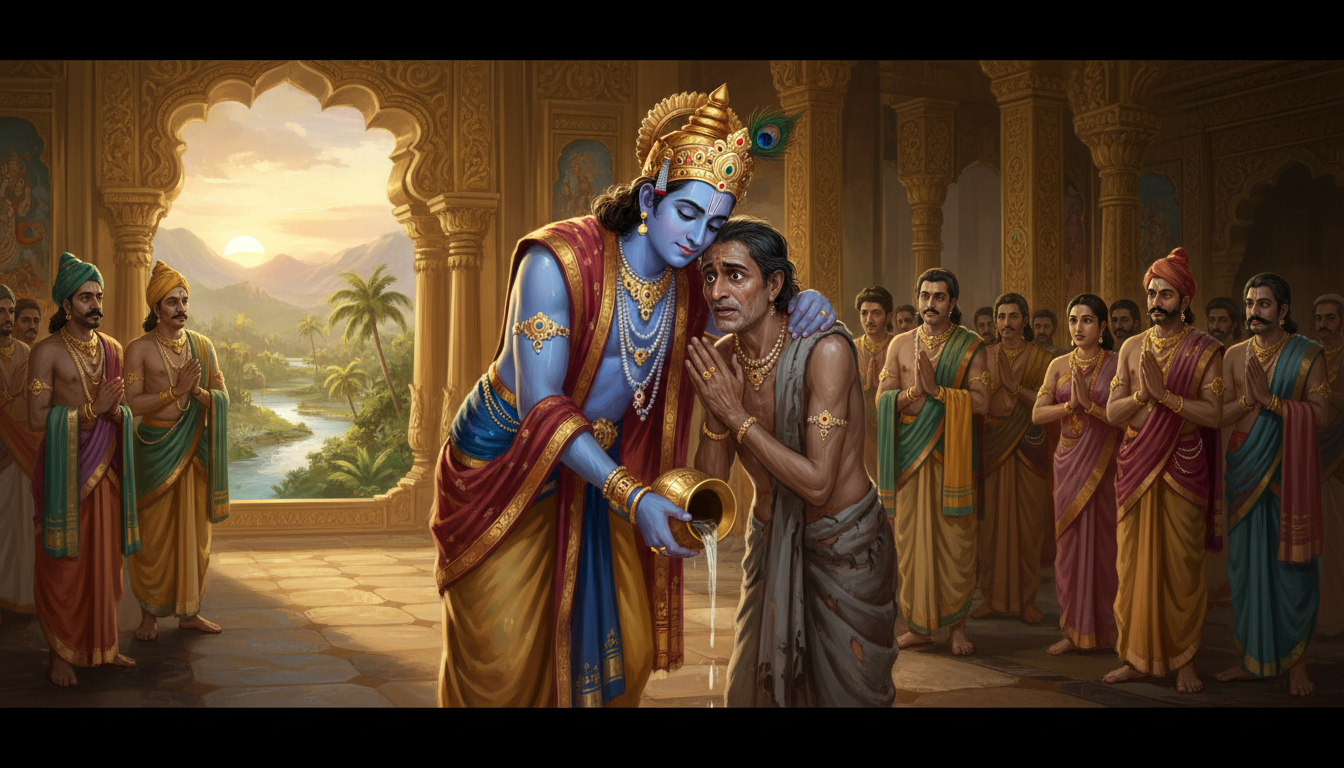
Bhagavad Gita Chapter 11, Verses 15-34: I Am Time
The mouths of the god and the instrument's task
A Mass of Light, Hard to Look At
Arjuna began to speak, and what came from him was not a question but a hymn, the words rising almost against his will as his eyes tried and failed to take in what stood before him. 'I see all the gods in your body, O god,' he said, 'and the multitudes of every kind of being. I see Brahma, the lord seated on his lotus throne, and all the sages, and the shining serpents.'
He went on describing what refused to be summarized. Countless arms, bellies, mouths and eyes on every side, a form with no visible end, no middle where the eye could rest, and no beginning it could trace back to. Everywhere he looked he found the same excess: not one crown but crowns beyond counting, not one mace or discus but a blaze of weapons held in more hands than a human mind could hold as an image. The whole of it burned with its own light, a mass of radiance so total that Arjuna said he could scarcely look at it directly, the way no one looks straight at the sun for long.
This was the same vision that had begun in wonder only moments before, and the wonder had not vanished, but something else had begun to thread through it, a note that had not been there when Krishna first offered the divine eye. Immeasurable, Arjuna called it, in every direction, without end. A being that fills every direction leaves no direction left over to retreat into. There is no angle from which such a form can be viewed partially, no corner of the sky a person could turn to and rest their eyes on something smaller. Arjuna stood inside a vision with no edges, and for the first time since the war chariot had stopped between the armies, he had nowhere left to look away to.
The Three Worlds Tremble
'I see you with a crown, a mace, a discus,' Arjuna went on, 'a mass of light shining everywhere, blazing all around like fire and sun, hard to see, immeasurable.' He said Krishna's eyes were the sun and the moon, that his mouth was a blazing fire whose heat scorched the universe with its own radiance.
There was a shift happening in the hymn, subtle at first, then unmistakable. Where Arjuna had begun by cataloguing wonders, gods, sages, weapons, crowns, he now began to describe something that acted on the world rather than simply filling it. Fire was not decorative in this vision; it burned. A mouth that scorches with its heat is a mouth that consumes what stands near it. Arjuna said that the space between heaven and earth, and every direction besides, was pervaded by this single form, and that the three worlds trembled at the sight of this astonishing and terrible shape.
He was not speaking abstractly. The trembling he described was not confined to distant gods or unseen realms; it was happening in his own body as he spoke, in the same hair standing on end and the same unsteady voice that Sanjaya had already reported. What had opened as a gift, the divine eye Krishna promised only a short while before, was proving to carry weight that an ordinary nervous system was never built to bear for long. Arjuna kept looking anyway, kept describing what he saw with the same careful attention a person gives to something they are afraid of and cannot stop watching.
The universe he had grown up believing he understood, an order of kings and duties and battle lines drawn for reasons he could explain to himself, was dissolving in front of him into something that had always been present underneath it, vast and blazing and entirely indifferent to whether Arjuna, or anyone, found it bearable to look at.
Into the Fanged Mouths
Then Arjuna saw something that turned the vision from overwhelming to unbearable. Among the countless mouths of the form, some were fitted with terrible fangs, blazing like the fires that burn at the end of an age, when the world itself is consumed and remade. And into those mouths, Arjuna watched warriors he knew by name rushing headlong, as if drawn by a current stronger than any of their own wills.
He named them as he saw them go: the sons of Dhritarashtra, all of them, entering together, and with them the great captains of both armies, Bhishma, Drona, and Karna, along with the chief warriors on Arjuna's own side as well. Some, he said, were caught between the terrible teeth, their heads already crushed to powder before the rest of them followed. He watched men he had shared meals with, argued with, sparred against since boyhood, disappear into a mouth built for exactly this purpose, the way rivers disappear into an ocean that never overflows no matter how much it receives.
This is the verse block where the vision stops being merely vast and becomes specifically, personally terrible for Arjuna. Until this point he had been shown the scale of the divine, which is frightening in the way any true immensity is frightening. Now he was shown its function, and the function was destruction, and the destroyed were not strangers or abstractions but the exact people whose deaths he had spent the earlier chapters of the poem trying to avoid causing.
There was no ambiguity left in what Arjuna was looking at. He had asked to see Krishna's true form, thinking, perhaps, that truth would be reassuring once fully seen. What he found instead was that the truth included an ending already underway, a war already being fought and won in a register beyond the battlefield, with or without his bow, and that he was watching it happen to men who were, in the world he still had to return to, still alive.
Like Moths Into a Flame
Arjuna reached for images from the world he knew to describe what he could not otherwise put into words. As many rivers rush toward the ocean, he said, so these heroes of the world were entering the flaming mouths of the form. As moths fly with increasing speed into a blazing fire, only to meet their destruction, so these worlds too were rushing into that mouth with great speed, to their own ruin.
Both images share the same shape, and Arjuna seemed to reach for both because neither alone was sufficient. The river does not choose the sea; it simply follows a slope that was always going to end there, a movement with no villain in it, only geography. The moth, by contrast, seems to choose the flame, driven by some blind pull it cannot override even though the fire will kill it. Arjuna's vision held both truths at once: the warriors rushing to their deaths were being carried by something as impersonal as gravity, and yet each of them was also, in some sense, driving forward under his own will, unable to stop, unable to see the fire as anything other than irresistible.
Having seen this much, Arjuna could no longer simply describe. He needed to ask. Devouring all the worlds on every side with your blazing mouths, he said, you lick at them again and again. Your fierce rays, Vishnu, fill the whole universe with radiance and scorch it. Then the question broke through everything else: tell me who you are, in this terrible form. I bow to you, foremost of gods, be gracious. I wish to understand you, the primal being, for I do not know your purpose.
It was, in its way, the same request he had made at the start of the chapter, only stripped now of any expectation that the answer would be comforting.
Time, and the Instrument
Krishna answered plainly, without softening what he said. 'I am time,' he told Arjuna, 'grown mighty, destroyer of the worlds, engaged here in gathering in all people.' Kalo 'smi loka-ksaya-krt, the line runs, and it names, in four words of Sanskrit, one of the starkest claims in the entire poem. Not a god who occasionally permits destruction as a necessary evil, but the very process of time itself, the force that ages every living thing toward its end regardless of virtue, regardless of anyone's willingness to watch.
Then came the sentence Arjuna most needed and least wanted to hear. Even without you, Krishna said, all these warriors arrayed in the opposing ranks shall cease to exist. Therefore arise and win glory. Conquer your enemies and enjoy a flourishing kingdom. By me alone have they already been slain; be merely the instrument, Savyasachin.
Nimitta-matram bhava, be merely the instrument, is one answer to the paralysis that had gripped Arjuna since the opening chapter of the Gita. He had believed, understandably, that the coming deaths of Bhishma and Drona and his cousins hung on his own choice to fight, that refusing his bow could somehow keep them alive. Krishna's vision dismantled that belief at its root. The outcome was already decided, already visible, already underway in a register beyond any single archer's decision. What remained for Arjuna was not whether the death would occur, but what part he would occupy inside a process that did not require his consent to proceed.
For a reader today, the claim is not really about war. It is about the difference between authorship and participation, between believing every consequence rests on your shoulders alone and recognizing that most of what happens in a life is already in motion, carried by forces larger and older than any one person's will, leaving each of us the far smaller, far more answerable task of choosing how we take our place inside it.
Dharma Lesson
What happens will happen regardless of any single actor's choice to participate in it; refusing to act does not stop the outcome, it only changes who claims a share in bringing it about. Being an instrument of what is already decided is not the same as being its author.