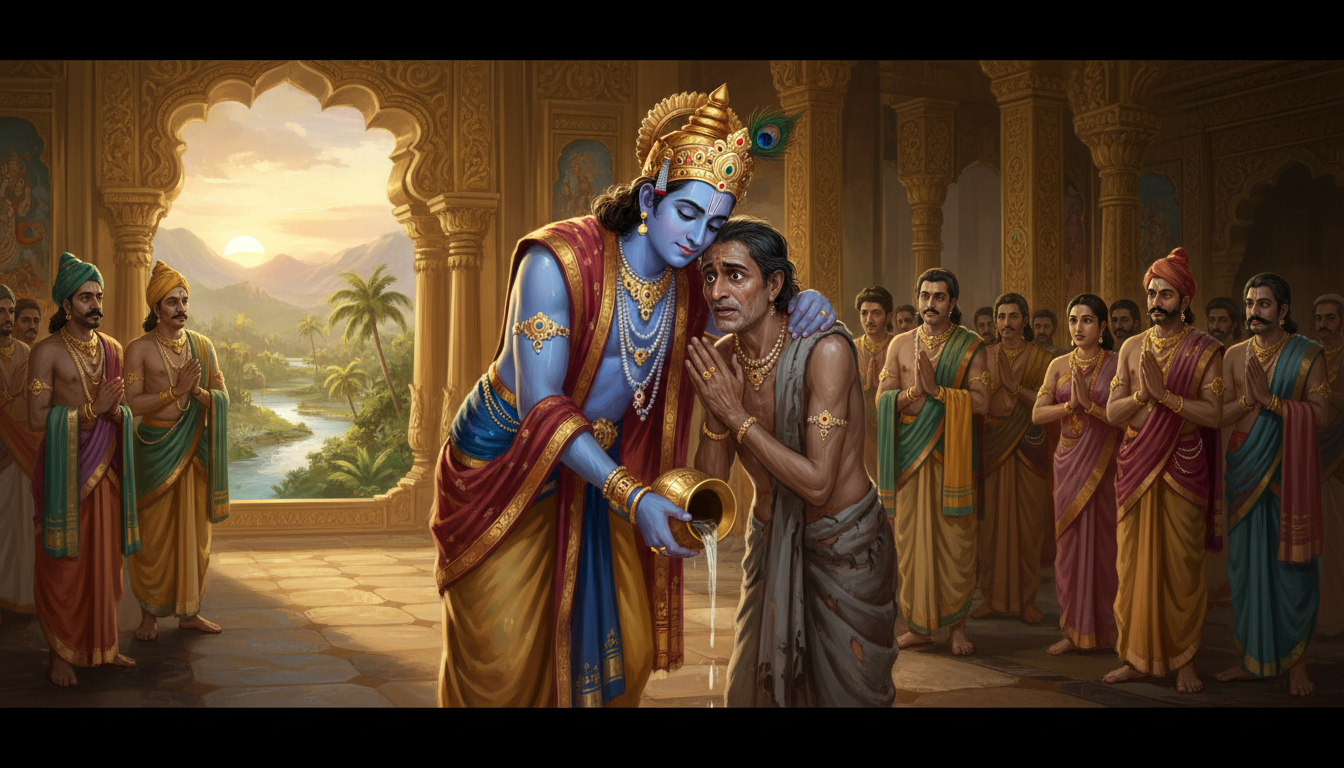
Bhagavad Gita Chapter 11, Verses 1-14: The Divine Eye
The request, the gift, and a thousand suns
If You Think I Can Bear It
The chariot still stood between the two armies, but the battle that mattered now was being fought in words. For ten chapters Krishna had unmade Arjuna's grief and remade his understanding, teaching him the nature of the self that does not die, the discipline of action without craving its fruit, and the vast unity binding every creature to its source. Arjuna listened to all of it, and something in him had genuinely changed.
'My delusion is gone,' he said, and there was no performance in it. 'Through your grace, Krishna, I have heard from you of the origin and dissolution of all beings, and of your own imperishable greatness. I understand it now, at least as words can carry it.'
But understanding, Arjuna found, was not the same as certainty, and the more Krishna described himself, the more Arjuna wanted proof beyond argument. Krishna had called himself the self seated in the heart of every creature, the beginning, middle and end of all things, the syllable Om, the seasons, the gambling of the cunning, the strength of the strong. Any one of those claims could be doubted by a careful listener. All of them together, spoken by a man who had grown up with cowherds and driven a chariot for his cousin's sake, strained belief past its ordinary limits.
'As you have described yourself, Lord, so I wish to see you,' Arjuna said. 'Supreme person, if you think I am able to behold it, show me your imperishable self.'
It was a bold request and Arjuna seemed to know it. He was asking not for another teaching but for an experience that would settle the matter beyond argument, the way seeing a mountain settles an argument about whether a mountain is there. He did not know what he was asking for. Few who make such requests ever do.
Hundreds of Forms, Thousands of Kinds
Krishna did not refuse, but he answered first with an inventory, as if to prepare Arjuna for what mere numbers alone could suggest. 'Behold, Partha,' he said, 'my forms by the hundred, by the thousand, of many kinds, divine, of many colors and shapes.'
He began naming the populations of his own body. The Adityas were there, the twelve solar deities who measure out the year. The Vasus stood among them, the eight gods of natural elements and phenomena. The Rudras came next, the fierce forms of Shiva presiding over storm and destruction, and after them the Maruts, the wind gods who ride together in packs across the sky. Krishna said he would show wonders never seen before, things beyond the reach of any eye that had looked at the world only as a world.
'And whatever else you wish to see, tell me,' he said, 'for the whole universe, moving and unmoving, stands here today in my body, unified, along with anything else you desire to see.'
This was the claim beneath all the smaller claims: not that Krishna possessed great power, which Arjuna already believed, but that the entire cosmos, every star and river and army and grain of dust, existed as a single body wearing the shape of his cousin's charioteer. It was the kind of statement that could not be tested by watching for a while and seeing whether it held up. It could only be seen whole or not seen at all.
Arjuna waited, gripping the rail of the chariot a little tighter than before. He had asked for this. There was no way to unask it now, and some part of him had already begun to suspect that what was coming would not resemble anything he had imagined when he made the request.
A Divine Eye
Then Krishna said the sentence on which the entire episode turns, the hinge between promise and vision. 'But you cannot see me with this eye of yours,' he told Arjuna. 'I give you a divine eye. Behold my majestic power.'
Divyam dadami te caksuh, the Sanskrit runs, I give you a divine eye, and the line deserves to be read slowly, because it quietly overturns an assumption Arjuna had been carrying since he made his request. He had asked to see, as though seeing were simply a matter of Krishna's willingness to display himself and Arjuna's willingness to look. But ordinary human sight, tuned to registering chariots and bowstrings and the faces of kinsmen across a battlefield, was never built to register what Krishna was offering to show. The instrument had to be upgraded before the object could be perceived at all.
This is one of the section's quiet teachings, easy to move past too quickly on the way to the spectacle that follows. Some truths are not withheld out of secrecy; they are withheld because the receiving faculty is not yet equipped to hold them. A person born blind is not being denied color by some malice in the world. The eye simply has not been given the capacity. What Krishna does here is not merely reveal himself. He remakes Arjuna's capacity to receive the revelation, and he insists that this remaking is a gift, not an achievement Arjuna could have produced through effort or merit alone.
Arjuna said nothing. There was nothing yet to say. Whatever had changed in his sight had changed silently, invisibly, in the space of that one sentence, and the world he had known a moment before was already beginning to give way to something his old eyes would never have survived looking at.
A Thousand Suns
At this point in the poem the narrator changes. It is Sanjaya, the charioteer gifted with far sight by the sage Vyasa so that he could describe the war to the blind king Dhritarashtra back in Hastinapura, who now takes over the telling, because what happens next is too vast for Arjuna's own voice to carry alone.
Sanjaya described a form with many mouths and eyes, wonders on every side, adorned with countless divine ornaments, bearing innumerable weapons raised and ready. Krishna wore celestial garlands and robes, anointed with heavenly fragrance, a being of every marvel at once, infinite, facing every direction simultaneously, so that there was no vantage point from which the form could be seen as anything less than whole.
Then came the line that has outlived every century since it was first sung: if the light of a thousand suns were to blaze up all at once in the sky, that would resemble the splendor of that great being. It is worth sitting with how carefully that image is built. Not one sun, which any farmer standing in a field already knows well enough to fear a little at noon. A thousand, rising together, none of them dimmed by the others' presence, all of them blazing at full strength in the same instant. Even that, the verse says, would only resemble the light Arjuna now saw, not equal it.
Sanjaya went on: there, in the body of the god of gods, Arjuna beheld the whole universe, in all its variety, standing united in one place. The many worlds that a mind can only ever visit one at a time, a mind that must choose between looking here and looking there, were suddenly all present together, undivided, inside a single shape upon a battlefield that Arjuna had walked onto that same morning as a man going to fight his relatives.
Hair on End
Then Sanjaya described what the vision did to Arjuna's body, before saying anything about what it did to his mind, because the body answered first. Overcome with wonder, his hair standing on end, Arjuna bowed his head to the divine form and, with joined palms, began to speak.
That detail, hair standing on end, appears again and again across the Gita's later verses as the marker of an experience too large for ordinary composure, and it is worth taking at face value rather than reading past. This was not an insight Arjuna could nod along to the way he had nodded along to the philosophy of earlier chapters. It arrived in his skin before it arrived in his understanding, the way real awe always does, whether it comes from a mountain range at dawn, a birth, a death, or a night sky far from any city's light.
For a modern reader, verses 11.1 through 11.14 offer something quietly useful, set apart from the more famous verses on duty and detachment that surround them. Arjuna had already been given, by his own account, a correct philosophical picture of reality. He said so himself: his delusion was gone, he understood the teaching. And still he asked to see, because a mind can hold a true description of something and remain, at the same level that matters most, unmoved by it. Description and encounter are not the same event, and this section is the moment the Gita insists on that difference rather than arguing it away.
What happens next, as Arjuna keeps looking, will cost him a great deal more than wonder. But it begins here, with a request honestly made, a promise honestly kept, and an eye given because the old one, however sincere, was never going to be enough on its own.
Dharma Lesson
Understanding alone does not exhaust reality; some truths must be seen, not merely reasoned toward, and seeing them requires an eye that ordinary sight cannot supply. Grace is what makes vision possible where effort alone would fail.