Bhagavad Gita Chapter 11, Verses 35-55: Bear With Me as a Friend
The hymn, the apology, and the return of the gentle form
Salutations From Every Side
Sanjaya resumed the telling, and what he described now was Arjuna finding his voice again after the terror of the fanged mouths and the warriors vanishing between them. Having heard Krishna name himself as time, destroyer of worlds, and having been told to be merely the instrument, Arjuna did not fall silent. He began, instead, to praise.
It is right, Arjuna said, that the world rejoices and delights in your glory. Demons flee in terror in every direction, and the hosts of perfected sages bow before you. Why should they not bow, he asked, to one greater even than Brahma, the original creator, the first cause beyond every other cause, the infinite lord of gods, the shelter of the universe, the imperishable, that which is and is not and what lies beyond both.
He offered salutations then in a pattern that circled the whole of space, as if no single direction could hold the being he was addressing. Namah purastad atha prsthatas te, the verse runs, salutations to you from the front and from behind. Salutations to you from every side, for you are all. Infinite in power, immeasurable in strength, you pervade everything, and therefore you are everything.
It is worth noticing what Arjuna's hymn does at this point that his earlier description, back when the vision first opened, did not yet do. Description had catalogued wonders: this many arms, that many mouths, light like a thousand suns. Praise does something else. It orients the one praising toward the object of praise, admits smallness in relation to a greatness that does not need the admission but that the admitting mind seems to need to offer anyway. Arjuna was no longer only reporting what he saw. He was placing himself in relation to it, which is the beginning of every act of worship, however it is later named.
Forgive Me for the Jokes at Dinner
Then Arjuna's hymn turned toward something unexpected, and it is this turn that has made the passage among the most loved in the entire poem, more loved by many readers than the thunder of the cosmic vision itself. Arjuna asked forgiveness.
Whatever I said carelessly, he told Krishna, thinking of you as a friend, calling out 'Krishna,' 'Yadava,' 'friend,' not knowing this greatness of yours, whether out of negligence or out of affection. And whatever disrespect I showed you in jest, whether at rest, on a couch, seated together, or at meals, whether alone or in front of others, forgive me for that, immeasurable one.
The list is disarmingly specific. Not grand theological error, but dinner-table teasing, the kind of needling familiarity that exists only between people who trust each other enough to risk it. Arjuna and Krishna had grown up as kinsmen and companions, had ridden together, argued together, no doubt laughed at each other's expense the way close friends do without a second thought. None of that, Arjuna now understood, had been offered to an ordinary man. It had all, unknowingly, been offered to the being who had just shown him a form that swallowed warriors like a river swallowed by the sea.
What makes the passage move a reader, across so many centuries and so many very different lives, is that it does not ask Arjuna to regret the friendship. He is not sorry he joked with Krishna, sorry he called him by name instead of by some grander title, sorry that their bond had been ordinary and warm rather than formal and awed. He is only sorry he did not know, at the time, what he now knows: that the friend was also this. The apology honors the friendship even as it register its enormous, unequal scale.
As a Father With a Son
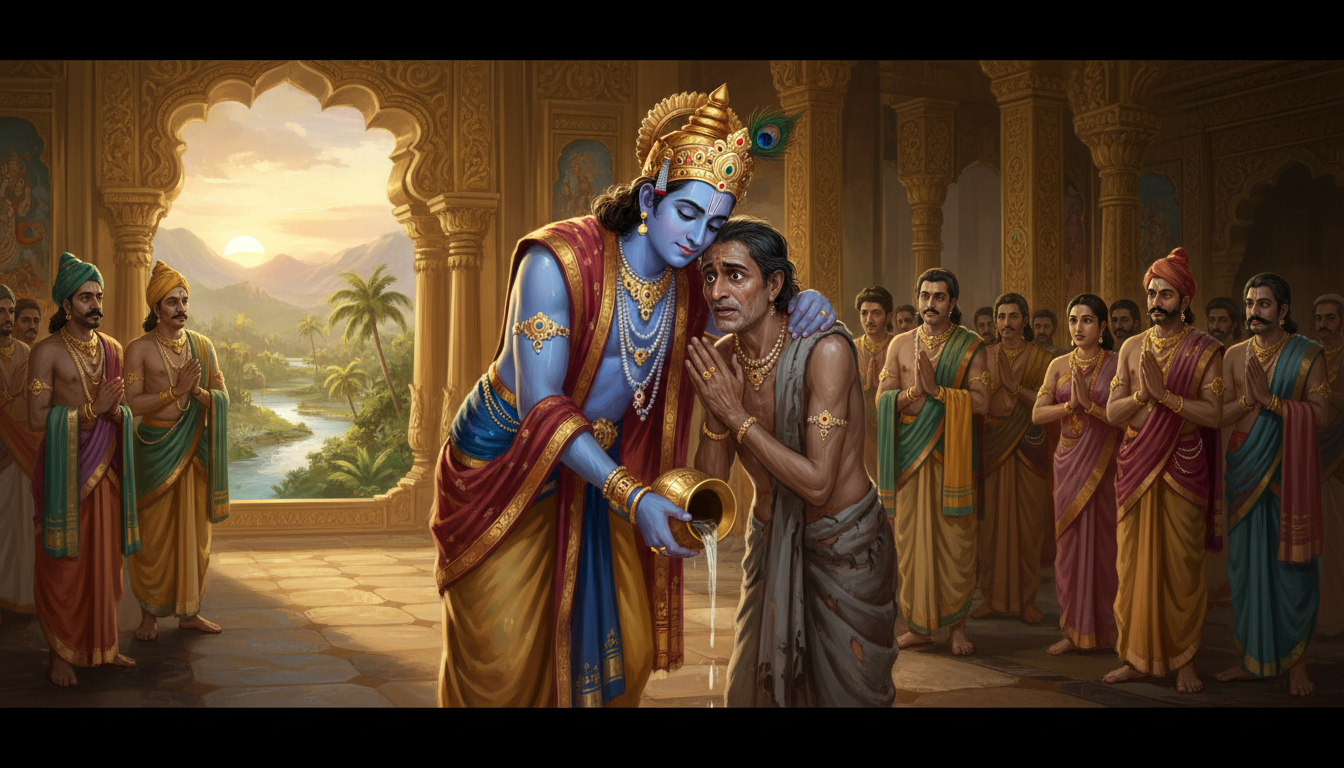
Arjuna reached for the closest human relationships he knew to ask for the kind of mercy he needed. You should bear with me, he said, as a father bears with his son, as a friend bears with a friend, as one who loves bears with the beloved. I have seen what no one has ever seen before, and I am overjoyed, but my mind is shaken with fear.
The line names something true about the shape of large experiences generally, not only this one. Joy and fear had not replaced each other in Arjuna as the vision unfolded; they had arrived together, tangled, neither one canceling the other. He was overjoyed to have seen what he saw, and his mind was shaken with fear at having seen it, and the sentence does not resolve that tension because the tension was simply what the experience had actually felt like from the inside.
Then Arjuna asked plainly for what he wanted. Show me, he said, that four-armed form, thousand-armed one, take on your form with a crown, holding the mace and discus. I wish to see you exactly as before, with that four-armed shape.
This is a striking request precisely because it asks for less than what has been shown. Having been given, by Krishna's own grace, an eye capable of seeing the fully cosmic vision, the whole universe folded together in one shape, Arjuna asks instead for something intermediate, a divine but bounded form he could recognize as belonging to someone rather than to everything. Not every soul, even one granted the sight of infinity, is meant to remain fixed on infinity without a form to hold it in mind. Arjuna wanted a shape he could still call by name.
The Gentle Shape Restored
Krishna answered with the same gentleness Arjuna had asked for. By my grace, he told him, and through my own power of illusion, this supreme form has been shown to you, luminous, universal, infinite, primal, which no one but you has ever seen before. Neither through the study of scripture, nor through sacrifice, nor through gift-giving, nor through ritual, nor through severe austerity can I be seen in this form by anyone else in the human world.
Krishna then restored what Arjuna had asked for. Sanjaya described it: having spoken thus to Arjuna, the great lord of forms once again showed his own gentle shape, and, becoming a figure of great compassion, he comforted the frightened Arjuna, saying, 'Having seen this terrible form of mine, do not be bewildered and do not be confused. With a fearless mind and a glad heart, see again this familiar form of mine.'
Sanjaya said that Arjuna, having seen this gentle human form again, his mind returned to composure, and he became himself once more.
The reversal matters as much as the vision that preceded it. Krishna does not leave Arjuna suspended in cosmic terror as though that were the truer or higher state to remain in permanently. He brings him back, deliberately, to the ordinary shape of a friend standing beside him in a chariot, because that ordinary shape was never a lesser truth to begin with, only a different register of the same one. The god who is time, destroyer of worlds, is also, without contradiction, the particular person who had shared meals and jokes with Arjuna since boyhood. The chapter does not ask Arjuna to choose between those two truths. It asks him to hold both, and it lets him rest in the one he can bear to stay inside.
Free of Enmity
Krishna closed the episode by telling Arjuna something that reframed everything that had come before it. Even the gods, he said, are forever longing to see this form of mine that you have seen. Not through the Vedas, not through austerity, not through charity, not through sacrifice can I be seen in this way that you have seen me. But by undivided devotion alone, Arjuna, can I be known and seen in this manner, and entered into.
Bhakti, unwavering, single-minded devotion, is named here as the one path that had actually delivered the vision, more than any ritual precision or intellectual mastery could have. And Krishna went further, promising something that returned the whole terrifying episode to a register of intimacy. Whoever does all actions for my sake, he said, regarding me as the highest goal, devoted to me, free from attachment, without enmity toward any being, that person comes to me.
Nirvairah, free of enmity, is the note the entire eleventh chapter ends on, and it lands with particular weight given everything Arjuna had just watched: warriors rushing into blazing mouths, entire armies already claimed by time before a single arrow had flown. The vision could easily have taught fatalism, a shrug at violence since the outcome was fixed regardless. Instead it closes on the opposite instruction, urging Arjuna toward a heart free of hostility even as he prepares to fight.
For a reader picking this section up today, whatever their own convictions, the chapter offers a shape worth sitting with: an honest request, a vision too large to bear alone, an apology for every careless word spoken to someone whose full depth was never fully known, and a return to ordinary affection as the place where the largest truths still have to be lived out. Awe, it turns out, is not where a person is meant to stay. Love, undivided and without enmity, is where the chapter finally sets Arjuna back down.
Dharma Lesson
Devotion that arises from love, even love expressed carelessly in jest and familiarity, is not a lesser path than awe before the infinite. Undivided bhakti reaches what terror alone cannot, and it asks only for a friendship free of enmity.