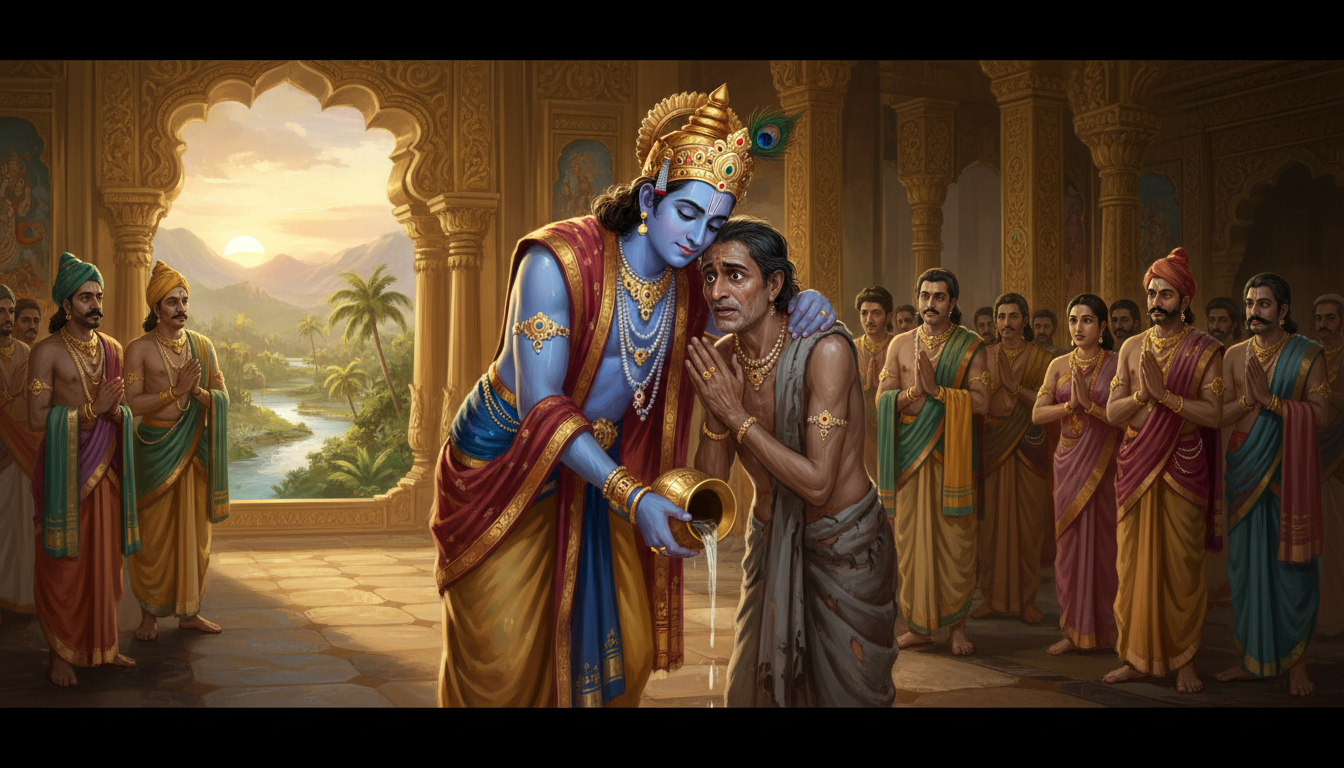
Bhagavad Gita Chapter 12, Verses 13-20: He Who Is Dear to Me
The portrait of the devotee, sung as a litany
No Hatred Toward Any Being
The chapter now changes shape. Krishna has finished ranking roads and begins drawing a portrait, and he draws it as a litany, because the phrase sa me priyah, he is dear to me, returns at the close of nearly every verse like the refrain of a song. Read the passage that way, as something chanted rather than argued, and the list stops sounding like a set of entry requirements and starts sounding like the description of somebody Krishna is fond of.
Verse 12.13 opens with the hardest line first: he who has no hatred toward any being. Not most beings, and not the ones who have earned better. Arjuna is standing in a chariot facing an army that contains men who tried to burn his family alive, who gambled away his wife's dignity in a public hall, and who laughed while it happened. The verse does not exempt him from it.
It goes on: friendly and compassionate, without mine-ness and without ego, equal in pain and pleasure, forgiving. The words nirmamo nirahankarah are precise about the two things being cut. Ahankara is the sense of being a separate somebody who must be defended. Mamata is the sense that a thing or a person is mine. Almost every quarrel a man has in a lifetime traces back to one or the other, and usually to both.
Verse 12.14 completes the opening panel: ever content, steady in yoga, self-controlled, of firm resolve, with mind and understanding given to me. He is dear to me.
Notice what is not on the list. No ritual performed, no scripture memorised, no austerity endured, no lineage, no victory. The first two verses of the litany describe a temperament rather than an achievement, and a temperament of the kind that is visible mainly to the people who have to live in the same house.
Neither Disturbing Nor Disturbed
Verse 12.15 is the one to test against an ordinary week.
He by whom the world is not agitated, and who is not agitated by the world; who is free from elation, envy, fear and anxiety; he is dear to me.
The verse runs in both directions, and most people are only ever asked about one of them. The usual question is whether the world disturbs you, and the usual spiritual ambition is to become unbotherable. Krishna puts the other clause first. Whether you disturb the world.
That is a strange test to sit with, and a searching one. It asks what happens to a room when a particular person walks into it. Do the people in it brace slightly? Does the conversation get careful? It is entirely possible to be serene inside and abrasive outside, and this verse counts that as a failure of the same practice. It is equally possible to be gentle with everyone and privately in torment over every slight, and that fails too. The line wants the same weather on both faces of one person.
Then the four disqualifiers, chosen with some care. Harsha is elation, the lift a man gets when he finally receives what he wanted. Amarsha is the inability to bear things, the seething at somebody else's advantage. Bhaya is fear, and udvega is agitation, the low hum of anxiety that runs underneath an entire day without ever being named.
The first pair are reactions to fortune, one's own and another's. The second pair are reactions to the future. Put together, the verse describes a person whose inner weather does not swing on news. Not somebody who has stopped caring what happens, but somebody whose steadiness is not borrowed from what happens.
Competent and Unanxious
Verse 12.16: he who is anapekshah, without dependence or expectation; pure; capable; unconcerned for himself; untroubled; who has given up every anxious undertaking. He is dear to me.
The line is easy to misread as a portrait of a man who has stopped doing anything, and two words prevent it. Daksha means skilled, competent, quick at what needs doing. This is not somebody who has withdrawn from usefulness. And what is renounced in the last clause is sarvarambha, all undertakings, which the commentators read as the projects a man launches to secure his own position. The competence stays. What goes is the anxious enterprise underneath it.
Anapekshah is the sharpest of them. It names the habit of watching for a return. A person does a kindness and then waits, without ever admitting to himself that he is waiting, to see whether it was noticed. The verse describes somebody who has set that watching down, which is a very different thing from having no preferences at all.
Verse 12.17 then compresses the whole portrait into four verbs: he who neither rejoices nor hates, who neither grieves nor craves, who has renounced good fortune and bad alike and is full of devotion, he is dear to me.
The four verbs form two pairs, and the pairs are about time. Rejoicing and hating are responses to what has arrived. Grieving and craving are responses to what has gone and to what has not yet come. Between them they account for most of what a mind does when it is left to itself for ten quiet minutes.
What keeps this from being a portrait of numbness is the last word of the verse. He is bhaktiman, full of devotion. Something in him is still burning. It has only stopped being pushed around by events.
The Same to Enemy and Friend
Verses 12.18 and 12.19 would have been the hardest to hear on that particular morning.
The same to enemy and to friend; the same in honour and dishonour; the same in cold and heat, in pleasure and pain; free from attachment; equal under blame and under praise; silent; content with whatever comes; homeless; steady of mind; full of devotion. That man is dear to me.
The same to enemy and friend, samah shatrau cha mitre cha. Arjuna hears this while looking at Bhishma on one side of him and Bhima on the other. The verse does not tell him that the two are interchangeable or that the war is a misunderstanding. It tells him that his inner posture toward them can be one thing while his duty toward them is another. That is the Gita's characteristic move: the outer act stands, and the accounting behind it changes.
Honour and dishonour, praise and blame. For a kshatriya these were not incidental matters. Reputation was the currency of the entire class, and the war itself had a great deal to do with an insult delivered in a hall. The verse asks Arjuna to become the one sort of man whose conduct cannot be steered by flattery or by contempt, which in that world is close to asking him to leave the economy.
Then the two quiet words at the end. Mauni, silent, which the tradition reads less as a vow against speech than as a mind that has stopped supplying a commentary on everything it meets. And aniketah, without a dwelling. Read literally it describes the wanderer with no fixed roof. Read as it usually is, it describes a person who no longer needs a particular arrangement of his life to be in place before he can be all right. Not homeless in fact, but homeless in the sense that nothing outside him is carrying his weight.
The Nectar and the Refrain
Verse 12.20 closes the chapter and changes the grammar. Those who honour this nectar of dharma as it has been declared, full of faith, holding me as the supreme goal, those devotees are exceedingly dear to me.
Two words are doing the work. Amrita, nectar or the deathless, is what the preceding litany has just been called, and that renames the whole list. For seven verses it has sounded like a set of admission requirements. Here it turns out to have been the thing itself, the deathless dharma rather than the examination for entry to it. And ativa, exceedingly, appears only in this last line. Through the litany the refrain has been simply he is dear to me. At the end it lifts.
The other word is shraddadhanah, having faith. Not having arrived. The verse is addressed to those who honour the teaching and are pointed toward it, which quietly opens the door to every reader who has just gone through those seven verses and recognised almost nothing of himself in them.
That is the sane way to hold this passage. Read as a checklist it is crushing. Nobody is free of hatred toward every being; nobody is genuinely equal under praise and blame by Thursday afternoon. Read as a portrait it does something else entirely. It shows what the practice looks like once it has been going on for a long time, which is useful as a direction rather than as a score, and along the way it points out which of a person's own reactions are worth noticing at all.
And there is one more thing in the refrain that is easy to miss. The chapter is not describing a man who becomes dear to God by qualifying. The verses have been describing the shape love takes in a person, and then saying that this shape is loved back. The traffic runs in both directions, which is the argument of the twelfth chapter compressed into three words.
Dharma Lesson
The portrait names no ritual, no scripture and no lineage; it names a temperament, and one visible mainly to the people who have to live beside it. Its most searching line asks not only whether the world disturbs you but whether you disturb the world, and counts a serene interior with an abrasive exterior as the same failure. Held as a checklist the litany is crushing, but the last verse addresses those who merely have faith in it, which makes it a direction rather than a score.