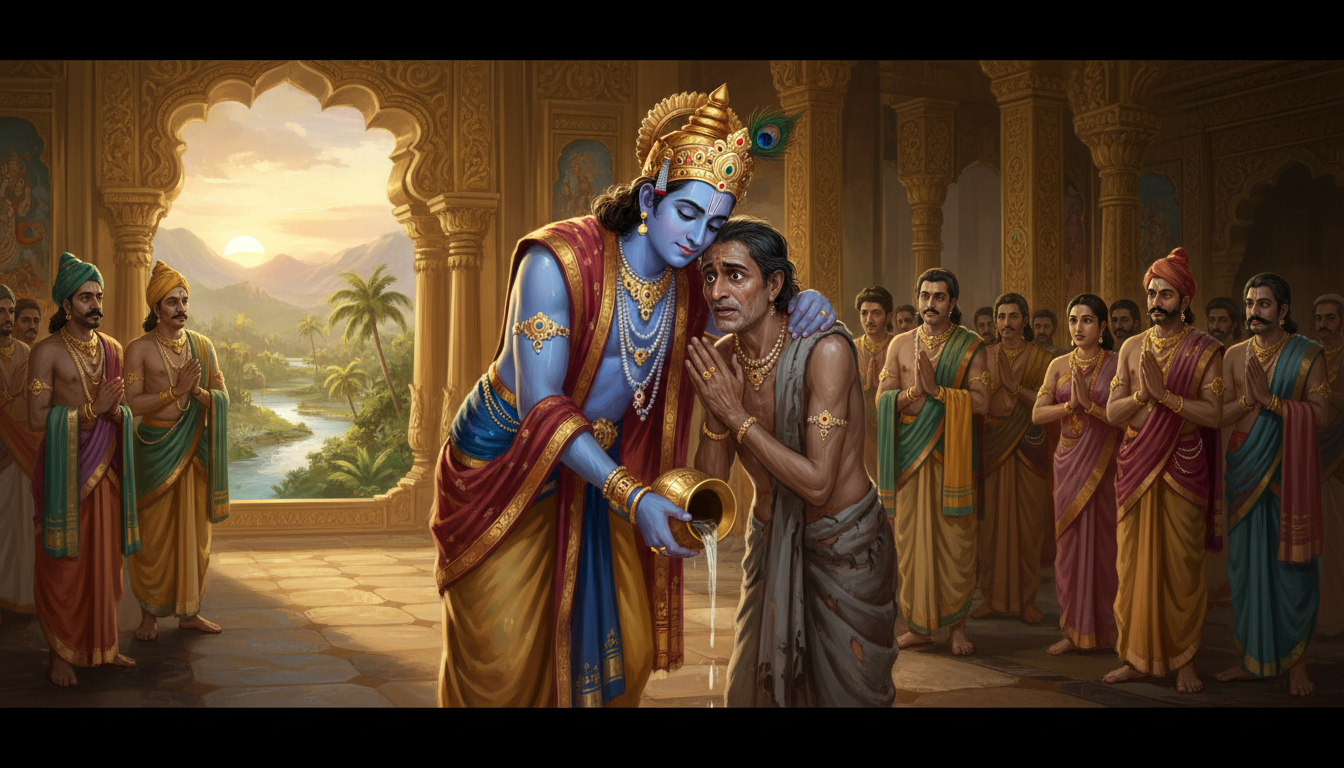
Bhagavad Gita Chapter 13, Verses 1-18: Field and Knower of the Field
Body as field, humility as knowledge
The Body Is Called a Field
Between the armies, the teaching reached the point where Arjuna wanted the vocabulary itself explained. In verse 13.1 he asks about six terms: prakriti and purusha, nature and the person; kshetra and kshetrajna, the field and the knower of the field; jnana and jneya, knowledge and what is to be known. Some editions do not count this question as a verse of the chapter, so their numbering runs one lower throughout, but the sequence of the argument is the same.
Krishna answers with a definition in verse 13.2. This body, Kaunteya, is called the kshetra, the field. Whoever knows it is called by those who know such things the kshetrajna, the knower of the field.
The word chosen does more than the English body suggests. A kshetra is farmland, ground that is ploughed and sown and reaped. It is where things grow, and where the consequences of what was sown eventually come up. To call the body a field is to say three things at once: that it is worked, that it yields, and that it is not the farmer.
Verse 13.3 then turns a piece of psychology into theology in a single line. Know me also as the knower of the field, in all fields. The awareness looking out of Arjuna is not a private flame lit at his birth and put out at his death. It is the same knower in every field there is, and the fields are countless. Knowledge of the field and its knower, Krishna adds, is in my view the real knowledge.
Verse 13.4 sets the syllabus for what follows: hear briefly from me what that field is, what it is like, what its modifications are, where it comes from, and who the knower is and what his powers are.
It is a striking place to be told all this. Arjuna is standing on a field of a different sort, and the chapter opens by informing him that the more consequential field is the one he is standing in.
What the Field Contains
Verse 13.5 pauses to say where the teaching comes from. It has been sung by sages in many ways, in various hymns, and in the reasoned and conclusive verses about brahman. Krishna is not announcing a novelty. He is compressing a tradition into a few lines.
Then verses 13.6 and 13.7 open the field and inventory what is in it, and the inventory is the surprise of the chapter.
The great elements, ahankara, buddhi and the unmanifest; the ten senses and the one more, which is mind; and the five objects of the senses. Then, in the same breath and the same list: desire, aversion, pleasure, pain, the aggregate, awareness, and firmness. This, briefly stated, is the field together with its modifications.
Read that slowly, because everything depends on what has been placed inside the field rather than outside it. Not merely bone and blood. The elements, yes, and the senses and the things they reach for. But also ahankara, the I-maker, the faculty that manufactures the sense of being a separate somebody. Also buddhi, the intelligence that weighs and decides. And then desire and aversion, pleasure and pain, the whole emotional weather of a life. And chetana, awareness as a working capacity, and dhriti, the firmness with which a man holds on to things.
Everything Arjuna would ordinarily have called himself is on that list. His courage is in the field. His grief for his teachers is in the field. His judgement is in the field. His very sense of being Arjuna, son of Kunti, is in the field.
What is not on the list is the one for whom the list appears. The chapter's method is subtraction, and it cuts far deeper than the ordinary distinction between body and soul, because it puts the entire personality on the body's side of the line.
Knowledge Turns Out to Be Conduct
Then, with no warning at all, verse 13.8 begins a definition of knowledge, and it contains no information whatever.
Absence of pride; absence of pretence; non-violence; patience; uprightness; service to the teacher; purity; steadiness; self-control. Indifference to the objects of the senses, absence of egoism, and the steady sight of the pain and the evil in birth, death, old age and disease. Non-attachment, and the absence of clinging to son and wife and home; constant evenness of mind in what is wanted and what is not. Unswerving devotion to me by undivided yoga; resort to quiet places and a distaste for crowds. Constancy in knowledge of the self, and sight of the goal of true knowledge. This, Krishna says at the end of the run in verse 13.12, is declared to be knowledge. What is contrary to it is ignorance.
A reader who came to the chapter for metaphysics has just been handed a list of manners. Amanitvam is not thinking oneself grand. Adambhitvam is not performing one's virtue for an audience. Acharya upasanam is showing up, in person and repeatedly, for whoever teaches you.
The claim underneath is the important one. The Gita is not saying that good conduct is a prerequisite for knowledge, a fee paid at the door before the real subject begins. It is saying that this conduct is what knowledge looks like from the outside. If a man announces that he has understood the one self seated in all beings, and he is arrogant with servants and impatient with his elders, the chapter does not call him an unpolished knower with more work to do. It calls his condition ajnana.
The line about steady sight of birth, death, old age and disease is the darkest of them and the least sentimental. It asks a person not to look away from the terms of the arrangement he was born into.
Hands and Feet Everywhere
Verse 13.13 turns to the second half of the pair. I shall declare that which is to be known, by knowing which one attains the deathless. It is beginningless, the supreme brahman, said to be neither being nor non-being.
That last clause is a warning label. What follows will not fit the categories a mind brings to it, so the verses proceed by contradiction on purpose.
Verse 13.14: with hands and feet everywhere, with eyes and heads and faces everywhere, with hearing everywhere, it stands enveloping all. The picture is deliberately impossible to draw. It is not a giant. It is the claim that wherever in the world there is a hand doing something or an eye seeing something, that is where this is acting and looking.
Verse 13.15 keeps the contradictions coming: shining through the functions of all the senses, and yet free of the senses; unattached, and yet supporting everything; free of the gunas, and yet the one who experiences them.
Verse 13.16: outside and inside all beings; unmoving and also moving; too subtle to be known; far away and near at hand. Far and near in the same breath. The verse describes something that cannot be approached by travelling and cannot be missed by standing still.
Verse 13.17 is the one that matters most for what the chapter has been building. Undivided, and yet it stands as though divided among beings. That is the whole riddle of the field. The knower is one; the fields are many; and the appearance of many separate knowers is a property of the fields, not of the knower. It is to be known, the verse adds, as the sustainer of beings, and their devourer, and the one who brings them forth.
Then verse 13.18 stops arguing and simply says it. It is the light even of lights, beyond all darkness. It is knowledge, the object of knowledge, and the goal of knowledge, seated in the heart of everyone.
Seated in the Heart of Everyone
Eighteen verses have done two things that do not obviously belong together, and the join between them is the useful part.
The first is the subtraction. Everything a person normally calls himself has been placed inside the field: the elements of the body, the senses, the mind, the intelligence that reasons, the I-maker that produces the sense of being somebody in particular, and the whole weather of desire, aversion, pleasure and pain. What is left over is not another item on the list. It is the one for whom the list appears. A modern reader can test the move without believing anything in advance, since whatever can be noticed is not the noticer, and a personality is entirely noticeable.
The second is that definition of knowledge in verses 13.8 to 13.12, and it is what keeps the first from becoming a private hobby. Having set up the most abstract distinction in the poem, Krishna defines the knowledge of it as humility, the absence of showing off, patience, non-violence, straightforwardness, staying with a teacher, evenness in fortune good and bad, and a refusal to look away from disease and age and death. Not a syllabus. A way of behaving in a house.
Put the two together and the logic of the chapter appears. If the knower is one and the same in every field, then arrogance is not merely a vice but a mistake about the facts, and cruelty is a misunderstanding acted out on somebody. The conduct list is not a code bolted on to the metaphysics for the sake of respectability. It is what the metaphysics looks like when a person actually believes it.
Which is why the chapter can end with the light of lights seated in the heart of everyone and mean the word everyone strictly. Arjuna, still in his chariot, still with the day's work in front of him, is being told that what he is looking for is not somewhere else, and neither are the people he is looking at.
Dharma Lesson
The chapter's inventory of the field is more radical than the usual split between body and soul, because it places the mind, the intelligence and the very sense of being somebody inside the field, leaving only the one for whom all of it appears. Having drawn the most abstract distinction in the poem, Krishna then defines knowledge of it as conduct: humility, absence of pretence, patience, service to the teacher, and a steady refusal to look away from age, disease and death. If the knower is one in every field, arrogance is not merely a vice but a mistake about the facts.