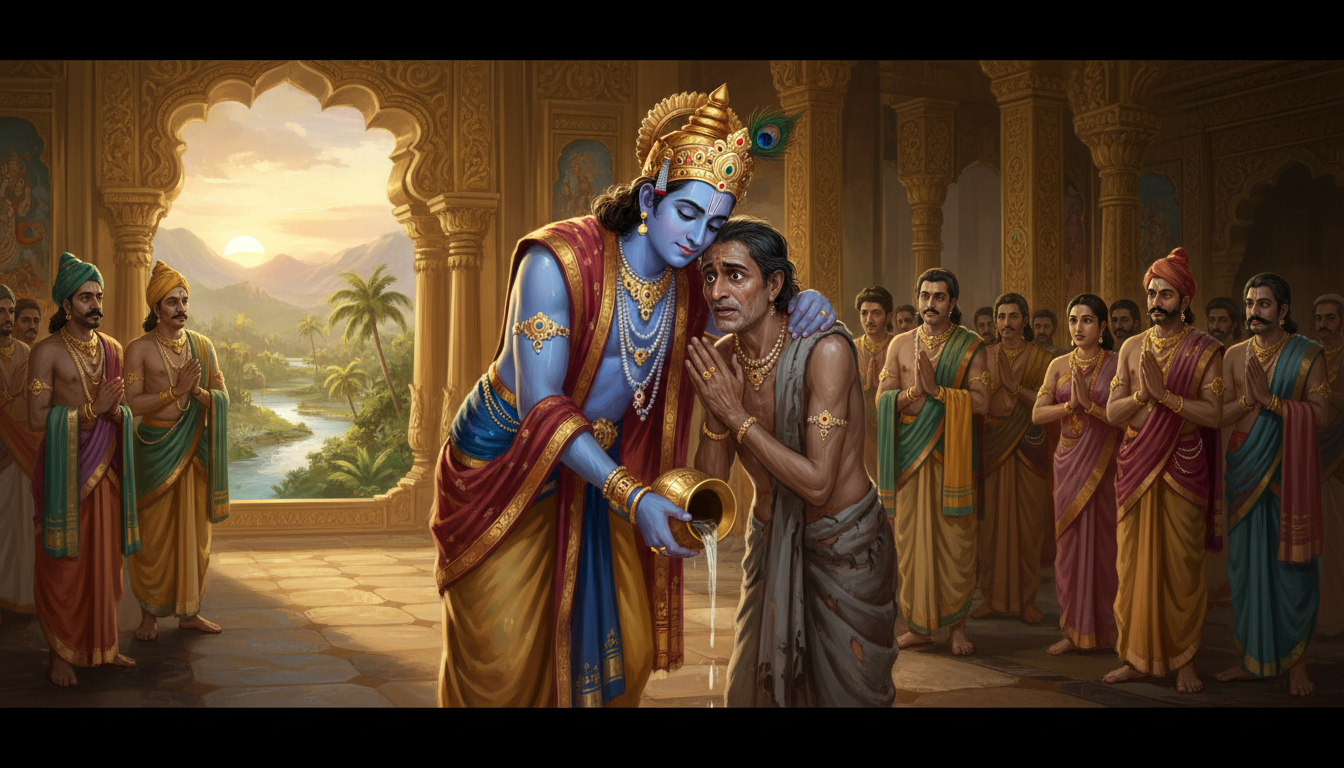
Bhagavad Gita Chapter 14, Verses 14-27: Crossing the Gunas
The one who watches the qualities operate
Where the Ropes Lead
Having taught Arjuna to recognize sattva, rajas and tamas by their signs, Krishna now told him where each one carries a soul when the body finally gives out. The teaching had moved, in the space of a few verses, from a diagnostic for the living hour to a map of what follows death.
"When one dies while sattva is predominant," Krishna said, "one attains the stainless worlds of those who know the highest." A life spent mostly in clarity, contentment and the pursuit of understanding tends, at its close, toward realms of comparable subtlety, untainted regions reserved for those whose habitual state was light rather than heat or fog. "Dying in rajas, one is born among those attached to action," he continued, and here the destination was recognizably human, another life among strivers, traders, builders, people whose days are governed by ambition and restless doing. "Dying in tamas, one is born in the wombs of the deluded," Krishna said, the plainest and grimmest of the three, a rebirth into confusion answering the confusion that had governed the life before it.
Then he offered the moral weight each guna carries, stated almost like a rule of grammar. "They say the fruit of good action is sattvic and stainless, the fruit of rajas is sorrow, and the fruit of tamas is ignorance." Good, painful, and dulling, in that order, matched exactly to the quality that produced the action in the first place. Nothing escapes this accounting; every deed ripens into fruit shaped by the guna that grew it.
"From sattva arises knowledge, from rajas greed, and from tamas alone arise heedlessness, delusion and ignorance," Krishna added, before giving Arjuna the single sentence meant to summarize the whole cosmic traffic pattern. "Those established in sattva go upward, those in rajas remain in the middle, and those in tamas, abiding in the lowest guna's ways, go downward." Three roads, one crossroads, and every soul standing at it whether it knows so or not.
The Turn Beyond the Roads
Having laid out the three roads so precisely, upward, level and downward, Krishna now did what he had done at several earlier turns in the teaching: he showed Arjuna a fourth possibility hiding behind the first three, not another road but an exit from the whole system of roads.
"When the seer perceives no agent other than the gunas," Krishna said, "and knows that which is beyond the gunas, he attains My state of being." This was the pivot the entire chapter had been building toward. A person still choosing among the three roads is still, in some sense, inside the traffic, still identified with whichever quality currently drives the chariot of the body and mind. But a person who sees clearly that sattva, rajas and tamas are the only actors on this particular stage, that nothing called I ever actually does anything, that the self merely watches the three qualities perform their turns, such a person is no longer traveling any of the three roads at all, because they are no longer mistaking themselves for the traveler.
Krishna made the stakes of this seeing explicit. "The embodied one who transcends these three gunas, from which the body arises, freed from birth, death, old age and sorrow, attains immortality." It was the largest promise the chapter had yet made, and it rested entirely on the small, exacting act of perception described a sentence earlier. Not a ritual, not an austerity, not even a virtue in the ordinary sense, but a seeing.
Arjuna weighed this. Every earlier stretch of the teaching had asked something of him, disciplined action, surrendered results, steady meditation. This asked, at bottom, for a single recognition to be held clearly enough that it stopped flickering in and out of view: that the gunas act, and nothing else does, and he, the watcher, had never been one of the three. If that recognition could be made to stay, Krishna was telling him, birth and death themselves lost their grip.
It was a large claim to make quietly, on a chariot, in the last hush before an army moved. Arjuna did what he had learned to do at such moments. He asked.
Arjuna's Question
"By what marks is one known, O Lord, who has crossed beyond these three gunas," Arjuna asked. "What is his conduct, and how does he go beyond these three gunas?" It was a practical question dressed as a philosophical one, the kind Arjuna had asked before and would ask again, because he was, at heart, less interested in doctrine for its own sake than in knowing what a certain kind of life actually looked like from the outside.
The question mattered because everything Krishna had just described, the seeing of no agent but the gunas, the crossing beyond birth and death, could sound like a private, invisible event, something that happened entirely inside a person's understanding with no outward trace at all. If that were true, it would be nearly useless as a teaching, since no one, including the person themselves, could ever check their own progress against it. Arjuna wanted the marks. He wanted to know what such a person did with their hands, their words, their attention, when light arrived and when it left, when action pressed in and when it withdrew, when confusion settled over a room.
He also wanted to know something more personal, though he did not say it outright. He was about to walk out onto a field where every guna would be provoked at once, fear and courage, grief and duty, the heat of combat and the exhaustion that would follow it. If there existed a way of standing inside all of that without being dragged by any of it, he needed a description precise enough to aim at, not a promise too abstract to use.
Krishna did not delay the answer, and did not soften it into vague praise of detachment. He gave Arjuna, in the next four verses, one of the most exact character portraits in the entire text, built entirely out of things a person does and does not do when light, activity, or heaviness arise and pass. It was, in its way, an answer built for a warrior rather than a hermit, and Arjuna listened for exactly that reason.
The Portrait of the One Beyond
"He who does not hate light, activity and delusion when they arise, O Pandava, nor longs for them when they cease," Krishna began, and already the portrait cut against instinct. Most people, he implied, either chase sattva's clarity and resent its absence, or catch themselves indulging rajas and then scold themselves for it, or fall into tamas and despair at their own heaviness. The one who has crossed the gunas does none of this. Light comes, and there is no clinging when it goes. Activity rises, and there is no self-congratulation while it lasts. Even delusion, the least flattering of the three, arrives and departs without triggering shame.
"Seated as if unconcerned, he is not shaken by the gunas," Krishna continued. "Knowing that only the gunas are operating, he stands firm and does not waver." This was the practical marker Arjuna had asked for, stated almost as a private sentence such a person might repeat to themselves in the middle of any storm: the gunas are operating. Not I am failing, not I am succeeding, simply a quiet naming of what is actually happening, quality moving through quality, nothing more.
"The same in pleasure and pain, dwelling in the self, regarding a clod of earth, a stone and gold as alike," Krishna said, pressing the portrait further into territory most people would find nearly impossible, "the same toward the pleasant and the unpleasant, wise, the same in censure and self-praise." And then the line built precisely for the field below them: "the same to friend and foe, having abandoned all undertakings, he is said to have crossed the gunas."
Arjuna heard in that last phrase, friend and foe treated alike, a return to the very grief that had opened the whole dialogue, his refusal to raise a bow against kinsmen he loved. Krishna was not telling him to stop loving them. He was describing a state in which love and hatred alike no longer determined the shape of right action, because the one who acted had stopped mistaking the gunas' turbulence for the truth of who anyone, friend or foe, really was.
The Shortcut and the Takeaway
Krishna closed the portrait with an offer that softened everything that had come before it. "He who serves Me with unwavering devotion, having crossed beyond these gunas, is fit for becoming Brahman," he said. All the discipline of seeing no agent but the gunas, all the equanimity toward gold and stone, friend and foe, could also be reached by a plainer road, steady devotion to the divine, love held constant enough that it quietly dissolved the grip of sattva, rajas and tamas without requiring a philosopher's precision along the way. It was the same generosity Krishna had shown earlier in the discourse, refusing to make the highest goal the property of only the most disciplined minds.
For a reader far from any battlefield, this stretch of the Gita offers something unusually testable. Most spiritual teaching asks for faith in outcomes no one can verify in a lifetime. This one asks only that a person watch their own hour, the way Krishna taught two chapters back, and notice a further, quieter fact: that praise inflates and blame deflates, that a rival's failure feels sweeter than it should and a friend's success occasionally stings before generosity catches up, that gold genuinely does look different to the eye than a stone does. None of this is a moral failing to Krishna's account. It is simply evidence that the gunas are still operating, still assigning different weights to things that are, at the level the teaching insists on, level.
The crossing described here is not indifference dressed up as wisdom, and it is not the numbness of someone who has stopped caring. It is closer to a shift in address, from a person swept along by whichever quality currently has the upper hand, to a person who can name what is happening, gold or stone, friend or foe, light or fog, without the naming itself being seized by the very quality it describes. That, Krishna suggests, is available to anyone willing to watch closely and love steadily, on a battlefield or in an ordinary week.
Dharma Lesson
Each guna carries a soul to a different destination at death, upward through sattva, level through rajas, downward through tamas, but the one who sees no agent besides the gunas themselves and knows what lies beyond them crosses birth, death, old age and sorrow entirely. That crossing shows itself as an equal eye toward praise and blame, friend and foe, and Krishna offers unwavering devotion as the surest way to reach it.