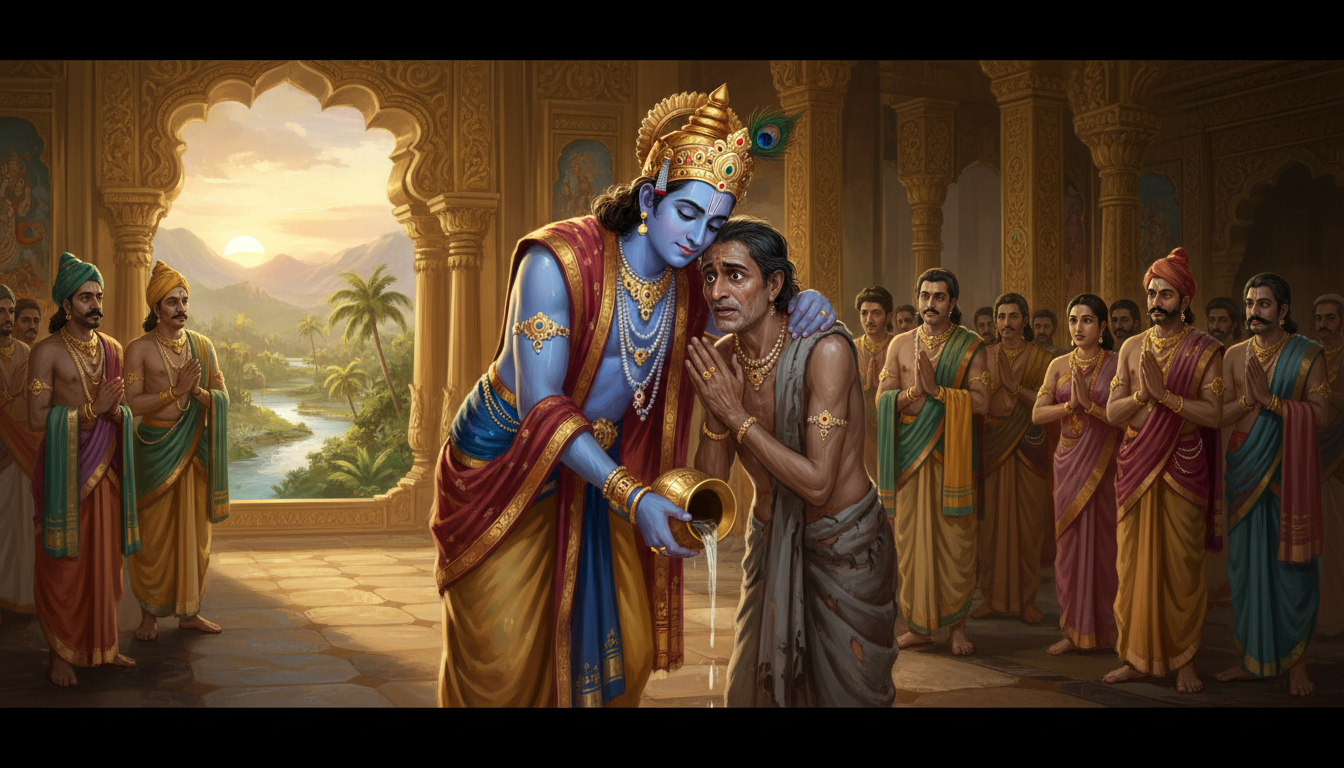
Bhagavad Gita Chapter 14, Verses 1-13: The Three Gunas
Ropes of gold, fire and lead
The Great Womb
Krishna paused, as he sometimes did between movements of the teaching, and told Arjuna that what came next was knowledge beyond even what had already been given, the highest of all knowledge, by knowing which sages had gone from this world to the highest perfection.
"Great Brahman is a womb to me," he said, "in which I place the seed, and from that union comes the birth of all beings." It was an image drawn from the most ordinary fact of life, conception, and applied to the origin of everything that exists. Nature herself, vast and undifferentiated, is the womb; Krishna, the source, plants within her the possibility of form; and from that meeting every creature, in every one of the many wombs that follow, receives its particular body.
"Whatever forms are produced in any womb whatsoever," Krishna continued, "great Brahman is their womb, and I am the seed-giving father." Arjuna took in the strangeness of it, a teaching that had spent chapters distinguishing the self from the body now describing all bodies, everywhere, as children of a single cosmic parentage. It was not a contradiction so much as a change of altitude; from up here, the whole churn of birth and death looked like one family.
The purpose of the image became clear as Krishna moved on. If every form owes its shape to this same womb, then the qualities that color those forms, the raw material out of which temperament and circumstance are woven, must also come from that same source. Which was, Krishna said, exactly what he meant to explain next: sattva, rajas and tamas, the three gunas born of prakriti, that bind fast in the body the imperishable dweller within.
Arjuna understood the sentence as a hinge. Everything said before about the self being untouched by prakriti's action still held. What followed would explain, in close and practical detail, how prakriti nonetheless manages to feel like a rope around that untouched self.
The Chain of Gold
"Sattva, rajas, tamas," Krishna said, naming them in the order they are usually named, though he was careful to add that none of the three held any natural precedence over the others in binding a soul. "These gunas, born of prakriti, bind fast in the body the imperishable embodied one, O mighty-armed one." A rope is a rope whatever its color, and all three, he wanted Arjuna to understand from the start, were varieties of the same bondage.
He began with sattva, the quality most often praised, and did not let the praise obscure the mechanism. "Of these, sattva, being stainless, is luminous and free from sickness," Krishna said. "It binds by attachment to happiness and by attachment to knowledge, O sinless one." This was the subtlety Arjuna had to sit with. Sattva is not the enemy of the other two the way virtue is sometimes imagined as opposed to vice; it is simply the finest of the three ropes, spun of light rather than heat or dark, but a rope all the same. A scholar absorbed in the pleasure of understanding, a person contented in a life of clarity and calm, both stand on excellent ground compared to greed or sloth, and both are still, in the strictest sense the Gita insists on, bound. Attachment to happiness, even the refined happiness of insight, is still attachment.
Krishna let this land before drawing the comparison outright. Sattva's chain, he implied without needing the metaphor spelled out further than the word itself suggested, is made of gold, beautiful to wear, comfortable against the skin, and no less a chain for that. A prisoner who loves his shackles is still a prisoner, though he suffers less than one who fights his.
Arjuna, who had spent his life cultivating exactly the discipline and clarity sattva describes, felt the teaching land closer to home than he expected. He had assumed virtue was the finish line. Krishna was telling him it was the last and finest obstacle before the finish line, not the finish line itself.
Fire and Lead
Having placed gold on the scale, Krishna turned to the other two metals of the same coinage. "Know rajas to be of the nature of passion, arising from thirst and attachment," he said. "It binds fast the embodied one, O son of Kunti, by attachment to action." Where sattva's rope glowed quietly, rajas burned. It is the guna of the restless builder, the ambitious commander, the trader who cannot stop calculating the next transaction even in sleep. Its root, Krishna said plainly, is trishna, thirst, a craving that never quite reaches the water it seeks and so keeps the body moving, striving, accumulating, mistaking motion itself for progress.
A rope of fire binds by heat rather than weight; it does not feel like captivity so much as urgency, the sense that one more effort, one more victory, one more acquisition will finally bring rest. Krishna did not say the rest never comes. He said the craving keeps generating fresh reasons for action long after any reasonable need has been satisfied, which is precisely how it holds a person fast.
Then the third and heaviest of the three. "Know tamas to be born of ignorance, deluding all embodied beings," Krishna said. "It binds fast, O Bharata, by heedlessness, indolence and sleep." Where rajas burns, tamas smothers. It is the fog that settles over a mind too dulled to distinguish right effort from wrong, the inertia that mistakes stillness for peace when it is really just neglect. A rope of lead does not need to be pulled taut; its own weight is enough to keep a person from rising.
Arjuna could see, laid out this way, that he had feared only the crudest of the three all along, the sloth and confusion of tamas, the very inertia he had briefly fallen into when he first let his bow drop. He had not yet reckoned with how the golden rope of sattva and the burning rope of rajas might bind him just as surely, only more comfortably.
Taking Turns
"Sattva attaches one to happiness, rajas to action, O Bharata," Krishna said, gathering the three together now, "while tamas, veiling knowledge, attaches instead to heedlessness." And then he added the detail that turned three static categories into a living weather system inside every person. "Sattva prevails, overpowering rajas and tamas. Rajas prevails, overpowering sattva and tamas. Likewise tamas prevails, overpowering sattva and rajas."
No guna holds permanent rule. A person is not simply sattvic or simply tamasic by fixed nature, the way a piece of iron is simply iron. Each quality rises for a season and is pushed down again by the others, in a single day, sometimes in a single hour. The disciplined, clear-eyed calm of a good morning can collapse by afternoon into restless ambition, and restless ambition, spent, can slump by evening into the heaviness of tamas. Krishna wanted Arjuna to notice this churn rather than assume he stood permanently on one side of it.
He then gave the diagnostic Arjuna, and every listener after him, could actually use. "When the light of knowledge shines forth in all the gates of this body, then it may be known that sattva has increased," Krishna said. A mind suddenly clear, senses suddenly alert without strain, a settled ease behind the eyes, these mark sattva's rise. "Greed, activity, the undertaking of actions, restlessness, craving, these arise when rajas increases, O best of the Bharatas." A person can feel this one arriving as a kind of itch, an inability to sit still, a hunger for the next thing before the current thing is finished. "Darkness, inertia, heedlessness and delusion, these arise when tamas increases, O joy of the Kurus."
Krishna was not offering these as abstract categories for later study. He was handing Arjuna a mirror to check against, right there on the chariot, in the hour before battle.
Reading Your Own Hour
What makes this stretch of teaching useful long after the specifics of any battlefield have faded is the plainness of the test Krishna offers. He does not ask Arjuna to consult a scripture or a teacher to know which guna currently governs him. He asks him to look.
Is there a clarity this morning, an ease of attention that makes the right next action almost obvious, without strain or hurry. That is sattva, the golden rope, pleasant to wear and still, the Gita insists, a rope. Is there instead a restlessness, a mind already three tasks ahead of the hands, a craving for more that arrives disguised as ambition or diligence. That is rajas, burning and productive and never quite satisfied. Or is there heaviness, a reluctance to begin anything, a fog that makes even simple choices feel unbearable. That is tamas, the dullest and heaviest rope, though Krishna is careful never to call it the wickedest; it is ignorance rather than malice, and it responds to rest and clarity rather than to punishment.
The modern reader, far from any chariot, still lives inside this weather. A workday can move from sattvic focus at dawn to rajasic overreach by noon to tamasic collapse by nine at night, and the temptation is to judge the collapse harshly while congratulating the focus. Krishna's teaching resists that judgment. All three are prakriti's doing, none of them the true self, and the practical use of naming them is not shame but recognition. A person who can say, plainly, that is rajas rising in me right now, has already loosened the rope a little, because naming a guna is the first act that does not itself belong entirely to the guna.
The chapter does not yet say how to get free of all three. That answer comes next. For now, Krishna has simply taught Arjuna, and every reader since, how to read the hour honestly, gold, fire or lead, before deciding what to do about it.
Dharma Lesson
Sattva, rajas and tamas are the three ropes by which embodied life binds itself, through happiness and knowledge, through restless craving, or through heedlessness and sleep. None of the three is the self; all three take turns overpowering one another in every living creature. Learning to read which rope currently holds you is the first step toward loosening it.