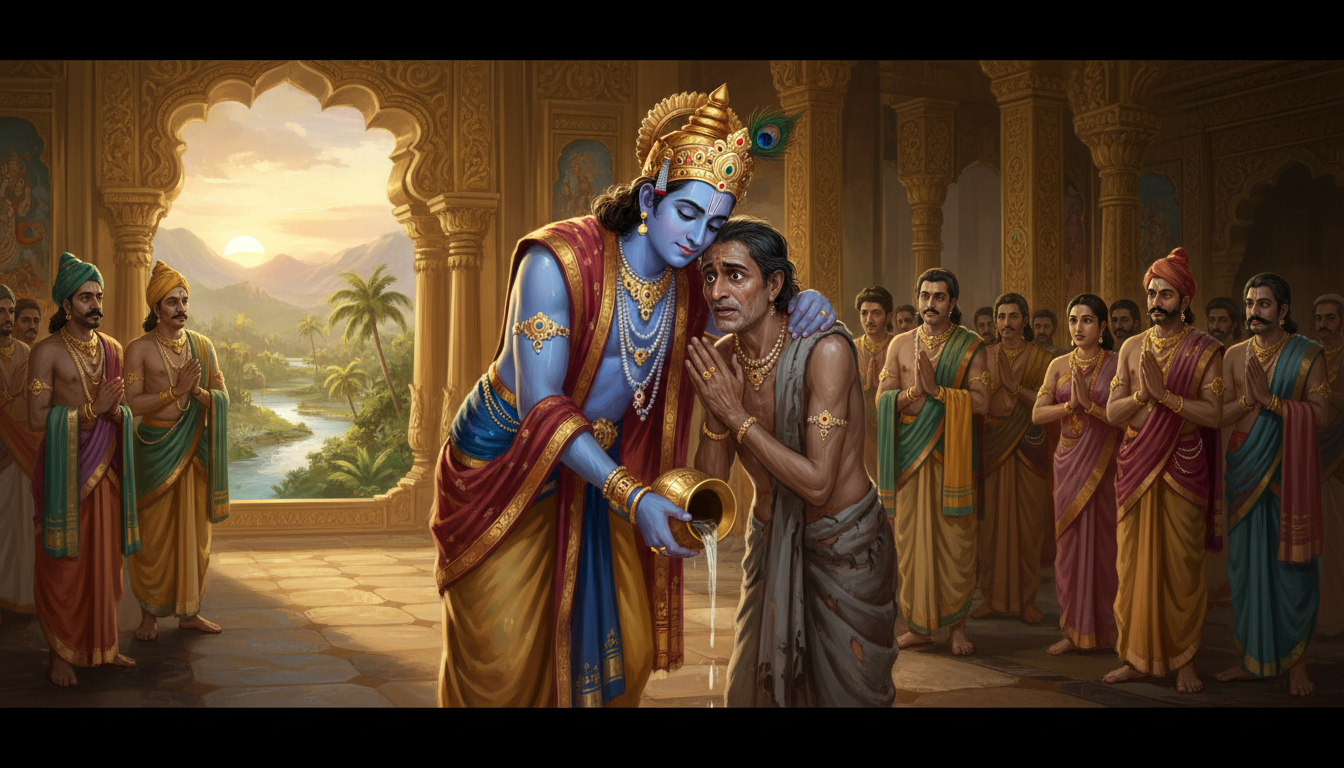
Bhagavad Gita Chapter 15, Verses 12-20: Purushottama
The light in the sun, the fire in the belly, the memory in the heart
The Light in Sun and Moon and Fire
Krishna had just finished describing a tree that had to be cut and a fragment of himself that travelled from body to body like fragrance carried on the wind. Now, without a break, he changed register entirely and began making claims about things Arjuna could see from where he was standing.
In verse 15.12 he says: the splendour that belongs to the sun and illumines the whole world, and that which is in the moon and in fire, know that splendour to be mine.
It is a smaller claim than it first sounds, and also a much larger one. Krishna does not say that he is the sun. He says the illuminating power in it is his, the tejas, the shining. The sun over Kurukshetra remains the sun; the fires burning in the camps remain fires; but the capacity in each of them to make other things visible is traced back to a single source that is not itself any of the three.
This matters because of what he had said six verses earlier. In 15.6 the highest abode was described as lit by neither sun nor moon nor fire. Now the same three lights return and their brightness is claimed as his own. The two statements only look opposed. The abode needs no borrowed light because it is the place light comes from; the sun and the moon and the household hearth are borrowers, and what they lend to the world was never manufactured on the premises.
What follows over the next several verses is a sequence of claims of exactly this shape, each of them locating Krishna not above the world in some remote seat but inside a specific and ordinary function of it: holding, nourishing, digesting, remembering. Read quickly they blur into a hymn. Read slowly they form an argument, and it is an argument about where to look for the divine when nothing extraordinary is happening at all.
Entering the Earth, Becoming the Sap
The next verse moves from light to weight. In verse 15.13 Krishna says: entering the earth, I support all beings with my energy; and having become the sap-bearing moon, I nourish all plants.
The first half names the plainest fact of embodied life, that things stay where they are put. Feet stay on the ground, the ground holds armies and cities and elephants, and none of it flies apart. Krishna calls this ojas, vigour or energy, and he claims it as an act of his own: not a decree issued from a distance but something done by entering, having gone into the earth. Arjuna is not being asked to imagine a god propping the world up from somewhere outside it. He is being told that whatever it is in matter that keeps on holding is the same presence that has been driving his chariot all morning.
The second half is stranger and more beautiful. Soma, in the older tradition, is at once the moon and the sap of plants and the pressed juice of the sacrifice, and Krishna claims the whole cluster: becoming the moon of taste and sap, he nourishes every growing thing. The image belongs to a world that watched the night sky closely and held that the moon's waxing and waning ran in the same rhythm as the rising of juice in stalk and stem.
A reader now can keep the point without keeping the botany. Krishna is naming the two things any living body needs before it needs anything else: something to stand on, and something to eat. Not consolation, not doctrine, not vision. Ground and food.
And he places himself in both, not as their giver standing apart with a full hand, but as the actual functioning of holding and of nourishing. The support is not sent from elsewhere. It is what is already happening, everywhere on that field, under the feet of two armies about to destroy each other.
Vaisvanara, the Fire in the Body
Then comes the verse that ordinary households have kept alive far longer than any commentary. In verse 15.14 Krishna says: becoming vaisvanara, I abide in the bodies of living beings, and joined with the upward and downward breaths, prana and apana, I digest the fourfold food.
Vaisvanara means the fire belonging to all people, and the claim is domestic to the point of bluntness. The god who a moment ago was the brightness of the sun is now the heat in the stomach of every soldier on that field, quietly breaking down whatever they ate before dawn. The four kinds of food are the traditional classification of what a body takes in: what is chewed, what is swallowed, what is licked and what is sucked. Nothing is left outside the reckoning, no category of eating judged too trivial to name.
This is why the verse is recited before meals in many homes to this day, spoken over rice and lentils by people who may never open the chapter that surrounds it. The recitation is not a request for a blessing on the food. It is an acknowledgement that the fire about to receive it is already the guest, that eating is a small offering made into a fire that lives in the body and needs no altar built for it.
Set in sequence, the movement of these three verses is deliberate. First the light in the sun, immense and distant and impossible to approach. Then the holding of the earth and the sap in plants, nearer, still impersonal. Now the warmth under a person's own ribs, working steadily whether or not anyone is thinking about it, joined to the two breaths that continue all night without instruction.
Krishna is closing the distance verse by verse. He began at the horizon. By 15.14 he is inside the listener, doing something for him that the listener never learned how to do.
Seated in Every Heart
The closing of that distance completes itself in verse 15.15, the verse most readers of this chapter remember longest.
I am seated in the hearts of all, Krishna says: sarvasya caham hrdi sannivistah. From me come memory, knowledge, and their loss. And it is I who am to be known by all the Vedas; I am the author of Vedanta and the knower of the Veda.
The first half is a claim of location and the second a claim of authorship, and the small clause between them is the one that unsettles people. Memory and knowledge coming from the divine is a familiar enough idea. But apohana, the taking away, the losing, is set in the same list, in the same breath, and given the same source. Krishna does not present forgetting as an accident or a defect in the machine. Whatever it is in a person that lets things drop out of reach, that loses the thread, that fails to recall at the moment of need, is named as coming from the same seat as the remembering.
Arjuna would have felt the weight of that on this particular morning. He had spent the whole conversation forgetting and then recovering things he already knew, collapsing in his chariot over facts about death and duty that nobody had to teach him from the beginning. The verse tells him where both movements originate.
The second half then makes a bolder claim still. The entire scriptural apparatus whose hymns were called the leaves of the tree back in 15.1 has, as its object, the speaker holding the reins. He is what the Vedas are for. He is the source of their culminating teaching and at the same time the one who knows it.
So the leaves are not discarded after all. They are pointed. And the direction they point runs inward, to a seat in the heart that was never located anywhere else.
The Person Beyond Both
Only now, with the ground prepared, does Krishna give the chapter its name.
There are two purushas in this world, he says in verse 15.16: the perishable and the imperishable. Kshara is all beings, everything that comes into being and passes out of it; akshara is called the unchanging, that which does not alter through any of it. Then verse 15.17: but there is another, the highest Person, uttamah purushah, called the paramatman, who having entered the three worlds sustains them as the imperishable lord.
And verse 15.18 draws the conclusion and the title together: because I transcend the perishable and am higher even than the imperishable, therefore I am celebrated in the world and in the Veda as purushottama, the supreme Person.
The structure matters. Krishna is not merely saying that spirit outranks matter, a claim most schools of his time would have granted without argument. He is placing a third term above both halves of that familiar pair. The changing world is real and perishable; the unchanging principle behind it is real and imperishable; and the one speaking is neither, having entered the three worlds while remaining exactly what he was.
Verse 15.19 makes the practical turn: whoever, undeluded, knows me thus as purushottama knows all, and worships me with his whole being, sarva-bhavena. Not with a portion of attention set aside for the purpose. With the whole of what he is.
Then 15.20 closes the chapter by calling itself a sastra, the most secret teaching, and promising that one who understands it becomes buddhiman and krta-krtya: awake, and one who has done what there was to do.
That last phrase is the section's gift to a reader now. Krta-krtya is not a reward for accumulating anything further. It is the condition of a person who has stopped hunting for the one missing piece, having noticed that the light he reads by, the ground he stands on, the food he digests and the memory he thinks with were never separate errands in the first place.
Dharma Lesson
Krishna locates the divine not in a distant seat but in the plainest functions of being alive: the light that lets a person see, the ground that holds him up, the food that feeds him, the fire that digests it, and the memory he thinks with. Because the same source gives both remembering and forgetting, neither one is finally an accident. To know this is to become krta-krtya, one who has done what there was to do, a state that comes not from acquiring a missing piece but from noticing that these were never separate errands.