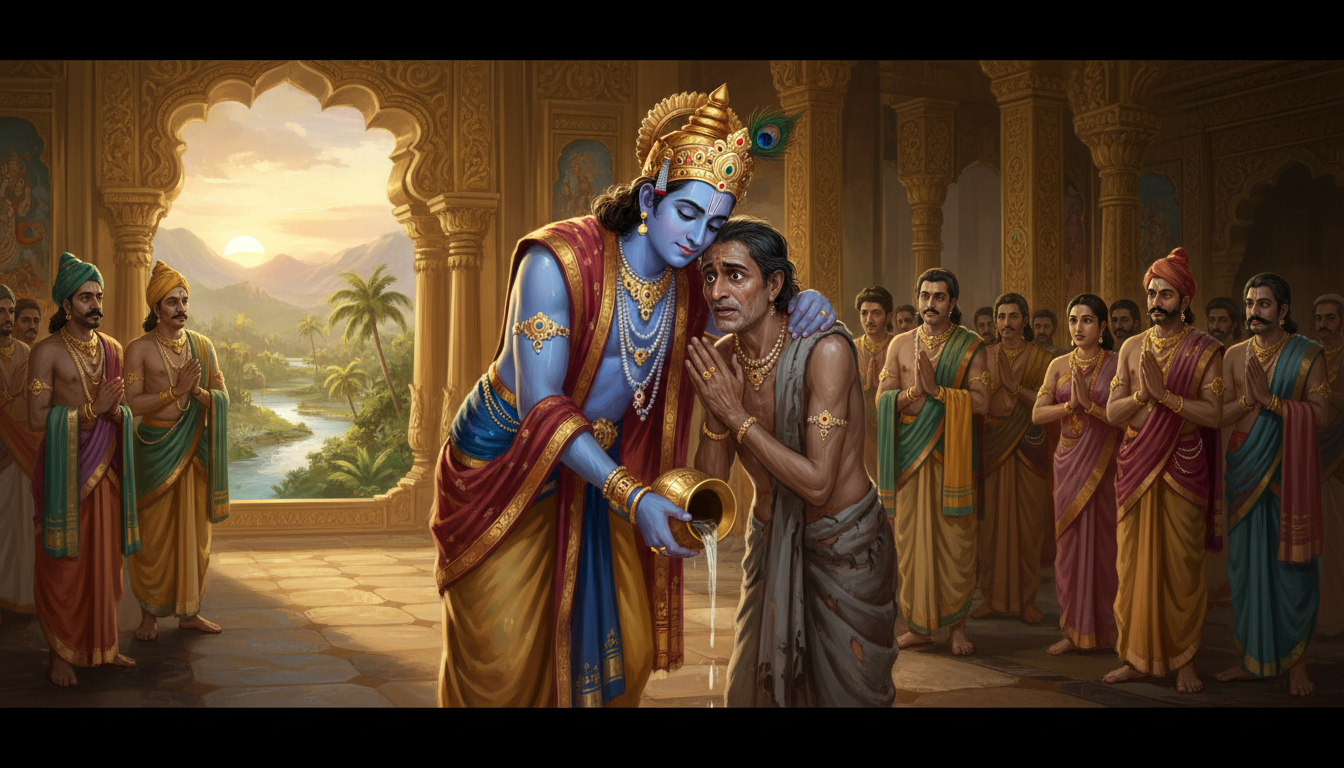
Bhagavad Gita Chapter 13, Verses 19-35: Prakriti, Purusha, and the Witness
Seeing the imperishable in the perishing
Two Roots of All Things
The armies had gone quiet in the middle distance, banners drooping in the noon stillness, while on the chariot between them Krishna continued the teaching he had begun with the field and its knower. Arjuna had asked what distinguished the seer from the seen, and now Krishna gave the answer in its barest form.
"Know that prakriti and purusha are both without beginning," he said. "Nature and the person who dwells in nature have no starting point one can point to, no first day. And know too that the transformations of quality, the gunas that color every experience, are born of prakriti alone."
He explained the division carefully, the way a physician might separate symptom from patient. Prakriti, he said, is called the cause in the matter of instrument and deed, the maker of body, senses and action, the machinery of doing. Purusha, by contrast, is called the cause in the experience of pleasure and pain, the one who tastes what the machinery produces without ever operating its levers.
"The purusha seated in prakriti experiences the gunas born of prakriti," Krishna said. "Attachment to these gunas is the cause of birth in wombs both good and evil." A soul that clings to what nature offers, mistaking the taste for the taster, is pulled by that very clinging into another body, another circumstance suited to what it loved.
Then he named the deeper figure standing behind this pair. "The supreme purusha in this body is also called the witness, the permitter, the supporter, the experiencer, the great lord, and the supreme self." Arjuna listened without interrupting, aware that Krishna was building toward a single, weighable sentence, the kind he had learned to wait for through the long morning of instruction.
"Whoever knows purusha and prakriti together with the gunas," Krishna said, "in whatever way that one now lives, that one is not born again." It was, Arjuna understood, a claim about freedom hiding inside a claim about anatomy.
Many Roads to the Same Field
Arjuna's face showed the question before he asked it. If this knowledge of purusha and prakriti was so decisive, freeing the knower from another birth, then how was a person, any person, meant to arrive at it. Krishna had anticipated this and did not wait to be asked twice.
"Some behold the self in the self by the self, through meditation," he said. "Others by the discipline of sankhya, the path of reasoned discrimination, and others again by the discipline of action, karma-yoga." Three routes, then, none of them privileged above the others, each suited to a different temperament. The meditator sits and watches until the seer stands apart from the seen. The follower of sankhya reasons the distinction into clarity, sorting the permanent from the passing until only the permanent remains in view. The worker performs every duty as offering, and the very posture of offering thins the sense of being the one who acts.
But Krishna did not stop with the three disciplined paths, and this was the turn Arjuna had not expected. "Others, however, not knowing this, worship having heard it from others," he said, "and they too cross beyond death, devoted to what they have heard." A farmer who has never sat in meditation, never studied sankhya, never disciplined a single action as sacrifice, but who has simply listened to a teacher and trusted enough to revere what was described, that farmer too crosses over.
Arjuna turned this over. It seemed almost too generous a door to leave open on a battlefield where precision of thought had governed every argument so far. But Krishna's teaching had never been for the philosopher alone. He had said as much already, that women, traders, laborers, and those born in lesser circumstances, all reach the highest goal by taking refuge in him. Hearing and trusting, it turned out, counted as a form of seeing, provided the trust ran deep enough to carry a person past the fear that governs an ordinary life. The field of knowledge, Krishna implied, has more than one gate.
What Sees Rightly
"Whatever is born, whether moving or unmoving," Krishna said, "know that it comes from the union of the field and the knower of the field." This was the hinge of the whole chapter, the sentence toward which every earlier distinction had been walking. Prakriti alone builds nothing that lasts and purusha alone experiences nothing at all; it is only their meeting, matter joined to witness, that produces a birth, a body, a war fought on a particular morning by particular men.
Krishna let that settle before he offered the sentence Arjuna would carry longest. "He sees who sees the Supreme Lord abiding equally in all beings, the imperishable within the perishing." It was a deceptively simple line. Every soldier on the plain below would perish, some by evening. Chariots would break, banners would fall, the grass itself would be trampled to mud by nightfall. And yet within every one of those perishing forms, Krishna said, sat something that did not perish at all, the same witness, undivided, watching through ten thousand different eyes.
"Seeing the same Lord existing equally everywhere," he continued, "one does not injure the self by the self, and thus reaches the highest goal." Arjuna heard in this an answer, indirect but unmistakable, to the despair that had brought him to lay down his bow in the first place. To see the same imperishable light in Bhishma and in himself, in kinsman and stranger alike, was not a reason to strike blindly. It was, if anything, a reason to act without the poison of hatred clouding the hand, since hatred assumes a difference at the root that the teaching denied.
Krishna added one further mark of the same insight. "He who sees that actions are done in every way by prakriti alone, and that the self is not the doer, he truly sees." The chariot, the bow, the war itself, all of it belonged to nature's turning wheel. What watched from within belonged to something the wheel could never touch.
One Sun, Many Windows
Krishna reached for an image next, the kind that Arjuna, raised among warriors rather than philosophers, could hold onto after the finer distinctions had blurred. "As space, though all-pervading, is not tainted, being subtle," he said, "so the self seated everywhere in the body is not tainted." Space passes through mud and through gold alike, filling the space inside a latrine and the space inside a temple without becoming either foul or sacred. It remains itself, untouched, no matter what it surrounds. The witness within a body, Krishna said, is exactly this kind of presence, threading through pleasure and grief, honor and humiliation, without taking on the color of any of them.
Then the second image, more famous still. "As the one sun illumines this whole world," Krishna said, "so the lord of the field illumines the whole field, O Bharata." A single sun rises over the camp of the Pandavas and the camp of the Kauravas both, denying its light to neither. It does not calculate whose tents deserve morning and whose do not. It simply shines, and every eye that opens sees by the same undivided light, whether the eye belongs to a devoted brother or a bitter rival.
Arjuna looked out at the two armies now fully visible in the strengthening sun, and understood the image was not decoration. Grandsire Bhishma stood lit by the same sun as he did. Duryodhana's banner caught the same light as his own. If a single sun served every soldier on that field without partiality, then the deeper light Krishna described, the one purusha seated in every body, could hardly be different for friend or for foe.
"Those who thus see with the eye of knowledge the distinction between the field and the knower of the field," Krishna said, "and the liberation of beings from prakriti, they go to the Supreme." The distinction, once seen, could not easily be unseen again.
What the Witness Changes
The teaching of these verses can sound, at first hearing, like something meant only for a hermitage, too abstract for a man about to fight a war. But Krishna had placed it precisely here, in the last quiet hour before the arrows began, because he meant it to change how Arjuna would fight, not whether he would.
The claim is not that action stops mattering. It is that action belongs entirely to prakriti, to the great machinery of body, senses, gunas and circumstance, while the self that watches never picks up a weapon at all. A person who actually sees this, even briefly, gets a strange kind of relief. The results of the day, victory or defeat, praise or blame, stop landing directly on the part of a person that most needs protecting. The witness described in verse 13.22, the permitter and supporter standing behind every deed, cannot be wounded by an arrow, however sharp, because it was never the one holding the bow.
This is not an excuse for carelessness. If anything the opposite: knowing that action is prakriti's business frees a person to act with full attention, since nothing essential is being risked in the doing. And the generosity of verse 13.25, which lets in the meditator, the philosopher, the worker and the simple listener alike, says something worth remembering on any ordinary day far from a battlefield. Insight is not the property of one temperament. A person who has never sat still long enough to meditate, who finds formal philosophy tedious, can still arrive by trusting a teacher and living out that trust, one decision at a time.
The hardest sentence to actually practice is the one about the single sun. It is easy to agree, in principle, that the same light animates every stranger. It is much harder to hold that thought steady while looking at someone who has wronged you. Krishna does not pretend otherwise; he simply insists that seeing rightly, however briefly held, changes what a person is capable of doing next.
Dharma Lesson
The self that watches is never the doer, and every action arises from prakriti's machinery, never from the witness itself. Seeing the same imperishable light in every perishing form is what Krishna calls true sight. This knowledge, however it is reached, ends the long wandering through birth after birth.