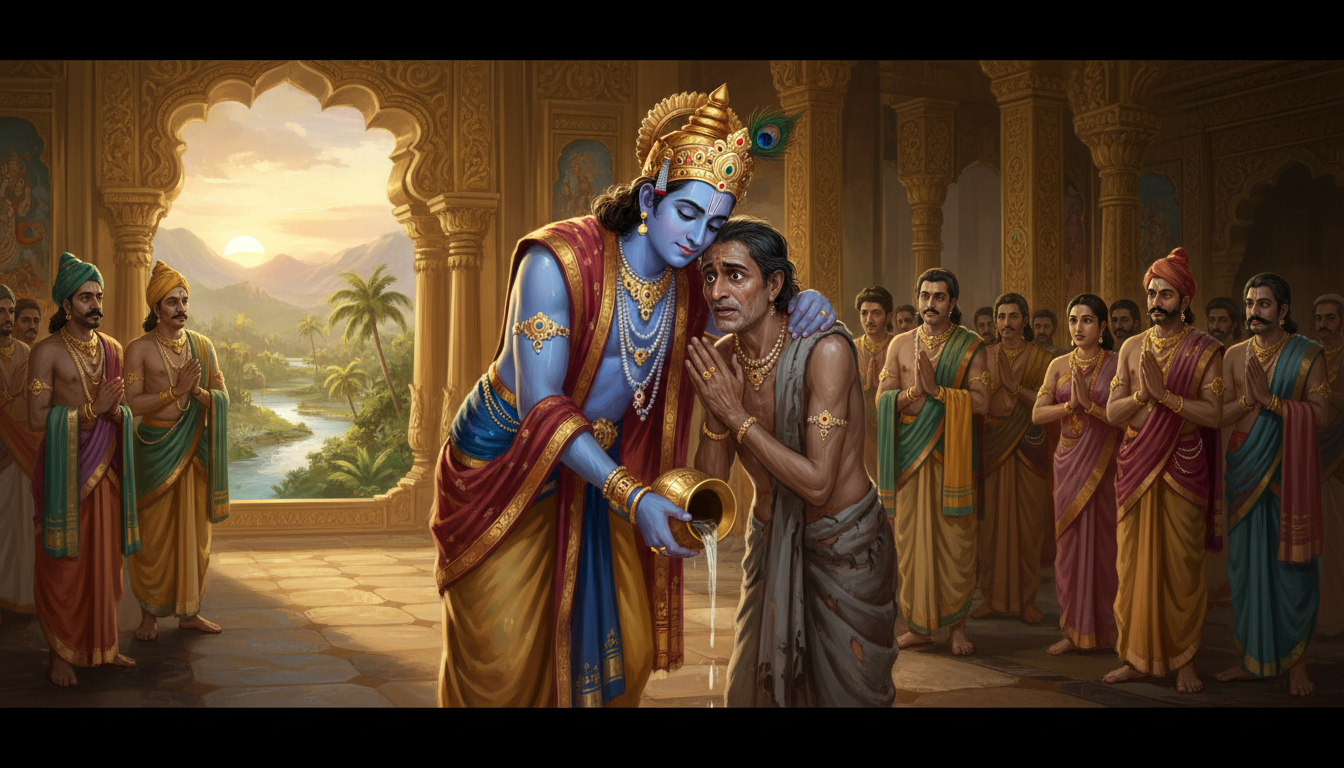
Bhagavad Gita Chapter 10, Verses 1-18: The Source of All
The lamp of knowledge and Arjuna's hunger to hear
What the Gods Do Not Know
Krishna paused before beginning the tenth chapter of his teaching, and told Arjuna plainly that what followed was for his benefit alone, because Arjuna delighted in hearing him speak. Then he set the frame for everything that would follow. In verse 10.2 he says that neither the multitudes of gods nor the great seers know his origin, for he is, in every sense, their source before he is anything else. Prabhavam, the word he uses, means the point from which something proceeds, and Krishna is telling Arjuna that he stands prior to the very beings who are usually imagined as standing at the beginning of things.
On the plain of Kurukshetra, where two armies waited in their ranks, this was not an abstract claim offered for its own sake. Arjuna had grown up on stories of Indra thundering from his heaven, of sages whose austerities had shaken the three worlds, of ancestors whose deeds still echoed through his family's fortunes. Krishna was quietly placing himself behind all of it, not as one god competing among many, but as the ground upon which the entire hierarchy of gods and sages stood, unable to see beneath their own feet to what supported them.
Whoever knows him in this way, Krishna added, as unborn, without beginning, and as the great lord of the worlds, that person alone among mortals is free from delusion and freed from every wrongdoing. Knowledge of his true nature was not being offered here as a piece of information to be filed away. It was offered as the kind of knowing that changes what a person is capable of doing, because a mind no longer confused about where everything ultimately comes from stops grasping after lesser, borrowed accounts of its own origin.
Everything a Person Prizes
Krishna then made the claim concrete by naming the very qualities a person is most likely to credit to themselves. In verses 10.4 and 10.5 he lists them out, deliberately, almost as an inventory: intelligence, knowledge, freedom from delusion, patience, truth, restraint, and calm; pleasure and its opposite, pain; birth and its opposite, death; fear and fearlessness; non violence, evenness of mind, contentment, austerity, charity; fame and, just as plainly, infamy. All of these, in their many varieties, he says, arise from him alone, matta eva prithag vidhah.
It is a striking list because it refuses to sort the qualities into flattering and unflattering piles before naming their source. Patience and truth sit beside fear and infamy, contentment beside pain, birth beside death. Krishna is not claiming credit only for what a person would be proud to possess. He is saying that the entire range of a life's inner weather, its best moments and its worst, its dignities and its humiliations, proceeds from the same single origin.
For Arjuna, standing at the edge of a battle that would soon hand him both grief and glory in the same afternoon, this was not a minor point folded into a longer list. It meant that neither his courage nor his coming sorrow would be foreign intrusions into a life that was otherwise entirely his own doing. Both belonged to the same current, arising from the same source that gave rise to Bhishma's steadiness, Drona's skill, and Duryodhana's ambition alike. No one on that field, on either side, stood outside this accounting, and none of them, Krishna implied, had built these qualities from nothing.
Speaking of Him, Delighting in Him
From that catalogue Krishna turned to how the wise actually respond once they grasp it. In verse 10.8 he states the principle plainly: aham sarvasya prabhavo mattah sarvam pravartate, I am the source of all, everything proceeds from me. The wise who understand this, he says, worship him bhava samanvitah, with their whole being brought into the act, not as a duty performed at arm's length but as a recognition so complete it reorganizes how a person spends their attention.
Verse 10.9 describes what this looks like in practice, and it is notably communal rather than solitary. Those who have understood turn their minds fully toward him, their very life given over to him, enlightening one another, bodhayantah parasparam, and constantly speaking of him among themselves. Krishna adds that they take delight and find contentment simply in this, in the conversation itself, in the shared act of turning the subject, again and again, back toward the same source.
There is something almost domestic in the picture, set against the grandeur of the claim it follows. Vast cosmic origin gives way to friends talking late, trading what they have each come to understand, none of them tiring of a subject that never seems to run dry. Arjuna, who would soon show exactly this hunger himself, was being shown in advance what the far side of confusion could look like: not a solitary illumination locked away in one person's mind, but a company of people who keep circling back to the same well because the water there does not run out.
The Lamp Lit from Within
Krishna then made a promise that went further than description, into something closer to a pledge of active help. In verse 10.10 he says that to those constantly devoted, who worship him with love, he gives the buddhi yoga, the discipline or clarity of understanding, by which they come to him. It is described as a gift rather than an achievement to be earned through effort alone, given specifically to those who have already turned their devotion in his direction and kept it there.
Verse 10.11 explains why the gift is necessary and how it is delivered. Out of compassion for them, Krishna says, he dwells within their own hearts, and there, with the shining lamp of knowledge, jnana dipena bhasvata, he destroys the darkness born of ignorance. The image is deliberately intimate. This is not knowledge handed down from a distant teacher's seat, or scripture memorized and recited. It is a lamp lit from inside the very place where confusion had been living, dispelling darkness at its source rather than describing the darkness from outside it.
For Arjuna, who moments earlier had heard himself and every rival on the field folded into the same single origin, this was the promise that mattered most practically. Understanding where all qualities come from is one kind of knowledge; feeling the confusion actually lift from inside one's own chest is another. Krishna was telling him that the second kind was available, not as a reward for flawless devotion, but as compassion extended precisely because ignorance, left alone, does not clear itself.
A Nectar Arjuna Cannot Tire Of
Something in Krishna's words finally broke Arjuna's composure, not into doubt this time but into open eagerness. In verses 10.12 and 10.13 he answers with a rush of names, calling Krishna the param brahma, the supreme abode, the supreme purifier, the eternal divine person, unborn and all pervading, and says that this is exactly what the sages have always told him: Narada, Asita, Devala, and Vyasa have all spoken of it, and now Krishna himself confirms it in his own voice.
Arjuna does not simply accept the claim and move on. He asks for more of it. In the verses that follow he requests that Krishna describe, fully and without omission, his divine yogic powers and the ways in which he pervades and sustains the worlds by remaining present within them, atma vibhutayah. He wants to know how to meditate on these glories, by what states of being he should be known, and in which of the many forms he might be recognized.
Then Arjuna says the line that gives this section its ordinary, human center: he never tires of hearing this, tripyami na hi srinvatah. It is a small confession from a warrior who, minutes before, had been paralyzed on the same field by grief. What steadies him now is not a command to fight but a hunger to understand, one that grows rather than depletes the more it is fed. For a modern reader, the lesson sits quietly underneath the philosophy: real understanding does not behave like other appetites, satisfied and then set aside. It keeps circling back, wanting the next verse, the next glimpse, because what it is reaching for was never a fixed quantity of facts to begin with.
Dharma Lesson
Every capacity a person prizes in themselves, intelligence, patience, courage, contentment, traces back to a single source rather than being self-made, which is reason for humility rather than pride. Real understanding is not hoarded information but a lamp lit from within that quietly dispels confusion, offered out of compassion to whoever stays devoted enough to receive it. Genuine hunger to understand, like Arjuna's, never exhausts itself the way ordinary curiosity does.