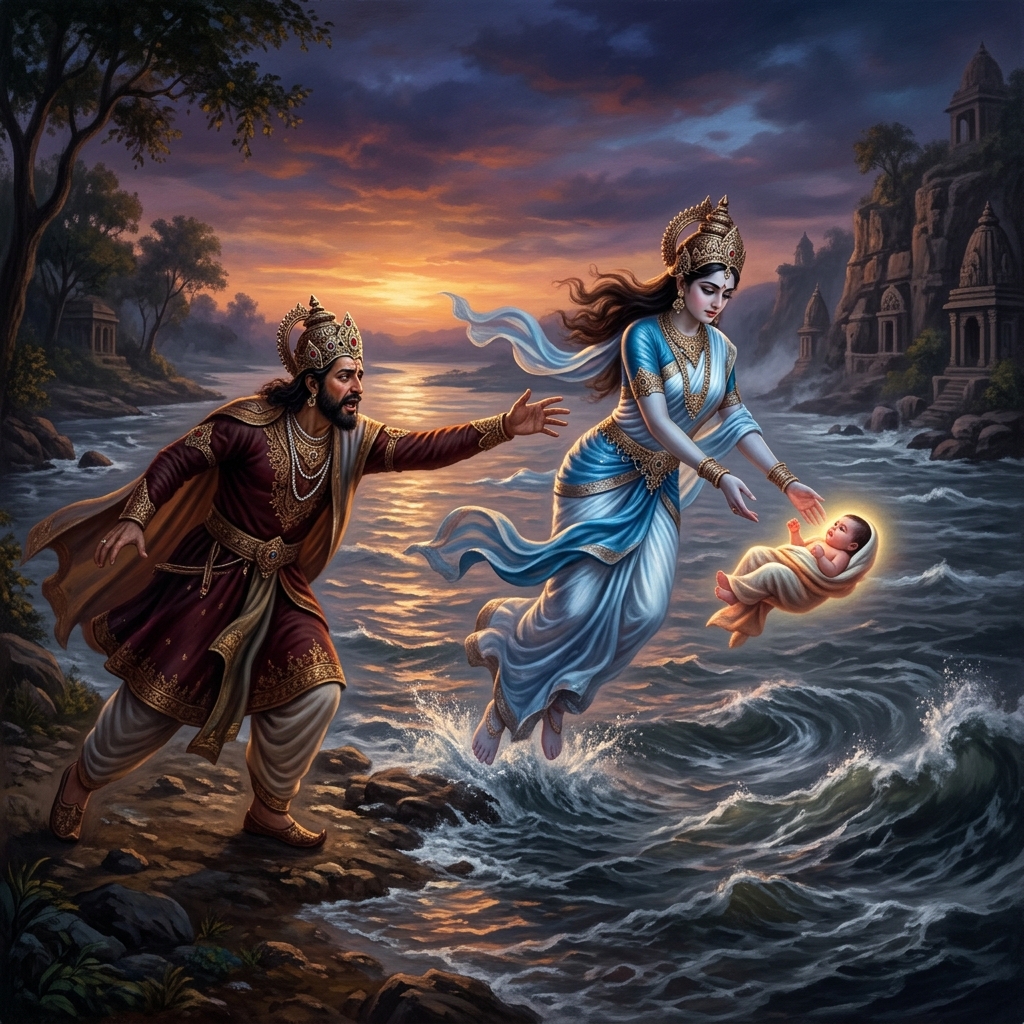
What the River Carried Away
The eighth child was a boy, and the river knew that this one would live.
Of the wedding there is another telling, and of the seven infants carried into the current before him; it is enough that Shantanu had kept his promise through seven births and broke it on the eighth. He came down the bank shouting, a king running like a herdsman, and Ganga stopped in the shallows with the living child high on her shoulder and turned to face him.
"You have spoken," she said. "Then hear the whole of it, since you have already paid for it."
She told him what he had married. She was the river herself, and the eight she had borne him were the Vasus, bright gods sentenced to human birth for the theft of a sage's cow. Seven had asked only to be sent back quickly, and she had sent them.
"This one is the eighth," she said, "and the greater share of the blame was his, so the greater share of the sentence is his also. He must live out an entire human life. He will be your son and he will never hold a son of his own. He will be the first man of his age and he will be alone inside it. Do you imagine your court could prepare a child for that?"
"Give me my son," Shantanu said.
"I will," said Ganga. "Not today. I will take him, and I will raise him, and I will give him back to you finished. Until then you will not send for him, you will not follow, and you will not ask. That is the last bargain I will make with you."
He asked how long. She did not answer, because she did not intend to be held to a number. Then the water closed over the two of them without a sound, and the king was left standing on his own bank with nothing in his arms, a widower to a wife who had not died.
The Sage Who Wrote the Sentence
Vasishtha knew who stood in the door of his hermitage before he raised his eyes. Rivers do not enter quietly a place where their story is already known.
"You cursed them," Ganga said.
"They stole my cow, and they were not sorry until they were caught," the sage answered. "I did not curse them out of temper. I gave them a term, and I set an end to the term. That is more mercy than most men receive."
"You gave seven of them a single season. You gave this one a lifetime." She set the boy down on the swept earth of the courtyard. He was small enough that the sacrificial fire seemed tall to him, and he did not cry, and he did not reach back for her. "I have not come to argue the justice of it. Justice is your trade. I have come because a sentence ought to be served well, and he cannot serve it ignorant. You wrote it. Teach him to carry it."
So the son of the river was schooled by the man who had condemned him, and neither of them ever called the arrangement strange. Devavrata learned the four Vedas and the six sciences that stand around them: the shaping of sound, the rules of grammar, the count of syllables in a metre, the order of the rites, the courses of the stars, the roots of words. He learned the law books and the long histories of kings, and the duties that bind a man in each of the four stages of his life.
He was told nothing twice. When the other pupils recited, they recited what they had memorised; when he recited, he seemed to be repaying something.
"He learns like a debtor," Vasishtha said to her once, at the water's edge.
"He is one," said Ganga. "So am I. Do not make him gentle. Make him exact."
At night she lay along her own bed of sand and listened to the hermitage sleep, and she did not go in, because she had promised herself she would not teach him to need her.
Statecraft and the Bow
When the boy had the scriptures, his mother went for the rest of him.
She brought him to Brihaspati, preceptor of the gods, who taught kings how to remain kings. Under him Devavrata learned the seven limbs of a state and the four means of dealing with men; how to read an envoy's face; how to keep a treasury without stripping the country, taking revenue as a bee takes honey, so that the flower is not harmed and gives again next season; when a war is cheaper than a peace and when a peace is the more expensive of the two.
"Teach him to govern," Ganga had said, "a kingdom he will never own."
Brihaspati had looked at her for a moment and had asked no questions.
Last she took him to Parashurama, and that was the hardest asking of the three. The son of Jamadagni had emptied the earth of kshatriyas twenty-one times over, and he did not pretend the memory embarrassed him.
"You bring me a prince," he said, "and you want me to put a bow in his hands."
"I bring you a Vasu serving a sentence," said Ganga. "He will never sit on a throne and he will never father a claimant. Every weapon you give him will be used for someone else's crown. If you have any quarrel left with the warrior class, arm the one man who will get nothing out of being armed."
Parashurama taught him. He taught him the whole science of the bow, the drawing and the release, the mounted shot and the shot from a moving chariot, the mantras that call down the celestial weapons and, harder, the mantras that recall them. He held nothing back, and at the end of it he said that he had never had a pupil who took correction so cleanly.
Neither the teacher nor the mother thought, in those years, to ask what would happen if the two of them ever stood on opposite sides of a woman's grievance.
The River Dammed With Arrows
Shantanu kept the bargain for years, because there was no way to break it, and then one day the river broke it for him.
He was hunting along the Ganga when he noticed that the water had gone thin in its bed, running shallow and slow where it had always run deep. He followed the channel upstream and found the reason: a wall of arrows, set shaft against shaft across the whole width of the current, holding back the river as a dam of stone would have held it. Standing at the end of the wall was a youth of about sixteen, bright as a young fire, with a bow in his hand and no particular expression of pride on his face.
The king stared at him. The youth touched the water, and he was gone, and the arrows were gone, and the Ganga came down full again as if nothing had ever interrupted her.
Then Shantanu called out to the river, and asked - not commanded, for he had learned that much - to be shown his son.
Ganga rose in her own shape, wearing her ornaments, and she led the young man by the hand up out of the water to the bank.
"Here is the eighth son you begot," she said. "Take him. He has the Vedas and their branches from Vasishtha, who once cursed him. He has the science of kings from Brihaspati, who teaches Indra. He has every weapon there is from Rama, son of Jamadagni, who has no love for kings and made an exception. He is a bowman no living man can stand against. I have kept nothing back from him and I am keeping nothing back now."
She put the young man's hand into his father's hand and let go of it, and she did not say goodbye to him, because that would have been a claim.
Shantanu brought Devavrata to Hastinapura and installed him as heir apparent, and for four years the kingdom was happy. What the boy gave up afterwards, by a river, for the sake of a fisherman's daughter, has its own telling.
Twice More Out of the Water
She rose for him twice more, and only once did she come in time to be of use.
Why Amba brought her grievance to Parashurama, and what she made of the refusal she received from Bhishma, belongs to her own story. What belongs to Ganga is this: that her son and her son's teacher met on the field with weapons drawn, and that she came up out of the current between them with her hair unbound.
She went first to Parashurama. "You taught him," she said. "A teacher does not test his own work with a spear."
"I gave my word to a weeping woman," said Parashurama. "Would you have me be the one man in the world who lies?"
Then she went to Bhishma, and she asked him, as she had never asked him for anything, to lay down the bow before his preceptor.
"You raised me to be exact," he said. "Mother, you taught me what a vow costs and you never once taught me how to break one. I will not fight him with anger. I will not fight him with less than everything, either."
They fought for twenty-three days. In the end the ancestors and the gods stood between them and stopped it, and neither man was beaten, and neither man was satisfied. It was the first thing Ganga ever asked of her son that he did not give her.
Decades later she rose the second time, on her own bank, where the ash was still warm. He had lain fifty-eight nights on a bed of arrows waiting for the sun to turn north, and he had chosen the hour of his own going, and they had burned him beside her water.
Ganga came up lamenting aloud: that a man who had held Parashurama had fallen to Shikhandi, that she had carried him and taught him and outlived him.
Krishna and Vyasa consoled her there. He was not taken, they told her; he set down the body when he chose to, and he has gone back to the Vasus, and the sentence is served.
She gathered what the fire had left, and carried it home, which is a mother's third work: to prepare, to release, and at the end to receive.
Dharma Lesson
A mother's work has three motions: to prepare, to release, and to receive. Ganga could not spare her son a single sorrow of the life he had been sentenced to, and she did not try; she gave him the finest teachers in the three worlds and then handed him back to a father who would need him. Love that grasps deforms whatever it holds, while love that prepares and lets go survives even the funeral fire.