The Divine Child
Krishna's life is the Mahabharata's answer to the question: What does God look like when God walks among us?
A Prison Birth
परित्राणाय साधूनां विनाशाय च दुष्कृताम्
Paritrāṇāya sādhūnāṃ vināśāya ca duṣkṛtām
The tyrant Kamsa ruled Mathura with an iron fist. He was Devaki's brother - a man who had once been generous and loving, until a prophecy destroyed him from within.
On the day of Devaki's wedding to the noble Vasudeva, as the bridal procession moved through the streets of Mathura with flowers and music, a voice rang from the heavens - disembodied, absolute, impossible to ignore.
"Kamsa! The eighth child of your sister Devaki will be your destroyer."
The effect was instantaneous and horrifying. Kamsa, who had been cheerfully driving his sister's chariot, transformed in a single heartbeat from a doting brother into a monster. He seized Devaki by her hair and drew his sword, ready to kill her on the spot.
Vasudeva intervened - not with violence but with desperate rationality. "Spare Devaki," he pleaded. "Kill me if you must, for it is I who will father her children. But spare my wife. I will bring you every child she bears. Every one. You can do with them as you wish."
Kamsa accepted. It was a bargain struck in blood - and over the following years, Kamsa kept his end with monstrous efficiency. Six children were born to Devaki and Vasudeva in prison. Six children were dashed against the stone walls of the dungeon by Kamsa's own hands. Six tiny lives extinguished before they could draw their first real breath.
The seventh child - Balarama - was mysteriously transferred from Devaki's womb to that of Rohini, another wife of Vasudeva, through divine intervention. Kamsa was told the pregnancy had ended in miscarriage. He believed it - barely.
And then came the eighth night.
The sky was black. Rain fell in sheets. Thunder shook the dungeon walls. And in a prison cell guarded by soldiers with orders to kill anything that breathed, Krishna was born.
He did not cry. He did not wail. He opened his eyes - dark as infinity, deep as the space between stars - and the cell flooded with light. The chains on Vasudeva's wrists fell open. The dungeon doors swung wide. The guards - every single one - fell into a deep, enchanted sleep.
Vasudeva lifted the infant and placed him in a basket. He walked out of the most heavily guarded prison in Mathura. The rain parted above him. Lightning froze in the sky. The river Yamuna, swollen with monsoon fury, rose to touch Krishna's feet - not to drown but to worship - and then parted to let Vasudeva cross.
He walked through the storm to the village of Gokul, to the home of the cowherd chief Nanda and his wife Yashoda. There, he exchanged Krishna for Yashoda's newborn daughter - Yogamaya, the goddess of divine illusion who had been born as a girl-child to serve as cover.
When Kamsa arrived at the prison to kill the eighth child, he seized the infant girl and dashed her against the stones. But she slipped from his hands, rose into the air, and transformed into her divine form - terrifying, multi-armed, blazing with cosmic power.
"You fool," the goddess laughed. "The one destined to destroy you has already escaped. He is beyond your reach. He grows stronger with every breath. And when the time comes, he will find you."
Kamsa screamed. His scream echoed through the dungeons of Mathura and was heard, they say, even in heaven.
The Butter Thief of Gokul
In Gokul, the supreme being of the universe became a mischievous toddler.
Krishna's childhood was a symphony of laughter, chaos, and miracles so casually performed that the cowherds of Gokul never quite realized they were raising God.
He stole butter. This, of all things, became his most famous childhood trait - the Supreme Creator of all worlds, the sustainer of billions of galaxies, crawling across kitchen floors to steal butter from earthen pots. He organized raids with his friends, climbing on each other's shoulders to reach pots hung from the ceiling. He smeared butter on his face and denied everything with an innocence so perfect that even Yashoda - who caught him red-handed daily - could never stay angry.
"Maiyya, I did not eat the butter!" he would say, butter literally dripping from his chin, and Yashoda would gather him in her arms and kiss his lying mouth and love him with a fierceness that only mothers understand.
But woven through the laughter were moments that made even the most practical cowherd stop and wonder.
One day, Yashoda forced Krishna to open his mouth, suspecting he had eaten mud. When the boy opened his mouth, Yashoda looked inside - and saw the entire universe. Galaxies. Stars. Planets. The ocean of cosmic creation. The cycle of birth, death, and rebirth - all contained within the mouth of a child sitting in a dusty courtyard.
Yashoda stumbled backward. Her mind, for one terrifying instant, grasped the truth: her son was not her son. Her son was the architect of reality itself, playing a role, wearing the costume of a human child for reasons no mortal could comprehend.
Then Krishna's maya descended like a soft veil, and Yashoda forgot. She picked him up, scolded him for eating mud, and went back to churning butter.
This was Krishna's Leela - his divine play. Not a performance but a participation. Not an illusion but a deeper truth wearing the disguise of ordinary life. The Supreme Being chose the life of a cowherd because the most profound love is not worshipped in temples - it is lived in kitchens, stolen from butter pots, and shared in the dust of village lanes.
Slayer of Demons
Kamsa did not rest. He could not. The prophecy gnawed at him like a rat chewing through a foundation. He sent demon after demon to Gokul - each one more terrifying than the last, each one tasked with finding and killing the divine child.
Putana came first - a Rakshasi who disguised herself as a beautiful woman and offered to nurse the infant Krishna. Her breasts were smeared with deadly poison. Any child who suckled would die instantly.
Krishna took her breast and drank - not the poison, but her life force. Putana screamed as her true form erupted from the disguise - enormous, hideous, with blazing eyes and teeth like tombstones. She thrashed and writhed across the village, flattening houses with her death throes, and then collapsed. Her corpse was so large it took three days to burn.
And Krishna, the infant, sat on the ground and giggled.
Trinavarta came next - a whirlwind demon who swept Krishna into the sky. The boy grew so heavy in the demon's arms that the wind itself could not carry him. Trinavarta crashed to earth, his back broken by the weight of the universe condensed into a toddler's body.
And still Krishna giggled.
Bakasura - a crane demon of monstrous size - tried to swallow him. Krishna burned the demon's beak from the inside, then tore the creature apart with his bare infant hands.
Aghasura - a serpent demon who took the form of a cave to swallow Krishna and all his friends - was destroyed when Krishna expanded his body inside the demon's throat until the creature burst.
Each demon was more powerful than the last. Each demon was destroyed more easily than the one before. The message to Kamsa - and to the cosmic order - was unmistakable: this child was not merely divine. He was divinity in its most absolute and playful form.
The most significant of these early encounters was with Kaliya - the great serpent who had poisoned the waters of the Yamuna river. When Krishna's friends and their cattle began to fall sick from the poisoned water, the boy - perhaps seven or eight years old - dove into the river.
He found Kaliya in the depths - a five-headed cobra of enormous size, wreathed in venom, master of a poisoned domain. Krishna danced on Kaliya's heads. Not fought - danced. His feet moved with a rhythm that was both martial and musical, each step crushing one of Kaliya's hoods while simultaneously creating a dance so beautiful that the naga's wives emerged from the river to beg for their husband's life.
"Go," Krishna told the humbled serpent. "Leave these waters. Find another home in the ocean. And harm no one ever again."
Kaliya obeyed. The river ran clean. And the cowherds of Gokul added another miracle to the growing list of things their strange, wonderful, impossible boy had done.
Govardhan - The Mountain on a Finger
अनन्याश्चिन्तयन्तो मां ये जनाः पर्युपासते
Ananyāś cintayanto māṃ ye janāḥ paryupāsate
The cowherds of Gokul had worshipped Indra, king of the gods, for generations. Every year, they prepared elaborate offerings to ensure good rains for their cattle and crops. It was tradition. It was expectation. It was how things were done.
Krishna, now a young boy with a smile that could start revolutions, decided to change things.
"Why do we worship Indra?" he asked the village elders. "What has Indra done for us? Our cattle graze on the grass that grows on Govardhan Hill. Our water comes from the streams that flow from Govardhan's slopes. It is the HILL that sustains us, not some distant god who sits in a palace of clouds and demands tribute."
The argument was theological dynamite. It was also, from a practical standpoint, entirely correct.
The elders were persuaded. Instead of their annual offering to Indra, they redirected their worship to Govardhan Hill - decorating it with flowers, offering food at its base, circumambulating it with their cattle and families.
Indra's response was immediate and apocalyptic.
The king of the gods summoned the Samvartaka clouds - the clouds of cosmic dissolution, the rain-makers of the end of the world. He unleashed them upon Gokul with all the fury of a god whose ego had been bruised by a seven-year-old boy.
The rain was not rain. It was a weapon. Thunderbolts struck the earth. Hail the size of fists shattered rooftops. The Yamuna rose and flooded the village. Cattle screamed. Children wailed. The cowherds huddled together in absolute terror, certain they were going to die.
"Krishna!" Yashoda cried. "What have you done? Indra is destroying us!"
Krishna walked to Govardhan Hill. He placed his left hand beneath its base - casually, as one might lift a mushroom from the forest floor - and raised the entire mountain above his head, balancing it on a single finger.
"Come!" he called to the cowherds. "Bring your families. Bring your cattle. Come under the mountain."
For seven days and seven nights, the entire village of Gokul sheltered beneath Govardhan Hill, held aloft by a boy who stood on one leg, smiling, as if holding up a mountain were no more difficult than holding up a parasol.
Indra threw everything he had. Lightning. Floods. Winds that could uproot forests. Nothing worked. The mountain did not wobble. The boy did not strain. The cowherds and their cattle stood dry and safe beneath a canopy of rock and the infinite patience of God.
On the seventh day, Indra descended from his celestial palace. He came not with thunder but with tears. He came not with weapons but with folded hands.
"Forgive me, Govinda," the king of the gods said, using the name that meant 'protector of cows.' "I did not know who you were. I fought you out of vanity - the greatest sin of the powerful."
Krishna smiled and gently lowered the mountain back to its place.
"It is not I who deserves your respect, Indra. It is these cowherds - these simple people who live honest lives and care for their cattle and their land. Any god worth worshipping would protect them, not punish them."
Indra performed the Abhisheka - the sacred coronation ceremony - anointing Krishna as 'Govinda,' the supreme protector. Then he returned to heaven, humbled for the first and last time in his immortal existence.
The Flute That Stopped the World
Of all Krishna's attributes - his beauty, his wisdom, his martial prowess, his cosmic divinity - none was more enchanting than his flute.
The instrument was simple - a length of bamboo with holes bored by his own fingers. But when Krishna played, the sound that emerged was not music in any ordinary sense. It was the sound of longing itself - the ache of the soul for its source, the cry of the finite for the infinite, the love that exists between the universe and the consciousness that dreams it into being.
When Krishna played his flute on the banks of the Yamuna, the cows stopped grazing and stood motionless, milk flowing unbidden from their udders. Birds halted mid-flight and hung in the air, their wings forgetting to beat. The river ceased its flow. Even the wind held its breath.
And the gopis came.
The gopis - the milkmaids of Vrindavan - are the Mahabharata's most profound symbol of divine love. They were not saints. They were not scholars. They were ordinary women who had been swept into an extraordinary love that overrode every social convention, every family obligation, every logical argument against what they were doing.
When Krishna played his flute in the moonlit forests, the gopis left their homes. They left their husbands. They left their children sleeping in their beds. They ran to the sound of the flute like rivers running to the sea - not because they chose to, but because they had no choice. The flute called something in them that was deeper than duty, older than society, more real than the world they left behind.
The Rasa Leela - the great cosmic dance - took place on a full-moon night in autumn. Krishna multiplied himself so that each gopi danced with her own Krishna, each believing she alone held the attention of the beloved. A thousand Krishnas danced with a thousand gopis, and the dance was a map of the universe itself - circular, infinite, each participant at the center of their own experience while simultaneously part of a pattern too vast for any individual to comprehend.
"Those who see the Rasa Leela as a physical romance," the sage Shuka would later explain, "are like those who mistake a lamp's light for the lamp itself. The Rasa is the dance of the soul with its creator - the most intimate relationship in existence, expressed through the most intimate human metaphor because no other metaphor is powerful enough."
The gopis wept when Krishna left for Mathura. They wept with a grief that has echoed through two thousand years of Indian devotional poetry, through the songs of Mirabai and Surdas and Jayadeva, through the paintings and sculptures and temple architecture of a civilization that understood that the highest form of love is the love that accepts separation without diminishing.
Krishna never returned to Vrindavan. Not as a cowherd. Not as the boy who stole butter and danced in moonlit forests.
But the flute, they say, still plays on certain autumn nights when the moon is full and the Yamuna runs silver. And those who hear it - even now, even in this age of machines and logic - feel something stir in the deepest chamber of their hearts.
The Death of Kamsa
Krishna was sixteen when he came for Kamsa.
The tyrant had organized a wrestling tournament - ostensibly a festival, in reality a trap. He had invited Krishna and Balarama to Mathura, planning to have them killed by his champion wrestlers, a mad elephant, or, failing all else, his own army.
Krishna and Balarama entered Mathura like a tide entering a dry riverbed - irresistible, transformative, changing everything they touched.
The elephant Kuvalayapida, maddened and enormous, was sent to crush them at the city gate. Krishna killed it with his bare hands, tearing out its tusks and carrying them into the arena like a boy carrying toys. The crowd - citizens of Mathura who had lived under Kamsa's terror for years - gasped.
In the wrestling ring, Kamsa's champions Chanura and Mushtika waited - professional killers, mountains of muscle and malice. The crowd saw two boys - beautiful, slender, dark-skinned and fair-skinned, not yet fully grown - and whispered in horror.
"They are children! This is murder, not sport!"
Krishna smiled. He always smiled before the impossible.
The fight was brief. Chanura, the greater champion, charged Krishna with the full force of a bull elephant. Krishna caught his arm, spun him overhead like a discus, and dashed him to the earth. The impact killed the wrestler instantly.
Balarama dispatched Mushtika with similar economy - a single blow from his plow-shaped weapon that sent the massive fighter crashing into the royal gallery.
Kamsa rose from his throne. His face was white. The prophecy he had tried to murder his way out of for sixteen years was standing in the arena below him, wearing a peacock feather and a smile.
"Uncle," Krishna said. Just that - just the word, loaded with sixteen years of unasked questions, six murdered infants, and the infinite patience of a god who had been waiting for this moment since before time began.
Kamsa drew his sword and leapt from the royal box. It was, perhaps, the bravest thing he ever did - the one moment when the coward in him was overcome by the cornered animal that would rather fight than flee.
Krishna caught him mid-leap. He grabbed Kamsa by the hair - the same hair that had been crowned with the stolen crown of Mathura - and dragged him across the arena floor. Then he struck. Once.
Kamsa, king of Mathura, slayer of innocents, brother turned monster, fell dead at the feet of the child he had spent sixteen years trying to kill.
The prophecy was fulfilled.
Devaki and Vasudeva were freed from their prison. Krishna touched his mother's feet - the mother whose arms he had left as a newborn, whose children had been murdered because of him, whose suffering had been the price of his divine mission.
"Do not weep, Mother," he told Devaki. "Your children are not dead. They live in realms beyond suffering. And now, your seventh and eighth sons stand before you - alive, strong, and free."
Devaki wept anyway. Some griefs are too deep for divine reassurance. Some losses cannot be healed even by God.
Architect of Dharma
After Kamsa's death, Krishna left the pastoral world of Vrindavan forever. The butter thief, the flute player, the dancer in moonlit forests became something else entirely: a king, a diplomat, a strategist, and a warrior.
He built Dwaraka - the Golden City - on an island off the western coast of India. The city was a marvel of engineering and beauty, with golden spires that caught the sunlight and harbors that welcomed ships from across the known world. It was, by all accounts, one of the greatest cities ever built by human hands, guided by divine vision.
But Krishna's purpose was not architecture. It was dharma.
When the conflict between the Pandavas and Kauravas escalated toward the point of no return, Krishna stepped into the role he had been born for - not as a warrior but as a guide, a counselor, the still point around which the wheel of the Mahabharata turned.
His embassy to the Kaurava court is one of the great diplomatic set-pieces in world literature. He went to Hastinapura not as God but as an ambassador, seeking peace. He asked for only five villages - one for each Pandava - as an alternative to war.
Duryodhana refused. "I will not give them enough land to place the point of a needle," the prince declared.
Krishna tried reason. He tried sentiment. He tried threat. He painted a picture of the devastation that war would bring - millions dead, dynasties erased, generations of wisdom lost. He was not performing. He genuinely wanted peace. God incarnate, perfectly aware that war was destiny, still tried to prevent it. The effort was what mattered.
When Duryodhana, in his arrogance, tried to arrest Krishna - to imprison God himself - Krishna revealed a fraction of his cosmic form. The court of Hastinapura saw, for one terrible instant, the being behind the diplomat: infinite, all-consuming, containing within itself every star, every creature, every moment of time past and future. Ministers fainted. Warriors dropped their weapons. Dhritarashtra, blind since birth, was granted temporary sight just so he could witness what his son had provoked.
Krishna withdrew his divine form. The ambassador departed. The last chance for peace went with him.
Both sides asked for his help. Krishna gave the Kauravas his army - the Narayani Sena, eleven Akshauhinis of divine warriors. And to the Pandavas, he gave only himself - unarmed, serving as Arjuna's charioteer, vowing not to lift a weapon throughout the entire war.
"But," he told Arjuna with a smile that concealed infinite strategy, "I will be your charioteer. I will guide your horses. I will be beside you for every moment of every day."
It was the most unequal trade in history. It was also the only one that mattered.
The Song of God
कालोऽस्मि लोकक्षयकृत् प्रवृद्धो
Kālo'smi lokakṣayakṛt pravṛddho
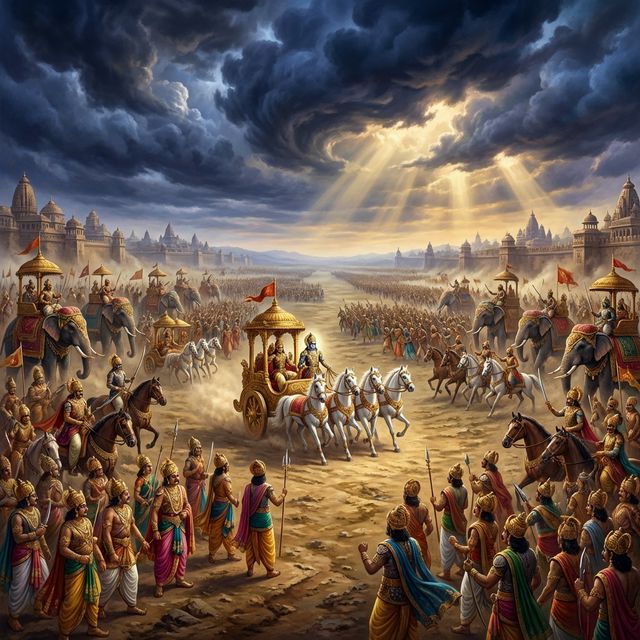
Between the two armies. Before the first arrow. In the silence that precedes apocalypse.
"I cannot fight them, Krishna. They are my teachers. My grandfathers. My cousins. My friends. How can I kill them and live? Better to beg in the streets than to rule a kingdom built on the bones of my family."
Arjuna's crisis was not military. It was existential. It was the question every human being eventually faces: How do I do what is right when doing right causes terrible harm?
And Krishna answered - not with a platitude, not with a command, but with seven hundred verses that would become the Bhagavad Gita, the most sacred text in Hindu philosophy.
He spoke of karma - action without attachment to results. "You have the right to perform your duty," he told Arjuna, "but never to the fruits of your actions. Do what is right because it is right, not because of what you will gain."
He spoke of the eternal soul. "The soul is never born and never dies. It cannot be cut by weapons, burned by fire, wetted by water, or dried by wind. It is eternal, all-pervading, unchanging. When you grieve for these warriors, you grieve for that which cannot be harmed."
He spoke of three paths to liberation: the path of knowledge (Jnana Yoga), the path of devotion (Bhakti Yoga), and the path of selfless action (Karma Yoga). He did not say one was superior to the others. All paths lead to the same truth - like rivers flowing into the same ocean.
And then, when words alone could not convey the depth of what he meant, Krishna revealed his Vishwarupa - his cosmic form.
The universe opened like a flower.
Arjuna saw Krishna as he truly was - not a charioteer, not a friend, not a diplomat, but the totality of existence itself. Within Krishna's cosmic form, Arjuna saw all of creation: every galaxy, every atom, every being that had ever lived or would ever live. He saw the gods. He saw the demons. He saw time itself - past, present, and future existing simultaneously, like layers of a vast and terrifying palimpsest.
He saw the warriors on both sides of the battlefield being drawn into Krishna's infinite mouths - devoured, consumed, as if death were not an event but a process already completed, and the war they were about to fight was merely the physical enactment of something that had already occurred in the mind of God.
"I am Time," Krishna declared, his voice the sound of every beginning and every ending that had ever been. "The destroyer of worlds. All these warriors are already slain by Me. You are merely the instrument."
Arjuna trembled. He covered his eyes. He begged Krishna to return to his human form - the dark-skinned, peacock-feathered charioteer who made the unbearable bearable simply by being near.
Krishna complied. The universe folded back into a smile.
"Now," Krishna said, picking up the reins, "shall we begin?"
The Charioteer's War
Krishna fought the Mahabharata war without lifting a weapon. This was his vow - and it was the most devastating strategy any commander has ever employed.
He did not need to fight. He fought through others. He fought through truth and deception. He fought through timing, positioning, psychology, and the merciless application of divine intelligence to human warfare.
It was Krishna who devised the strategy to fell Bhishma - using Shikhandi as a shield. It was Krishna who convinced Yudhishthira to speak the half-truth that destroyed Drona. It was Krishna who maneuvered Ghatotkacha into position so that Karna would waste the Vasavi Shakti. It was Krishna who created the false sunset that drew Jayadratha from his hiding place.
Every major turning point of the war passed through Krishna's hands. He was the unseen general, the shadow strategist, the mind behind every Pandava victory. And he achieved it all from the driver's seat of a chariot, never once touching a weapon.
Only once did he come close to breaking his vow.
On the ninth day, when Bhishma's assault was threatening to annihilate the Pandava army, Krishna leapt from the chariot, seized a broken chariot wheel, and strode toward Bhishma - his divine fury blazing with such intensity that the battlefield fell silent.
"Come, Krishna!" Bhishma called, tears streaming down his ancient face. "Come and kill me! To die at your hands is the greatest honor any warrior can receive!"
Arjuna raced after Krishna and physically restrained him. "You vowed not to fight! You vowed! Let me handle Bhishma!"
Krishna allowed himself to be pulled back. Whether he truly intended to break his vow or was merely demonstrating to Arjuna the urgency of the situation, only God knows - and God, in this case, was the one being restrained.
At the end of the war, when the last arrow had been fired and the last pyre had burned, Arjuna asked Krishna a question that had been burning in his mind for eighteen days.
"You are God. You could have ended this war in a single afternoon. You could have killed Bhishma, Drona, Karna, and Duryodhana with a thought. Why didn't you?"
Krishna's answer contained the central philosophy of the entire Mahabharata:
"Because it was not my war to fight, Arjuna. It was yours. I came not to solve your problems but to give you the wisdom to solve them yourself. A god who fights humanity's battles creates dependents. A god who teaches humanity to fight its own battles creates the possibility of dharma."
The Departure of God
सर्वधर्मान्परित्यज्य मामेकं शरणं व्रज
Sarva-dharmān parityajya māmekaṃ śaraṇaṃ vraja
Thirty-six years after the war, Gandhari's curse came true.
The Yadavas - Krishna's own clan, the people he had protected and led for decades - destroyed themselves. A drunken festival devolved into a brawl, the brawl into a massacre. Brothers killed brothers. Cousins killed cousins. The same madness that had consumed the Kurus now consumed the Yadavas, as if violence were a contagion that no amount of time could cure.
Krishna watched it happen. He did not intervene. Just as he had not intervened at Kurukshetra - except to guide, to counsel, to speak the truth - he did not intervene as his own people tore themselves apart.
Balarama, his elder brother, his lifelong companion, departed first - sitting in meditation by the ocean, his soul departing from his body in the form of a great white serpent - Shesha, the cosmic serpent on whom Vishnu sleeps.
Krishna was alone.
He walked into the forest near Dwaraka - the same forest where, ages ago, he had danced the Rasa Leela and played the flute that stopped the world. He sat beneath a tree and rested his left foot against his right thigh.
A hunter named Jara - mistaking the exposed sole of Krishna's foot for the ear of a deer - shot a poisoned arrow.
The arrow struck true. God died from a hunter's mistake.
Or perhaps not a mistake at all. Perhaps the universe's most intricate design - the same design that had put Krishna in a basket on the Yamuna, in a wrestling ring in Mathura, and in a chariot at Kurukshetra - had brought him to this forest, this tree, this hunter, this arrow.
As Krishna lay dying - if dying is even the right word for what happens when God puts down one role and picks up another - he spoke his final words to the distraught Jara:
"Do not grieve. You have done what was destined. You are not my killer - you are my messenger. Through you, I return to where I belong."
His body dissolved into light. The light rose into the sky - higher and higher, past clouds and stars and galaxies - until it returned to Vaikuntha, the eternal abode, where Vishnu had been dreaming this dream all along.
Dwaraka sank into the sea. The golden city, the jewel of the western coast, was swallowed by waves within hours of Krishna's departure. The ocean closed over its spires and palaces with the finality of a book being shut.
The age of heroes was over. The Dwapara Yuga ended. The Kali Yuga began - the age of darkness, of diminished dharma, of human beings left to find their own way without the visible hand of God to guide them.
But the Gita remained. The flute's echo remained. And the promise remained:
"Whenever dharma declines and adharma rises, I manifest myself. Age after age, I return."
The divine child of Gokul, the butter thief of Vrindavan, the charioteer of Kurukshetra, the architect of dharma - Krishna's story does not end with his departure. It continues in every heart that hears the flute, in every mind that reads the Gita, in every soul that asks the only question that matters: How do I live so that my life serves something greater than myself?
The answer, Krishna would say, is always the same: with love, with duty, with courage, and with the unshakeable faith that behind the chaos of the world, there is a dancer - and the dance, however tragic, however terrifying, however beautiful, is always divine.
Dharma Lesson
Krishna's life is the Mahabharata's answer to the question: What does God look like when God walks among us? The answer is surprising - God looks like a butter thief, a flute player, a charioteer, a diplomat who fails to prevent a war. Krishna's Leela teaches that the divine is not distant or austere. It is playful, intimate, present in the ordinary moments of life. But his life also teaches the hardest lesson: that even God obeys the rules of the game. Krishna could have prevented every tragedy in the Mahabharata. He chose not to - because the purpose of divine incarnation is not to eliminate suffering but to demonstrate that suffering can be transcended. The Gita's message is not 'I will save you' but 'I will show you how to save yourself.' This is the ultimate respect - the respect of a teacher who believes in the student enough to let them face their own battles.