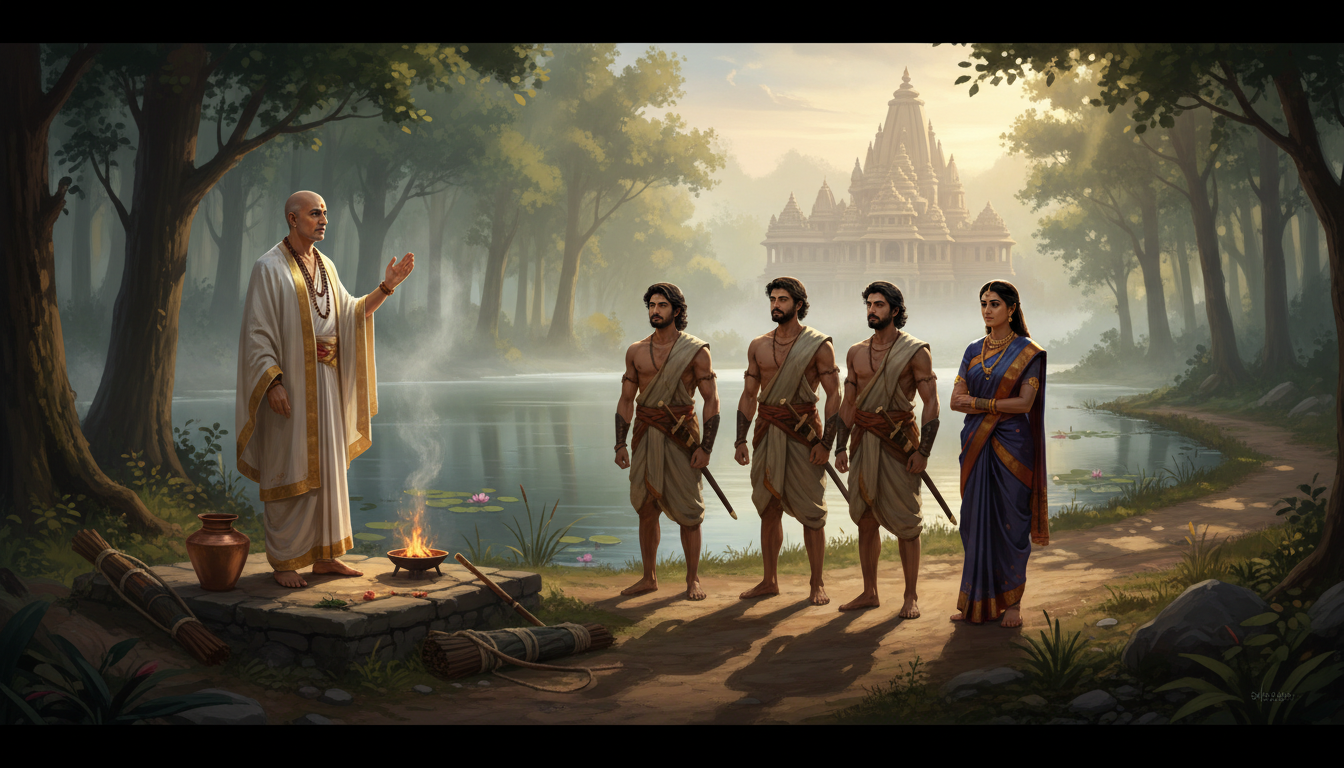
What Dhaumya Told Them About Kings
The rules for living inside another man's palace
The Last Council at the Lake
Vaishampayana said: At the lake of Dwaitavana, on the day the twelve years ran out, they sat down and disposed of everything they still owned.
The terms were exact and everybody in that circle knew them by heart. Twelve years in the forest, which they had now finished. Then one more year lived among people, and if in that thirteenth year they were discovered by anyone who knew them, the whole thirteen began again from the start. It was not a sentence that could be served with courage. It could only be served with care.
They had already chosen the kingdom. Virata of the Matsyas was old, and virtuous, and powerful, and charitable, and liked by everybody, and known to be attached to the Pandavas, and his was a country where six strangers looking for work would not be remarkable.
"You have each said what office you will perform," Yudhishthira said. "I have said, according to the measure of my sense, what office I will perform. Now for the rest.
"Let our priest go to the house of Drupada, and take the charioteers and the cooks with him, and maintain our Agnihotra fires there. Let Indrasena and the others take the empty cars and go quickly to Dwaravati. And let all these maidservants of Draupadi go to the Panchalas with the charioteers and the cooks. And let every one of them say the same sentence: we do not know where the Pandavas have gone. They left us at the lake of Dwaitavana."
It was a tidy dispersal. The fires went one way, the vehicles another, the servants a third, each with a story that would hold. Nothing was left at the lake that could be questioned.
When they had settled it among themselves, they went to Dhaumya and asked what he thought.
The One Provision You Have Not Made
"Sons of Pandu," Dhaumya said, "the arrangements you have made about the Brahmanas, your friends, the cars, the weapons and the sacred fires are excellent."
Then he named the gap.
"But it behoves you, Yudhishthira, and Arjuna especially, to make provision for the protection of Draupadi."
He let that sit. Of the six of them, she was the one with no cover. The brothers were going in as a courtier, a cook, a dancing-master, a horse-keeper and a herdsman, and every one of those is a man in a place where men are expected. She was going in as a Sairandhri, a woman of no family who dresses other women's hair, which is a position with no protector attached to it, in a palace, for a year.
"You are well acquainted with the characters of men," the priest went on, "and I know it. Yet whatever your knowledge may be, friends may be permitted out of affection to repeat what is already known. This too is subservient to the eternal interests of virtue, pleasure and profit. I shall therefore speak to you about something. Mark it.
"To dwell with a king is difficult. I shall tell you, princes, how you may live in a royal household and avoid every fault. Honourably or otherwise, you will have to pass this year in a king's palace, undiscovered by those who know you. Then in the fourteenth year you will live happy."
And then Dhaumya, who had walked behind them for twelve years and said very little, gave the longest speech he makes anywhere in this history. It is not a blessing and it is not a prophecy. It is a manual. A priest who had spent his life in the households of kings sat down with six people who had only ever been on the receiving end of service, and taught them, item by item, how to be servants without being destroyed.
A Deity in an Embodied Form
"In this world," he said, "the king, who is the cherisher and protector of all beings, is a deity in an embodied form. He is like a great fire that has been sanctified with all the mantras. Handle him accordingly.
"Present yourself before the king only after you have obtained his permission at the gate. Keep no contact whatever with royal secrets. Desire no seat that another man may covet.
"He who does not, considering himself a favourite, occupy the king's car, or his couch, or his seat, or his vehicle, or his elephant, is alone worthy of dwelling in a royal household. He who does not sit upon a seat whose occupation is calculated to raise alarm in the minds of malicious people, is alone worthy of dwelling in a royal household."
That phrase came back again and again through the whole discourse, like the refrain of a hymn, and they were meant to hear it as one: is alone worthy of dwelling in a royal household. Everything else was negotiable. That was the test.
"No one should offer counsel to a king unasked. Pay him homage in season, and then sit beside him silently and respectfully, for kings take umbrage at babblers and they disgrace prating counsellors.
"Contract no friendship with the king's wife, nor with the inmates of the inner apartments, nor with anybody who is the object of royal displeasure. One who is about the king should do even the most unimportant thing with the king's knowledge. Behave with a sovereign in that way and no harm will come to you."
Consider Yourself Born Blind
"Even if a man attains the highest office," Dhaumya said, "he should, so long as he is not asked or commanded, consider himself as born blind, having regard to the king's dignity. For, repressers of foes, the rulers of men do not forgive even their own sons and grandsons and brothers when those happen to tamper with their dignity.
"Kings should be served with careful regard, exactly as Agni and the other gods are served, and he who is disloyal to his sovereign is certainly destroyed by him.
"Renouncing anger and pride and negligence, a man should follow the course the monarch directs."
They were listening to this on the ground beside a forest lake, five of them the sons of a king and one of them a king himself who had performed the Rajasuya and received tribute from every quarter of the earth. Dhaumya was telling the emperor of Indraprastha to make himself born blind for a year in another man's hall. He did not soften it and Yudhishthira did not object to it. That is roughly what the year required.
Say the Profitable Thing Anyway
"After carefully deliberating on everything," the priest said, "a man should set before the king those matters that are both profitable and pleasant. But should a subject be profitable without being pleasant, he should still communicate it, in spite of its disagreeableness.
"Be well disposed toward the king in all his interests, and do not indulge in speech that is at once unpleasant and unprofitable."
That is the hinge of the whole code, and it is easy to walk past. A courtier may say the useful thing that stings. A courtier may say the pleasant thing that helps. What he may never do is open his mouth to say a thing that hurts and does no good, which is what most speech in most courts consists of.
"Always thinking, I am not liked by the king, a man should banish negligence and be intent on bringing about what is agreeable and advantageous to him. He who does not swerve from his place, who is not friendly to those hostile to the king, who does not strive to do the king wrong, is alone worthy to dwell in a royal household."
Always thinking, I am not liked by the king. Dhaumya did not tell them to assume they were valued. He told them to assume the opposite every morning, and to work as though the favour they had was on loan, because in a royal household it always is.
Where to Sit and How to Laugh
Then he came down to the smallest details, and did not think them beneath him.
"A learned man should sit either on the king's right or on his left. He should not sit behind him, for that is the place appointed for the armed guards, and to sit in front of him is always forbidden.
"When the king is engaged in doing anything for his servants, let no one come forward pressing himself zealously ahead of the others. Even if the aggrieved man is very poor, such conduct is still inexcusable.
"It behoves no man to reveal to others any lie the king may have told, for the king bears ill will toward those who report his falsehoods. And kings always disregard the persons who regard themselves as learned.
"No man should be proud, thinking, I am brave, or, I am intelligent. A person obtains the good graces of a king, and enjoys the good things of life, by behaving agreeably to the king's wishes.
"No one should move his lips, his arms or his thighs before the king. Speak and spit in the king's presence only mildly. In the presence even of laughable objects, a man should not break out into loud laughter like a maniac, nor should he show unreasonable gravity by containing himself to the utmost. Smile modestly, to show your interest in what is before you."
Bhima was there, listening to a rule against loud laughter and a rule against moving your arms, days before he walked into a kitchen in Matsya to be a cook and to throw wrestlers in the lists for a king's entertainment. It is not recorded that he said anything.
And there is a reason the small rules come with the large ones and are given the same weight. Nobody is ever discovered by a great error. A man in hiding is discovered because he sat down in the wrong chair, or laughed too loudly at the wrong joke, or answered a question that had not been put to him, or held himself a little too straight when a king came into the room. The whole thirteenth year would eventually turn on questions of exactly that size: a hand marked with bowstring scars, a walk, a temper.
Who Is Alone Worthy
"He who is ever mindful of the king's welfare, and is neither exhilarated by reward nor depressed by disgrace, is alone worthy of dwelling in a royal household.
"That learned courtier who always pleases the king and the king's son with agreeable speeches succeeds in dwelling in a royal household as a favourite. The favourite courtier who, having lost the royal favour for a just reason, does not then speak evil of the king, regains his prosperity. The man who serves the king, or who lives in his dominions, should if he is sagacious speak in praise of the king both in his presence and in his absence.
"The courtier who attempts to obtain his end by employing force upon the king cannot keep his place long, and runs the risk of death as well. No one should, for the purpose of his own interest, open communications with the king's enemies. And no one should distinguish himself above the king in matters requiring ability and talent.
"He who is always cheerful and strong, brave and truthful and mild, of subdued senses, and who follows his master like his shadow, is alone worthy to dwell in a royal household. He who, on being entrusted with a work, comes forward saying, I will do this, is alone worthy of living in a royal household. He who, on being entrusted with a task within the king's dominions or outside them, never fears to undertake it, is alone fit to reside in a royal household.
"He who, living away from his home, does not sit remembering his dear ones, and who undergoes present misery in the expectation of future happiness, is alone worthy of dwelling in a royal household."
That last one was not a rule of etiquette. That was the whole thirteenth year said in one line, to five men and a woman who were about to live away from home for twelve months under names that were not theirs, keeping their heads down for the sake of a fourteenth year they could not yet see.
And the line before it was aimed at somebody in particular. He who, on being entrusted with a task within the king's dominions or outside them, never fears to undertake it. Within a year a king of the Matsyas would look round a hall for somebody to send out after sixty thousand stolen cattle with a boy who had never fought, and the man who stepped forward would be a dancing-master in bangles and earrings. Dhaumya had told him in advance not to hesitate.
Take No Bribe, Wear What He Gives You
"Do not dress like the king," Dhaumya said, "and do not indulge in laughter in his presence, and do not disclose royal secrets. By acting so you may win royal favour.
"Commissioned to a task, do not touch bribes, for by such appropriation a man becomes liable to fetters or to death.
"The robes, the ornaments, the cars and the other things which the king may be pleased to bestow should always be used, for by this one wins the royal favour."
There is a symmetry in those three that a careless reader misses. Take nothing that is offered to you in secret. Wear everything that is given to you in the open. A servant who refuses the king's gifts is telling the hall that he holds himself apart, which is its own kind of insolence; a servant who takes money quietly from petitioners has sold the only thing the king actually employs him for.
"Children," the priest finished, "controlling your minds, spend this year in this way, you sons of Pandu. Regaining your own kingdom afterwards, you may live as you please."
He called them children at the end of it, having spent an hour instructing an emperor. There was nobody left alive who was entitled to do that except him.
None but Kunti and Vidura
Yudhishthira answered him with one of the shortest and highest compliments he pays anyone in the whole history.
"We have been well taught by you. Blessed be you. There is none that could have said so much to us, save our mother Kunti and Vidura of great wisdom."
Those are the two names that mean something in that sentence. Kunti had raised five sons alone in a house that did not want them and had told them once, without knowing what she was saying, to share what they had brought home. Vidura had stood up in the assembly at Hastinapura when nobody else would, had argued dharma with a blind king who did not want to hear it, and had sent a warning about a house of lac in language nobody else could read. To be put in that company, by that man, at that hour, was as much as a priest could ever be given.
"It behoves you now to do all that is necessary for our departure," Yudhishthira said, "and for our coming safely through this trouble, and for our victory over the foe."
Notice what he asked for, in that order. Departure first, then survival, then victory. He had just been told for the better part of an hour how to make himself small, how to be born blind, how not to laugh, how to praise a man he did not have to respect, and he had not argued with a word of it. A king who cannot make himself a servant for one year has no business asking for a kingdom back at the end of it.
The Fires Go to Panchala
So Dhaumya, that best of Brahmanas, performed the rites ordained for a departure, according to the ordinance.
He lit their fires. He offered oblations on them with the mantras, for the prosperity and the success of the sons of Pandu, and for their reconquest of the whole world; which is a thing to say aloud over a fire in a forest when the men you are saying it for own nothing but the clothes they are standing in.
Then they walked round the fires, and round the Brahmanas of ascetic wealth, and the six of them set out, placing Yajnaseni in front of them where they could see her.
And when the heroes had gone, Dhaumya took up their sacred fires and carried them away to the Panchalas, to be kept burning in Drupada's house until somebody came back for them. Indrasena and the others went to the Yadavas, and looked after the horses and the cars, and passed their time quietly and out of sight.
The priest walked east with the fires. The six walked south toward Matsya with a code of conduct and nothing else, and for the next twelve months every one of them lived inside another man's palace by it: the emperor at the dice board saying only what was profitable, the strongest man alive smiling modestly in a kitchen, the greatest archer alive teaching girls to dance, and a queen dressing another woman's hair. The year held. It held right up until a man in that palace looked at the Sairandhri and did not care what the rules were, and then it did not hold at all, and everything Dhaumya had said about the protection of Draupadi turned out to have been the most important sentence in the speech.
Dharma Lesson
Service under another man's roof is a discipline in its own right, with rules as exacting as any vow. The man who cannot make himself small for a single year, and take no offence and no bribe while he does it, has not shown that he can be trusted with a kingdom afterwards.