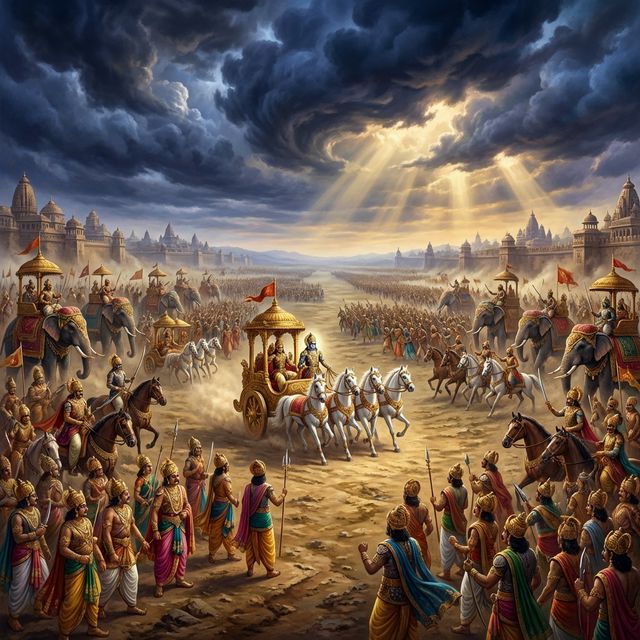
The Road to Jayadratha
Arjuna breaks through the head of Drona's array on the fourteenth morning, from the omens at dawn to the river of blood
The Hour Called Rudra
Sanjaya told this part of it to a blind king in a hall, and he told it in the order that it happened, beginning with the noise.
The Kuru divisions had been arrayed. Drums and mridangas were beaten, conchs were blown, an awful roar went up that made the hair stand on end, and the field filled slowly with Bharata heroes who wanted a fight. Then the hour called Rudra set in, and Savyasachin made his appearance.
He did not come alone. Many thousands of ravens and crows went sporting on the front of Arjuna's car, keeping pace with it. Animals with terrible cries, and jackals of inauspicious sight, began to yell and howl on the Kaurava right as they advanced. Thousands of blazing meteors fell with great noise. The earth trembled. Dry winds got up in every direction with thunder in them, driving hard pebbles and gravel into the faces of men, and all of this happened at the moment Kunti's son came to the commencement of the battle.
Sanjaya, who had watched every day of that war, set the omens down without comment. They belonged to the Kauravas, who saw them, and not to the man they were about.
Across the field, Satanika the son of Nakula and Dhrishtadyumna the son of Drupada, two warriors possessed of great wisdom, were arraying the Pandava divisions. This was the fourteenth morning. Abhimanyu had been dead since the afternoon before, six men had killed him inside a formation he could enter and not leave, and Arjuna had sworn in front of both armies that Jayadratha of the Sindhus would die before the sun went down or he would walk into fire himself.
Drona had spent the night answering that vow with an array. Forty-eight miles of it, part cart and part circle, with a lotus inside the cart and a needle inside the lotus, and Jayadratha stationed at the far end of the needle behind Karna and Kripa and Ashwatthama and Shalya and a hundred thousand horse.
Between the man and the vow lay every soldier Duryodhana had.
The Continent and the Sea
At the very van of all the Kaurava troops, covering a piece of ground that measured the length of fifteen hundred bows, stood Durmarshana, a son of Dhritarashtra, with a thousand cars and a hundred elephants and three thousand heroes and ten thousand foot behind him.
He had thought about what he wanted to say.
"Like the continent resisting the surging sea, even I will today resist the wielder of Gandiva, that scorcher of foes, that warrior who is irresistible in battle. Let people today behold the wrathful Dhananjaya collide with me, like a mass of stone against another stony mass. Ye car-warriors that are desirous of battle, stay ye as witness. Alone I will fight with all the Pandavas assembled together, for enhancing my honour and fame."
That noble son of yours, said Sanjaya, said this and stood there surrounded by many great bowmen, waiting to be looked at.
What came toward him is described in the text by a list, because one comparison was not enough. Like the Destroyer himself in wrath. Like Vasava armed with the thunder. Like Death armed with his club and urged on by Time. Like Mahadeva with the trident, who cannot be ruffled. Like the blazing fire at the end of the yuga risen to consume the creation. The slayer of the Nivatakavachas, inflamed with rage and swelling with might, the ever-victorious Jaya, devoted to truth and desirous of achieving his great vow, clad in mail, decked in a golden diadem, wearing garlands of white flowers and white robes, with angadas on his arms and excellent earrings in his ears, standing on his own foremost of cars. Nara, accompanied by Narayana. Shaking Gandiva, and shining like the risen sun.
Arjuna placed his car at the very van of his army, in the exact place where the densest showers of arrows would fall, and blew his conch. Krishna, fearlessly, blew Panchajanya at the same moment.
Every animal in the Kaurava host voided itself where it stood. Men lost their strength at the sound, some were filled with dread, some lost their senses altogether, and the ape on Arjuna's banner opened his mouth wide and made an awful noise with the other creatures on the standard, to help.
Conchs and horns and cymbals were beaten again on the Kuru side to cheer the warriors up.
Then Arjuna spoke to his driver.
"Urge the steeds, O Hrishikesa, to where Durmarshana stayeth. Piercing through that elephant division I will penetrate into the hostile army."
Where Is Partha? Here Is Partha
Kesava urged the steeds to where Durmarshana was standing, and the encounter that commenced there was between one and the many.
Partha covered them like a pouring cloud, the way a mass of clouds pours rain on the breast of a mountain. They answered with great lightness of hand, covering both Krishna and Dhananjaya with arrows, and then Arjuna became filled with wrath and began striking the heads of car-warriors off their trunks.
The earth became strewn with beautiful heads decked with earrings and turbans, the nether lip bitten by the upper, the faces adorned with eyes still troubled with wrath. They looked, Sanjaya said, like an assemblage of plucked and crushed lotuses lying about the field. Golden coats of mail dyed with gore lay thick over the ground like masses of cloud charged with lightning. The sound of severed heads dropping on the earth was the sound of palmyra fruits falling when they have ripened in due time.
Headless trunks stood up, some with the bow still in hand, some with naked swords upraised in the act of striking. The brave men who could not brook Arjuna's feats and wanted to beat him had no distinct perception of the moment their own heads came off. Arms that had been cut from their bodies, cased in armour, decked with angadas, still holding lances or battle-axes or scimitars, were seen to jump and jerk and move about the field with great force, as if in rage.
And the army began to say one thing.
"This is one Partha." "Where is Partha?" "Here is Partha!"
Deprived of their senses by Time, said Sanjaya, they regarded the whole world as full of Partha only. Many of them perished by striking one another. Some struck their own selves.
Nobody could detect the minutest opportunity for hitting him. He seemed to dance on the car as it moved, with the bow drawn incessantly to a circle, and the quickness with which he took his shafts, fixed them, and let them off filled his enemies with wonder. As the sun rising in the welkin destroys the thick gloom, so Arjuna destroyed that elephant force with shafts winged with kanka plumes, until the ground where Durmarshana's men had stood looked like the earth strewn with huge hills at the hour of universal dissolution.
Then they broke. Cavalry, car-warriors and foot together, urging their beasts with spurs and hooks and the horns of their bows and threatening speeches, and many of them, blinded and running, ran straight into Arjuna instead of away from him.
Dushasana's Elephants
Afterwards the blind king asked the question that had been sitting in him.
"When the van of my army, thus slaughtered by the diadem-decked Arjuna, broke and fled, who were those heroes that advanced against Arjuna? Did any of them actually fight with him, or did all of them abandon their determination and enter the cart array, getting behind the fearless Drona, who resembled a solid wall?"
One did. Dushasana, cased in a beautiful coat of mail made of gold, his head covered with a turban decked with gold, saw the state of the troops and became filled with wrath, and he had a way of fighting Arjuna that did not require him to stand in front of Arjuna. He had an elephant force brought around the Pandava until it seemed capable of devouring the whole earth.
With the sound of the bells, the blare of conchs, the twang of bow-strings and the grunting of the tuskers, the earth and the points of the compass and the sky seemed entirely filled. That period of time, Sanjaya said, became fierce and awful.
Arjuna saw the huge beasts with their trunks extended coming at him like winged mountains urged on with hooks, and uttered a leonine shout, and went into them. Like a makara going down into the deep when the tempest has raised the water into mountains, the diadem-decked penetrated that elephant host.
The shafts from Gandiva numbered thousands upon thousands and their touch was the touch of snakes of virulent poison. Elephants mangled by them made loud noises and fell incessantly on the earth like mountains shorn of their wings. Struck at the jaw, or on the frontal globes, or on the temples with long shafts, they uttered cries like the cries of cranes. Arjuna cut off the heads of the men standing on their necks, and those heads with their earrings fell constantly to the ground and looked like a multitude of lotuses that Partha was calling down as an offering to his gods.
Warriors hung dead from the sides of wandering elephants, stripped of armour, covered with blood, looking like painted pictures. In some instances two and three men, pierced by a single well-shot arrow, fell together.
Then that division broke too. Their leader himself was in great pain. Dushasana, greatly afflicted by those shafts and overcome by fear, took what was left of his force into the cart array and went looking for Drona to deliver him.
Past the Gate
Having slaughtered Dushasana's force, Savyasachin wanted the ruler of the Sindhus, and the road to him ran through the entrance of the array, where Drona was standing in white armour with his bow stretched, like the Destroyer in wrath.
At Krishna's request Arjuna joined his hands.
"Wish me well, O Brahmana, and bless me, saying Swasti. Through thy grace, I wish to penetrate into this impenetrable array. Thou art to me even as my sire, or even as king Yudhishthira the just, or even as Krishna. I tell thee this truly, O sinless one. Even as Ashwatthama deserves to be protected by thee, I also deserve to be protected by thee. Through thy grace I desire to slay the ruler of the Sindhus in battle. O lord, see that my vow is accomplished."
The preceptor smiled at his pupil.
"O Vibhatsu, without vanquishing me, thou shalt not be able to vanquish Jayadratha."
Then he covered him with sharp arrows, his car and his steeds and his standard and his charioteer, still smiling. Arjuna, observant of kshatriya duties, pierced him with nine. Drona cut off his bow-string, and hit his horses and his standard and his driver, and while Arjuna was stringing the bow again the old man went on shooting.
What came back was a demonstration. Six hundred arrows as though he had taken and shot only one. Then seven hundred more, then a thousand that could not be resisted, then ten thousand. Men and horses and elephants of Drona's array fell dead in heaps, car-warriors dropped from their cars deprived of horses and standards and weapons and life, and elephants came down like summits of hills loosened by thunder.
Drona struck him in the chest with a long shaft made to drink the life-blood of any foe, and Arjuna shook in all his limbs like a hill during an earthquake, and recovered, and shot again.
Then Krishna, who was counting the hours, said what he had been thinking.
"O Partha, O thou of mighty arms, we should not waste time. We must go on, avoiding Drona, for a more important task awaits us."
"O Kesava, as thou pleasest."
They kept Drona to their right and went past him, Arjuna shooting over his shoulder as he went.
"Whither dost thou proceed, O son of Pandu? Is it not true that thou ceasest not to fight till thou hast vanquished thy foe?"
"Thou art my preceptor and not my foe. I am thy disciple and therefore like to thy son. Nor is there a man in the whole world who can vanquish thee in battle."
The Bhoja and the Wheel-Guards
Behind him came Drona, pursuing. Around him closed the men whose work that morning was to stop him: Kritavarma of the Satwata race, the ruler of the Kamvojas, Jalasandha, Srutayudha, and ten thousand car-warriors under them. The Abhishahas, the Surasenas, the Sivis, the Vasatis, the Kaikeyas, the Madrakas, the Narayana Gopalas and the tribes of the Kamvojas, all of them regarded as very brave, put Bharadwaja's son at their head and became regardless of their lives. They resisted that one man, said Sanjaya, the way medicines resist a raging disease.
Two Panchala princes, Yudhamanyu and Uttamaujas, followed Arjuna as the protectors of his wheels. Their whole assignment in that war was to stay behind him and keep his flanks clear.
Arjuna went at the array itself, and blasted it the way a disease scorches a body. Steeds were pierced, cars were broken with their riders in them, elephants were overthrown, umbrellas were cut off and displaced, vehicles lost their wheels. Drona came up on him again with five and twenty straight shafts aimed at the vitals, and Arjuna invoked the Brahma weapon and cut the arrows out of the air, and even so, though he was young and struggling vigorously, he could not put a single shaft into his teacher. That, Sanjaya said, was the most wonderful skill they saw all morning.
So he left him. Avoiding the invincible Drona, who stood immovable like the Mainaka mountain, he took his car in between Kritavarma and Sudakshina the ruler of the Kamvojas, and began to slaughter the host of the Bhojas.
Kritavarma pierced him coolly with ten arrows. Arjuna answered with a hundred, and three more that stupefied him. The Bhoja laughed and put five and twenty into Arjuna and Krishna both. Arjuna cut his bow, and put one and twenty shafts into him that resembled angry snakes of virulent poison, and Kritavarma took up another bow and hit him five times in the chest.
Krishna saw the minutes going.
"Do not show any mercy to Kritavarma. Disregarding thy relationship with him, crush and slay him."
Arjuna stupefied him with arrows and drove on into the Kamvoja force, and did not kill him, though he had him within reach.
Kritavarma, furious, turned and took the two wheel-guards instead. He cut their standards and their bows, they strung others and came on again, and he held them there. Struggle as they did, Yudhamanyu and Uttamaujas obtained no admittance into the Dhritarashtra host that morning.
From that point Arjuna was inside the Kaurava army alone.
The Mace and the Karnikara Tree
Srutayudha came at him shaking his large bow, and this was a man with a promise on him. His mother was the river Parnasa and his father was Varuna, and she had begged the lord of the waters to make her son unslayable on earth. Varuna had given him a mace with mantras in it and one rule: it was never to be hurled at a man who was not engaged in fight, or it would turn in the air and kill the thrower.
He pierced Arjuna with three arrows and Janardana with seventy. Arjuna answered with ninety straight shafts, then cut his bow and his quiver, then killed his horses and his charioteer, and Srutayudha came down off the useless car with the mace up.
Then, when his hour had come, he disobeyed the injunction and threw Varuna's mace at Krishna, who was driving and not fighting.
It struck Sauri on one of his well-formed and stout shoulders and failed to shake him, as the wind fails to shake the Vindhya mountain, and it came back. It struck the wrathful king standing on his own car, like an ill-accomplished act of sorcery injuring the performer, and killed him. Falling, that dear son of Parnasa looked like a tall banian broken by the wind, and a cry of Alas and Oh went up all over the field at the sight of a man slain by a weapon of his own.
The troops fled. Then Sudakshina, son of the ruler of the Kamvojas, came against Phalguna.
Arjuna sped seven shafts at him. They passed clean through his body and went into the earth. Sudakshina, pierced like that, pierced Arjuna with ten arrows winged with kanka feathers and Vasudeva with three. Then Arjuna cut off his bow and his standard, and Sudakshina uttered a leonine shout and hurled a terrible dart made wholly of iron.
It came like a large meteor emitting sparks, went through Arjuna and fell to the ground, and he swooned on the terrace of his own car and came back to himself licking the corners of his mouth.
Fourteen shafts took the prince's horses and standard and bow and driver, and countless others cut his car into fragments. Then one sharp arrow in the chest, and his mail split and his limbs went slack and his diadem and angadas came off, and he fell head downwards like a pole of Indra hurled from an engine.
He lay on the bare ground, deserving of the costliest bed, in his gold garland, with eyes of a coppery hue. Sanjaya said he looked like a beautiful karnikara tree in spring, growing on a mountain summit, uprooted by the wind.
Srutayus and Achyutayus
When Sudakshina and Srutayudha were both down, the Kaurava warriors rushed at Partha in a rage. The Abhishahas, the Surasenas, the Sivis and the Vasatis scattered their arrowy showers on him. He consumed six hundred of them at once, and they fled like smaller animals from a tiger, and rallied, and surrounded him again, and he felled their heads and arms with shafts from Gandiva until not an inch of that field was unstrewn, and the crows and vultures over it seemed to form a cloudy canopy.
Two men watched their people being exterminated and came to end it: Srutayus and Achyutayus, proud, strong-armed, solicitous of great fame, willing for Duryodhana's sake to compass the destruction of Arjuna. They took him from the right and the left at once, and with a thousand straight shafts covered him like two masses of cloud filling a lake.
Then Srutayus, filled with wrath, struck Dhananjaya with a well-tempered lance, and the crusher of foes, deeply pierced, swooned away on his car, and the sight of it stupefied Kesava too. In that moment Achyutayus struck the son of Pandu forcibly with a keen-pointed spear, pouring acid, Sanjaya said, into a wound already made. Partha kept himself upright by seizing the flagstaff.
A leonine shout went up from the whole Kaurava army in the belief that Dhananjaya was dead. Krishna, scorched with grief, spoke soft words to a man who could not hear them, and those two archers of true aim poured arrows from every side until the car and its wheels and its horses and its flagstaff could not be seen at all.
Then Vibhatsu came back slowly to his senses, like one returned from the very abode of the king of the dead.
He looked at his car covered over with arrows and his friend standing in it, and at the two men in front of him burning like two fires, and invoked the weapon named after Sakra.
Thousands of straight shafts flowed out of it. They caught the arrows of Srutayus and Achyutayus in the air and sent them coursing off through the welkin, and then took the arms and the heads off the two bowmen, and they fell like a couple of tall trees broken by the wind.
Men who saw it, Sanjaya said, felt the surprise they would have felt at the sight of an ocean going dry.
Fifty car-warriors of their following died after them. Then their sons, Niyatayus and Dirghayus, rushed at the son of Kunti in rage and grief, much pained by the calamity that had happened to their sires, and Arjuna despatched them both to Yama's abode in a moment, by means of straight shafts.
The River That Ran to Yama
The bulls among kshatriyas in that army could not resist him now. He agitated the Dhartarashtra ranks the way an elephant agitates the water of a lake full of lotuses.
Thousands of trained elephant-riders among the Angas surrounded him with their beasts. Urged by Duryodhana, kings of the west and the south, and others headed by the ruler of the Kalingas, closed in with elephants huge as hills. Partha cut off the heads and the ornamented arms of the men riding at him, and the field strewn with those heads and those arms in their angadas looked like golden stones entwined by snakes, and the arms falling looked like birds dropping out of trees. Elephants pierced with thousands of arrows and bleeding looked like hills in the rainy season with liquefied red chalk streaming down their sides.
Then the Mlecchas came in on him: Yavanas and Paradas and Sakas and Valhikas, Darvabhisaras and Daradas and Pundras by the thousand, in bands, together forming a force that could not be counted. Fierce-eyed men accomplished in smiting, who looked like messengers of Death and were conversant with the deceptive powers of the Asuras, robed in strange attire, armed with strange weapons, their heads completely shaved or half-shaved or covered with matted locks. They covered Arjuna with arrows, being accomplished in various modes of warfare.
Dhananjaya poured his own arrows on them, and those arrows, shot from Gandiva, looked like flights of locusts as they coursed through the sky. He caused a shade over the troops like the shade of clouds, and under it he killed them all. Those dwellers of hills and denizens of mountain-caves who were left fled away in fear.
Ravens and kankas and wolves came down with great glee and drank the blood of the elephants and the horses and their Mleccha riders where they lay.
And Arjuna caused a fierce river to flow there whose current consisted of blood.
Slain foot-soldiers and horses and cars and elephants made its embankments. The showers of shafts poured into it were its rafts. The hair of the combatants was its moss and weeds, and the fingers cut off from their arms were its little fishes. It flowed toward the region of Yama, obstructed here and there in its current by the bodies of dead elephants floating in it, and it was as awful, Sanjaya said, as Death itself at the end of the yuga.
The earth on both sides of it was one bloody expanse, like the ground when Indra sends down a heavy downpour and covers uplands and lowlands alike.
Six thousand horsemen went into the jaws of death there, and a thousand foremost kshatriyas after them.
The Mace of the Amvashthas
As a conflagration urged by the wind consumes a dense forest of trees and creepers and dry wood and grass, so did that fire, Pandu's son Dhananjaya, having shafts for its flames and urged on by the Krishna-wind, angrily consume the forest of Dhritarashtra's warriors. He made the terraces of the cars empty. He seemed to dance, bow in hand, in the middle of those vast masses of men.
While he was proceeding like that, still going forward, still looking for one man in an army of half a million, another Srutayus, the ruler of the Amvashthas, put himself in the road.
Arjuna felled his horses with keen shafts equipped with kanka feathers, and cut his bow, and careered on past him. So the ruler of the Amvashthas, with his eyes troubled in wrath, took up a mace and came after the car on foot, and struck the car with it to stop it, and struck Kesava with it.
That was the second man that morning to lift a mace at a charioteer who was not fighting, and this one was not carrying a boon from Varuna.
Arjuna, seeing Kesava struck, became filled with wrath and covered the man with shafts equipped with wings of gold, like clouds covering the risen sun. Then, with other shafts, he cut the mace itself into fragments in the man's hands, reducing it almost to dust, and all this, Sanjaya said, seemed highly wonderful. The Amvashtha looked at what was left of his weapon, threw it down, and took up another huge mace, and struck both Arjuna and Kesava with it again.
Then Arjuna, with a couple of sharp broad-faced arrows, cut off the uplifted arms that held it, those arms that looked like a couple of Indra's standards, and with another winged arrow took off his head.
He fell, filling the earth with a loud noise, like a tall standard of Indra when the strings that tie it to its engine are cut.
That was the morning. Durmarshana's van, Dushasana's elephants, the gate where his teacher blessed him and then tried to kill him, Kritavarma spared, Srutayudha killed by his own mace, Sudakshina, Srutayus and Achyutayus and their two sons, and Mlecchas beyond counting, and the sun still climbing.
Then the cars closed around him in rings, and hundreds upon hundreds of elephants behind them, and Partha became invisible, like the sun covered with clouds.
Behind him, in the dust he had come through, Duryodhana was already driving to Drona to ask what could possibly be done next.
Dharma Lesson
The omens on this morning belong to the men who see them, not to the man they surround, and the epic is careful about that. Arjuna rides under crows and falling meteors toward the one thing he has sworn to do, and it is his enemies who lose their senses at the sound of his conch. Notice too how the day sorts its dead. Srutayudha has a boon that makes him unslayable and one condition attached to it, and he breaks the condition in the heat of a moment and is killed by his own weapon; the Amvashtha king repeats the same act with an ordinary mace and dies of it too. And Kritavarma, who is a kinsman, is stupefied and left alive with Krishna's order to kill him still hanging in the air, because a man riding toward a vow at sunset has to choose what he spends the hours on.