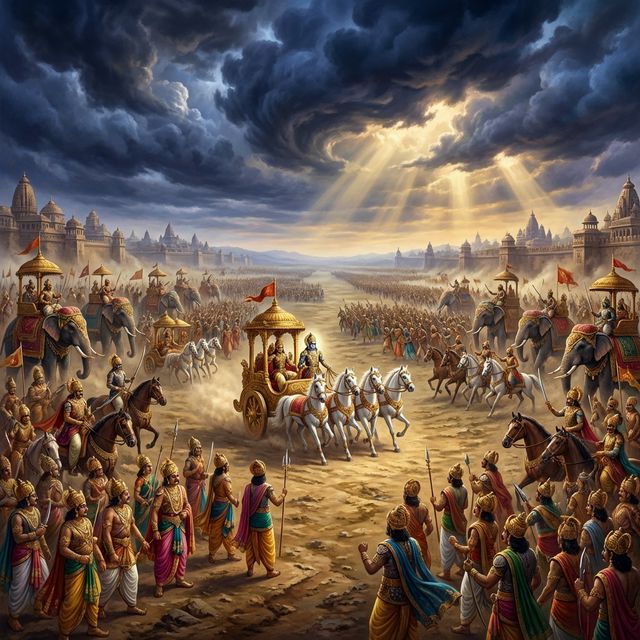
The Brothers of Avanti
Two kings see Arjuna's horses tire, and one of them walks up to Krishna with a mace
The Question About the Grandson of Shini
Dhritarashtra had been listening to the fourteenth day for a long time by then, and he stopped Sanjaya at the place where Drona had almost had Dhrishtadyumna and had lost him.
"After the shafts of Drona had been cut off," the king said, "and Dhrishtadyumna thus rescued by Yuyudhana, that foremost one of the Vrishni race, what did that great bowman, that foremost of all wielders of weapons, do in battle unto that tiger among men, the grandson of Sini?"
The rescue itself had taken one moment. Drona had stripped the prince of the Panchalas of shield and sword and horses and standard and both his rear drivers, had drawn the bowstring back to his ear, and had shot the arrow that was meant to finish him. Satyaki cut that arrow out of the air with fourteen of his own, and a deer walked out of the lion's mouth in front of the whole army.
A thing like that is not forgiven on a battlefield. It is answered.
Sanjaya said: "Then Drona, like a mighty snake, having wrath for his poison, his stretched bow for his wide-open mouth, his sharp shafts for his teeth and whetted arrows for his fangs, with eyes red as copper from rage, and breathing hard, borne on his red steeds of great speed that seemed to soar into the skies or get at the top of a mountain, rushed towards Yuyudhana, scattering his arrows equipped with golden wings."
It is worth saying plainly who was standing in that path. Satyaki, the grandson of Sini, was a Vrishni of Krishna's own house, a pupil of Arjuna, and the one man on the Pandava side that day who had been sent alone through the Kaurava army and had come out the other end of it. He was not a great name being offered up to a greater one.
He watched the preceptor of all the princes come at him, and he began to smile.
What He Told His Driver
What Satyaki saw coming was not a man. Sanjaya described it as weather.
An irresistible Drona cloud, having showers of arrows for its watery downpour, the rattle of car-wheels for its roar, the outstretched bow for its volume, long shafts for its lightning-flashes, darts and swords for its thunder, wrath for the winds, and urged forward by those red steeds that were the hurricane driving it.
Into that, the hero of Sini's race turned to his charioteer and spoke to him smilingly, in the tone a man uses when he has decided something and is comfortable with it.
"Suta, proceed quickly and cheerfully, urging the steeds to their greatest speed, against that heroic Brahmana, fallen off from the duties of his order, that refuge of Dhritarashtra's son, that dispeller of the king's sorrows and fear, that preceptor of all the princes, that warrior ever boastful of his prowess."
Every clause of it is an insult, and every clause of it is also true, which is what gave it its edge. The man ahead of him was a Brahmana who had spent eighteen days killing Kshatriyas for wages. Satyaki did not shout it. He said it to his driver, in the hearing of whoever was near, and the excellent steeds of silvery hue, endued with the speed of the wind, went straight at the red ones.
Then those two chastisers of foes struck each other with thousands of shafts, and each of them filled the sky.
They covered the ten points of the compass. They poured on each other like two clouds emptying themselves on the earth at the expiry of summer. The sun became invisible above them. The very wind ceased to blow. And out of that downpour of arrows a continuous and thick gloom was made in that quarter of the field, unbearable to the other heroes, so that men fighting nearby had to back out of it to see anything at all.
Inside the gloom, neither of them stopped shooting for an instant.
The Field Stops to Watch
The sound of those torrents of arrows striking one another in the air was heard to resemble the thunder hurled by Sakra. Warriors pierced through with long shafts looked like snakes bitten by snakes of virulent poison. Men heard the twangs of the two bows and the slap of the two palms on the strings as though summits of mountains were being struck by lightning, over and over, without a pause between.
The cars of both, their steeds and their charioteers, stuck all over with shafts of golden wings, became beautiful to look at. The umbrellas of both were cut off. The standards of both went down. Both men were covered with blood from crown to foot, and both were still full of the hope of victory, and with blood trickling from every limb they looked like a pair of elephants with the secretions of the rutting season running down their bodies.
And then the battle around them stopped.
The roars and shouts of the soldiers ceased. The blare of conchs ceased. The beat of drums ceased. Nobody uttered any sound, said Sanjaya, and all the divisions became silent, and the warriors stopped fighting where they stood, and people filled with curiosity became spectators of that single combat. Car-warriors and elephant riders and horsemen and foot-soldiers surrounded the two of them and watched with steadfast eyes. The elephant divisions stood still. The horse divisions stood still. The car divisions stood still, still disposed in their array.
Variegated with pearls and corals, decked with gems and gold, adorned with standards and ornaments, with coats of mail of gold and triumphal banners and rich caparisons on the elephants, with yak-tails on the heads of the steeds and garlands round the frontal globes and rings round the tusks, the Kuru host and the Pandava host together looked like a mass of clouds at the close of summer, with rows of cranes across them and myriads of fire-flies beneath, adorned with rainbows and flashes of lightning.
Both armies watched. And above them, said Sanjaya, the gods headed by Brahma and Soma watched too, and the Siddhas and the Charanas and the Vidyadharas and the great Snakes, stationed on their foremost of sky-ranging cars.
Sixteen Bows
Then he of Dasarha's race cut off the shafts of the illustrious Drona in mid-flight, and within a moment cut the bow that had shot them.
Within the twinkling of an eye the son of Bharadwaja had taken up another bow and strung it. Satyaki cut that one. Drona, with the utmost quickness, was waiting with a third in his hand. Satyaki cut that one too.
As often as Drona strung a bow, Satyaki cut it off, and he did it nine times and then seven times more.
There is no defence against that and no answer to it. It is not strength. It is the hand being faster than the other hand, sixteen times running, in front of two armies standing still to count. Drona was the man who had taught archery to every prince on that field, both sides of it, and he was being disarmed in his own subject at a rate that left him nothing to do but reach for the next weapon.
And what Drona did then is the reason this passage is remembered.
He thought, and Sanjaya reports the thought: This force of weapons that I see in this foremost one among the Satwatas exists in Rama and in Dhananjaya, and was seen also in Kartavirya, and in that tiger among men, Bhishma.
Four names. Parashurama, who emptied the earth of Kshatriyas. Arjuna, who was Satyaki's own teacher. Kartavirya of the thousand arms. And the grandsire. The son of Bharadwaja put the man in front of him into that company, in the middle of a fight he was losing, and mentally applauded him. Beholding that lightness of hand equal to that of Vasava himself, that foremost of all persons conversant with weapons was highly gratified with Madhava.
The gods with Vasava at their head were gratified as well. The Gandharvas had never before seen such quickness in Yuyudhana, though they and the Siddhas and the Charanas had long known everything that Drona was capable of.
Then Drona took up another bow, and stopped being gratified.
Agneya Against Varuna
He aimed weapons, and Satyaki baffled them with the illusion of a weapon of his own and struck him with sharp shafts while he was doing it. Judges of skill among the Kaurava warriors applauded that, because they knew it was a feat nobody else on the field could have performed.
Then Satyaki began to shoot back the same weapons that Drona shot. Whatever the preceptor sent, the pupil of his pupil answered in kind, astra for astra, and Sanjaya says the thing that a court chronicler does not say lightly: that seeing this, the scorcher of foes fought with a little less boldness than usual.
So Drona, filled with wrath, invoked the celestial weapons for the destruction of Yuyudhana. He called up the Agneya, the fire.
Satyaki, beholding that terrible foe-slaughtering weapon coming, invoked the Varuna, the water.
When the two of them were seen to take up celestial weapons, loud cries of Oh and Alas went up from the field, because everyone watching understood at once what was in the air over their heads and how little of the plain would be left if it came down. The very creatures whose element is the sky ceased to range through it.
The Agneya and the Varuna, grafted upon their shafts, came against each other above the two cars and cancelled, and both became fruitless, and nothing at all happened, which was the best outcome available to anyone present.
Just at that time the sun passed down in his course.
Then Yudhishthira and Bhimasena and Nakula and Sahadeva, wanting Satyaki out of that duel alive, came at Drona with the Matsyas and the Salweya troops behind them. And from the other side thousands of princes with Dushasana at their head came hurrying to cover Drona, who was now surrounded by enemies.
What had been one combat that an army could watch became a battle again, and worse than before. The earth was covered with dust and with showers of arrows from both sides, and everything being covered, nothing could any longer be discerned. When the troops were overwhelmed like that, said Sanjaya, the fighting went on in utter disregard of persons and of rules.
The Road to the Sindhu King
When the sun turned in his downward course towards the summit of the Asta hills, when the welkin was covered with dust and the heat of the solar rays abated, the day began to fade fast. Some soldiers rested. Some fought on. Some came back to the encounter still hoping to win it.
And while the troops were busy with all that, Arjuna and Vasudeva went for Jayadratha.
Everything about the fourteenth day was in that movement. Arjuna had sworn at dawn that the ruler of the Sindhus would be dead before the sun went down or he would enter the fire himself, and the whole Kaurava army had spent the day being a wall between the two of them, and the wall was still there and the light was going.
The son of Kunti made a road. By means of his shafts he opened through the hostile soldiers a way wide enough for his car, and Janardana drove into it. Wherever the car of the son of Pandu went, the Kaurava troops broke and yielded, and he of Dasarha's race showed his skill in driving by wheeling it through circling motions no one could anticipate.
The arrows were engraved with Arjuna's own name. They were well tempered and thick and far-reaching, tied round with catgut, of straight joints, some of cleft bamboo and some wholly of iron, and they resembled the fire that burns at the end of a Yuga, and they drank the blood of living creatures in that battle along with the birds of prey that had come down to the field. Standing on his car, Arjuna shot his shafts a full two miles ahead of himself, so that the men they killed were already dead by the time the car arrived where they lay.
Hrishikesa drove those horses at a speed that made the universe wonder. Not the car of Surya, said Sanjaya, nor that of Rudra, nor that of Vaisravana, ever went so fast. No car had ever before moved in battle with the celerity of a wish.
But the horses had been running since morning.
The Two Brothers of Avanti
Arrived in the middle of that throng of cars, the excellent white steeds bore Arjuna's car with difficulty. They were suffering from hunger and thirst and toil, they had been mangled by the weapons of many heroes, and they were picking their way over slain horses and men and broken cars and the bodies of dead elephants that lay in thousands like hills. They still described beautiful circles as they went. They were simply no longer fast.
And two men on the field noticed it.
Vinda and Anuvinda were brothers, kings of Avanti in the west, who had brought their forces to Duryodhana and had fought together in every great battle of that war. They came up now at the head of their troops, saw that the steeds of Arjuna were tired, and were filled with joy.
They pierced Arjuna with sixty-four shafts, Janardana with seventy, and the four horses with a hundred.
Then Arjuna, filled with wrath, and having a knowledge of the vital parts of the body, struck them both with nine straight shafts, every one of which was capable of going into a vital. The brothers answered by covering Vibhatsu and Kesava with showers of arrows and uttering leonine roars.
Partha of the white steeds cut off, with two broad-headed shafts, the beautiful bows of both brothers, and then their two standards bright as gold. Vinda and Anuvinda took up other bows and, infuriated, began to grind the son of Pandu with their arrows. Dhananjaya, exceedingly enraged, cut off those two bows as well, with a single shaft for each.
Then with a few arrows whetted on stone and winged with gold he killed their horses, and their charioteers, and the two warriors who guarded their rear, and the men who followed those. And with one broad-headed arrow, sharp as a razor, he cut off the head of the elder brother, and Vinda fell to the earth deprived of life like a tree broken by the wind.
Anuvinda, standing on a car with no horses left to it, looked at his brother lying there, and reached for a mace, and got down.
The Mace Against the Mountain
He came on foot, and he came dancing.
That is how Sanjaya tells it: that foremost of car-warriors, the brother of Vinda, apparently dancing as he advanced with the mace in his arms, proceeding through that battle for the sake of avenging the slaughter of his elder brother. He had no chariot, no horses, no bow, and one weapon, and the two men in front of him were Arjuna and Krishna.
He reached the car. Filled with rage, Anuvinda struck Vasudeva on the forehead with the mace.
The latter, however, trembled not, but stood still like the mountain Mainaka.
That is the whole account of the blow. A king of Avanti hit Krishna in the head with an iron club as hard as grief could swing it, and the driver did not move, and the story goes on as though nothing had been attempted.
Then Arjuna, with six arrows, cut off his neck, and his two legs, and his two arms, and his head. Cut into fragments in that manner, the limbs of Anuvinda fell down like so many hills, and the second brother lay near the first.
Beholding them both slain, their followers rushed at Arjuna in rage, scattering hundreds of arrows, and he killed them soon, and looked, said Sanjaya, resplendent as a fire consuming a forest at the expiry of winter. Passing over those troops with some difficulty, Dhananjaya shone out like the risen sun coming clear of the cloud that had hidden it.
The Kauravas were frightened when they saw him come through. Then they recovered, and rejoiced, and rushed at him from every side, understanding two things at once: that he was tired, and that the ruler of the Sindhus was still a long way off.
And Arjuna, hemmed in with leonine roars all round him, smiled, and spoke to Krishna in soft words.
"Our steeds are afflicted with arrows and tired. The ruler of the Sindhus is still at a distance. What do you think to be the best that should be done now? Tell me truly. You are always the wisest of persons. Unyoking the steeds to their ease, pluck off their arrows, O Madhava."
"I am also of the opinion which you have expressed," said Kesava.
"I will hold in check the whole army," Arjuna said. "Do you properly perform what should be done next."
Then he stepped down off the terrace of his own car in the middle of the Kaurava host, with the sun going down and Jayadratha still alive somewhere ahead of him, and took up Gandiva, and stood on the ground like an immovable hill while they came at him.
Dharma Lesson
Vinda and Anuvinda are not villains and are not fools. They notice that the greatest bowman alive has tired horses, and they act on what they see, which is exactly what their order asks of them. The lesson is in what happens next: the elder dies for the opening, and the younger, who could have withdrawn, gets down from a useless chariot with a mace because a brother is lying on the ground. The epic does not mock him for it. It records the dance he made as he came, and lets us decide what to call a courage that changes nothing.