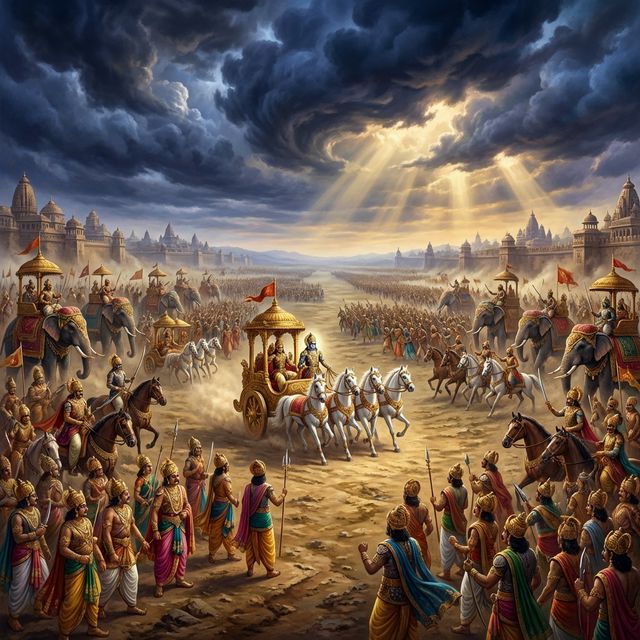
The Secret of the Gods
Vyasa tells the blind king why the war was ordained before his eldest son was born
The King Falls Again
Vaishampayana, telling the whole of it to Janamejaya long afterwards, said that the parables had not worked.
Vidura had been talking for hours. He had given the old king the forest and the beasts of prey, the car of the body with the senses yoked to it as steeds, the messengers of death who come dressed as years and seasons and fortnights, and the medicine of wisdom that a man of restrained soul may apply to any grief. Dhritarashtra had praised the speech while it was going on. He had asked for more of it, and had been given more.
And then, even after hearing the words of Vidura, the chief of the Kurus, afflicted with grief on account of the death of his sons, fell down senseless on the earth.
It was not the first time that week and it would not be the last. What is worth noticing is who was standing near enough to catch him. His friends were there. The island-born Vyasa was there, who was his own father, the sage begotten of Satyavati who had raised up this line out of a dead king's empty house. Vidura was there, whose voice had just stopped in the middle of a sentence. Sanjaya was there, the charioteer's son who had watched eighteen days of the war with borrowed sight and had come back with the news. And the attendants who used to wait at the gates and who enjoyed the king's confidence were there.
They sprinkled cool water over his body. They fanned him with palm leaves. They gently rubbed him with their hands, and for a long while they comforted the king while he lay in that condition, and none of them said anything, because there was nothing to say that had not already been said and failed.
The monarch recovered his senses after a long time. Then he wept for a long while, overwhelmed with grief on account of the death of his sons, and only after the weeping had run itself out did he begin to speak.
What he said was that he intended to die.
Fie on the State of Humanity
"Fie on the state of humanity," the king said. "Fie on the human body! The woes that are suffered in this life frequently arise from the very state of humanity."
He was answering Vidura, in his way. Vidura had described the round of birth and death as a long road with halts on it, and had recommended self-restraint as the cure. Dhritarashtra did not dispute a word of it. He simply reported what the road felt like from where he was lying.
"Alas, O lord, great is the grief, like poison or fire, that one suffers at the loss of sons, of wealth, of kinsmen, and relatives. That grief causes the limbs to burn and our wisdom to be destroyed."
There is the whole difficulty of the scene in one clause. The medicine Vidura had prescribed was wisdom, and the disease being treated destroys wisdom. A man cannot apply the remedy with the hands the sickness has taken away from him. The old king had listened to a physician describe a cure that only the healthy can swallow.
"Overwhelmed with that grief, a person regards death to be preferable. This calamity that has overtaken me through ill-luck is even like that. It will not, I see, end except with life itself."
Then he said it plainly, to his father, who was standing over him.
"O best of regenerate ones, I shall therefore put an end to my life this very day."
Having said those words unto his high-souled sire, that foremost of all persons conversant with Brahman, Dhritarashtra was overwhelmed with grief and became stupefied. The king, reflecting on his woes, went silent. He had announced his death and then had not been able to keep talking about it, and he lay there in the middle of his own hall with a hundred sons gone and nothing further to add.
Hearing those words of his, the puissant Vyasa began to speak to his son, who was afflicted on account of the death of his children.
The sage did not begin with comfort. He began by reminding the king of everything the king already knew.
Why Then Dost Thou Grieve
"O mighty-armed Dhritarashtra, listen to what I say. Thou art possessed of learning, thou hast great intelligence, and thou art skilled in understanding duties. Nothing of that which should be known is unknown to thee, O scorcher of foes!"
It was not flattery. It was an accusation with the edge turned away, and both of them understood it. A man who knows everything and grieves like this is a man refusing to use what he knows.
"Without doubt, thou knowest the instability of all things doomed to death. When the world of life is unstable, when this world itself is not eternal, when life is sure to end in death, why then, O Bharata, dost thou grieve?"
Then Vyasa moved from the general truth to the particular one, and the particular one had a name in it.
"Before thy very eyes, O king, the concatenation of facts brought about by Time, making thy son the cause, produced this hostility. This destruction of the Kurus was inevitable. Why then dost thou grieve for those heroes that have attained to the highest end?"
And he turned and gestured at the man who had just stopped speaking.
"O thou of mighty arms, the high-souled Vidura knew everything. With all his might he had endeavoured to bring about peace. It is my opinion that the course marked out by Destiny cannot be controlled by anyone, even if one struggles for eternity."
That is a strange pair of statements to set side by side, and Vyasa set them side by side deliberately. Vidura knew. Vidura tried. Vidura could not have succeeded. The sage was not excusing the counsellor for failing; he was excusing the world for being the kind of place in which such a counsellor fails.
Then he offered the old king the one thing that nobody in that hall had been able to offer him, which was not consolation but information.
"The course that was settled by the gods was heard directly by me. I will recite it to thee, so that tranquillity of mind may be thine."
And Dhritarashtra, who had announced an hour before that he was going to die that day, lay still and listened.
The Earth Comes to Ask for Her Promise
"Once before, without any fatigue, I repaired very quickly to the court of Indra."
Vyasa says it the way a man mentions a road he has often walked. He had gone up, and there he beheld all the denizens of heaven assembled together, and all the celestial rishis also, headed by Narada. It was a full court. The gods were sitting, the sages were sitting, and nothing in particular was happening.
"There, O monarch, I saw also the Earth."
In her embodied form. Not the ground underfoot and not a figure of speech, but the goddess herself, standing among them in a body, having repaired to the gods for the accomplishment of a particular mission. She had come to collect on something.
Approaching them, she said: "That which ye all should do for me hath, ye blessed ones, been already promised by you while you were in Brahma's abode. Let that be accomplished soon."
That is the whole of her speech and it is worth reading twice for what it assumes. There had been an earlier assembly, in another place, before this one. A petition had been heard there and an undertaking given. She was not asking for a favour. She was reminding a room full of gods that they were late.
What she was carrying is not stated in her words because everyone present knew it. She bears the weight of creatures. Every king with his armies, every host raised and fed and marched from one end of the country to the other, every one of them stands on her, and there had come to be too many of them, and she had gone up to say so and had been promised relief, and the relief had not arrived.
Hearing these words of hers, Vishnu, the adored of all the worlds, smiled.
The smile is in the text and there is no explaining it away. The god who was about to describe the deaths of several million men in a single field began by smiling at the goddess who had asked for it, in the midst of the celestial conclave, and then he told her the name of the instrument.
The Eldest of the Hundred Sons
"The eldest of the hundred sons of Dhritarashtra, who is known by the name of Duryodhana, will accomplish thy business."
Vyasa was reciting this to Dhritarashtra. He did not soften the address. The god had identified the man by his father, in front of the assembled heaven, years before the father in question had a son at all.
"Through that king, thy purpose will be achieved. For his sake, many kings will assemble together on the field of Kuru. Capable of smiting, they will cause one another to be slain through the instrumentality of hard weapons. It is evident, O goddess, that thy burthen will then be lightened in battle. Go quickly to thy own place and continue to bear the weight of creatures, O beauteous one!"
She was dismissed courteously and sent back to work, and the court went on, and in due time a child was born in Hastinapura.
"From this thou wilt understand, O king, that thy son Duryodhana, born in Gandhari's womb, was a portion of Kali, sprung for the object of causing a universal slaughter."
Then the sage listed what that portion looked like from the inside of a family, and every item on the list was something the old king had watched with his own understanding for sixty years. He was vindictive. He was restless. He was wrathful. He was difficult of being gratified.
"Through the influence of Destiny his brothers also became like him. Shakuni became his maternal uncle and Karna his great friend. Many other kings were born on earth for aiding in the work of destruction."
And then Vyasa gave the rule that the whole account turns on, which is not about gods at all but about government.
"As the king is, so do his subjects become. If the king becomes righteous, even unrighteousness in his dominions assumes the shape of righteousness. Servants, without doubt, are affected by the merits and defects of their masters. Those sons of thine, O king, having obtained a bad king, have all been destroyed."
He let that stand a moment before he said the rest of it, because the rest of it was the part the father would not want.
"Thy sons, through their own faults, have been destroyed. Do not grieve for them. There is no cause for grief. The Pandavas have not, O Bharata, the least fault in what has happened. Thy sons were all of wicked souls. It is they that caused this destruction on earth."
What Narada Said at the Rajasuya
"Conversant with truth, Narada knew all this," Vyasa said. "Blessed be thou. Narada had truly informed Yudhishthira of all this in his court on the occasion of the rajasuya sacrifice."
That was the height of the Pandava fortune. Indraprastha was new, the kings of the earth had come in with tribute, the hall was full, and into that hall the sage had walked and said this:
"The Pandavas and the Kauravas, encountering each other, will meet with destruction. Do that, O son of Kunti, which thou shouldst!"
Upon those words of Narada, the Pandavas became filled with grief. It is a small line and it changes the shape of the whole story. At the moment of their greatest triumph they were told the ending, and they were told it as an instruction rather than a prophecy, with the doing left to them.
"I have thus told thee that which is an eternal secret of the gods," said Vyasa to the old king. "This will destroy thy grief and restore to thee a love of thy life-breath, and cause thee to cherish affection for the Pandavas, for all that has happened has been due to what had been ordained by the gods."
Then he admitted his own share in it.
"O thou of mighty arms, I had learnt all this some time before. I also spoke of it to king Yudhishthira the just on the occasion of his foremost of sacrifices, the rajasuya. When I secretly informed him of all this, Dharma's son endeavoured his best for preserving peace with the Kauravas. That, however, which is ordained by the gods proved too powerful to be frustrated by him. The fiat of the Destroyer is incapable of being baffled anyhow by mobile and immobile creatures."
So there had been three men who knew and three men who tried. Vidura, who argued in this hall until he was thrown out of it. Yudhishthira, who kept asking for five villages. Vyasa himself, who had carried the secret and handed it to the one man most likely to be crushed by it.
None of them had been able to move it by a day.
The Water of Wisdom
Having laid the ordinance of the gods in front of the old king, Vyasa stopped arguing about fate and used the only lever that had ever worked on Dhritarashtra, which was another man's suffering.
"Thou art devoted to virtue and possessed of superior intelligence, O Bharata! Thou knowest also that which is the way and that which is not the way of all creatures. If king Yudhishthira learns that thou art burning with grief and losing thy senses frequently, he will cast off his very life-breath."
That is the sentence that saved the king's life, and it is not about the king at all.
"He is always compassionate and possessed of wisdom. His kindness extends even to all the inferior creatures. How is it possible, O king, that he will not show compassion to thee?"
The nephew who had just won the war was in no better condition than the uncle who had lost it, and both of them were within a day's ride of killing themselves out of grief, and Vyasa proposed that each be kept alive by being made responsible for the other.
"At my command, and knowing that what is ordained is inevitable, as also from kindness to the Pandavas, continue to bear thy life, O Bharata! If thou livest thus, thy fame will spread in the world. Thou shalt then be able to acquire a knowledge of all duties and find many years for obtaining ascetic merit. This grief for the death of thy sons that has arisen in thy heart, like a blazing fire, should always be extinguished, O king, by the water of wisdom!"
Dhritarashtra heard the words of Vyasa of immeasurable energy and reflected upon them for a little while. Then he gave the honest answer of a man who has been persuaded of something without being cured of anything.
"O best of regenerate ones, I am exceedingly afflicted by a heavy load of grief. My senses are repeatedly forsaking me and I am unable to bear up my own self. Hearing, however, these words of thine about what had been ordained by the gods, I shall not think of casting off my life-breath, and shall live and act without indulging in grief!"
He did not say the grief was gone. He said he would carry it and go on.
Hearing these words of Dhritarashtra, Satyavati's son, Vyasa, disappeared then and there.
Dharma Lesson
Vyasa does not tell the king that his sons were innocent, and he does not tell him that grief is unreasonable. He tells him two things at once that most people would think contradict each other: that the war was ordained by the gods, and that his sons were destroyed through their own faults. The epic sees no difficulty in holding both. What finally moves Dhritarashtra is neither argument but the news that Yudhishthira will die if he goes on grieving, which is the oldest reason there is for staying alive when your own life has stopped seeming worth the trouble.