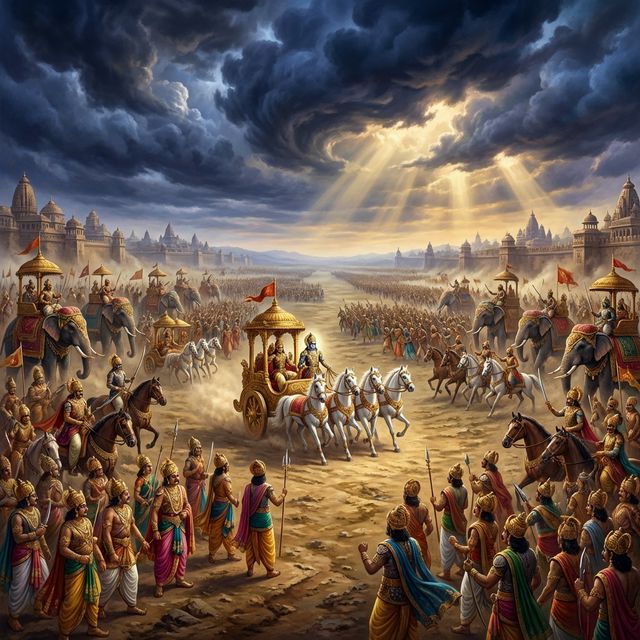
The Gods and the Salavrikas
Vyasa answers Yudhishthira's guilt with the war heaven fought for thirty-two thousand years
The Count He Could Not Stop Making
The war was over and the king had still not taken the throne.
Vaisampayana, who told the whole of it long afterwards to Janamejaya, the great-grandson of Arjuna, said that Yudhishthira sat among his brothers on the field where it had happened and would not be comforted, and that when he finally spoke it was to make a list.
"Sons and grandsons and brothers and sires and fathers-in-law," he said, "and preceptors and maternal uncles and grandsires. Many high-souled Kshatriyas. Many relatives by marriage, friends, companions, sister's sons, kinsmen. And many foremost of men coming from diverse countries. All of them, grandsire, have fallen."
The man he called grandsire was Krishna Dwaipayana Vyasa, the island-born rishi who had begotten Dhritarashtra and Pandu and Vidura at the asking of a queen, and who was therefore the ancestor of both the armies that had just destroyed each other. He had come to the field to argue the king out of his grief, and he had been at it for some time without success.
"All these," Yudhishthira said, "have been caused to be slain by myself alone, from desire of kingdom. Having caused so many heroic kings who were always devoted to righteousness and all of whom had quaffed Soma in sacrifices, what end shall I attain? Thinking that this earth has been bereft of many lions among kings, all of whom were in the enjoyment of great prosperity, I burn continually to this day."
Then he went past the dead to the living, which was the part he could not get around.
"What will be the plight of those foremost of ladies who have been deprived of sons, of husbands, and of brothers? Reproaching the Pandavas and the Vrishnis as cruel murderers, those ladies, with emaciated features and plunged in grief, will throw themselves on the earth. Not beholding their sires and brothers and husbands and sons, they will cast off their life-breath through affliction and go to the abode of Yama. I have no doubt of this.
"The course of morality is very subtle. It is plain that we shall be stained with the guilt of slaughtering women for this. Having slain our kinsmen and friends and thereby committed an inexpiable sin, we shall have to fall into hell with our heads downwards.
"So we shall waste our limbs with the austerest of penances. Tell me, grandsire, to what mode of life I should betake myself then."
Vaisampayana said that the island-born rishi reflected keenly for some time before he answered.
Time Has Neither Mother Nor Father
"Remembering the duties of a Kshatriya, king," Vyasa said, "do not give way to grief. All those Kshatriyas have fallen in the observance of their proper duties. In the pursuit of great prosperity and of great fame on earth, those foremost of men, all of whom were liable to death, have perished through the influence of Time."
Then he took the killing out of Yudhishthira's hands and named the four men sitting nearest to him.
"Thou hast not been their slayer. Nor this Bhima, nor Arjuna, nor the twins. It is Time that took away their life-breaths according to the great law of change."
And having said it, he described the thing he was handing the blame to, because a man is not consoled by a word he does not understand.
"Time hath neither mother, nor father, nor anybody for whom he is disposed to show any favour. He is the witness of the acts of all creatures. By him have they been taken away. This battle was only an occasion ordained by him. He causes creatures to be slain through the instrumentality of creatures. That is the manner in which he puts forth his irresistible power."
It is not a doctrine of accident. Vyasa was careful about that, and the care is the whole of the argument. Time, he said, is dependent upon the bond of action and is the witness of all actions good and bad. It is Time that brings about the fruits, fraught with bliss or woe, of what we do.
"Think of the acts of those Kshatriyas that have fallen. Those acts were the causes of their destruction, and it is in consequence of them that they have perished. Think also of thy own acts, of thy vows and thy restrained soul. And think how thou hast been forced by the Supreme Ordainer to do this thing.
"As a weapon made by a smith or a carpenter is under the control of the person handling it, and moves as he moves it, so this universe, controlled by actions done in Time, moves as those actions move it. Seeing that the births and deaths of creatures take place without any assignable cause and in perfect wantonness, grief and joy are perfectly needless."
Yudhishthira did not answer. Vyasa looked at him and conceded the point that arguments do not settle.
"Although this entanglement of thy heart is a mere delusion, still, if it pleaseth thee, king, perform the expiatory rites. But first hear something that is heard of the gods."
Thirty-Two Thousand Years
"It is heard, Partha, that the gods and the Asuras fought against each other," Vyasa said.
He began with the fact that decides everything in such a quarrel, and it is a family fact rather than a moral one.
"The Asuras were the elder, and the gods the younger brothers."
That is the shape the whole of the Mahabharata has been standing in for eighteen days. An older line and a younger line, born of the same father, with one inheritance between them. Yudhishthira was being told that the first war in the world had the same plan as his own, and that in that one the younger brothers were the gods.
"Covetous of prosperity, fierce was the battle fought between them," Vyasa said. "The fight lasted for two and thirty thousand years."
Set that beside the war that had just ended. Eighteen days had emptied the earth of its kings, killed the sons of a hundred houses, filled the field outside with what the jackals were still working through, and left the victor unable to stand up and be crowned. Eighteen days had done that. The gods had fought for thirty-two thousand years.
Vyasa gave one image of it and no more.
"Making the earth one vast expanse of blood, the gods slew the Daityas and gained possession of heaven."
The earth is not even where they were fighting for. Heaven was the prize, and the earth was only the floor they stood on while they took it, and by the end of it that floor was one unbroken sheet of blood from edge to edge. The gods whom Yudhishthira had been invoking every morning of his life, to whom the dead kings around him had all poured Soma, had waded through that for three hundred centuries and had come out the other side owning the sky.
Nobody in the account is punished for it. There is no expiation mentioned at that point in the story, no penance, no hell with the head downwards. The gods slew the Daityas and gained possession of heaven, and the sentence ends there and moves on.
It was the moving on that Vyasa wanted him to notice. But there was a second part to it, and the second part was the one that answered what Yudhishthira had actually asked.
The Eighty-Eight Thousand
"Having obtained possession of the earth," Vyasa said, "a large number of Brahmanas, conversant with the Vedas, armed themselves, stupefied with pride, with the Danavas for giving them help in the fight."
Every word of that has a weight on it.
They were Brahmanas. Not fallen men, not impostors, not the sort of creature that only wears the thread. They were conversant with the Vedas, which is the highest thing that can be said of a man of that order, and the one qualification that in every other passage of the epic puts a person permanently beyond the reach of a weapon. To kill such a man is the sin for which the books can barely find an expiation. Yudhishthira knew that better than most, having spent the whole war being reminded of what Drona was, and having lied once to bring him down.
And these men picked up arms. They armed themselves stupefied with pride, and they went over to the Danavas, the children of Danu, who were the enemy, and they fought on that side in a war for the possession of the world.
"They were known by the name of Salavrika," Vyasa said, "and they numbered eight and eighty thousand."
The name is not a family and not a country. A salavrika is a wolf, and it is the word the text uses for men who have gone over into being something else, and eighty-eight thousand of them stood in the line with the Danavas holding weapons.
Then Vyasa said what happened to them, in seven words, without any softening at all.
"All of them, however, were slain by the gods."
Not driven off. Not disarmed and sent back to their fires. Not cursed, which is the usual instrument for a Brahmana who has gone wrong. Eighty-eight thousand men who knew the Vedas were killed by the gods on a battlefield, and the gods are still the gods afterwards, and men still pour offerings to them, and no rite of cleansing is recorded as having been required.
"Those wicked-souled persons who desire the extinction of virtue and who set sinfulness agoing," Vyasa said, "deserve to be slain even as the furious Daityas were slain by the gods."
He let that sit in front of the king who had been saying, all morning, that he could not be forgiven.
Sin Sometimes Assumes the Form of Virtue
Having shown him the deed, Vyasa gave him the rule that governs it, and he gave it as arithmetic.
"If by slaying a single individual a family may be saved, or if by slaying a single family the whole kingdom may be saved, such an act of slaughter will not be a transgression."
That is the whole of the permission, and it is worth noticing how narrow it is. It is not a licence to kill enemies. It is a calculation with a saved thing on the other side of it, and the saved thing has to be larger than the killed thing, and the man doing the sum has to be honest about which is which. Nothing in it excuses a war fought for a kingdom by a man who wanted the kingdom.
Then came the sentence that Yudhishthira had been trying to get somebody to say to him for days, and it did not comfort him, because it is not a comfortable sentence.
"Sin, king, sometimes assumes the form of virtue, and virtue sometimes assumes the form of sin. They, however, that are learned, know which is which."
There is no test given. No mark, no sign, no way of telling from outside. The learned know, and everybody else is guessing, and a man may perform a rite in perfect confidence and be doing murder, and a man may kill and be doing his duty, and the two look identical while they are happening.
"Therefore console thyself, son of Pandu, for thou art well versed in the scriptures. Thou hast only followed the path formerly trodden by the very gods. Men like yourselves never go to hell. Comfort these thy brothers and all thy friends, scorcher of foes."
And then Vyasa drew the line that separates his listener from the men who really are damned, and it is not drawn where Yudhishthira had been drawing it. It has nothing to do with the number of the dead.
"He who deliberately engages himself in sinful acts, and committing sinful acts feels no shame but continues the same as before, is called in the scripture a great sinner. There is no expiation for him and his sins know no diminution."
Then, to the man in front of him: "Thou art born in a noble race. Forced by the faults of others, thou hast most unwillingly done this, and having done this, thou repentest of it."
The grief the king had been offering as evidence against himself was being entered on the other side of the ledger.
How Indra Became Satakratu
"The Horse-sacrifice, that grand rite, has been indicated as an expiation for thee," Vyasa said. "Make preparations for that sacrifice, monarch, and thou shalt be freed from thy sins."
And because a prescription is easier to swallow when somebody else has taken it first, he named the patient.
"The divine chastiser of Paka, having vanquished his foes with the assistance of the Maruts, gradually performed a hundred sacrifices and became Satakratu."
The chastiser of Paka is Indra, who killed the Asura of that name, and the Maruts are the storm-gods who ride with him, and Satakratu is the title a god earns by completing a hundred rites. It is one of the commonest names in the hymns. Yudhishthira had used it himself, probably without thinking about what stands behind it, all his life.
What stands behind it is a war. Indra vanquished his foes first, with the storm at his back, and only then began the sacrifices, and the sacrifices went on until there were a hundred of them, and the hundredth one gave him the name that men have been calling him by ever since. The greatest of the gods of heaven had needed a hundred rites to work off what he did to win heaven. He had not been too holy to require them, and he had not been too proud to perform them.
"Freed from sin, possessed of heaven, and having obtained many regions of bliss and great happiness and prosperity," Vyasa said, "Sakra, surrounded by the Maruts, is shining in beauty and illuminating all the quarters with his splendour. The lord of Sachi is adored in the heavens by the Apsaras. The Rishis and the other gods all worship him with reverence."
That is the end of the road Vyasa was pointing at. Not a man scoured clean of his history, but a king who did the thing, and then did the work, and is now shining at the top of the world with everyone singing to him, and the blood of thirty-two thousand years somewhere back at the beginning of the account and never denied.
"Thou hast got the earth through thy prowess," Vyasa said. "All the kings have been vanquished by thee, sinless one, through thy prowess. Now there is the other half of it."
Put Their Sons on Their Thrones
The other half was not a rite. It was a list of errands, and it began with the houses the Pandavas had emptied.
"Proceeding with thy friends to their kingdom, king, install their brothers, sons, or grandsons on their thrones."
Every one of those kingdoms had sent a king to Kurukshetra and had got nothing back. Vyasa was telling the victor to go to each of them in person, with his friends beside him, and find the nearest surviving male of the house, and seat him in the chair his father had died out of. Not annex them. Not garrison them. Put the dead man's family back on the dead man's throne.
"Behaving with kindness towards even the children in the womb, make thy subjects glad and happy, and rule the earth."
The children in the womb are the ones whose fathers are already dead on the field and who have not yet been born to find it out. They are the last people on earth with a claim on a conqueror, and they are named specifically, because it is exactly the sort of claim a tired government forgets.
Then the instruction that has no parallel anywhere near it in the epic.
"Install on their thrones the daughters of those that have no sons. Women are fond of pleasure and power. Through this means they will cast off their sorrows and become happy."
Where a king has left no son, the daughter takes the seat. Vyasa gives a reason for it that is briskly worldly rather than lofty, and the effect of the reason is to make the thing ordinary: she wants what any ruler wants, she will be consoled by having it, seat her.
"Having comforted the whole empire in this way, Bharata, adore the gods in a Horse-sacrifice as the virtuous Indra did in days of old."
And last, once more, the thing he had said at the beginning and would keep saying until it was heard.
"It is not proper for us to grieve for those high-souled Kshatriyas. Stupefied by the power of the destroyer, they have perished in the observance of the duties of their own order. Thou hast discharged the duties of a Kshatriya and obtained the earth without a thorn in it. Observe thy own duties, son of Kunti, for then thou shalt be able to obtain happiness in the other world."
The king had asked what mode of life he should take up. He had been told: this one. Go and be the king, and put the sons of the men you killed back in their fathers' chairs, and hold the sacrifice, and stop.
Dharma Lesson
Vyasa does not tell Yudhishthira that the killing was clean. He tells him that the gods did it too, on a scale that dwarfs Kurukshetra, and that they went on afterwards to perform a hundred sacrifices before anyone called them shining. The permission he gives is narrow, a life for a family and a family for a kingdom, and the warning attached to it is that sin and virtue can wear each other's faces and only the learned can tell them apart. What separates a king from a great sinner, in this account, is not the body count but whether he feels the shame and does the work, and then goes back and seats the children of the men he killed in their fathers' chairs.