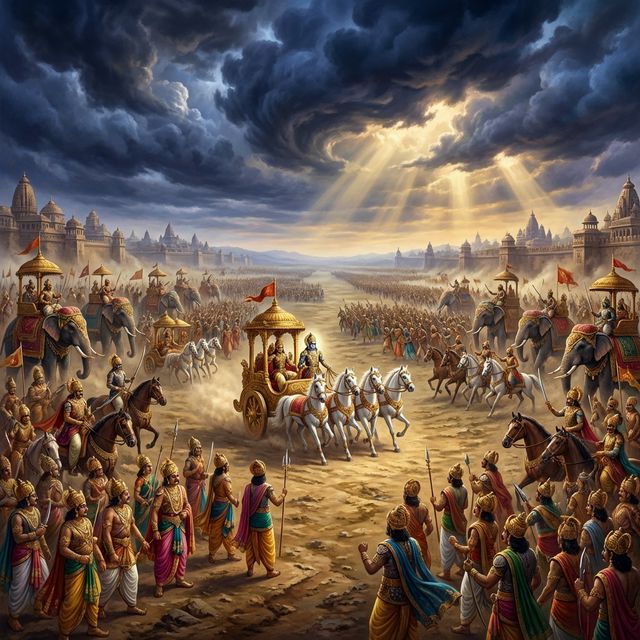
The King Who Was Left Alone
Vyasa tells Yudhishthira of Hayagriva, who fought robbers after his army was gone and won heaven at his post
The Sage Speaks Again
Arjuna had finished, and the king had not answered him. Vaishampayana, reciting the whole of it to Janamejaya generations afterwards, puts the moment down in a single line: thus addressed by Arjuna of curly hair, the Kuru king born of Kunti remained speechless.
They were still on the bank of the river, near the field, with the water rites for the dead behind them and the crown already on Yudhishthira's head. He did not want it. His brothers had been taking turns for days telling him why he must keep it, and the arguing had reached the stage where a man stops replying.
Then the island-born spoke. Krishna-Dwaipayana Vyasa, who had fathered the fathers of both armies and had watched the whole ruin come on from a long way off, had already answered the king once that morning, on the duties of domesticity and the duties of Kshatriyas, ending with the history of Sudyumna, the royal sage who cut off the hands of a Brahmana that begged to be punished and became eminent for the act. Now he began again. He addressed Yudhishthira as Ajatasatru, the man whose enemy has not been born.
"Let these great car-warriors of abundant energy of mind, O monarch," he said, "let these brothers of thine, O Yudhishthira, chief of the Bharatas, obtain those wishes of theirs that they cherished while dwelling in the woods."
That is a claim on the king made on behalf of four other men. Whatever they had promised themselves during those years of bark and roots, they had promised it against a future that only Yudhishthira could now unlock, and he was proposing to walk away from it.
"Rule thou the earth, O son of Pritha, like another Yayati, the son of Nahusha. Before now misery was yours while ye dwelt in the woods in the observance of ascetic penances. That misery is ended, O tiger among men. Enjoy happiness, therefore, for some time."
Notice what the sage did not say. He did not tell the king that his grief was unreasonable, or that the dead were well. He told him to be happy for a while, as though happiness were a duty with a term attached, and then he began to set out what the term contained.
The Debts, and the Two Sacrifices
"Having earned and enjoyed religious merit and wealth and pleasure for some time with thy brothers, thou mayst then, O king, retire into the woods."
The forest was not being refused him. It was being postponed, and put in its proper place at the end of a sequence, which is the whole of Vyasa's argument. Yudhishthira wanted to go into the woods immediately, out of horror at what the throne had cost. Vyasa was telling him that the woods are what a man goes to when he has finished paying, and that he had not begun to pay.
"Be freed first, O Bharata, from the debt thou owest to persons that may beg of thee, to the Pitris, and to the gods. Thou mayst then, O son of Kunti, practise all the other modes of life that come afterwards."
Three creditors, and the order of them is worth holding. The men who come to a king's gate and ask. The ancestors, who are fed by the rites of a householder and by nobody else. The gods, who are fed by sacrifice. A man who walks into the forest with those three unpaid has not renounced anything. He has defaulted, and taken his peace of mind out of other people's mouths.
"Do thou, O son of Kuru's race, perform the sacrifices of Sarvamedha and Aswamedha. Thou shalt then attain, O monarch, to the highest end hereafter. Installing thy brothers also in great sacrifices with plentiful presents to the Brahmanas, thou shalt, O son of Pandu, acquire great fame."
So the programme was complete, and it was entirely a programme of work. Rule. Pay. Sacrifice, on the largest scale the books know. Put your brothers at the head of great rites of their own, and give away enough to make the gift memorable. Then, when there is nothing outstanding, go.
And having finished with what the king should do, the sage came to the part that concerns what a king is answerable for, and he introduced it the way such things are always introduced.
"There is a saying, O tiger among men and best of the Kurus. Listen to it, for by acting according to it, O king, thou shalt not swerve from virtue."
The saying, when it came, was about robbers.
Those Whose Practices Resemble Robbers
"Those men only, O Yudhishthira, whose practices resemble those of robbers, cause a king by their counsels to take to a career of war and victory."
It is a hard sentence to have read out to you on a riverbank within sight of the ground where eighteen armies went down. Vyasa is not saying that a king must never fight. He says a great deal in the other direction before he is done. He is saying something narrower and more uncomfortable: that when a king is talked into making conquest the business of his reign, the men doing the talking are of a particular kind, and the kind can be named. Their trade is taking what belongs to other people. They have simply found a way to do it with an army instead of with a knife on a road.
Yudhishthira had been counselled for years by men who wanted a war, and had been sitting for days being counselled by the same men that he must now enjoy what the war had bought. He was in a position to test the sentence against his own memory, which is presumably why it was said to him.
"That king who, guided by considerations of place and time and moved by an understanding dependent on the scriptures, pardons even a number of robbers, incurs no sin."
That is the other side of it, and it is placed immediately after, so that neither half can be quoted alone. Robbers are the standing enemy of a kingdom, and the king may still pardon them, in numbers, without staining himself, provided he has weighed the place and the hour and has an understanding trained on the scriptures rather than on his own appetite. Mercy is not a lapse in a king. It is one of the things he is competent to do, exactly as chastisement is.
"That king who, realising his tribute of a sixth, doth not protect his kingdom, taketh a fourth part of the sins of his kingdom."
Here is the arithmetic that runs under everything else. The sixth part of the harvest is the king's, and it is not a gift. It is the wage of protection. A king who draws the wage and does not do the work is not merely idle. A quarter of every wrong committed in his country is entered against his name, and he will be asked for it.
The Rules by Which a King Does Not Swerve
"Listen also to that by which a king may not swerve from virtue."
What followed was a list, and Vyasa gave it plainly, without ornament, in order.
By transgressing the scriptures one incurs sin, while by obeying them one may live fearlessly. That is the ground of it: the texts are not a burden laid on a king but the only thing that lets him sleep.
That king who, guided by an understanding based upon the scriptures and disregarding lust and wrath, behaves impartially, like a father, towards all his subjects, never incurs sin. Two passions are named and no others. Wanting, and rage. Strike those out of the seat of judgment and what is left behaves like a father, which is to say it does not have favourites among its children and does not stop feeding the difficult one.
If a king, afflicted by destiny, fails to accomplish an act which he should, such failure would not be called a trespass.
By force and policy should the king put down his foes. He must not suffer sin to be perpetrated in his kingdom, but should cause virtue to be practised.
Certain people are to be protected before others, and Vyasa named them: brave men; those that are respectable in their practices; those that are virtuous in their acts; those possessed of learning; Brahmanas conversant with Vedic texts and rites; and men of wealth.
In determining suits and in accomplishing religious acts, they that are possessed of great learning should alone be employed. And a prudent king will never repose his confidence upon one individual, however accomplished. However accomplished. The clause is put in to close the door that every king walks through.
Then the portrait of the other kind of ruler. That king who does not protect his subjects, whose passions are ungovernable, who is full of vanity, who is stained with haughtiness and malice, incurs sin and earns the reproach of tyranny. And if the subjects of a king waste away from want of protection and are afflicted by the gods and ground down by robbers, the sin of all this stains the king himself. The gods and the robbers are put in the same clause, and the king is charged with both.
Last, the mercy in the whole system. There is no sin in doing an act with heartiness, after full deliberation, and after consultation with men capable of offering good advice. Our tasks fail or succeed through destiny. If exertion, however, be applied, sin would not touch the king.
Having said that a king is judged by his exertion and not by his outcome, Vyasa gave him a king who was destroyed.
Without a Follower by His Side
"I shall recite to thee, O tiger among kings, the story of what happened to an ancient king of the name of Hayagriva, O son of Pandu."
Horse-necked, the name means, and that is nearly all the description the epic gives him. He belongs to no lineage the listener is expected to know. He has no capital that is named, no queen, no son, no counsellor. He is a king in the way a figure in a legal example is a man, and the story of him is four clauses long.
"The story, viz., of the heroic Hayagriva of unstained deeds, who after having slain a large number of his foes in battle, was himself defeated and slain while without a follower by his side."
Everything is in the last phrase. He was not betrayed, and he was not taken asleep, and there is no traitor in this account because there is nobody in it at all except the king. He had an army at the start of that day and at the end of it he did not, and the epic does not say where it went, and the silence is the point. What is recorded is that when the field was empty he was still standing on it.
"Having achieved all that should be done for keeping foes under check, and adopted all those foremost of means by which men may be protected, Hayagriva acquired great fame from the battles he fought and is now enjoying great bliss in heaven."
He had done the work. He had checked his enemies as far as a king can check them, and taken up every one of the foremost means by which men are protected, which is the list Yudhishthira had just been given. He had drawn the sixth part and earned it. And it was not enough, because it is not always enough.
"Mangled by robbers with weapons, boldly fighting with them, and casting off his life in battle, the high-souled Hayagriva, ever attentive to his kingly duties, achieved the object of his life."
Robbers. Not an emperor with a hundred thousand cars, not a rival house with a claim, not a god in disguise testing him. The same dasyus who had been in the saying three breaths earlier, the standing enemy that a kingdom is organised against, and they cut him to pieces with their weapons while he fought them.
He died of exactly the thing a king exists to prevent, and the epic calls it the object of his life achieved.
The Bow Was the Stake
Then Vyasa did something to that little death on an empty field. He read it as a rite, and he read it part by part, matching every implement of the altar to something the man had in his hands.
The bow was his sacrificial stake, the post to which the victim is tied. The bowstring was the cord for tying the victims. His shafts constituted the smaller ladle, and the sword was the large one, the two spoons with which the offering is lifted and poured. Blood was the clarified butter that he poured. The car was the altar. The wrath he felt in battle was the fire. And the four foremost of steeds yoked unto his vehicle were the four Hotris, the priests who chant the invitation to the gods.
A man who has ever watched a sacrifice will recognise the whole apparatus, and will also recognise that every item of it has been made worse. The cord that ties the goat is a bowstring. The ghee is blood. The fire is a man's temper. The priests do not speak; they are horses. This is not a decoration laid over a battle to make it respectable. It is a battle described in the vocabulary of the altar so that both things are seen at once, and neither is let off.
"Having poured upon that sacrificial fire his foes as libations, and then his own life-breaths at the completion of the sacrifice, that vigorous lion among kings, viz., Hayagriva, became freed from sin and is now sporting in the regions of the gods."
The foes went in first, one after another, as libations go in through the length of a long rite. That accounts for the large number of them he killed before the end. And then there is the final oblation, the one that closes the ceremony, and by then he had nothing left to lift with the ladle, so he poured in his own breaths.
This is the part no sacrificer ever does. The whole institution rests on the offerer standing outside the fire and handing things into it. A man who has run out of everything else and puts himself in has either destroyed the sacrifice or completed it, and the epic says completed, and says he came out of it freed from sin.
Sporting in the Regions of the Gods
After that the sage said the same thing over and over, and changed only the reason.
Having protected his kingdom with policy and intelligence, the high-souled Hayagriva, of resigned self and great strength of mind, accustomed to the performance of sacrifices, filled all the worlds with his fame and is now sporting in the region of the gods. Having obtained the merit dependent on sacrifices, and every kind of merit connected with human affairs, he wielded the rod of chastisement and ruled the Earth with vigour and without pride. For this the virtuous and high-souled Hayagriva is sporting in the region of the gods.
Possessed of learning, practising renunciation, actuated by faith, and full of gratitude, that king, having performed diverse acts, left this world of men and won the regions that are reserved for the intelligent and the wise, and for those that are of approved usages and behaviour, and for those prepared to cast off their lives in battle.
Having studied the Vedas well and the other scriptures also, having ruled his kingdom properly and caused all the four orders to adhere to their respective duties, the high-souled Hayagriva is sporting in joy in the regions of the gods.
Having won many battles and cherished his subjects, having drunk the Soma juice in sacrifices and gratified the foremost of Brahmanas with presents, and judiciously wielded the rod of chastisement over those placed under his sway, and at last cast off his life in battle, that king is living happily in heaven.
Four times the same destination, reached by four different roads, and the roads are the ordinary duties of an ordinary reign. Study. Revenue. Rites. Judgment, applied to the people under his hand. Care of subjects. Not one miracle in the list, and not one victory that lasted.
"His life was worthy of every praise. Learned and honest men applaud it, deserving as it is of every applause. Having won heaven and acquired the regions reserved for heroes, that high-souled monarch of virtuous deeds became crowned with success."
And there the story stops, without ever saying that the kingdom was saved. It is not said that the robbers were driven off, or that anything at all survived the afternoon. Vyasa never claims the outcome. He claims the man.
The king listening was the one who had won. He had the earth and a crown he had spent the morning trying to give back, and he had been shown a man who lost everything including his life and was now at play among the gods. Between the two of them the difference was not victory. It was that one of them was still at his post.
Dharma Lesson
Vyasa answers a king who wants to leave the throne by describing a king who stayed on it and was killed for nothing. Hayagriva took the sixth part and earned it, protected whom he was told to protect, and still lost the field, and the epic counts his exertion rather than his result. That is the mercy hidden in the rules: tasks fail or succeed through destiny, and what is asked of a ruler is that he keep working at the post while he is standing in it. Grief at an outcome is not the same thing as guilt for it.