The Night Falls on the Fourteenth Day
Ashwatthama breaks the Panchalas after dark, Drona looses the wind weapon, and Krishna pulls Yudhishthira out of a fight he is winning
The Errand Given to Drona's Son
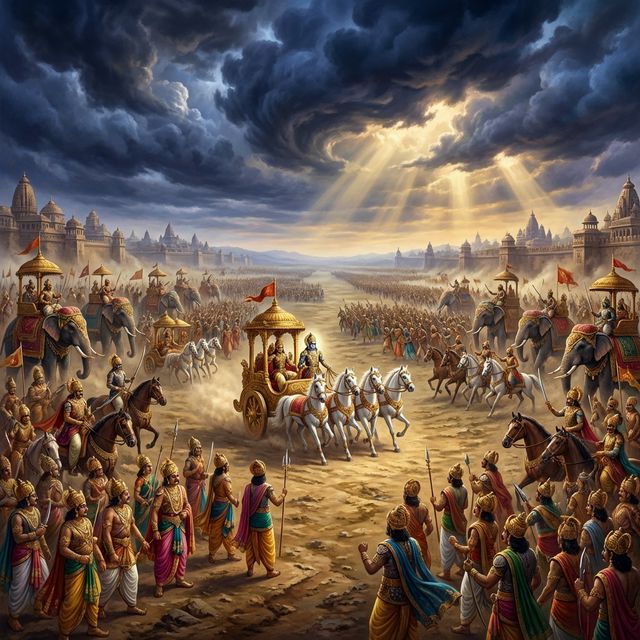
The fourteenth day of the war had already outlived its own sunset. Sanjaya, telling it afterwards to the blind king in his hall, had to keep saying so, because nothing about that stretch of the fighting behaved as a day should. Jayadratha was dead. The light had gone out of the west. Nobody had sounded the withdrawal.
Duryodhana had just come away from a quarrel in his own lines, where Karna had insulted Kripa and Ashwatthama had drawn a scimitar on Karna and been held back by the king's own hands. Now the king went to Ashwatthama again, and this time he came asking.
"O Aswatthaman, be pleased with me and destroy my enemies. Neither the gods nor the Danavas are capable of staying within the range of thy weapons. Slay the Panchalas and the Somakas with all their followers. As regards the rest, we will slay them, protected by thee. Yonder, O Brahmana, the Somakas and the Panchalas are careering amid my troops like a forest-conflagration. Thou hast been born, O mighty-armed one, for the destruction of the Panchalas. Even thus the reverend ones crowned with ascetic success have said."
That was the burden he laid on him: not a line to hold, not a flank to cover, but a people to end.
Ashwatthama was Drona's son, and there was nobody on that field with a more complicated position. His father was commander of the Kaurava army. His father had also taught the Pandavas archery and loved them, and the men Duryodhana wanted destroyed were the Panchalas, whose prince Dhrishtadyumna had been born out of a sacrificial fire for the express purpose of killing Drona.
He heard the king out. Then he set his heart upon destroying the foe, said Sanjaya, like Indra bent upon destroying the Daityas, and before he went he told Duryodhana exactly what he thought of him.
It Is Even So As Thou Sayest
"It is even so as thou sayest, O descendant of Kuru," Ashwatthama said. "The Pandavas are always dear to both myself and my father. So also are we both dear unto them. Not so, however, in battle. We will, according to the measure of our might, fearlessly contend in battle, reckless of our lives."
Then he set out the arithmetic of the war as he saw it, and it was not flattering to anyone.
"Myself, Karna, Salya, Kripa, and Hridika's son could, O best of kings, destroy the Pandava host within the twinkling of an eye. The Pandavas also could within the twinkling of an eye destroy the Kaurava host, if we were not present in battle. We are fighting with the Pandavas to the best of our might, and they also are fighting with us to the best of their might. Energy, encountering energy, is being neutralised, O Bharata. The Pandava army is incapable of being vanquished as long as the sons of Pandu are alive. This that I tell thee is true. The sons of Pandu are endued with great might. They are, again, fighting for their own sake. Why should not they be able to slay thy troops?"
He had answered the strategy. Then he answered the man.
"Thou, however, O king, art exceedingly covetous. Thou, O Kaurava, art deceitful. Thou art vainglorious and suspicious of everything. For this, thou suspectest even us. I think, O king, thou art wicked, of sinful soul, and an embodiment of sin. Mean and of sinful thoughts, thou doubtest us and others."
And then, having called the king he served an embodiment of sin to his face, in his own camp, in the middle of a war, he told him he would go and do it anyway.
"As regards myself, fighting with resolution for thy sake, I am prepared to lay down my life. I will presently go to battle for thy sake, O chief of the Kurus. I will fight with the Panchalas, the Somakas, the Kaikeyas, and the Pandavas also. Scorched with my arrows today, the Chedis, the Panchalas and the Somakas will fly away on all sides like a herd of kine afflicted by a lion. Today the royal son of Dharma, beholding my prowess, will regard the whole world to be filled with Aswatthamans."
Then he went.
Strike Ye All At My Body
He did not look for a gap in the Panchala line. He went to the front of it and offered himself.
"Ye mighty car-warriors," said the son of Gotama's daughter to the Panchalas and the Kaikeyas, "strike ye all at my body. Displaying your lightness in the use of arms, fight ye with me coolly."
It was the invitation of a man who wanted to be shot at by everyone at once. They took it. Thus addressed by him, all those combatants poured showers of weapons upon Drona's son like clouds pouring torrents of rain, and for a moment he was lost inside it.
Then he baffled that shower, and out of the men who had accepted his invitation he killed ten. Ten brave warriors, one after another, in the very sight of Dhrishtadyumna and of the sons of Pandu. Sanjaya does not name them and does not linger over them. The point of the account is the arithmetic of it, that a whole body of car-warriors was told to shoot at one target, that the target survived the volley, and that in the time it takes to tell it the ten foremost of the men who had shot were dead on the field.
The Panchalas and the Somakas, thus worked in battle, abandoned the son of Drona and fled away in all directions.
That is the sentence Duryodhana had paid for. Understand what these men were. The Panchalas were Drupada's people, the Somakas their kinsmen, and between them they had furnished the Pandava army with its commander and its best divisions and its appetite for this war. They had stood against Bhishma for ten days. They had gone into the wheel formation after Abhimanyu. They were not troops who ran.
They ran now, from one Brahmana in a chariot, in the last of the light, and they left the field open behind them.
Bees Into A Flowering Tree
Dhrishtadyumna was the son of the Panchala king, and he had watched his own men break.
He came at Ashwatthama surrounded by a hundred brave and unreturning car-warriors mounted upon cars decked with gold, the rattle of whose wheels resembled the roar of rain-charged clouds, and he did not begin with arrows. He began with contempt.
"O foolish son of the preceptor, what is the use of slaying vulgar combatants? If thou art a hero, fight then with me in battle. I will slay thee. Wait for a moment without flying away."
Then he struck him with many keen and terrible arrows capable of piercing the very vitals. They were swiftly-coursing shafts, equipped with golden wings and keen points, and they came in a continuous line, and Sanjaya, who saw it, reached for the gentlest image in the whole of that night to describe it. Those shafts penetrated into Ashwatthama's body like freely-roaming bees in search of honey entering a flowering tree.
Deeply pierced and swelling with rage, like a trodden snake, the proud and fearless son of Drona took an arrow in his hand and answered.
"O Dhrishtadyumna, wait for a moment, without leaving my presence. Soon shall I despatch thee to Yama's abode with my keen shafts."
Having said it, he covered the son of Prishata from every side with clouds of arrows, displaying that lightness of hand which was the family's inheritance and which nobody in either army could match except his father and Arjuna.
And in the middle of that, hidden inside a moving wall of arrows, with a man who meant to kill him standing forty paces off, the prince of Panchala began to talk. What he said was the most important thing anybody said on that field after dark, and it was not a threat. It was a schedule.
After This Night Passeth Away
"Thou knowest not of my origin, O Brahmana," said Dhrishtadyumna, "or of my vow."
He was telling the truth about the origin. He had not been born like other men. Drupada, humiliated by Drona years before over a broken friendship, had gone to the Brahmanas and bought a sacrifice, and out of that fire had come a young man in armour with a bow already in his hand, made for one purpose and no other. Everybody on that field knew it. Drona knew it, and had taken the boy into his own house and taught him arms anyway.
"O thou of wicked understanding, having first slain Drona himself, I will not therefore slay thee today when Drona himself is still alive. O thou of wicked understanding, after this night passeth away and bringeth in the fair dawn, I shall first slay thy sire in battle and then despatch thee also to the region of Spirits. Even this is the wish entertained by me. Standing before me, display, therefore, till then, the hatred thou bearest towards the Parthas, and the devotion thou cherishest for the Kurus. Thou shalt not escape from me with life."
Then he added the charge that Brahmanas who fight had been hearing all their lives, and that Ashwatthama had heard from his own side of the field earlier the same evening.
"That Brahmana who, abandoning the practices of a Brahmana, devoteth himself to the practices of a Kshatriya, becomes slayable by all Kshatriyas, even as thou, O lowest of men."
He had told his enemy the order of operations. The father first, at dawn. The son afterwards. And he had told him to stay alive in the meantime so that the second half could be carried out.
Thus addressed in language so harsh and insulting, that best of Brahmanas Aswatthaman mustered all his rage and answered with two words.
"Wait. Wait."
And he gazed at Prishata's son, said Sanjaya, apparently burning him with his eyes.
A Gambling Match In Which The Stake Was Life
Sighing in rage like a snake, the preceptor's son covered Dhrishtadyumna with a shower of arrows.
The prince did not tremble. Surrounded by all the Panchala troops, struck all over, he relied on his own energy and sent many arrows back, and the two of them settled into it. Both engaged in a gambling match in which the stake was life itself, says Sanjaya, and having chosen that image he does not apologise for it, though every man in that army knew what a gambling match had already cost this family.
They filled the welkin and all the points of the compass with clouds of shafts, and created a thick gloom with them, and continued to fight inside it, unseen by any of us. That is Sanjaya's own admission. The two best swordsmen of the argument disappeared into a weather of their own making, and the armies watching could hear it and could not see it.
The Siddhas and Charanas and the other sky-ranging beings applauded them highly. Below, the men did the same. Leonine shouts went up, and all the combatants blew their conchs, and hundreds and thousands of musical instruments began to sound, and the two hosts stood there in the dark cheering a duel they could only follow by ear, like two wild elephants heard fighting in a forest.
For a short time it seemed to be waged equally.
Then Drona's son made a rush, and it stopped being equal. He cut off the bow, and the standard, and the umbrella, and the two Parshni drivers who guard the flanks of a war-car, and the principal driver, and the four steeds of the high-souled son of Prishata, all of it, in one pass.
And then he turned on the men behind him. He caused the Panchalas in hundreds and thousands to fly away by means of his straight shafts. He slew a hundred of them with a hundred arrows and three foremost of men with three keen arrows, in the very sight of Drupada's son and of Arjuna, and the Pandava host began to tremble in fear.
The Panchalas and the Srinjayas left him and fled with their banners torn. Then the son of Drona uttered a loud roar like a mass of clouds at the end of summer, and stood there in the ruin he had made, resplendent, said Sanjaya, like the blazing fire at the end of the Yuga after it has consumed all creatures.
The Kings Under The Fallen Umbrellas
Yudhishthira and Bhimasena came up and encompassed Drona's son on all sides, and Duryodhana, seeing it, brought his own troops in with Drona beside him, and the fight stopped being a duel and became a massacre in the dark.
Sanjaya tells it as a list of peoples, which is how a herald counts a battlefield. Yudhishthira in wrath began to despatch vast numbers of Amvashthas, Malavas, Vangas, Sivis and Trigartas to the domain of the dead. Bhima, mangling the Abhishahas and the Surasenas and other Kshatriyas difficult to defeat, made the earth miry with blood. Arjuna of the white steeds despatched the Yaudheyas, the Mountaineers, the Madrakas and the Malavas to the regions of the dead.
These were nations. They had come from the hills and the river country and the far east because a king they owed service to had asked for it, and on the fourteenth night they were being subtracted from the world by name, a people at a time, in a light too poor to fight by.
Elephants forcibly struck with swiftly-coursing shafts began to fall down on the earth like double-crested hills. The field was strewn with the lopped-off trunks of elephants that still moved in convulsions, so that the earth seemed covered with moving snakes.
And over all of it lay the umbrellas.
Covered with the fallen umbrellas of kings that were adorned with gold, the field of battle looked resplendent like the firmament at the end of the Yuga bespangled with suns, moons and stars.
It is the strangest sentence in this part of the account and the truest. Every one of those parasols had been carried over a living king that morning as a mark of his sovereignty. They had come off their poles and off their bearers and were lying face up in the mud in their hundreds, catching what light there was, and from a chariot they looked like a night sky. A man had to be told what he was seeing to know that the stars were the roofs of dead kings.
The Wind Weapon
About this time a fierce uproar arose near Drona's car, and in the middle of it could be heard the words that carry furthest in a night battle. Slay. Strike fearlessly. Pierce. Cut in pieces.
They had found the old man in the dark and were closing on him.
Drona, filled with rage, invoked the Vayavya weapon, the astra of the wind god, and began to destroy the foes about him with it like a mighty tempest destroying gathering masses of clouds. There is no duel in that sentence and no name of any warrior he killed. A wind came off one chariot and everything standing near it went away.
Thus treated by Drona, the Panchalas fled from fear, in the very sight of Bhimasena and of Arjuna, who had to watch their own centre come apart a second time in one evening.
The two brothers checked the flight of their troops and turned them round and came at Drona's force with a large body of chariots, Arjuna attacking on the right and Bhima on the left, pouring two dense showers of arrows on the son of Bharadwaja from both sides at once. The Srinjayas and the Panchalas and the Matsyas and the Somakas followed them in. Duryodhana's best car-warriors came the other way to hold the ground round their commander's car.
And then the Bharata host broke.
Slaughtered by Arjuna and overcome and afflicted by the darkness, says Sanjaya, and he puts the two causes in that order and gives the darkness equal weight. Duryodhana himself and Drona both endeavoured to rally them and could not. That vast host, in the hour when the world was enveloped in gloom, flew away in all directions, and many kings abandoned the animals and the vehicles they rode and went off on foot into the dark, overwhelmed with fear.
Somewhere in that ruin Satyaki hunted down Somadatta of the house of Bahlika and killed him, and the Kauravas rushed at Satyaki with a great throng of cars, and the night swallowed that too.
Kings Should Fight With Kings
Yudhishthira came back into it with the Prabhadrakas and a large force behind him and began, with his shafts, to strike and rout the troops of Bharadwaja's son at the very sight of the man himself. Drona, with eyes red in wrath, turned on him.
This was the thing Drona had promised Duryodhana he would do. He had sworn to take Yudhishthira alive, and for four days the whole shape of the war had been built around that promise, and here at last, in the dark, with nobody in the way, was Yudhishthira.
The preceptor pierced the son of Pritha with seven keen arrows. Yudhishthira pierced him with five. Drona licked the corners of his mouth for a moment and cut off both the standard and the bow of the king, and the king, at a time when speed was of the utmost consequence, took up another bow that was sufficiently tough and hard, and put a thousand arrows into Drona and his steeds and his driver and his standard and his car.
All this seemed exceedingly wonderful, says Sanjaya, and it should. Afflicted with the strokes of those arrows and feeling great pain, Drona, that bull among Brahmanas, sat down for a while on the terrace of his car.
Then he recovered his senses, and sighed like a snake, and invoked the Vayavya weapon a second time.
Yudhishthira, bow in hand, fearlessly baffled that weapon with a weapon of the same name, and cut the Brahmana's great bow in two, and when Drona took up another, cut that one also.
It was at that moment, with the eldest Pandava winning, that Krishna spoke to him.
"Listen, O mighty-armed Yudhishthira, to what I say. Cease, O best of the Bharatas, to fight with Drona. Drona always striveth to seize thee in battle. I do not think it fit that thou shouldst fight with him. He who hath been created for Drona's destruction will, without doubt, slay him. Leaving the preceptor, go where king Suyodhana is. Kings should fight with kings, they should not desire to fight with such as are not kings. Repair thou thither, O son of Kunti, where Dhananjaya with myself, and Bhima also, are fighting with the Kurus."
Yudhishthira reflected for a moment.
Then he turned the car, and made the earth resound with its rattle, and went across the field to take up the flank of his brother Bhima, who was going through the enemy like the Destroyer with his mouth wide open.
He left the preceptor standing. And Drona, on that night, began to consume his foes, the Panchalas.
Dharma Lesson
Ashwatthama tells Duryodhana to his face that he is covetous, deceitful and an embodiment of sin, and then goes out and slaughters the Panchalas for him, which is the whole tragedy of the Kaurava side in one man: clear sight paired with obedience, and no intention of letting the first change the second. Against that, Krishna's instruction to Yudhishthira looks almost small. Stop fighting the man you are beating, because he is not your work and because the tool for him has already been made and is standing forty paces away swearing at his son. Restraint here is not gentleness. It is the discipline of leaving a killing to the one whose whole life was shaped for it, and it is the only thing on that field anybody does on purpose.