The Marks of a True Friend
Bhishma lists the men a king may bind himself to, and the men he must keep at a distance
The Question After the Argument
The night before, the brothers had argued about what a man should want most, and had not agreed. Vidura had spoken for Virtue, Arjuna and the twins for Wealth, Bhima for Desire, and Yudhishthira had listened to all of them and then told them that he thought Emancipation stood above the three. They had joined their hands and praised him, and he had praised them back, and the argument had ended the way family arguments end, with everyone satisfied and nothing settled.
In the morning, Vaisampayana says, the king went out again to the field where the old man was lying, and asked him about duties.
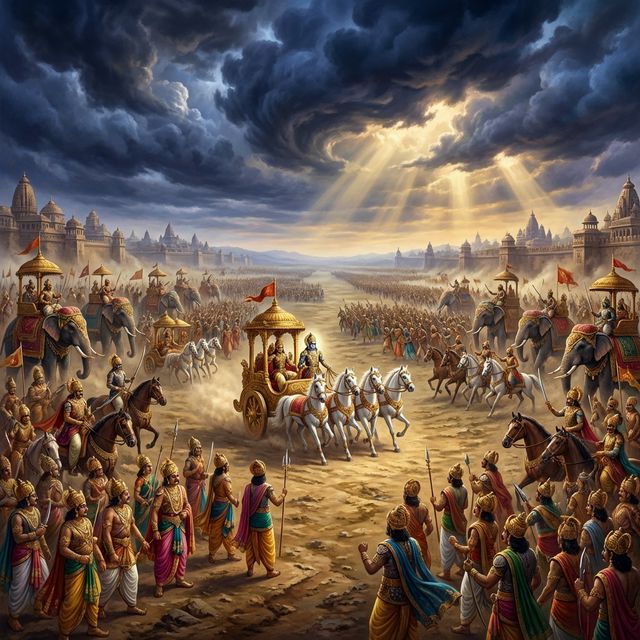
Bhishma was still on the bed of arrows at Kurukshetra, waiting for the sun to turn north before he would let himself die. Yudhishthira sat down beside the shafts.
"O grandsire, O thou that art possessed of great wisdom, I shall ask thee a question," he said. "What kind of men are said to be of gentle disposition? With whom may the most delightful friendship exist? Tell us also who are able to do good in the present time and in the end."
Then he said the thing that had been under the question all along, and it did not sound like a king asking about statecraft. It sounded like a man who had just buried his cousins and his sons and his teachers.
"I am of opinion that neither swelling wealth, nor relatives, nor kinsmen, occupy that place which well-wishing friends occupy. A friend capable of listening to beneficial counsels, and also of doing good, is exceedingly rare."
A friend who can hear good advice, and who can also act. Not one or the other. Yudhishthira had been surrounded his whole life by men who could do one of those two things, and he had watched what the shortage of the other had cost.
"Listen to me, O Yudhishthira," Bhishma said, "as I speak to thee, in detail, of those men with whom friendships may be formed and those with whom friendships may not be formed."
He began with the ones to refuse.
The Men a King Must Not Take
The list Bhishma gave is long, and he did not hurry it or soften it, and it is worth having in the order he gave it, because the order is an argument.
He began with the men whose fault is in what they want. One that is covetous. One that is pitiless. One that has renounced the duties of his own order. One that is dishonest, one that is a knave, one that is mean, one that is of sinful practices. One that is suspicious of all men, which he set down as a vice and not as a caution.
Then the men whose fault is in what they fail to do. One that is idle. One that is procrastinating. One that is of a crooked disposition. One that is an object of universal obloquy, which is to say a man everybody speaks badly of, and Bhishma did not pause to allow that everybody might be wrong. One that dishonours the life of his preceptor. One that is addicted to the seven well-known vices of kings. One that casts off distressed friends.
Then the men who have stopped being ashamed. One possessed of a wicked soul. One that is shameless. One whose sight is ever directed towards sin. One that is an atheist. One that is a slanderer of the Vedas. One whose senses are not restrained. One that gives free indulgence to lust. One that is untruthful. One that is deserted by all. One that transgresses all restraints. One that is deceitful, one that is destitute of wisdom, one that is envious, one that is wedded to sin, one whose conduct is bad, one whose soul has not been cleansed. One that is cruel. One that is a gambler.
A king lying beside a king who had lost a kingdom at dice put that item in the middle of the list without comment, and moved on.
And then, at the head of the whole class, the one Bhishma would come back to at the end: one that always seeks to injure friends.
The Man Who Speaks Like a Friend
The second half of the catalogue is not about vices at all. It is about temper, and it reads like the description of somebody Bhishma had actually had to deal with.
One that covets wealth belonging to others. That wicked-souled wight who never expresses satisfaction with what another may give him according to the extent of his means, which is to say the man who is given everything a friend has and is annoyed that it is not more. One that is never pleased with his friends. One that becomes angry on occasions that do not justify anger. One that is of restless mind. One that quarrels without cause.
That sinful bloke who feels no scruple in deserting well-meaning friends. That wretch who is always mindful of his own interests, and who quarrels with friends when those do him a very slight injury, or inflict on him a wrong unconsciously. Not a wrong. A slight one, or one the other man did not know he was doing. There are people who keep a ledger of those, and Bhishma is saying that a king should be able to identify them early.
Then the worst of the kind, in one line: one who acts like a foe but speaks like a friend. After him, one who is of perverse perceptions, one who is blind to his own good, one who never takes delight in what is good for himself or others.
And a last group, which he set apart. One who drinks alcoholic liquors. One who hates others. One who is wrathful. One who is destitute of compassion. One who is pained at the sight of another's happiness. One who injures friends. One who is always engaged in taking the lives of living creatures. One who is ungrateful. One who is vile.
"Alliances of friendship should never be formed with any of them," Bhishma said. "Similarly, no alliance should be formed with him who is ever intent upon marking the faults of others."
Which was a strange note to end on, in the middle of the longest recital of other men's faults in the whole discourse, and he seems to have known it, because he turned at once to the other side of the ledger.
The Men Worth Binding To
"Listen now to me as I indicate the persons with whom alliances of friendship may be formed."
They that are well-born. They that are possessed of eloquence and politeness of speech, which Bhishma put second, ahead of learning, ahead of courage, ahead of everything a king is supposed to prize. A man you cannot bear to talk to will not be a friend to you however useful he is.
They that are endued with knowledge and science. They that are possessed of merit and other accomplishments. They that are free from covetousness. They that are never exhausted by labour. They that are good to their friends. They that are grateful. They that are possessed of varied information and knowledge. They that are destitute of avarice. They that are possessed of agreeable qualities. They that are firm in truth. They that have subdued their senses. They that are devoted to athletic and other exercises. They that are of good families. They that are perpetuators of their races. They that are destitute of faults. They that are possessed of fame.
Read down that column and notice what is not in it. Not one clause about power. Not one about wealth, or armies, or territory, or what the man can be made to do for you. A king choosing allies is being told to choose them as a private person chooses the people he will sit with, and the qualities on the list are almost all qualities that cost their owner something to keep.
Two of them are worth stopping on. They that are never exhausted by labour, because a friend who tires is a friend who will be gone in the second year of a war. And they that are grateful, which is the plain opposite of the item Bhishma will shortly name as the vilest thing a man can be.
"These," he said, "should be accepted by kings for forming alliances of friendship with them."
Then he went on, because the harder half of the good list was still to come, and it is not made of accomplishments at all.
Like a Red Blanket Made of Wool
The rest of Bhishma's good list is a list of behaviours under strain.
They who become pleased and contented if one behaves with them according to the best of one's powers. They who never get angry on occasions that do not justify anger. They who never become displeased without sufficient cause. Those persons who are well conversant with the science of Profit and who, even when annoyed, succeed in keeping their minds tranquil. They who devote themselves to the service of friends at personal sacrifice.
And then the image the passage is remembered for. They who are never estranged from friends but who continue unchanged in their attachment, like a red blanket made of wool, which does not easily change its colour.
A dyed woollen blanket holds its red through weather and washing and years of use until it wears out still red. That is the whole of the comparison, and it is a domestic one, not a heroic one. The virtue being praised is not loyalty in a crisis. It is not fading.
They who never disregard, from anger, those that are poor. They who never dishonour youthful women by yielding to lust and loss of judgment. They who never point out wrong paths to friends. They who are trustworthy. They who are devoted to the practice of righteousness. They who regard gold and brick-bats with an equal eye. They that adhere with firmness to friends and well-wishers. They who muster their own people and seek the accomplishment of the business of friends regardless of their own dignity, casting off all the marks of their own respectability.
That last one is a picture: a man of rank going out himself, without his retinue and without his title in front of him, to get a friend's business done.
"Indeed, the dominions of that king spread on every direction, like the light of the lord of the stars, who makes alliances of friendship with such superior men," Bhishma said. "Alliances should be formed with men that are well-practised in weapons, that have completely subdued their anger, that are always strong in battle and possessed of high birth, good behaviour, and varied accomplishments."
Then he came back to the other list and pulled two names out of it.
"Amongst those vicious men, O sinless one, that I have mentioned, the vilest, O king, are those that are ungrateful and that injure friends. Those persons of wicked behaviour should be avoided by all. This, indeed, is a settled conclusion."
The House the Robber Gave Away
"I desire to hear in detail this description," Yudhishthira said. "Tell me who they are that are called injurers of friends and ungrateful persons."
He had been given two words and he wanted them filled in, and Bhishma, who had answered a hundred questions in that fortnight with a definition, answered this one with a story instead.
"I shall recite to thee an old story whose incidents occurred in the country, O monarch, of the Mlecchas that lies to the north."
There was a certain Brahmana belonging to the middle country. He was destitute of Vedic learning, which for a Brahmana is not a misfortune but a description of a life not lived. One day, beholding a prosperous village, the man entered it from desire of obtaining charity.
In that village lived a robber possessed of great wealth. Bhishma spent four clauses on him and every one of them is a compliment. He was conversant with the distinctive features of all the orders of men. He was devoted to the Brahmanas. He was firm in truth. He was always engaged in making gifts.
A man who lived by plunder, in a village of hunters at the edge of the world, and who knew exactly what was owed to each kind of man and paid it.
The Brahmana went to his door and begged. What he asked for was not a meal. He solicited a house to live in, and such necessaries of life as would last for one year.
And the robber gave it to him. He gave him a piece of new cloth with its ends complete, which is the whole and unspoiled cloth a guest is given when the host means the gift honourably. He gave him a widowed woman possessed of youth. He gave him a commodious house.
Obtaining all those things from the robber, the Brahmana became filled with delight. His name was Gautama, and he began to live happily in that house, and he began to hold as his own the relatives and kinsmen of the woman the robber chief had given him.
He stayed for years in that prosperous village of hunters. And he began to practise, with great devotion, the art of archery.
The Cranes on His Shoulder
Every day, like the other robbers residing there, Gautama went into the woods and slaughtered wild cranes in abundance.
Always engaged in slaughtering living creatures, he became well-skilled in that act and soon bade farewell to compassion. That is Bhishma's phrase for it, and the order matters: the skill came first and the compassion went afterwards, quietly, without his noticing. In consequence of his intimacy with robbers he became like one of them.
He lived happily there for many months, and large was the number of cranes he slew.
One day another Brahmana came to that village. He was dressed in rags and deer-skins and bore matted locks on his head. Of highly pure behaviour, humble, frugal in fare, thoroughly conversant with the Vedas, observant of the Brahmacharya vows. He had been a dear friend of Gautama, and he came from that same part of the middle country that Gautama had left.
He would not accept food given by a Sudra, and so he searched a village teeming with robber-families for the house of a Brahmana where a traveller could properly be received.
At last he came to the house owned by Gautama, and just at that moment Gautama was coming home from the woods.
Armed with bow and sword, he bore on his shoulders a load of slaughtered cranes, and his body was smeared with the blood that trickled down from the bag. The guest looked at the man entering that door, who then resembled a cannibal, and recognised him.
"What is this that thou art doing here through folly? Thou art a Brahmana, and the perpetuator of a Brahmana family. Born in a respectable family belonging to the Middle country, how is it that thou becomest like a robber in thy practices? Recollect, O regenerate one, thy famous kinsmen of former times, all of whom were well-versed in the Vedas. Born in their race, alas, thou hast become a stigma to it. Awake thyself by thy own exertions. Recollecting the energy, the behaviour, the learning, the self-restraint, the compassion that are thine by the order of thy birth, leave this thy present abode."
Gautama answered him in great affliction of heart.
"O foremost of regenerate ones, I am poor. I am destitute also of a knowledge of the Vedas. Know, O best of Brahmanas, that I have taken up my abode here for the sake of wealth alone. At thy sight, however, I am blest today. We shall together set out of this place tomorrow. Do thou pass the night here with me."
Full of compassion as he was, the friend passed the night in that house, refraining to touch anything. He was hungry, and he was asked repeatedly, and he would not eat.
Dharma Lesson
Bhishma's two lists are not about who is useful but about who does not change. The friend worth keeping is the one who is content with what you could give, who does not sharpen a small and unmeant injury into a quarrel, and who holds his colour like dyed wool through years of ordinary wear. And the fault he calls the vilest is not cruelty or greed but ingratitude, because a man who forgets what was done for him has already stopped being able to see the person who did it.