The Legs of the Snake
Bhishma on how to live through a lawless season, and why slander must never be heard
The Question About the Bad Years
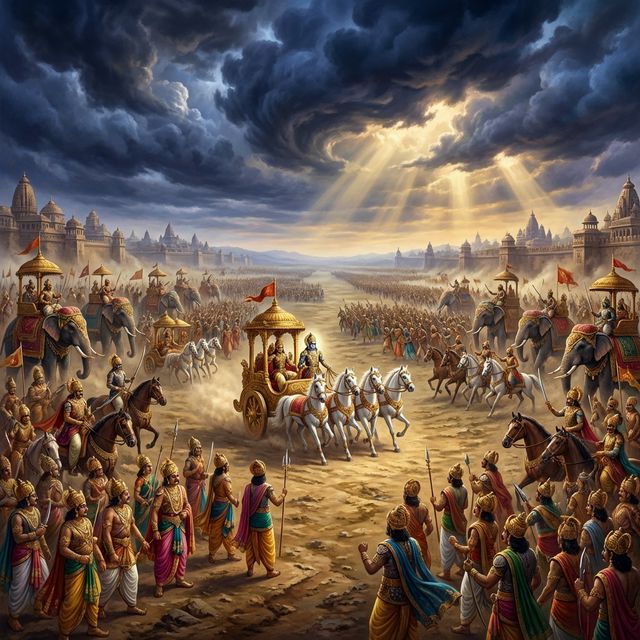
The long instruction on the field had come to the part of it that carries a name of its own. Apaddharma, the morality of seasons of distress: not what a man should do when the world is in order, but what is left to him when it is not. Bhishma had spent that stretch of the morning on kings, and on nothing but kings. The king whose counsels leak. The king whose ministers have been bought by the enemy. The king who should abandon his capital and his treasury and walk out of his own gates rather than lose his life, because a life can acquire another capital and a capital cannot acquire another life.
His brothers sat around him, and Krishna, and Vyasa and the rishis who had come out to the field to hear it. Yudhishthira, sitting among the arrows, turned the question away from kings altogether.
"When practices fraught with high morality and beneficial to the world disappear," he said, "when all the means and resources for the support of life fall into the hands of robbers, when, indeed, such a calamitous time sets in, by what means should a Brahmana subsist, O grandsire, who from affection is unable to desert his sons and grandsons?"
It is worth seeing what he had put into that question, because every clause of it closes a door.
The man in it is not a king. He has no capital to abandon and no treasury to empty and no army to be defeated. He is a householder in a bad year, and the bad year is not a failure of rain but a failure of order: the practices that make a country liveable have gone, and everything a man could eat or sell or plant is in the hands of people who took it. And he cannot walk away into the forest and starve like a sage, because of the last clause. From affection he is unable to desert his sons and grandsons. There are children in the house. A man on his own can be honourably hungry. A grandfather cannot.
Bhishma answered him with a single sentence first, and it named a possession rather than a permission.
"When such a time sets in, the Brahmana should live by the aid of knowledge."
The One Thing the Robbers Had Not Taken
It was the one thing that could not be on the list of what the robbers had taken. The fields, the herds, the stores, the roads: all of that had changed hands, and a man who had spent forty years learning the Vedas walked out of a plundered village carrying the whole of his estate behind his forehead, where no one could get at it.
Then Bhishma stated the principle underneath, and it is stated as a fact about the world and not as a wish.
"Everything in this world is for them that are good. Nothing here is for them that are wicked."
That is a claim about ownership. Not that the good will eventually be rewarded and the wicked eventually punished, which is the comfortable version, but that the goods of the world belong, rightly and now, to the people who use them rightly, and that a wicked man in possession of a granary is not an owner in any sense the moralist is obliged to respect. Everything that follows in the section rests on that sentence, and a reader who skips it will think the rest is licence.
"He who, making himself an instrument of acquisition, takes wealth from the wicked and gives it unto them that are good, is said to be conversant with the morality of adversity."
Read the description of the man. He is an instrument of acquisition. He is not the acquirer. The wealth passes through him from one set of hands to another, and he is not named as one of the pairs of hands. Bhishma does not say that a starving man may steal for his grandchildren; he says that a man who moves property from the wicked to the good, in a season when property has stopped meaning anything, understands what morality is in adversity. The distinction is thin, and it is meant to be thin. It is the whole width of the road at that point.
And then the same permission is handed up to the king, with a condition welded onto it.
"Desirous of maintaining his rule, the king, without driving his subjects to indignation and rebellion, may take what is not freely given by the owner, saying, 'This is mine!'"
The Man Who Is Not to Be Blamed
The condition is the interesting half. It is not a moral test but a practical one, and it is the only limit set on the taking: whatever the king does, his people must not be goaded by it into indignation and rebellion. A ruler in a bad year is allowed to put his hand on what has not been offered him. He is not allowed to make his subjects hate him for it. Where exactly that line falls is left to him to find, in the dark, in the season when he is worst equipped to look for it.
Bhishma then dealt with the man who does these things and the reputation he takes away from them.
"That wise man who, cleansed by the possession of knowledge and might and of righteous conduct at other times, acts censurably in such a season, does not really deserve to be censured."
The exemption is not general. It is not offered to whoever finds himself in a hard year. It attaches to a record, and the record has three parts, all of them prior: knowledge, might, and righteous conduct at other times. A man who has those behind him may do a censurable thing in the emergency and not be a censurable man. A man who has not is simply doing the censurable thing.
"They who always support themselves by putting forth their might never like any other method of living. They that are endued with might always live by the aid of prowess."
That is said without approval and without condemnation. It is an observation about a kind of man, dropped into the middle of the argument the way a soldier drops it: the strong will always prefer to eat by being strong, and you may as well know it about them.
"The ordinary scriptures, that exist for seasons of distress without exceptions of any kind, should be practised by a king at such times. A king, however, that is endued with intelligence, while following those scriptures, would do something more."
He does not say what the something more is. The books are the floor, not the ceiling, and the difference between an adequate king and an intelligent one is whatever he thinks of that is not written down.
The Accusers in the Villages
Then, in the middle of all this permission, one flat prohibition.
"At such times, however, the king should not oppress Ritwijas and Purohitas and preceptors and Brahmanas, all of whom are honoured and held in high esteem. By oppressing them, even at such times, he incurs reproach and sin."
The Ritwija is the priest engaged for a particular sacrifice; the Purohita is the priest kept in the household, who stands beside the king year after year; the preceptor is the man who taught him. These are the people a desperate ruler reaches for first, because they are near, and unarmed, and holding endowments. Bhishma shuts that door and does not put a hinge in it. Even at such times.
"This that I tell thee is regarded as an authority in the world. Indeed, this is the eternal eye by which practices in seasons of distress are to be viewed. One should be guided by his authority. By this is to be judged whether a king is to be called good or wicked."
Everything else in the bad year is negotiable. This is the eye that watches the negotiating.
And then, without a break, Bhishma turned from what a king may take to what a king may listen to.
"It is seen that many persons residing in villages and towns, actuated by jealousy and wrath, accuse one another. The king should never, at their words, honour or punish anybody."
Both halves of that are load-bearing, and the second half is the one that gets forgotten. Never punish a man on the strength of what his neighbours say about him. And never honour one either. Slander does at least as much of its work by promotion as by ruin, and a king who can be steered toward a reward is as thoroughly in the accuser's hands as a king who can be steered toward a rod. In a season when the resources of life have fallen into the hands of robbers, and every man in the village has a reason to want his neighbour's field looked at, the accusations will come in daily, and they will be sincere, and they will be about jealousy and wrath.
Close Your Ears or Leave the Place
Then the rule itself, in three short clauses that leave no room to stand in.
"Slander should never be spoken. If spoken, it should never be heard. When slanderous converse goes on, one should close one's ears or leave the place outright."
Notice that the remedy is physical. Not disapproval, not a mild change of subject, not the private reservation of a man who listens to the whole thing and declines to believe it. Hands over the ears, or out of the room. Bhishma allows exactly two responses to talk of that kind, and both of them are movements of the body, because he knows what happens to a man who stays and listens with a good conscience. He does not leave with an opinion he weighed. He leaves carried, and unable afterwards to say who carried him.
"Slanderous converse is the characteristic of wicked men. It is an indication of depravity."
It is put as a diagnosis rather than a scolding. You are not being told that slander is unkind. You are being told what it indicates about the man producing it, and therefore what to do with everything else he tells you.
"They, on the other hand, O king, who speak of the virtues of others in assemblies of the good, are good men."
That is the positive test, and it is sharper than the negative one. The good man is not identified by his silence. Silence is only the absence of the fault. He is identified by what he does say about an absent man when he is sitting in a room full of good people who would be glad to hear the other kind of story, and the thing he chooses to bring out of his mouth is the absent man's virtues.
"As a pair of sweet-tempered bulls, governable and well-broken and used to bear burthens, put their necks to the yoke and drag the cart willingly, even so should the king bear his burthens."
The bulls are sweet-tempered, well-broken, used to it, and willing. There is no straining in the image and no heroism in it. That is how the load of a bad season is supposed to be taken up: by an animal that has done it before and does not argue about the cart.
Where the Learned Do Not Agree
Bhishma was careful, at the end, to show his son the places where the learned do not agree, and to be fair to the side he did not hold.
"Others say that a king at such times should conduct himself in such a way that he may succeed in gaining a large number of allies. Some regard ancient usage as the highest indication of righteousness. Others, that is, they that are in favour of the conduct pursued by Sankha towards Likhita, do not hold this opinion."
Sankha was the elder brother who, when the younger, Likhita, ate fruit from his garden without asking for it, sent him to the king to be punished for the theft and would not soften it. The party that admires what Sankha did are the party who hold that the rule is to be enforced by its letter, on your own brother, in a small matter, against every custom that would have let it pass. They are not, Bhishma says, arguing in bad faith.
"They do not advance such an opinion through either malice or covetousness."
"Examples are seen of even great Rishis who have laid down that even preceptors, if addicted to evil practices, should be punished. But approvable authority there is none for such a proposition. The gods may be left to punish such men when they happen to be vile and guilty of wicked practices."
There it is again, from the other direction. The king was forbidden to oppress his teachers; now the rishis who would let him punish a wicked one are heard out and then set aside, and the case is handed over to a court the king does not sit in. A man who is owed a punishment will get it. Not from you.
"The king who fills his treasury by having recourse to fraudulent devices certainly falls away from righteousness."
After everything that had been permitted, that is where the floor was laid. He may take what is not freely given and say This is mine, in the open, in a bad year, and answer for it. He may not get it by a trick.
The Legs of the Snake
"The code of morality which is honoured in every respect by those that are good and in affluent circumstances, and which is approved by every honest heart, should be followed."
Two tests, meant to be used together. The code kept by good men who are also comfortable, because a rule that only the desperate keep proves nothing; and the assent of an honest heart, which is not a licence to consult your own preferences but a warning that a rule your conscience will not sign is one you have got wrong somewhere.
"He is said to be conversant with duty who knows duty as depending on all the four foundations."
Then Bhishma admitted the difficulty, which is the most useful thing in the section.
"It is difficult to find out the reasons on which duties stand, even as it is difficult to find out the legs of the snake."
A snake has no legs to be found. It moves, rapidly and evidently, on something, and a man watching it cross a floor cannot say what. Duties move in the same way. They carry weight and they get where they are going, and the mechanism is not visible to the person standing over them, and Bhishma will not pretend otherwise to a king who has to rule by them.
But he did not stop at the difficulty. He gave a method for it.
"As a hunter of beasts discovers the track of a shaft-struck deer by observing spots of blood on the ground, even so should one seek to discover the reasons of duties."
The hunter cannot see the deer. He sees one dark spot in the dust every few paces, and goes to it, and looks for the next, and the trail is made of nothing but those. That is what is offered to a man who cannot see the whole of the right thing: not a rule that covers his case, but the next mark on the ground.
"Thus should a man tread with humility along the path trod by the good. Such, indeed, was the conduct of the great royal sages of old, O Yudhishthira."
The path was already there. Other men had walked it in their own bad years, and had left it, and the only instruction is to put your feet where theirs went and not to be proud while doing it. Somewhere behind all of it was the grandfather in the plundered village with the children in his house, who had been asked about at the beginning and had not been mentioned since, and who was now to go and find, one spot at a time, where the good had walked before him.
Dharma Lesson
Bhishma allows a great deal in a season of distress, and then draws the line in a place most people would not expect. A ruler may put his hand on property that was never offered him; he may not be steered by talk. The reason is that theft in the open can be answered for, while a man who has listened to slander no longer knows which of his judgements are his own. Notice too that the remedy offered is not restraint but movement: close your ears, or leave the room, because there is no safe way to sit and hear it.