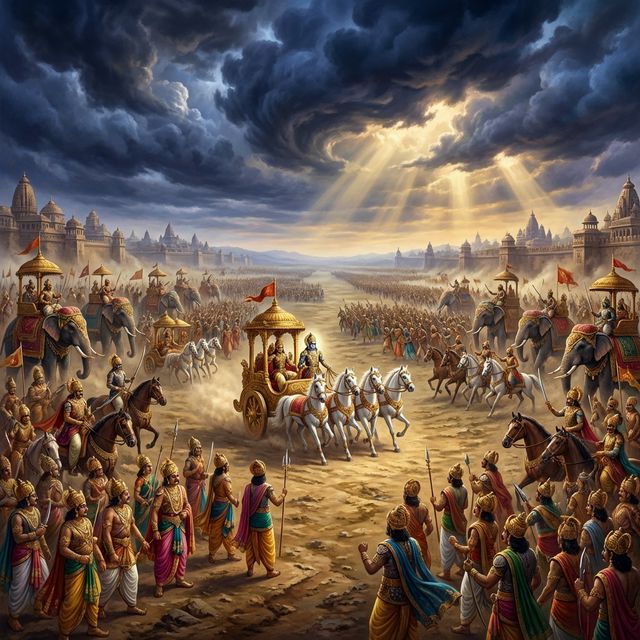
The Kings Who Gave Lawfully
Indra refuses the Rishis, a king answers too quickly, and the names of those who reached heaven by honest gifts
The Question Janamejaya Asked
Vaishampayana had come to the end of the horse sacrifice, and the end of it was not a triumph.
He had described the gifts made in profusion, the Brahmanas gratified, the poor and the blind and the helpless all satisfied, the flowers raining down on the head of Yudhishthira the just. And then he had described the blue-eyed mongoose with one side of his body turned to gold, who walked into that assembly and said in a human voice that the whole rite was not equal to a prastha of powdered barley given away by a Brahmana of Kurukshetra who lived by the unccha vow. The mongoose had explained himself at length, and had not been contradicted, and had vanished.
Janamejaya, who was the great-grandson of the king in that story, did not accept it.
"O puissant Rishi," he said, "kings are attached to sacrifices. The great Rishis are attached to penances. Learned Brahmanas are observant of tranquillity of mind, peacefulness of behaviour, and self-restraint. Hence it seems that nothing can be seen in this world which can compare with the fruits of sacrifices. Even this is my conviction. That conviction, again, seems to be undoubtedly correct."
He was not arguing from sentiment. He was arguing from the record, and he produced the record.
"Innumerable kings, O best of regenerate persons, having worshipped the deities in sacrifices, earned high fame here and obtained Heaven hereafter. Endued with great energy, the puissant chief of the deities, Indra of a thousand eyes, obtained the sovereignty over the deities through the many sacrifices he performed with gifts in profusion, and attained to the fruition of all his wishes."
That was the case, and it is a strong one. The lordship of heaven itself had been bought at an altar.
"When king Yudhishthira, with Bhima and Arjuna by him, resembled the chief of the deities himself in prosperity and prowess," Janamejaya said, "why then did that mongoose depreciate that great Horse-sacrifice of the high-souled monarch?"
Vaishampayana did not defend the mongoose and did not defend the sacrifice. He began, instead, to talk about Indra.
The Sacrifice of the Thousand-Eyed
"Do thou listen to me, O king," he said, "as I discourse to thee duly, O Bharata, on the excellent ordinances relating to sacrifice, and the fruits also, O ruler of men, that sacrifice yields."
Formerly, on one occasion, Sakra performed a particular sacrifice.
Sakra is Indra under another of his names, and it is worth noticing which name the story chooses for him here. Not the wielder of the thunderbolt. Not the slayer of Vritra. The lord of a hundred sacrifices, doing the hundred and first, at the height of everything Janamejaya had just finished praising him for.
The account of it is admiring, and the admiration is not ironic. The limbs of the sacrifice were spread out. The Ritwijas became busy in accomplishing the diverse rites ordained in the scriptures, each man at his own office, nothing left to improvisation. The pourer of libations, possessed of every qualification, was engaged in pouring libations of clarified butter, and the qualification is mentioned because a man not qualified would have ruined it. The great Rishis were seated around, which is to say that the most exacting audience available in the three worlds was watching, and had come.
The deities were summoned one by one by contented Brahmanas of great learning uttering scriptural mantras in sweet voices. Those foremost of Adhwaryyus, not fatigued with what they did, recited the mantras of the Yajurveda in soft accents.
Hold on to that phrase. Not fatigued. Soft accents. This was not a rite being hurried through by tired men in a smoky field. Everything was correct, everything was unhurried, everything was beautiful, and everyone present was competent to judge whether it was.
Nothing in the description can be faulted. That is the point of describing it at such length. Whatever is about to go wrong with the sacrifice of the chief of the gods, it is not going to be a defect of learning, or of wealth, or of attention, or of the standing of the man performing it.
Then the time came for slaughtering the animals.
The Animals Grew Cheerless
When the animals selected for sacrifice were seized, the great Rishis felt compassion for them.
That is the whole of the turn, and it happens in a single sentence, and it happens to the wrong people. These were not squeamish men. They were ascetics who had come to attend a rite performed according to the scriptures, at which animals had certainly been offered before, in their sight, without any of them saying a word. They knew the ordinances. They were seated in the places the ordinances gave them.
And when the ropes went on, they looked at the animals, and the text says exactly what they saw. The animals had all become cheerless.
Beholding that, those Rishis, endued with wealth of penances, approached Sakra and said unto him what nobody says to the king of the gods in the middle of his own sacrifice.
"This method of sacrifice is not auspicious. Desirous of acquiring great merit as thou art, this is verily an indication of thy unacquaintance with sacrifice."
They had called Indra ignorant of the thing he was famous for. Then they said the sentence the whole story turns on.
"O Purandara, animals have not been ordained to be slaughtered in sacrifices. O puissant one, these preparations of thine are destructive of merit. This sacrifice is not consistent with righteousness. The destruction of creatures can never be said to be an act of righteousness."
Not that it was excessive. Not that it was unnecessary in this instance. That it had never been ordained at all, and that the merit he was accumulating was being destroyed by the very act he thought was accumulating it.
They had come with their compassion, and they had stayed to make an argument out of it, and the argument was about the scriptures rather than about their own feelings. That is why it could not simply be dismissed as softness. It was a claim about what the books said, made by men who had spent their lives in the books, standing in front of a fire that was already lit.
Seeds Kept for Three Years
They did not stop at the objection. They brought a remedy with them, and the remedy is the practical heart of the passage.
"If thou wishest it, let thy priests perform thy sacrifice according to the Agama. By performing a sacrifice according to the true import of the scriptural ordinances, great will be the merit achieved by thee. O thou of a hundred eyes, do thou perform the sacrifice with seeds of grain that have been kept for three years. Even this, O Sakra, would be fraught with great righteousness and productive of fruits of high efficacy."
Seeds kept for three years. It is a small, technical, unglamorous instruction, and it is the only alternative anyone offers in the whole of this history.
Grain three years old will not sprout. It is grain that has finished with the possibility of becoming a plant, and can therefore be poured into a fire without anything being cut off in the middle of its living. The Rishis were not asking Indra to abandon his sacrifice or to substitute a symbol for it. They were telling him to lay in a different store, three years in advance, and to conduct the identical rite with it, and they promised him the fruits would be high.
The whole of the remedy costs him three years of foresight and nothing else. No merit is lost. No ordinance is broken. He is offered the same heaven at the same price with the killing taken out of it.
The deity of a hundred sacrifices, however, influenced by pride and overwhelmed by stupefaction, did not accept these words uttered by the Rishis.
Two reasons are given, and neither of them is an argument. He was proud, and he was stupefied. He did not answer their point about the Agama. He did not produce a text of his own. He was the lord of a hundred sacrifices and they were telling him he did not understand sacrifice, and he refused, and the refusal is recorded as a failure of character rather than a difference of opinion.
The fire was still burning. The animals were still tied.
The Dispute That Wore Everyone Out
Then, O Bharata, a great dispute arose in that sacrifice of Sakra between the ascetics as to how sacrifices should be performed, that is, should they be performed with mobile creatures or with immobile objects.
Notice that the quarrel is no longer between the Rishis and Indra. It is among the ascetics themselves. Once the chief of the gods had refused to be corrected, the question was loose in the assembly, and men who had arrived that morning in complete agreement about everything found that they disagreed about this.
Mobile or immobile. That is the ancient way of putting it, and it is exact. Everything offered on a fire is either something that can walk away from it or something that cannot. A goat and a handful of barley are the same thing from the point of view of the ladle. They are not the same thing from the point of view of the goat.
All of them were worn out with disputation.
That is a plain and rather human line, and it is the reason for everything that follows. The dispute did not end in a conclusion. It ended in exhaustion. Learned men had argued the scriptures against each other until nobody had anything new left to say and nobody had changed his position, and the sacrifice was still standing there half performed with the whole assembly deadlocked around it.
So the Rishis, those beholders of truth, having made an understanding with Sakra about referring the matter to arbitration, went looking for someone to decide it.
Read that carefully, because it is the only sensible thing done by anyone in this story. They did not out-shout each other. They did not appeal to Indra's authority, which was compromised, or to their own, which was divided. They agreed, both sides and the king of the gods together, to put the question to a third party and abide by what he said.
There was a man alive at that time who was famous for his righteousness, and they went to him.
His name was Vasu, and he was the ruler of the Chedis.
The King Who Answered Without Weighing
They asked king Vasu, "O highly blessed one, what is the Vedic declaration about sacrifices? Is it preferable to perform sacrifices with animals, or with steeds and juices?"
Everything about the moment was in his favour. He had been sought out by the great Rishis and by the chief of the deities together. He had the standing to settle it. He had been asked a question about the Vedic declaration, which is a question with an answer, and he was reckoned the sort of man who would know it. Nobody was hurrying him.
Hearing the question, king Vasu, without at all judging of the strength or weakness of the arguments on the two sides, at once answered, saying, "Sacrifices may be performed with whichever of the two kinds of objects is ready."
At once. That is the charge against him, and the story states it twice over so that it cannot be missed: he did not weigh the arguments, and he replied immediately.
The answer itself sounds generous. It offends nobody. It gives each party its practice and sends everyone home. It is also a lie, because one of those two things had been declared and the other had not, and the king had been asked which, and he had answered a different question instead. He had ruled on convenience. Whichever is ready.
Having answered the question thus, he had to enter the nether regions.
There is no trial, no curse spoken aloud, no interval in which he might have corrected himself. The puissant ruler of the Chedis, a king whose righteousness was the reason he had been chosen in the first place, went down out of the world for one sentence, and the epic states the reason without softening it. He had to undergo that misery for having answered falsely.
Then Vaishampayana drew the rule out of the wreckage.
"Therefore, when a doubt arises, no person, however wise, should singly decide the matter, unless he be the puissant and self-born Lord himself of creatures."
Not that the king was stupid. That no one man, standing alone, is competent to decide a doubtful question of righteousness. The one exception named is the Grandsire who made the world.
Gifts That Go for Nothing
Having buried a king in the middle of his answer, Vaishampayana turned to the thing Janamejaya had actually asked about, which was the worth of a great man's giving.
The catalogue he gave is a catalogue of failures, and it is worth having in the order he gave it.
Gifts made by a sinner with an impure understanding, even when they are very large, become lost. Such gifts go for nothing. The size is mentioned only to be dismissed.
By the gifts made by a person of unrighteous conduct, one who is of sinful soul and who is a destroyer, just fame is never acquired, either here or hereafter. He may buy the appearance of fame. He does not acquire the thing itself, in this world or the next.
That person of little intelligence who, from desire of acquiring merit, performs sacrifices with wealth acquired by unrighteous means, never succeeds in earning merit. The desire is genuine in that man. He wants the merit. He has simply paid for it with something that was never his to spend.
That low wretch of sinful soul who, hypocritically assuming a garb of righteousness, makes gifts unto Brahmanas, only creates the conviction in men about his own righteousness. That is all he manufactures. A conviction, in other people, about himself.
That Brahmana of uncontrolled conduct who acquires wealth by sinful acts, overwhelmed by passion and stupefaction, attains at last to the goal of the sinful. The learning does not save him and the birth does not save him.
Then the portrait behind all of them. Someone, overwhelmed by cupidity and stupefaction, becomes bent on amassing wealth. He is seen to persecute all creatures, urged by a sinful and impure understanding. He who, having acquired wealth by such means, makes gifts or performs sacrifices therewith, never enjoys the fruits of those gifts or sacrifices in the other world, in consequence of the wealth having been earned by unrighteous means.
Persecutes all creatures. The phrase reaches back to the animals tied at Indra's altar and forward to every ledger in which a man's generosity is funded by somebody else's suffering. The fire does not launder it. What was wrong when it was gathered is still wrong when it is given away.
Roots, Fruits, Potherbs, Water, Leaves
Against all of that he set a single sentence, and the sentence is an inventory of nearly nothing.
Men endued with wealth of penances, by giving away, to the best of their power, grains of corn picked up from the fields, or roots, or fruits, or potherbs, or water, or leaves, acquire great merit and proceed to Heaven.
Grains picked up from the fields is the unccha vow, the same one kept by the Brahmana of Kurukshetra whose prastha of barley had outweighed a horse sacrifice at the start of all this. Roots and fruits are what a forest recluse eats. Potherbs are the bitter leaves nobody else wants. Water is free and available to a man with nothing at all.
To the best of their power. That is the measure, and it is the only measure named. Not the weight of the gift. The proportion it bears to what the giver had.
And then he widened it past giving altogether.
Even such gifts, as also compassion to all creatures, and Brahmacharyya, truthfulness of speech and kindness, and fortitude, and forgiveness, constitute the eternal foundations of Righteousness, which itself is eternal.
Seven things stand in that list beside the handful of leaves, and none of the seven costs money. Compassion to all creatures, which is what the Rishis felt when they looked at the tied animals. Brahmacharyya. Truthfulness of speech, which is precisely what king Vasu failed at while doing nothing else wrong. Kindness. Fortitude. Forgiveness.
Righteousness is called eternal and the foundations are called eternal, and the word is doing real work in a discourse about sacrifice. A rite yields a fruit, and a fruit is consumed, and heaven bought at an altar is a term of residence that runs out. These are named as the foundation rather than the fruit. They are what the structure is standing on, not what it pays.
Janamejaya had asked why one mongoose should be believed against the practice of innumerable kings. He was about to be given the kings.
The Kings Who Gave Lawfully
"We hear of Vishvamitra and other kings of ancient times."
The list is short and it is not explained, and each name on it is a whole history the audience was expected to know already.
Vishvamitra, who was born a king and spent lifetimes of effort becoming a Brahmana, and who is put first here not for the effort but for the giving.
Asita.
King Janaka, the ruler of Mithila, who governed a kingdom while holding nothing in it as his own, and who is the standing example in this epic of a man who could be a king without the kingship costing him anything.
Kakshasena.
Arshtisena.
King Sindhudwipa.
These and many other kings, endued with wealth of penances, having made gifts of articles acquired lawfully, have attained to high success.
That last clause is the entire answer to Janamejaya's question, and it takes eight words. Having made gifts of articles acquired lawfully. Not gifts in profusion. Not gifts of a hundred sacrifices. Lawfully acquired, and then given.
Indra had been offered the same terms in the middle of his own rite, and the terms were three years of grain and no killing, and he had refused them out of pride. Vasu had been handed the question in one sentence and had answered it without weighing it and had gone down into the earth. The kings on this list are the ones who did the plain thing, at the ordinary price, with what was honestly theirs.
And Vaishampayana closed it by taking the whole matter out of the hands of kings.
"Those amongst Brahmanas and Kshatriyas and Vaisyas and Sudras who betake themselves to penances, O Bharata, and who purify themselves by gifts and other acts of righteousness, proceed to Heaven."
All four orders, named in order, and no distinction drawn between them at the end of the sentence. The gate that had been shut against the lord of a hundred sacrifices was standing open to any of the four with a handful of leaves in his hand.
The mongoose had said as much, in the middle of a horse sacrifice, and had not been believed.
Dharma Lesson
The epic does not say that sacrifice is worthless; it says that no rite can clean what was wrongly got or wrongly done. Indra had every qualification except the willingness to be corrected, and Vasu had every virtue except the patience to weigh a question before answering it, and both of them lost more than any offering could have bought. What survives the whole discourse is small and cheap and available to anyone: grain gleaned from a field, water, a handful of leaves, given to the best of one's power out of what was lawfully one's own.