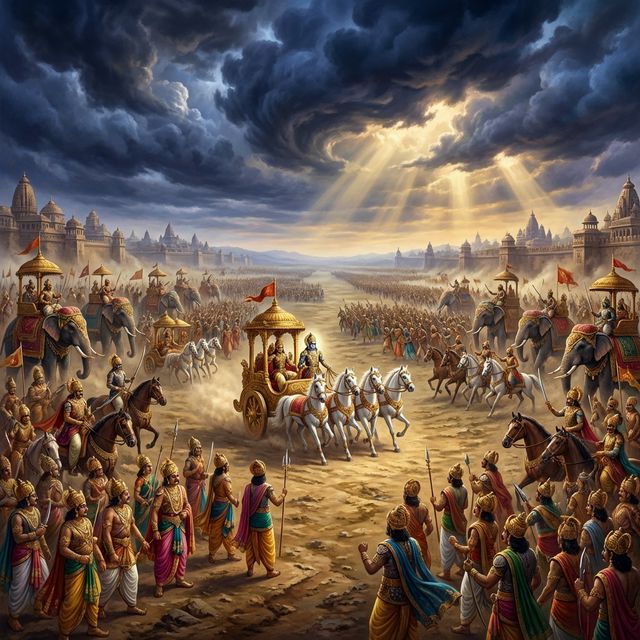
Arjuna's Hymn at Parting
On the road to Hastinapur, Arjuna praises Krishna and gives him leave to go home
Let My Car Be Yoked
Vaisampayana told it to Janamejaya in this way. The teaching was over. Krishna had finished repeating to Arjuna, in that quiet town where the two of them had been sitting together since the war ended, the whole of the religion he had first declared on the field with the armies waiting; and at the end of it he had said the plainest thing he had said all day.
"It is long since I saw the lord my sire. I wish to see him again, with thy leave."
Arjuna answered that they would go that same day to the city named after the elephant, and that they would meet Yudhishthira there, and that from Hastinapur Krishna could go home to his own city.
After this, Krishna ordered Daruka, his charioteer, the man who had held his horses through eighteen days without once being named in a report of the fighting.
"Let my car be yoked."
Within a very short space of time Daruka came back and said, "It has been yoked."
Then the son of Pandu commanded all his attendants. "Prepare yourselves and be ready. We shall repair to-day to the city named after the elephant." The troops accoutred themselves and informed Pritha's son of immeasurable energy that everything was equipt.
So the two of them ascended their car and set out, and Vaisampayana, who is careful about such things, says what they did on that road. The loving friends engaged the while in delightful conversation.
It is worth stopping on that. Every other journey these two had taken together in the last twenty years had a battle or an embassy or a burning forest at the end of it. This one had nothing at the end of it but a leave-taking, and they filled the road with talk, and one of them had begun to understand that the talking was nearly finished.
It was on that ride, seated behind Daruka with the dust going up on either side, that Dhananjaya of great energy turned to Vasudeva and once more began to speak.
Having Obtained Thee for Our Raft
"O perpetuator of the Vrishni race," Arjuna said, "the king has obtained victory through thy grace. All his foes have been slain, and he has recovered his kingdom without a thorn in it to make it disagreeable. O slayer of Madhu, through thee the Pandavas are endued with a powerful protector. Having obtained thee for our raft we have crossed the Kuru ocean."
That is where the hymn begins, and it begins where a soldier would begin it. Not with the nature of God. With the ledger of the war. The kingdom is recovered and the thorn is out of it, and the man saying so is the one who did the shooting, and the first sentence he says is that the victory belonged to somebody else.
The raft is his own image and it is exact. A raft is not a boat. It is a thing you cling to with your arms while the water does what it likes, and it does not promise you a dry crossing, only that you will be on the far side when the crossing is over. The Kuru ocean had taken his son, his teacher, his grandsire, the sons of his enemy and most of the men he had ever known by name, and Arjuna does not pretend otherwise. He says only that there had been something to hold on to, and that he was still holding it, and that it was now getting down off the car and going west.
And then, without any joint in the speech at all, the address changes. The friend beside him on the seat becomes the thing that made the water.
"O thou that hast this universe for thy handiwork, salutations to thee, O Soul of the universe, O best of all beings in the universe. I know thee in that measure in which I am approved by thee."
Read that last line twice. He does not claim to know Krishna. He claims to know exactly as much of him as Krishna has consented to be known. It is the only modest sentence in a hymn otherwise made entirely of superlatives, and it is the one that gives the rest its licence.
The Moonlight Is Thy Smile
From there the praise opens out, and Arjuna, who had spent his life describing distances and targets, begins describing the world as a body.
"O slayer of Madhu, the soul of every creature is always born of thy energy. Playful sport is thine. Earth and sky, O lord, are thy illusion. This whole universe, consisting of mobile and immobile objects, is established on thee."
Sport is the word to hold on to. Creation, preservation and destruction are not labour to the one he is sitting beside; they are the way that one amuses himself, and Arjuna has just come off a field where the amusement cost eighteen akshauhinis. He says it anyway, because he has decided to say the whole of what he sees.
"Thou createst, by modification, the four orders of Being," he said, and named them as the books name them: the viviparous, that are born from the womb; the oviparous, that are born from the egg; those that are born of filth and heat; and those that come up out of the ground. "Thou createst the Earth, the Welkin, and Heaven, O slayer of Madhu."
Then the catalogue turns to the face and the weather at once.
The stainless lunar light is thy smile. The seasons are thy senses. The ever-moving wind is thy breath. And death, existing eternally, is thy wrath.
He puts death in the list. A man composing flattery would have left it out. Arjuna sets it exactly where it belongs, between the wind and the goddess, because he has watched that wrath work for eighteen days and knows the name of every man it took.
"In thy grace is the goddess of prosperity. Verily, Sree is always established in thee, O thou of the highest intelligence. Thou art the sport in which creatures engage; thou art their contentment; thou their intelligence, thou their forgiveness, thou their inclinations, thou their beauty. Thou art the universe with its mobile and immobile objects. At the end of the cycle, it is thou, O sinless one, that art called destruction."
And then the bowman ran out of arrows.
"I am incapable of reciting all thy qualities in course of even a long period. Thou art the Soul and the Supreme Soul. I bow to thee, O thou of eyes like the petals of the lotus."
He had not been asked for any of it. The car went on down the road.
I Learnt It From Narada and From the Grandsire
Having finished the praise, Arjuna does something that is very like him. He cites his authorities.
"O thou that art irresistible, I have learnt it from Narada and Devala and the Island-born, and the Kuru grandsire also, that all this universe rests on thee. Thou art the one Lord of all creatures."
Four names, and he had them from four different rooms of his life. Narada, who came and went among gods and men with news that nobody wanted. Devala, an ascetic of the old school. The Island-born, which is Vyasa, who fathered the line Arjuna belonged to and wrote down what became of it. And the Kuru grandsire, Bhishma, who had said it last of all from a bed of arrows with his death postponed until the sun should turn north.
Arjuna is telling Krishna that he did not arrive at this by himself and did not arrive at it on the strength of affection. Men whose business was the truth had told him, one after another, over a lifetime, and the last of them had told him while dying of wounds that Arjuna's own army had given him.
Then he binds himself.
"This, O sinless one, that thou hast declared unto me in consequence of thy favour for myself, I shall duly accomplish in its entirety, O Janarddana."
He means the teaching just concluded, the second giving of what had been given before the battle, and he promises to live by it. And then, as if the promise reminded him of what it had already cost, he goes back once more over the work of the war and gives the credit away a second time.
"Exceedingly wonderful is this which thou hast done from desire of doing what is agreeable to us, viz., the destruction in battle of the Kaurava prince, the son of Dhritarashtra. That host had been burnt by thee which I subsequently vanquished in battle. That feat was achieved by thee in consequence of which victory became mine. By the power of thy intelligence was shown the means by which was duly effected the destruction of Duryodhana in battle, as also of Karna, as of the sinful king of the Sindhus, and Bhurisravas."
The host was burnt before I ever came to it, says the greatest archer alive, and I only went through the ashes. Duryodhana, Karna, Jayadratha and Bhurisravas: four deaths that the world credits to the Gandiva, handed back across the seat of a chariot to the man holding the reins.
"I shall accomplish all that which, O son of Devaki, pleased with me thou hast declared to myself. I do not entertain any scruple in this."
Thy Departure Meets With My Approbation
Then the hymn ends, and what it ends on is a piece of household business, because Krishna had asked for leave and leave had to be got from the king.
"Repairing to king Yudhishthira of righteous soul, I shall, O sinless one, urge him to dismiss thee, O thou that art conversant with every duty. O lord, thy departure for Dwaraka meets with my approbation."
That is Arjuna letting him go. He had begun the speech calling him the Soul of the universe and he finishes it promising to speak to his elder brother about the travel arrangements, and he adds the one thing a friend adds at a parting, which is a picture of the welcome at the other end.
"Thou shalt soon see my maternal uncle, O Janarddana. Thou shalt also see the irresistible Valadeva and other chiefs of the Vrishni race."
My maternal uncle. Arjuna's mother Kunti was Vasudeva's sister, and so the old man Krishna was aching to see was Arjuna's uncle as well. The two men on that car were cousins before they were anything else, and at the very end of the hymn the god goes back to being a relative going home to his father.
Thus conversing with each other, the two reached the city named after the elephant. They entered the palace of Dhritarashtra, which resembled the mansion of Sakra, with cheerful hearts and without any anxiety.
And Vaisampayana names for us everyone who was sitting in that hall, because the list is a kind of accounting of what was left. King Dhritarashtra. Vidura of great intelligence. King Yudhishthira, and the irresistible Bhimasena, and the two sons of Madri by Pandu. The unvanquished Yuyutsu, the one son of Dhritarashtra who had crossed over before the first day and was therefore alive to sit there. Gandhari of great wisdom, and Pritha, and the beautiful Krishna who is Draupadi, and the other ladies of Bharata's race with Subhadra counting first. And all those women who used to wait upon Gandhari.
One blind king, one blindfolded queen, one surviving son of a hundred, and a room of women.
Approaching Dhritarashtra, those two chastisers of foes announced their names, as men do to a man who cannot see them, and touched his feet. They touched the feet of Gandhari and of Pritha and of Yudhishthira the Just and of Bhima. They embraced Vidura and enquired after his welfare.
Then night came, and the old king dismissed them all to their chambers, and Krishna went to Arjuna's apartments and passed the night in happy sleep with Dhananjaya for his companion. It was the last such night either of them would have.
Do Ye Say What Is in Your Mind
When morning came, the two heroes finished their morning rites, dressed their persons properly, and went to the mansion of Yudhishthira the Just, where the king sat with his ministers.
They entered the well-adorned chamber, and Vaisampayana says they beheld the king like the two Aswins beholding the chief of the celestials. And Yudhishthira, seeing something plainly unsaid between them, spoke first to spare them the asking.
"Ye heroes, ye foremost ones of Yadu's and Kuru's race, it seems that ye two are desirous of saying something to me. Do ye say what is in your mind. I shall soon accomplish it. Do not hesitate."
Then Phalguna, well conversant with speech, humbly approached the king and put it with nothing of the hymn left in it.
"Vasudeva here, of great prowess, O king, is long absent from home. He desires, with thy permission, to see his sire. Let him go, if thou thinkest it meet, to the city of the Anarttas. It behoveth thee, O hero, to grant him permission."
Yudhishthira gave it at once, and then went on giving, because the leave was easy and the parting was not.
"O lotus-eyed one, blessed be thou. Do thou go this very day to the city of Dwaravati for seeing that foremost one of Sura's race. Thy departure is approved by me. Thou hast not seen my maternal uncle, as also the goddess Devaki, for a long time. Meeting him and repairing to Valadeva also, thou wilt worship both of them at my word as they deserve."
Then the requests that a man makes when he is losing something.
"Do thou also think of me daily, as also of Bhima, that foremost of mighty men, and of Phalguna and Nakula and Sahadeva. Having seen the Anarttas, and thy sire, and the Vrishnis, thou wilt come back to my horse-sacrifice, O sinless one."
The king of the whole earth asking a departing guest to remember him, and fixing a date to see him again, and then trying to load him with goods.
"Do thou then depart, taking with thee diverse kinds of gems and various sorts of wealth, and whatever else thou likest. It is through thy grace, O Kesava, that the whole Earth has come under our dominion and all our foes have been slain."
Vasudeva refused the treasure in a way that left nothing to argue with.
"O mighty-armed one, all jewels and gems, all wealth, and the entire Earth, are thine and thine alone. Whatever wealth exists in my abode, thou, O lord, art always the owner thereof."
To which Yudhishthira, the son of Dharma, said only, "Be it so," and worshipped him.
Urge the Steeds to Speed
Vasudeva then went to his paternal aunt.
Kunti had been his father's sister, and she had sent five sons into a war that he had driven the middle one through, and there is no speech recorded between them. He honoured her duly and walked round her person from left to right, the circuit a man makes about a thing he reveres, and she accosted him properly in return, and then he was accosted by all the others with Vidura first among them.
The four-armed elder brother of Gada then set out from Nagapura on his excellent car. Placing his sister, the lady Subhadra, on the car beside him, Janarddana departed with the permission of both Yudhishthira and his paternal aunt, and a large train of citizens went out of the gates with him.
And so did everyone else. The hero who had the foremost of apes on his banner, which is to say Arjuna with Hanuman on the flagstaff, went with him. Satyaki went. The two sons of Madravati went. Vidura of immeasurable intelligence went, and Bhima whose tread resembled that of a prince of elephants went, all of them walking or riding out along the road behind Madhava because none of them could think of a reason to stop yet.
Janarddana of mighty energy let it go on for a while, and then caused all those extenders of the Kuru kingdom, and Vidura also, to return.
Then he turned to the two men who were staying on the car, and said the two words that end the episode.
"Urge the steeds to speed."
Daruka urged them. Satyaki sat beside him, the foremost one of Sini's race. And that grinder of hostile masses, Janarddana of great prowess, went on toward the city of the Anarttas after having slain all his foes, like He of a hundred sacrifices proceeding to Heaven after the slaughter of all his own.
Vaisampayana gives that comparison and then stops. He does not say what the men standing in the road did next, or how long they stood there. He had already given the sentence that mattered on the way out, when the car was going the other way with the two of them on it and the whole of the epic still to be settled: the loving friends engaged the while in delightful conversation.
There would be one more meeting, at a horse-sacrifice, with a date on it. And after that there would be Dwaraka, and the sea.
Dharma Lesson
Arjuna's praise is not flattery, because he pays it in the one currency he owns: he hands back the four killings the world credits to his bow. A man who has been given everything can only give thanks by refusing the credit for it. And the hymn ends not in the sky but on a road, with a request for travel leave and a message to an uncle, because devotion that cannot survive being ordinary was never devotion at all.