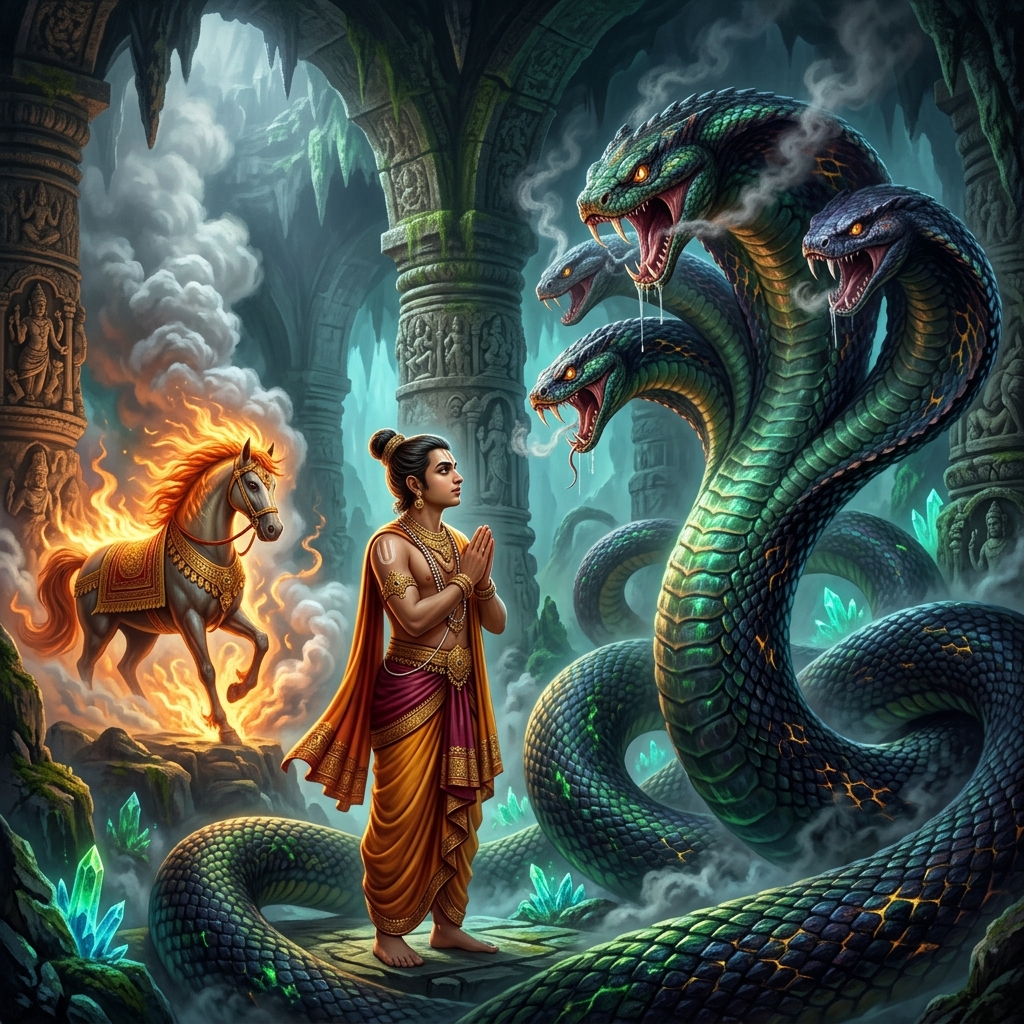
A Man Walking in the Waste
When the crowning was done at Hastinapura and the ashes of the pyres had been given to the river, Krishna turned his chariot west and went home.
The road to Dwaraka runs out of the river country and into the waste: the great desert of the west, where the wells stand two days apart and the villages sit low against the ground as though ducking from something, and the wind moves the dunes about so that a road a man has known for thirty years may be somewhere else by the time he comes back along it. Daruka drove. Krishna sat behind him and watched the country go from green to yellow to a white that hurt the eye, and said very little, which was not usual with him.
On the fourth or fifth day a figure came walking out of the shimmer ahead, alone, with no water and no companion and no evident concern about either.
He was very old. His hair had gone the color of the sand and hung to his waist, his skin was burnt to a hide by a lifetime of that sun, and his eyes, when the chariot came near enough to see them, were the disconcerting eyes of a man who has spent forty years looking at things nobody else looks at. This was Uttanka, whose fierce and unforgiving pursuit of a queen's earrings for his teacher's wife is a story told in its own place. The years since had not softened him in the least. They had only moved him further out into country where there was less to be soft about.
Krishna stopped the chariot, stepped down, and touched the old man's feet.
Uttanka took him by both shoulders, delighted, and looked him over. "Madhava. In my desert. I have had no news out of the east in a long while - I hear nothing here but wind." He was already smiling. "Tell me about the Kurus. Are Dhritarashtra's sons and Pandu's sons living together in peace? You were kin to both of them. It would have been your doing."
The News From the East
Krishna did not answer at once, and the smile on the old man's face began, slowly, to change.
"There was a war," Krishna said. "At Kurukshetra. It lasted eighteen days, and eighteen armies went into it, and the earth has been given that entire generation to hold." He said it plainly, without softening it, the way he had said harder things to better-prepared men. "Duryodhana and all his brothers are dead. Bhishma is dead, and Drona, and Karna, and Jayadratha, and Shalya, and Abhimanyu, and Drupada, and Virata, and Draupadi's five sons in their beds on the last night. Yudhishthira sits on the throne at Hastinapura and rules over widows. Out of that whole royal generation, seven men on one side and three on the other walked off the field alive."
The desert was very quiet. Somewhere far off the wind was shifting sand about.
"You," said Uttanka.
Krishna waited.
"You were there." The old man's voice was climbing and thinning at the same time. "You were among them, in that court, with those men, and they honored you, and they would have listened to you - and you let them do it? Kinsmen slaughtering kinsmen, boys cut down in their thousands, women left with nothing to hold but ash, and Krishna standing in the middle of it? You could have stopped the whole thing with one sentence."
"I could have."
"Then it is your doing." Uttanka stepped back and raised his hand, and there was nothing theatrical about it. The man had austerity banked in him like a fire under earth, and everyone on that road knew what he was holding. "Hear me, then. For this I curse you, Janardana, and my curse will not be a small one. I have not spent it in forty years."
Daruka went white and started forward. Krishna lifted two fingers without turning his head, and Daruka stopped where he stood.
A Curse Is Austerity Spent
"Wait," Krishna said. And then, gently: "Brahmana, do not do that yet. Not because of what it would do to me. Because of what it would cost you. A curse is austerity spent - forty years of standing in that sun, burned out of you in a single breath and gone, and you will want every hour of it later for better work than this. Spend it on understanding me instead. I will not run from your anger. Earn it first."
"Then answer me."
"I will. I went to that court myself. I stood in Duryodhana's hall as an envoy and asked for five villages - five, out of an empire - and offered to end the entire quarrel on those terms; that embassy is a story men still tell. He laughed in my face and tried to have me seized. I said everything that a man can say. I said it to his father, and to Bhishma, and to Karna alone on a riverbank, and to Arjuna when his own hands were shaking on the last morning."
"You are God," Uttanka said. "You could have compelled them."
"Yes." Krishna's voice did not rise at all. "And what would I have been ruling over then? Dharma is not a wall built to keep men from falling. It is a road they remain free to walk off. I set myself in their path and pleaded with them, and free men chose their war around me, and they had that right, and the reaping of it belonged to them. Understand what I am and you will stop needing to blame me. I am born in every age. When dharma sickens I come down and take a body, and sometimes the age is healed gently and sometimes it must pass through fire, and this age had to pass through fire. I did not light it. I stood in it with them."
"Words," said the old man, but with much less certainty than before.
"Then look," said Krishna. "Not with those eyes."
What the Sage Was Shown
What Uttanka saw then, on an empty road in the middle of a waste with nothing around him but sand, has only once been described with any success, by a man on a chariot at Kurukshetra who had also asked to see it.
There was no direction in which it was not. Suns standing in ranks, the ancestors, the seven sages, the gods drawn up in their orders, mouths and eyes and arms beyond counting, and the whole burning weight of past and future turning inside one form, and moving through all of it everything that had ever died going in and everything that would ever be born coming out. The old man's mind, which had carried forty years of accumulated fire, simply set down what it was holding. The curse was in his mouth, formed, ready. It went out of him like a lamp in wind.
When he could see the road again he was on his knees in the sand, and Krishna was standing over him: an ordinary dark-skinned man with dust on his feet.
"Forgive me," Uttanka said. "I did not know."
"There is nothing to forgive. Ask me for something instead."
Uttanka thought about it seriously, which is rare in men who are offered boons. He wanted nothing that men usually want; he had put all of that down somewhere back in the years. "I live out here," he said at last. "There is no water. That is the whole of my difficulty, and it has been the whole of it for a long time. When thirst finds me in this waste, let there be water."
"Then think of me when you are thirsty," said Krishna, "and the clouds will come."
He climbed back into the chariot, and Daruka took up the reins, and the wheels went away west into the glare, and Uttanka stood on the road a long while after they had gone.
The Hunter With the Water Bag
The thirst came a few days later, as it always did, and it came hard.
Uttanka remembered his boon and thought of Krishna, and waited for the sky to change, and the sky did not change. What came instead, out of the shimmer where the chariot had gone, was a hunter: a ragged, filthy, low-caste man of the desert, naked but for a strip of cloth, with dogs at his heels and a bow across his back and a bag of animal hide slung at his hip. The bag was full. Water was beading along its seams.
"Drink, brahmana," the man said, and held it out. "You look finished."
Uttanka looked at the hunter, and at the dogs, and at the leather, and at the water inside it, and everything that forty years of ritual purity had taught him came up in his throat at once. "Keep it," he said. "From your hand? Out of that bag? I would sooner have the thirst."
He said it three times, because the man asked three times.
The hunter shrugged and walked off into the glare and was not there any longer, and Krishna was standing on the road in his place, and Uttanka's stomach turned over before a word had been spoken.
"That was Indra," Krishna said. "I asked him for water for you, and he said the gift he had was too great to be given to a mortal. I told him to bring it anyway. What was in that bag was amrita, and you would have drunk the nectar of the gods and never thirsted again in any world. You refused it on account of the hands that carried it."
The old man sat down in the sand.
"Grace comes dressed however it pleases," said Krishna, not unkindly. "It is under no obligation to arrive in clean linen. You have kept your purity and lost immortality. Do not do it a second time."
The boon held after that, and holds still. To this day the herdsmen of the waste, when the sky goes black over dry country and rain comes down onto sand that has not been wet in a year, say the name of a sage who once came near to cursing God. Those are Uttanka's clouds.
And Krishna, having watered one old man in the desert, rode on west to Dwaraka.
Dharma Lesson
Uttanka's fury is the honest question every reader of this epic arrives at sooner or later: if God was standing in the road, why was there a war? The answer he is given is that dharma is not a wall built to keep men from falling but a road they remain free to walk off, and that free men chose their war around a God who stood pleading with them. His second lesson is smaller and harder: grace wears whatever clothes it likes, and a purity that can turn away a ragged hunter can turn away heaven itself.