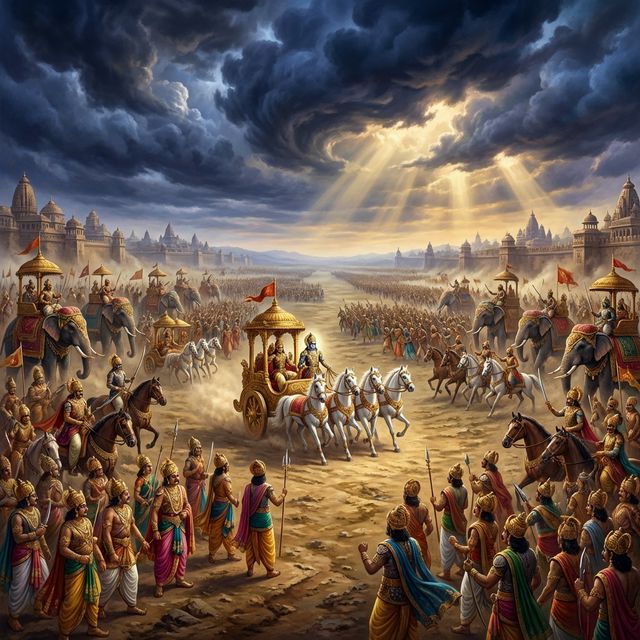
Rules for a Long Life
Bhishma sets out the conduct of an ordinary day, and how brothers should hold together
A Hundred Years, and Why Men Do Not Get Them
The grandsire had been answering questions for a long time by then. He lay on the bed of arrows at Kurukshetra, waiting for the sun to turn north, and every morning the king and his four brothers came out from the camp and sat down on the ground around him, and Yudhishthira asked whatever was left to ask.
That morning the question was about the length of a life.
"Man, it is said, is endued with a period of life extending for a hundred years," Yudhishthira said, "and with energy and might that are considerable. Why then, O grandsire, do human beings die even when they are very young? By what is a man's life shortened? Is it by penances, or Brahmacharya, or silent recitation of sacred Mantras, or drugs? Is it by his acts, or speech?"
He had watched a great many men die young in that place, and none of them had run out of energy or might.
"It is by conduct that one acquires longevity," Bhishma said, "and it is by conduct that one acquires wealth and prosperity. Indeed, it is by conduct that one acquires the fame that rests upon great achievements both here and hereafter. The man whose conduct is improper or wicked never acquires a long life. All creatures become afraid of such a man and are oppressed by him."
Not penance. Not mantras. Not drugs. Conduct, which is to say the ordinary shape of a man's day, repeated until it has made him.
Then the list of the shortlived, and it is not the list a soldier would have made. They that are atheists. They that are destitute of all acts. They that are disobedient to preceptors and transgress the injunctions of the scriptures. They that are unacquainted with duties and therefore unobservant of them. They that transgress all restraints become shortlived here and go to Hell hereafter.
And against them, the sentence to carry away.
"Even those men live for a hundred years who, though destitute of all accomplishments, betake themselves to propriety and righteousness of conduct and become endued with faith and freed from malice. He that is free from wrath, that is truthful in speech, that never does any injury to any creature in the universe, succeeds in living for a hundred years."
Then, without any change of tone, he came down from that height to a handful of small ugly habits, which is the method of the whole discourse.
"He who always breaks little clods of earth, or tears up the grass that grows under his feet, or cuts off his nails with his teeth, or is always impure, or very restless, never succeeds in acquiring a long life."
The Hour Before Dawn
Then he laid out the day itself, beginning where the day begins.
One should wake at the hour known as the Brahma Muhurta, the last watch before dawn, and lying there in the dark one should think of both religion and profit, dharma and artha together, neither one alone. Getting up from bed, one should wash the face and the mouth, and with the hands joined in an attitude of reverence say the morning prayers. So also, when evening comes, one should say the evening prayers, restraining speech with other people the while.
"The Rishis, in consequence of their adoring the two twilights with great regularity, succeeded in attaining to longevity," Bhishma said. "Hence one should, restraining speech, say one's prayers regularly at the two twilights."
He was strict about it. As regards those Brahmanas who do not say their prayers at the two twilights, a righteous king should set them to accomplish such acts as are ordained for the Sudras. A man who will not do the work of his order may be given the work of another.
There is a rule about the sun that goes with the twilights. One should never look at the rising sun, nor at the setting sun, nor at the sun when he is in eclipse, nor at his image lying in water, nor at midday when he stands on the meridian. The eye is not to be spent on the thing the prayer is addressed to.
Rising from bed, one should first salute one's parents and one's preceptors and the other seniors deserving of respect. "By so doing," said Bhishma, "one attains to long life."
In the forenoon one should dress the hair, apply collyrium to the eyes, wash the teeth, and worship the deities. The tooth-stick is to be used with the speech restrained, and cast off when it is done with, and a new one taken every day. One should never be in bed when the sun is up. If a man fails on any day to be up with the sun, he should perform an expiation for it.
One should not worship the deities without having first washed the teeth. And having not yet worshipped the deities, one should not go to see anybody at all, except one's preceptor, or one that is old in years, or one that is righteous, or one that is possessed of wisdom.
The morning belongs to the gods and the old. Everyone else can wait until the man is fit to be seen.
On the Road
The rules for the road are the rules of a man who has spent his life among crowds and knows what the street does to the careless.
One should not set out on a journey at early dawn, nor at midday, nor in the evening twilight, nor with a companion that is unknown, nor with a Sudra, nor alone. One should never go alone on a journey to foreign parts, nor proceed alone to any place at night. Before evening comes, one should be back at one's house and remain within it.
Then the rule of giving way, which is the whole of courtesy in a single line.
"While going along a road, one should, standing aside, always make way to a Brahmana, to kine, to kings, to an old man, to one that is weighted with a burden, to a woman quick with child, or to one that is weak."
Look at the company that list keeps. The king and the cow and the pregnant woman and the porter under his load are all given the road by the same gesture, and the man who steps aside does not get to choose which of them deserves it.
When one meets a large tree that is known, one should walk round it. When one comes upon a spot where four roads meet, one should walk round that too before pursuing the journey. And at midday, or at midnight, or at night in general, or at the two twilights, one should not go to the place where four roads meet at all.
When an old man goes along the road, one should always follow him instead of walking ahead of him.
There are rules of the same kind for what a man puts on before he goes out. One should never wear sandals or clothes that have been worn by another, nor the upper garment for covering the lower limbs, nor a piece of cloth that has not its lateral fringes. When one goes to bed one should wear a different piece of cloth, and when making a journey a different piece again, and when worshipping the deities a different piece again.
The garlands should be white, not red, and a garland once worn is not to be taken off the body, nor worn over the outer garments.
"A garland of gold," Bhishma added, "can under no circumstances become impure."
Wordy Shafts
Then he came to speech, and the old man who had been shot full of arrows four months earlier chose his image with care.
"One should never pierce others with wordy shafts. Indeed, one should never utter any cruel speech. Wordy shafts fall from the mouth. Pierced therewith, the victim grieves day and night. The man of wisdom should never shoot them for piercing the vitals of other people."
Then the comparison, and there is nobody on that field better placed to make it.
"A forest, pierced with shafts or cut down with the axe, grows again. The man, however, that is pierced with words unwisely spoken becomes the victim of wounds that fester and lead to death. Barbed arrows and Nalikas and broad-headed shafts are capable of being extracted from the body. Wordy shafts, however, are incapable of being extracted, for they lie embedded in the very heart."
He was lying on a bed made of the extractable kind while he said it.
Out of that principle came the particulars. One should not taunt a person that is defective of a limb, or that has a limb in excess, or one that is destitute of learning, or one that is miserable, or one that is ugly or poor, or one that is destitute of strength. One should avoid censuring and calumniating others, and all kinds of deceitful behaviour. One should never utter such words as trouble other people, or as are inauspicious, or as are sinful. One should never indulge in the calumny of others, and not in self-reproach either, for calumny is sinful whether of others or of oneself.
One should avoid atheism, calumniating the Vedas, censuring the deities, malice, pride, arrogance and harshness. One should never speak ill of Brahmanas. One should not point at the stars with the fingers. If asked, one should not say what the lunation is on a particular day, for by telling it a man's life is shortened.
And the rod is not to be taken up in anger for laying it upon another. Only the son or the pupil, it has been said, can be mildly chastised, and that for the purposes of instruction and nothing else.
"The man that desires his own good," Bhishma said, "should never seek to provoke against himself the wrath of others."
The Four Directions of a Meal
The rules of eating are the longest part of the whole discourse, and Bhishma went through them without hurrying, because a man eats twice a day for a hundred years and there is no other act he will perform so often.
Wash the feet before sitting down. "One who sits to one's meals after having washed one's feet lives for a hundred years." Wash the mouth three times with water before eating, and three times again after. Eat in a seated posture, never walking, never with the food placed on the bare ground, never without a piece of upper garment wrapping the body, never making any noise, never censuring the food that is set down. Eat silently, and always leave a remnant of what was placed before you. Having finished, mentally touch fire.
Then the four directions, which the text gives as a plain table of rewards.
He who eats with his face turned eastwards becomes endued with longevity. By eating with the face turned southwards a man acquires great fame. By eating with the face turned westwards he acquires great wealth. By eating with the face turned northwards he becomes truthful in speech.
The guest comes before the man of the house. The man of intelligence should first offer water and then food to one that has become his guest, and only after having served the guest should he sit to his own meal. And of the friends who sit down in the same line with him: "He who sits down to dinner in a line with friends and himself eats any food without giving thereof to his friends is said to eat virulent poison." Nor should one eat anything without giving a portion of it to persons who are wishfully gazing at the food.
The forbidden things are named. Flesh of animals not slain in sacrifice. The flesh of the back. The flesh of goats, of kine, and of the peacock. Dried flesh and all flesh that is stale. Salt taken up with the hand. Curds and flour of fried barley at night. Any food in which a hair is detected. Any food eaten at the Sraddha of an enemy. Any food eaten doubtingly. Any dish shared from one plate with another man, even if that other be of one's own rank.
Samyava and Krisara and meat and Sashakuli and Payasa should never be cooked for oneself alone. Whenever they are cooked, they should be offered to the deities.
One should eat once in the morning and once after evening, and abstain from everything in the interval.
Bed, Bath, and the Tirthas of the Hand
He went on to the care of the body, where the smallness of the rules is the point of them.
Sleep. One should never sleep with the head turned towards the north or the west. One should not lie down upon a bedstead that is broken or rickety, nor sleep on a bed without having examined it first with the aid of a light, nor sleep in a transverse direction, nor in a state of nudity. Sleep at daytime shortens life. To sleep after the sun has risen shortens life. They who sleep at either of the twilights, or at nightfall, or in a state of impurity, have their lives shortened. At the evening twilight one should not sleep and should not study and should not eat, but should collect the senses for meditation without doing any act at all.
Bathing. One should never bathe in a state of nudity. One should never, while bathing, repeatedly dip the head in water, for by so doing a man shortens his life, and one who has bathed by dipping the head should not afterwards apply oil to the body. One should not suffer the limbs to be rubbed or pressed after bathing, nor smear unguents without having first bathed, nor wave the cloth in the air to dry it, nor on any account use the water that another has used. After bathing one should use perfumes mixed with water, and unguents made of Priyangu, sandalwood, Vilwa, Tagara and Kesara.
Purity. One should never touch these three things of great energy while one is in an impure state: fire, a cow, and a Brahmana. By observing this rule a man acquires longevity. Nor should one, while impure, cast the eyes on the sun, the moon, and the stars. One should never touch another's head, for it is said in the scriptures that the life-breaths are all concentrated in the head, and one should never strike another on the head, nor seize another by the hair. One should never teach or study while impure. When a storm rises or a bad odour permeates the air, one should not think of the Vedas at all.
"Persons conversant with ancient history recite a Gatha sung by Yama in days of old," Bhishma said. "He that runs while impure, or studies the Vedas under such circumstances, loses his Vedas and shortens his life."
Even the hand is mapped. Between the tip and the root of the thumb is situate the sacred Tirtha known by the name of Brahma. On the back of the little finger is the Deva-tirtha. The space between thumb and forefinger discharges the rites of the Pitris.
Three That Carry Poison
Then came the rule about who must never be slighted, and it is the sharpest thing in the discourse.
"One that wishes to live long should never disregard or insult any of these three, however weak or emaciated they may appear to be: the Brahmana, the Kshatriya, and the snake. All three are endued with virulent poison."
He graded them. The snake, if angry, burns the victim with only a glance of its eyes. The Kshatriya also, if angry, burns the object of his wrath as soon as he sees him, with his energy. The Brahmana is stronger than either, and destroys not only the object of his wrath but his whole race as well, and does it not by vision alone but by thought. "The man of wisdom should therefore tend these three with care."
With the preceptor there is no argument at all. One should never engage in any disputation with one's preceptor. If the preceptor becomes angry he should always be pacified by due honours being paid to him. "Even if the preceptor happens to be entirely wrong," Bhishma said, "one should still follow and honour him. Without doubt, calumnious sayings against the preceptor always consume the lives of those that utter them."
With the old there is a physical reason given, and it is a strange and memorable one.
"The life-breaths of a young man go upwards when an old and venerable person comes to his abode. He gets them back by standing up and properly saluting the guest."
Something leaves the young man when age walks in at his door, and the only way to get it back is to rise. Old men should always be saluted. On seeing them one should offer a seat with one's own hand, and after the old man has taken his seat one should then sit down oneself and remain with the hands joined in reverence.
The house has its own duties. A kinsman who happens to be old, or a friend who happens to be poor, should be established in one's house and his comforts looked after as if he were a member of the family, and by doing this a man acquires both fame and long life.
Even the creatures that come in are read as signs. The establishment of pigeons in a house is fraught with blessedness, as of parrots both male and female. If fireflies and vultures and wood-pigeons and bees enter a house or seek residence in it, acts of propitiating the deities should be performed, for these are creatures of evil omen, as are ospreys.
A Wife, Sons, and the Sixty-Four Kalas
The last stretch of the discourse is about founding a household and then handing it on.
One possessed of wisdom should wed a maiden born in a high family, endued with auspicious indications, and of full age, one who is agreeable and handsome and accomplished in qualifications of diverse kinds. One should wed in a family that is higher than one's own or at least equal to it. A woman deficient of any limb should be avoided, and one that has any malformation, and one of the same Pravaras, and one born in the race to which one's own mother belongs, and one born in a family in which there has been epilepsy or leprosy or a succession of early deaths.
Then the children. Begetting children upon her and thus perpetuating one's race, a man should make over his sons to a good preceptor for acquiring general knowledge and also a knowledge of the especial customs of the family. The daughters should be bestowed upon youths of respectable families that are possessed of intelligence. The sons should be established, and a portion of the family inheritance given to them as their provision.
"One should never seek to injure women," Bhishma said. "Spouses should always be protected. Malice always shortens life."
And a man is not finished learning when he marries. He should attend with great care to the Vedas and to the science of arms, and to the practice of riding an elephant, a steed and a war-chariot. He should acquire the science of reasoning, the science of words, the science of the Gandharvas, and the four and sixty branches of knowledge that are known by the name of Kala. Every day he should hear the Puranas and the Itihasas and the life-stories of high-souled persons. One should always obey the commands of one's mother and father and preceptor, without at all judging whether those commands are beneficial or otherwise. And when the period ordained for the domestic mode of life has been passed, one should enter the life of a forest recluse.
Then he gathered the whole morning back into the word he had started from.
"Thou shouldst know that conduct is the root of prosperity. Conduct is the enhancer of fame. It is conduct that prolongs life. It is conduct that destroys all calamities and evils. Conduct has been said to be superior to all the branches of knowledge. What remains untold by me should be heard by thee from the mouths of persons well-versed in the three Vedas. The Self-born Brahman himself has said that one should show compassion unto all orders of men."
The Eldest and the Younger
Yudhishthira had one more question, and of all the questions he asked on that field it is the one that was most plainly about himself.
"Tell me, O chief of Bharata's race, how the eldest brother should behave towards his younger brothers, and how the younger brothers should behave towards their eldest brother."
Four men were sitting there listening to him ask it.
"Do thou, O son, always behave towards thy younger brothers as their eldest brother should," Bhishma said. "Thou art always the eldest of all these thy brothers. That high conduct which the preceptor should always adopt towards his disciples should be adopted by thee towards thy younger brothers. If the preceptor happens to be unendued with wisdom, the disciple cannot possibly behave towards him in a respectful or proper way. If the preceptor happens to be possessed of purity and highness of conduct, the disciple also succeeds in attaining to conduct of the same kind."
Then the practical advice, which is the opposite of what a man in authority usually wants to hear.
"The eldest brother should at times be blind to the acts of his younger brothers, and though possessed of wisdom should at times act as if he does not understand their acts. If the younger brothers be guilty of any transgression, the eldest brother should correct them by indirect ways and means."
And he explained why the correction must be indirect, and the reason has nothing to do with tenderness.
"If there be good understanding among brothers, and if the eldest brother seek to correct his younger brothers by direct or ostensible means, persons that are enemies, O son of Kunti, that are afflicted with sorrow at the sight of such good understanding, set themselves to disunite the brothers and cause dissension among them."
A public reproof between brothers is a gift handed to whoever is watching. There had been a man watching that family for a very long time who would have known exactly what to do with such a gift.
"It is the eldest brother that enhances the prosperity of the family or destroys it entirely," Bhishma said. "If the eldest brother happens to be unendued with sense and wicked in behaviour, he brings about the destruction of the whole family. The eldest brother who injures his younger brothers ceases to be regarded as the eldest, and forfeits his share in the family property, and deserves to be checked by the king. That family in which a sinful person takes birth becomes subject to every evil. The birth of such a person serves no useful purpose, even as the flowers of the cane."
No Senior Equal to the Mother
Having said what the eldest owes, he said what he may keep.
If the eldest brother makes any acquisition without using the paternal property, and by going to a distant place, he may keep that acquisition without giving any share of it to his younger brothers. Such among the brothers as are wedded to evil acts forfeit their shares, and in that case the eldest may take the whole of the Yautuka property and give them none of it. If unseparated brothers desire, during the lifetime of their father, to portion the family property, the father should give equal shares unto all his sons. And if the eldest brother happens to be of sinful acts and undistinguished by accomplishments of any kind, he may be disregarded by his younger brothers.
Then Bhishma set a limit on all of it.
"If the wife or the younger brother happens to be sinful, her or his good must still be looked after. Persons conversant with the efficacy of righteousness say that righteousness is the highest good."
The property may be withheld. The care may not.
Then the ladder of seniority, counting upwards.
"The Upadhyaya is superior to even ten Acharyas. The sire is equal to ten Upadhyayas. The mother is equal to ten sires, or even the whole earth. There is no senior equal to the mother. Verily, she transcends all in respect of the reverence due to her."
And at the top of the ladder, where the count runs out, the rest of the family arranges itself.
"After the father has ceased to breathe, the eldest brother should be regarded as the father. It is the eldest brother who should assign unto them their means of support, and protect and cherish them. All the younger brothers should bow to him and obey his authority, and live in dependence upon him even as they did upon their father while he was alive."
There was one more distinction to draw.
"So far as the body is concerned, it is the father and the mother that create it. That birth, however, which the Acharya ordains is regarded as the true birth, and is besides really unfading and immortal."
Then the last words of the answer, and they are about women again, and they close the circle.
"The eldest sister, O chief of Bharata's race, is like unto the mother. The wife of the eldest brother also is like unto the mother, for the younger brother in infancy receives suck from her."
The king sat on the ground with his brothers around him, the eldest of them, the father of them now, and said nothing at all.
Dharma Lesson
The epic keeps its largest claim for its smallest instructions. A man is not made long-lived by austerities but by the ordinary shape of his day, by which way he faces at a meal, whether he steps aside for a burdened stranger, whether he swallows the cruel sentence he had ready. Bhishma puts the biting of nails beside adultery and the wordy shaft beside the barbed arrow, and he does it lying on arrows that could at least be pulled out. The rules for brothers follow the same logic: a family is not destroyed by one great betrayal but by an elder who corrects in public what he should have mended in private.