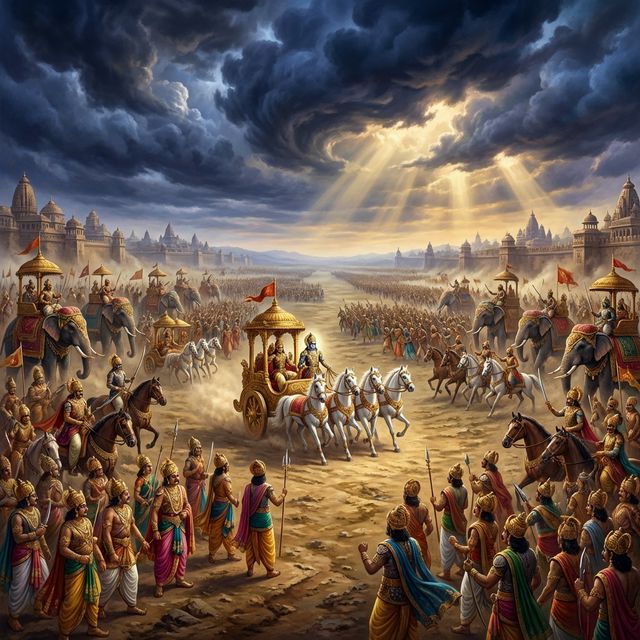
How the Krittikas Took Abhijit's Place
A star leaves the sky in envy of her elder sister, and Skanda's six nurses are raised into the empty station
Six Days Old and Lord of the Host
Markandeya had been days in the Kamyaka by then, and the sons of Pandu had learned to let him talk without interrupting. He was telling them the birth of the war god, and he had brought the account as far as the anointing.
Skanda was six nights old. That is the fact the whole of the rest depends on, and Markandeya kept putting it back in front of Yudhishthira so that he would not forget it. Six nights old, born of the Fire god, golden-eyed, dressed in a pair of clean red cloths so that he looked like the sun peering out from behind a mass of red clouds. The gods had offered him the sovereignty of the three worlds and he had refused it, telling Indra to go on being Indra, and had asked instead to be made the leader of the celestial armies, for the destruction of the Danavas and for the well-being of cows and Brahmanas. So Indra had anointed him. The golden umbrella held over his head looked like a halo of blazing fire. The red cock his father had given him was set on the top of his chariot, where it looked like the image of the all-destroying fire, and Brihaspati had said the marriage hymns over him and Devasena, whom Brahma had appointed to be his bride before he was born.
"Understand what that means," Markandeya said. "A child not a week old had an army, a wife, a standard, and the ear of every god in heaven. And everyone in the three worlds who had ever lost something now knew exactly where to go and ask for it back."
They came almost at once.
Six women walked into the camp of the celestial forces on the White Mountain. They were ladies of high religious merit and austere vows, and they had nowhere else on earth or in heaven to be, because their husbands had put them out of their houses.
The Wives Who Were Cast Out
They were the wives of the seven great Rishis, six of the seven, and the seventh had not come with them because nobody had ever accused her of anything.
The charge against these six was that they had given birth to Skanda. It was not true. What had happened was that Swaha, in love with the Fire god and unable to reach him, had taken the shape of one wife after another and gone to him in the shape she had taken, and the seed she carried away from him was what had at last become the child. The women themselves had been asleep in their own houses the whole time. But the rumour had gone out, and the rumour was the kind that fastens, and the Rishis had believed it.
They stood in front of the six-day-old commander of the armies of heaven and told him so without any softening of it.
"We, O son, have been cast out by our god-like husbands, without any cause. Some people spread the rumour that we gave birth to thee. Believing in the truth of this story, they became greatly indignant, and banished us from our sacred places. It behooves thee now to save us from this infamy. We desire to adopt thee as our son, so that, O mighty being, eternal bliss may be secured to us by that favour. Do thou thus repay the obligation thou owest to us."
Read the last line again, because it is the hinge of the whole scene. They were not begging. They were presenting an account. He had cost them their homes and their standing without ever meaning to, and they had come to collect what he owed. And they had worked out the only settlement that would answer, which was that the lie should be made true.
"O ladies of faultless character," Skanda said, "do you accordingly become my mothers. I am your son and ye shall attain all the objects of your desire."
He was six days old and he had just acquired six mothers, none of whom had borne him. Where he was going to put them was not yet clear to anybody in that camp.
A Star That Went to the Woods
Indra had been standing by through all of this with something on his mind, and when the women had finished he made a sign that he wished to speak.
"What is it?" Skanda said.
Vasava, who is Indra, told him about a scandal in the sky.
"The lady Abhijit, the younger sister of Rohini, being jealous of her seniority, has repaired to the woods to perform austerities. And I am at a loss to find out a substitute for the fallen star. May good luck attend on thee, do thou consult with Brahma for the purpose of filling up the room of this great asterism."
To follow that, one has to know what an asterism is in this reckoning. The nakshatras are not decorations. They are a fixed roster of stations along the moon's road, twenty-seven of them, each with a presiding lady and each with her turn at holding the sky, and the count is not a matter of taste. It was fixed at the creation and it was full.
Abhijit had walked out of it.
The reason she walked out is given in a single clause and it is one of the plainest things in the epic. Rohini was her elder sister. Rohini was the moon's beloved, the one he came back to, the one whose name is spoken first. Abhijit could not bear the seniority. Not the beauty and not the husband, which would at least be the ordinary complaint. The precedence. The order in which they were named. And rather than stand in the sky and be second for the rest of eternity she went down into the forest to burn it off with austerities, which is the one form of self-destruction the world calls holy.
So there was a hole in the roof of the world where a star had been, and the king of the gods, who could not sleep for it, had come to a child six days old and asked him to please go and speak to his grandfather about it.
Krittika Is Given the Room
The trouble with filling the vacancy was arithmetic.
Dhanishtha and the other asterisms had been made by Brahma at the beginning, and the number he had made was the number there was. There were no spare ladies waiting in reserve. Rohini herself had been serving as one of them, and with her included the roster stood complete, which is another way of saying that every star in the sky already had a station and none of them could be moved into Abhijit's without opening a second hole where the first had been closed.
The answer, when it came, was to raise something that had never been counted.
In accordance with Sakra's advice, Krittika was assigned a place in the heavens. That is the whole of the transaction as Markandeya gives it, and it is worth pausing on who Krittika is. She is not one lady. She is six, the six who found the child in the reed bed on the mountain and quarrelled over which of them should nurse him until he grew six mouths and drank from all of them at once, and it is from them that he is called Kartikeya, the son of the Krittikas. They were the wet nurses. They had no station. And now the six of them together were set up in the sky as one asterism in the room of the star that could not bear to be second.
That star is presided over by Agni, the Fire god, who was Skanda's father, and Markandeya says it shines as if with seven heads.
Six flames and the fire that fathered him. Anyone who has looked for the Krittikas on a clear night and counted them has been counting a household.
While that was being settled, Vinata came forward. She is the mother of Garuda, and she had lost one son to the sky and had a long memory of what it costs to be alone.
"Thou art as a son to me," she said, "and entitled to offer me the funeral cakes. I desire, my son, to live with thee always."
"Be it so, all honour to thee," said Skanda. "Do thou guide me with a mother's affection, and honoured by thy daughter-in-law, thou shalt always live with me."
That made seven mothers, and eight, and the queue had not moved.
The Mothers of All Creatures
Then the great mothers came, and they were not six women in trouble with their husbands. They were the powers that stand behind birth itself, and they had been waiting their turn in the line.
"We have been described by the learned as the mothers of all creatures," they said. "But we desire to be thy mothers, do thou honour us."
"Ye are all as mothers to me, and I am your son," Skanda said. "Tell me what I can do to please you."
He had said the same sentence to everybody who had come to him that day, and every time it had been answered with something simple. This time it was not.
"The ladies Brahmi, Maheswari and the rest were appointed as mothers of the world in bygone ages," they said. "We desire, O great god, that they be dispossessed of that dignity, and ourselves installed in their place, and that we, instead of them, be worshipped by the world. Do thou now restore to us those of our progeny, of whom we have been deprived, by them on thy account."
There it is, and it took no time at all to get there. They wanted the office. They wanted the worship that goes with the office. And they wanted their children back, the ones taken from them and handed to the reigning mothers, and they had noticed and were pointing out that it was on his account that the transfer had been made.
Skanda gave them half of it and refused the half that mattered.
"Ye shall not recover those that have been once given away," he said, "but I can give you other offspring if ye like."
It is the answer of somebody who has already learned, six days into his existence, that a thing given cannot be called back without making the gift a lie, and that the only honest generosity left is new generosity. He was offering to make them mothers again from the beginning.
They did not want to begin again. They wanted what they had lost, and having been told they could not have it, they told him what they would take instead.
What the Mothers Asked to Be Allowed to Eat
"We desire that living with thee and assuming different shapes we be able to eat up the progeny of those mothers and their guardians. Do thou grant us this favour."
It is said in one breath, the way people say the thing they have been holding all along. They could not be the mothers of the world, so they would be the hunger that comes for the world's children, and they would do it in borrowed shapes so that nobody would see them coming, and they asked their new son to sign it.
He did not shout at them. What he said was worse.
"I can grant you progeny," Skanda said, "but this topic on which ye have just now dilated is a very painful one."
That is the only judgment he passes, and he passes it as a description of his own state. Then he turned the request inside out and handed it back.
"May ye be prosperous. All honour to you, ladies, do ye vouchsafe to them your protecting care."
Protect them. The same children. Nothing else about their standing changed, no lecture and no curse, only the object of the verb reversed, and by the courtesy in it they were left with nowhere to go but agreement.
"We shall protect them, O Skanda, as thou desirest," they said. "Mayst thou be prosperous. But, O mighty being, we desire to live with thee always."
That was the real petition, and it had been the real petition from the beginning. Not the office and not the children. To be near him. And so he gave them a settlement that has governed the sickroom and the birth chamber ever since.
"So long as children of the human kind do not attain the youthful state in the sixteenth year of their age, ye shall afflict them with your various forms, and I too shall confer on you a fierce inexhaustible spirit. And with that ye shall live happily, worshipped by all."
Sixteen years, and after that the child is out of their reach. Within those years they may come. They are not to devour, they are to afflict, and they are also the ones who have promised to protect, so that the same powers that trouble a child are the ones a household prays to for that child, and the prayer is not a contradiction but the terms of the bargain.
The Thing That Came Out of Him
Then a fiery powerful being came out of the body of Skanda for the purpose of devouring the progeny of mortal beings, and it fell down upon the ground, senseless and hungry.
That is the sentence. It came out of him, it could not stand, and it was hungry. He had promised a fierce inexhaustible spirit and this was the spirit, born the way he had been born, out of fire, with nothing in its head but appetite. And bidden by Skanda, that genius of evil rose and took a terrific form, and good Brahmanas call it Skandapasmara, the falling sickness of Skanda, which takes a child in the middle of a room and throws it down.
After that Markandeya named the rest of them, one by one, and the naming is the point, because a thing with a name can be addressed and a thing that can be addressed can be asked to go away.
Vinata, who had asked to live with him always, is the terrific Sakuni graha, the bird spirit.
She whom the learned know as Putana Rakshasi is the graha called Putana. And that other, hideous to look at, is the pisacha called Sita Putana, the pale Putana, and she is the cause of abortion in women.
Aditi is also known by the name of Revati, and the evil spirit that comes from her is called Raivata, and it too afflicts children.
Diti, the mother of the Daityas, is called Muhkamandika, and that terrible creature is very fond of the flesh of little children.
And the male and female children said to have been begotten by Skanda himself are spirits of evil, and they destroy the foetus in the womb. They are the Kumaras, and they are the husbands of those very ladies, and children are seized by them unawares.
Nine names so far and every one of them a household word in a house where a baby has died. There is no attempt anywhere in the passage to explain the deaths away or to say that they are deserved. The epic simply concedes that infants are taken, gives the takers faces and names and a season during which they are permitted to come, and moves on to the rest of the list.
Eighteen in the Lying-In Room
Surabhi, whom the wise call the mother of the bovine kind, is ridden by the evil spirit Sakuni, and in her company he devours children on this earth.
Sarama, the mother of dogs, habitually kills human beings while they are still in the womb.
And she who is the mother of all trees has her abode in a karanja tree, and she is nothing like the others. She grants boons. She has a placid countenance, and she is always favourably disposed towards all creatures, and those who desire to have children bow down to her where she sits in that tree. In the middle of the worst list in the Vana Parva there is one seat under one tree where a woman who wants a child may go and be answered.
These eighteen spirits, Markandeya said, fond of meat and wine, and others of the same kind, invariably take up their abode in the lying-in room for ten days.
Ten days. Not forever and not at random. There is a period after a birth during which that room is understood to be crowded, and the customs that surround it, the lamps and the watching and the refusal to leave the mother alone, are the practical form of that belief.
Three more were named, and each is an explanation of a particular grief. Kadru enters the body of a pregnant woman in a subtle form and destroys the foetus there, and the mother is made to give birth to a Naga. The mother of the Gandharvas carries the foetus away, and that is why conception in a woman turns out to be abortive. The mother of the Apsaras removes it from the womb, and that is why the learned speak of conceptions that are stationary, that neither grow nor come to anything.
Then the two who are wholly good. The daughter of the Divinity of the Red Sea nursed Skanda, and she is worshipped under the name of Lohitayani on Kadamva trees. And Arya acts the same part among female beings as Rudra does among male ones. She is the mother of all children, and she is distinctly worshipped for their welfare.
Until children attain their sixteenth year these spirits exercise their influence for evil, and after that, for good. That is the turn on which the whole catalogue rests. The same power that came for the child comes back to guard the man. They are propitiated with burnt offerings, ablutions, unguents and sacrifices, and above all by the worship of Skanda, and when they are honoured with due reverence they bestow on men whatever is good for them, and valour, and long life.
The Spirits That Come After Sixteen
"And now," said Markandeya, "having bowed down to Maheswara, I shall describe the nature of those spirits who influence the destinies of men after they have attained their sixteenth year."
The list that follows is a physician's list. Every item in it begins with something the sufferer sees or smells or hears, and ends with the name of the thing that is doing it to him.
The man who beholds gods, whether sleeping or awake, soon turns mad, and the influence under which those hallucinations take place is called the celestial spirit.
When a person sees his dead ancestors while he is sitting at ease or lying in his bed, he soon loses his reason, and that illusion is the work of the ancestral spirit.
The man who shows disrespect to the Siddhas and is cursed by them in return runs mad, and that is the Siddha spirit.
The one by whose influence a man smells sweet odours and tastes various tastes when there is nothing about him to smell or taste, and is tormented by it, is called the Rakshasa spirit.
The spirit by whose action the celestial musicians blend their existence into the constitution of a human being, and make him run mad in no time, is the Gandharva spirit. He who is always tormented by Pisachas is under the Paisacha spirit. And when the spirit of the Yakshas enters a man's system by some accident, he loses his reason immediately, and that is the Yaksha spirit.
Then two that are laid at no one's door but the man's own. He who loses his reason because his mind has been demoralised with vices runs mad in no time, and his illness must be remedied by the methods prescribed in the Sastras. And men run mad from perplexity, from fear, and from beholding hideous sights, and there the remedy lies in quieting their minds.
There are three classes of these spirits. Some are frolicsome, some are gluttonous, and some are sensual. Until a man attains the age of three score and ten they continue to torment him, and after that fever becomes the only evil spirit that afflicts sentient beings.
And they avoid, all of them, those who have subdued their senses, who are self-restrained, of cleanly habits, god-fearing, and free from laziness and contamination.
"I have thus described to thee, O king, the evil spirits that mould the destinies of men," Markandeya said to Yudhishthira, in a forest, in the thirteenth year of somebody else's quarrel. "Thou who art devoted to Maheswara art never troubled by them."
Dharma Lesson
Abhijit did not lose her place in the sky. She left it, because she could not bear to be named second, and the sky closed over her without argument. What fills the room she vacated is not a greater star but six nurses who had never been counted at all, raised for the plain reason that they had fed a child. The epic sets envy of precedence and the unrecorded work of care side by side and lets the reader see which one the heavens found easier to replace.