The Impossible Challenge
Destiny works in mysterious ways.
The Daughter of Fire
In the kingdom of Panchala, in the city of Kampilya on the banks of the Ganga, King Drupada nursed a grief that had hardened into a vow. Years before, his old friend Drona had humbled him, taking half his kingdom through the arms of the Kuru princes. Drupada wanted a son who could one day kill Drona, and a daughter whose beauty would bind the greatest archer of the age to his house. So he had commanded a mighty sacrifice, and from the consecrated flames two children had risen, full-grown and shining.
First came Dhrishtadyumna, dark and fierce, armored and armed, born to be the death of Drona. Then, stepping from the same fire, came a maiden of dusky beauty, with eyes like lotus petals and the fragrance of blue lotuses clinging to her. A voice from the heavens named her: Krishnaa, the dark one, who would bring about the work of the gods. Men called her Draupadi, daughter of Drupada, and Panchali, princess of Panchala.
Now she had come of age, and her beauty was spoken of across Bharatavarsha. Drupada had not forgotten his purpose. He let it be known that he would hold a swayamvara, a contest by which his daughter would choose her husband, and he set a test of archery so severe that he believed only one man on earth could pass it: Arjuna, son of Pandu, the finest bowman of his generation.
But Arjuna and his brothers were thought to be dead, burned alive in a palace of lac at Varanavata. Drupada did not know that the Pandavas lived, hidden among wandering ascetics, biding their time. He only knew that he would test the kings with a bow no ordinary hand could draw, and trust that fate would deliver the man he sought.
The Pandavas in Hiding
Far from Kampilya, in the small town of Ekachakra, five brothers and their mother lived disguised as poor Brahmins, begging their bread from door to door. They were the sons of Pandu - Yudhishthira the just, Bhima the strong, Arjuna the archer, and the twins Nakula and Sahadeva - and with them was Kunti, their mother, who had escaped the burning lac house through a tunnel dug by their faithful well-wishers. The world believed them dead, and that belief was their shield.
They wore the matted hair and deerskins of wandering students, hiding the calluses of warriors beneath ash and rags. Bhima had already slain the cannibal Baka, ridding Ekachakra of its terror, but they kept moving, never staying long enough for anyone to wonder at their bearing.
One evening a company of Brahmins passed through, travelers full of news, and the Pandavas fell into talk with them. "Where do you journey?" Yudhishthira asked. The travelers spoke of Panchala, of King Drupada, and of the swayamvara of his fire-born daughter, the most beautiful woman alive. Kings from every land were gathering to win her, they said, and there would be feasting and gifts and a grand contest of arms.
Then the sage Vyasa himself came to their humble lodging. Grandfather of their line, knower of all that was and would be, he looked on the five brothers with knowing eyes. "Go to Panchala," he told them quietly. "There a great fortune awaits you. The princess of Panchala has been destined for you since before her birth. Go, and do not fear." His words settled over them like a blessing, and at dawn the family set out westward, toward Kampilya and the unfolding of their fate.
The Road to Kampilya
The road to Panchala was crowded with travelers, all drawn by the same hope. Merchants, bards, and Brahmins thronged the highways, and among them rode princes in gilded chariots, their banners bright, their hearts full of confidence that the fire-born maiden would be theirs.
As the Pandavas walked the dusty roads by night, they met a man of dark and noble form upon the riverbank - Vyasa again in some tellings, or a wandering sage in others - who guided them and spoke of the deep design that bound their lives to the princess of Panchala. He told them of a maiden of a former age who had prayed to Lord Shiva for a husband, and in her fervor had asked five times for a lord endowed with virtue. Shiva, hearing the fivefold prayer, had granted that in a life to come she would have five husbands, each a portion of greatness. "That maiden," the sage said, "is now born as Draupadi. Do not trouble your hearts over what is to come. The gods have arranged it."
The brothers listened in wonder, not yet grasping how the prophecy touched them. They came at last to Kampilya and took shelter in the workshop of a potter on the edge of the city, a humble dwelling of clay and straw where no one would think to look for kings. There they lived among the common folk, going out each day to beg alms, watching the city fill with the pomp of the gathering swayamvara.
For sixteen days the festival ran its course - music and dancing, wrestling and feasting, the giving of gold and the showing off of horses and elephants. The Pandavas mingled in the crowds as anonymous mendicants, their eyes taking in everything, their purpose hidden behind humble smiles. And on the final day, the day of the great test, they walked together into the vast arena where the destiny of kings would be decided.
The Arena of Kings
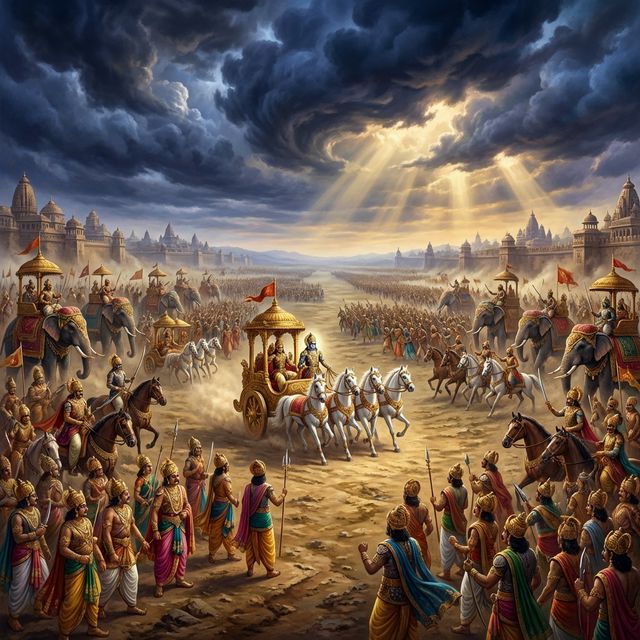
The amphitheater of Kampilya had never seen such a gathering. On a level plain to the northeast of the city, Drupada had raised a grand arena ringed with mansions and pavilions, draped in garlands and perfumed with sandal and incense. Tiered galleries rose on every side, and into them poured the citizens of Panchala while trumpets sounded and drums rolled like distant thunder.
Kings and princes filled the seats of honor. Duryodhana came with his Kaurava brothers and with Karna, his great friend. Shishupala of Chedi was there, and Jarasandha the emperor of Magadha, and Shalya of Madra, and Shakuni of Gandhara, and a hundred rulers besides, each gleaming in jewels and pride, each certain the prize would be his. In a quiet corner of the gallery reserved for Brahmins sat five brothers in deerskins, unnoticed among the chanting ascetics.
At the center of the arena, raised upon a platform, stood the instrument of the test: a bow of enormous size and stiffness, heavy as a beam, that Drupada had had specially forged. Beside it lay arrows, and high above, fixed to a tall pole, turned a contrivance of revolving rings, and at its top a small target shaped like a fish. Below it, set into the ground, was a basin of clear water that caught the reflection of the spinning target overhead.
When the day reached its height, Draupadi entered, and the murmur of the crowd died into silence. She was robed in silk the color of flame, garlanded in gold, a golden vessel in her hands for the choosing. Her dark beauty seemed to light the whole arena. Behind her came her brother Dhrishtadyumna, who would announce the terms of the contest, his voice carrying to the farthest gallery.
The Terms of the Test
Dhrishtadyumna led his sister to the center of the arena and lifted his hand for quiet. His voice rang out clear and proud across the assembly. "Hear, you assembled kings and princes! Here stands the bow, and there above turns the target. He who strings this bow, and with five arrows pierces the eye of the revolving fish, looking not at the target itself but only at its reflection in the water below - to him, if he be of noble birth, my sister Draupadi shall be given in marriage this day."
A stir of excitement and unease passed through the kings. The test was cruel in its difficulty. To string the great bow alone would tax the strongest arm. To then hold it steady, fix an arrow, and aim by the trembling, inverted image dancing in the water, sending the shaft up through the whirling rings to strike the fish in its tiny eye - that seemed beyond any mortal skill.
Dhrishtadyumna then turned to his sister and recited the names and lineages of the suitors, one by one, the proud houses of the assembled rulers, so that she might know each man who would attempt the feat. Draupadi listened with composure, her garland of choosing in her hands, her eyes calm and searching.
One by one the kings rose to their challenge. They had come trusting in their fame and strength, and now the bow waited like a judge. The crowd leaned forward. In the Brahmin gallery, Arjuna sat utterly still, his gaze fixed on the great bow as a thirsty man looks at water. His brothers watched him, and watched the arena, and said nothing.
The Mighty Kings Fail
One after another the great rulers came down to the bow, and one after another the bow defeated them. They approached it with swaggering confidence and left it with bowed heads. Some could not even lift the weapon from its rest. Others raised it only to be flung back when it sprang from their grip, sprawling on the ground to the gasps of the crowd. The bow seemed to mock the pride of the powerful.
Shishupala strained at it and sank to his knees. Jarasandha, emperor of Magadha, whose strength was legendary, grasped the bow and bent it part way - and the bow bent him in return, hurling him down before all. Shalya of Madra fared no better. King after king made the attempt, and the heap of the defeated grew, their fine garments dusted with the soil of the arena, their boasts silenced.
From her platform Draupadi watched them come and go, and her garland did not stir. She had no wish to belong to any of these proud, failing men. As the parade of failure wore on, a restless anger began to spread through the kings. They glanced at one another, humiliated, and some muttered that Drupada had set an impossible test to mock them all.
Then Karna rose. The crowd hushed at once, for here was a warrior whose skill none could deny. Tall and golden, born with armor and earrings that shone like the sun, he walked to the bow with an easy, terrible confidence. He took it up as though it weighed nothing, set the string upon it, and made ready to draw. In that instant it seemed the contest was over and the prize was his.
Karna Turned Away
As Karna raised the strung bow and fitted an arrow to it, a clear voice rang across the arena, sharp as a blade. "I will not wed a suta, a charioteer's son." It was Draupadi, standing tall upon her platform, her words leaving no room for doubt.
For Karna, though radiant as a god and matchless in arms, was known to the world as the son of Adhiratha the charioteer, a man of the suta caste who drove the chariots of the Kurus. His birth had followed him all his life like a shadow he could not outrun, and no one yet knew that he was in truth the eldest son of Kunti, born of the Sun before her marriage. To the assembly he was a charioteer's son, however great, and Draupadi would not put her garland on him.
The words struck Karna more deeply than any arrow could. He looked up once at the laughing sun overhead, as if appealing to it, and a bitter smile touched his lips. Then, slowly, he relaxed the great bow, set it back upon its platform, and walked away from the contest. He returned to his seat beside Duryodhana, his face dark with a wound that would never fully heal, and the seeds of a lifelong resentment took root in his heart.
Duryodhana seethed beside him, and the other defeated kings grew sullen and angry, their pride bruised, their tempers rising. The arena grew tense, full of muttered complaints and bitter looks. It seemed the great gathering would dissolve into ill will and grievance, with no man worthy of the fire-born maiden, and the bow standing untouched and triumphant at the center of it all.
The Brahmin Steps Forward
When the last of the kings had failed and the contest seemed at an end, a young man rose from the gallery of the Brahmins. He was clad in the deerskin of an ascetic, lean and quiet, but he moved with a grace that made the crowd fall silent. It was Arjuna, third of the Pandavas, though no one in the arena knew it.
A murmur of surprise rippled through the assembly, and then objection. "A Brahmin, to attempt what kings could not?" cried some of the warriors. "It is unseemly. If even mighty rulers have failed, how shall a beggar of alms succeed? And if by some folly he should win, what disgrace to give the princess to such a one." The Brahmins in the gallery, however, rose in support of their own, waving their deerskins and calling out encouragement, glad that one of their kind would dare what the proud kings would not.
Drupada watched the young man closely, and something stirred in his heart - a hope he hardly dared to name. He had set his test believing that only the greatest archer alive could pass it, and as he looked at the calm, sure bearing of this Brahmin youth, the memory of the son of Pandu came unbidden to his mind. "Let him try," the king said, and his voice quieted the objectors. "Valor is not the property of any one birth. Let the Brahmin approach the bow."
Arjuna walked down into the arena and came to stand before the great bow at last. He paced around it once with reverence, as a worshipper circles a shrine. Then he bowed his head, offered a silent prayer to the gods and to the giver of all skill, and reached out his hands toward the weapon that had thrown down a hundred kings.
The Fish Falls
Arjuna laid his hand upon the great bow, and it yielded to him as if it had only been waiting for the right man. In one smooth motion he lifted it, bent it, and slipped the string into its notch - the very feat that had broken the strength of every king. The arena drew a single breath and held it.
He took up five arrows and fitted the first to the string. He did not look up at the spinning target overhead. Instead he bent his gaze downward, into the basin of water at his feet, and fixed his eye on the trembling reflection of the fish as it whirled among the turning rings. Steady as stone, he drew the bow to its full curve, the muscles standing out along his arms, and for a long moment the whole world seemed to wait upon his stillness.
Then he loosed. The arrow sang upward through the gap in the revolving rings and struck the eye of the fish, and the target tumbled down to the earth. A heartbeat of silence, and then the heavens themselves seemed to answer - flowers rained down from the sky, drums of triumph sounded, and the Brahmins in the galleries leapt up shouting and waving their deerskins in wild jubilation.
Draupadi rose from her seat, took up the garland of white flowers, and walked across the arena to the young Brahmin. Before all the assembled kings she placed it around his neck, choosing him for her lord. A roar of joy went up from the common people and the Brahmins, but among the defeated kings the cheers curdled into rage. That a mere mendicant should carry off the prize they had all failed to win - it was an insult past bearing. Hands went to swords, and the bright arena darkened with the storm of their fury.
The Brothers Fight the Kings
The defeated kings turned their anger upon Drupada. "He has insulted us all," they cried, "summoning us as suitors only to bestow his daughter on a beggarly Brahmin. Such a marriage is unlawful. Let us seize the maiden and punish this faithless king." Weapons flashed in the sunlight, and the kings surged forward in a body, ready to overturn the swayamvara by force.
Arjuna and Bhima placed themselves before the trembling Drupada and his daughter, two ascetics in deerskins standing against a host of armed monarchs. Bhima, seeing no weapon at hand, ran to a tree at the edge of the arena, tore it from the earth roots and all, stripped it of its branches, and stood with the great trunk raised like a club, a figure so terrible that even kings hesitated. Arjuna strung his bow and stood ready beside him, calm and unshaken.
Karna fell upon Arjuna, and the two matched arrow for arrow in a furious exchange, neither able to gain the upper hand, until Karna, marveling at the Brahmin's skill, drew back, saying that he would not contend longer with a Brahmin of such power. Shalya rushed at Bhima, and the two grappled like maddened elephants, until Bhima lifted the king of Madra bodily and dashed him to the ground, though he spared his life. The other kings, seeing these two Brahmins scatter their champions, lost heart and fell back in confusion.
From among the spectators, two men of the Vrishni clan watched the battle with keen and knowing eyes - Balarama and his younger brother Krishna. Marking the matchless skill with the bow, the strength that uprooted trees, and above all the bearing of these supposed Brahmins, Krishna smiled to himself. "Those are no beggars," he said quietly to his brother. "That is Arjuna, and that the mighty Bhima. The sons of Pandu live."
Kunti's Word
Having driven off the angry kings, the brothers slipped away from the arena and made their way back through the city to the potter's house, with Draupadi walking among them. The crowds parted around the strange procession - five ascetics and a princess robed in flame-colored silk - but the brothers kept their counsel and did not reveal who they were.
Kunti waited within the humble dwelling. As the brothers neared the door, brimming with the joy of their victory, they called out in the old playful way of returning hunters: "Mother! Come and see what wonderful alms we have brought home today!" The words were spoken lightly, half in jest, for they meant the marvel of the prize they had won.
Kunti, busy within and not yet seeing what they brought, answered as she always did when her sons came home with their gathered alms. "Whatever it is, share it equally among yourselves, all of you together." The words left her mouth before she turned and saw the maiden standing in the doorway. At once she understood, and a chill of dismay passed over her, for a mother's word, once given, was a thing that could not be unsaid, and she had bound her five sons to share a wife.
Kunti took Yudhishthira aside, distressed. "I have spoken in error, my son. Find some way that my words do not become a sin, that this princess does not bear the stain of falsehood." Yudhishthira, ever mindful of dharma, pondered the difficulty. He looked at the faces of his brothers, and saw in each of them, even in the calm Arjuna who had won her, a hidden longing for the fire-born maiden. He saw that her beauty had touched them all, and that to divide them over her would be to break the love that was their only strength.
The Marriage of Five and One
When Drupada learned that the victor was Arjuna, and that the five Brahmins were in truth the sons of Pandu come alive out of the fire of Varanavata, his old grief turned to joy, for his daughter would marry into the noblest house and the desire of his heart was fulfilled. Yet when Yudhishthira declared that Draupadi would be wife to all five brothers, the king drew back in dismay. "One man may have many wives," he protested, "but never have I heard that one woman may have many husbands. This is against the law of the world and the teaching of the scriptures. How can such a thing be allowed?"
While they debated, the sage Vyasa arrived, and Drupada laid the matter before him. Vyasa took the king aside and revealed the hidden truth behind the marriage. In a former life, he said, Draupadi had been a virtuous maiden who prayed long to Lord Shiva for a husband, and in the intensity of her devotion she had asked five times over for a lord endowed with every virtue. Shiva, pleased, had told her that since she had asked five times, she would in a life to come have five husbands, each a portion of greatness. "This is no sin," Vyasa said, "but the ripening of a divine boon. The Pandavas are no ordinary men, and she is no ordinary woman. Their union is ordained by the gods themselves."
Some of the ancient tellings add that the five brothers were portions of the gods, and Draupadi a portion of the goddess Shri, fated to share their fortunes through the great war to come. Hearing Vyasa's words, and granted by the sage a moment of divine sight to perceive the truth, Drupada set aside his doubts and gave his consent with a glad heart.
So the marriage was solemnized. With the sacred fire as witness, the priests chanting the holy verses, Draupadi was wedded to each of the five Pandavas in turn, on five successive days, beginning with the eldest, Yudhishthira. It was agreed that she would belong to each brother for a span of time, dwelling with one and then the next, and that none should look upon her while she was with another. Thus the fire-born princess of Panchala became the queen of all five sons of Pandu, and through this union the scattered, hidden Pandavas gained a powerful ally in Drupada and stepped once more onto the stage of the world, their long exile in disguise at an end and the great destiny of their house renewed.
Dharma Lesson
Destiny works in mysterious ways. The rejected princes of Hastinapura, believed dead, revealed themselves as the greatest warriors of their age. And Draupadi's unusual marriage, though it scandalized many, was sanctioned by the sage Vyasa himself, for Draupadi had prayed five times for a husband in a previous life, and every prayer must be answered.