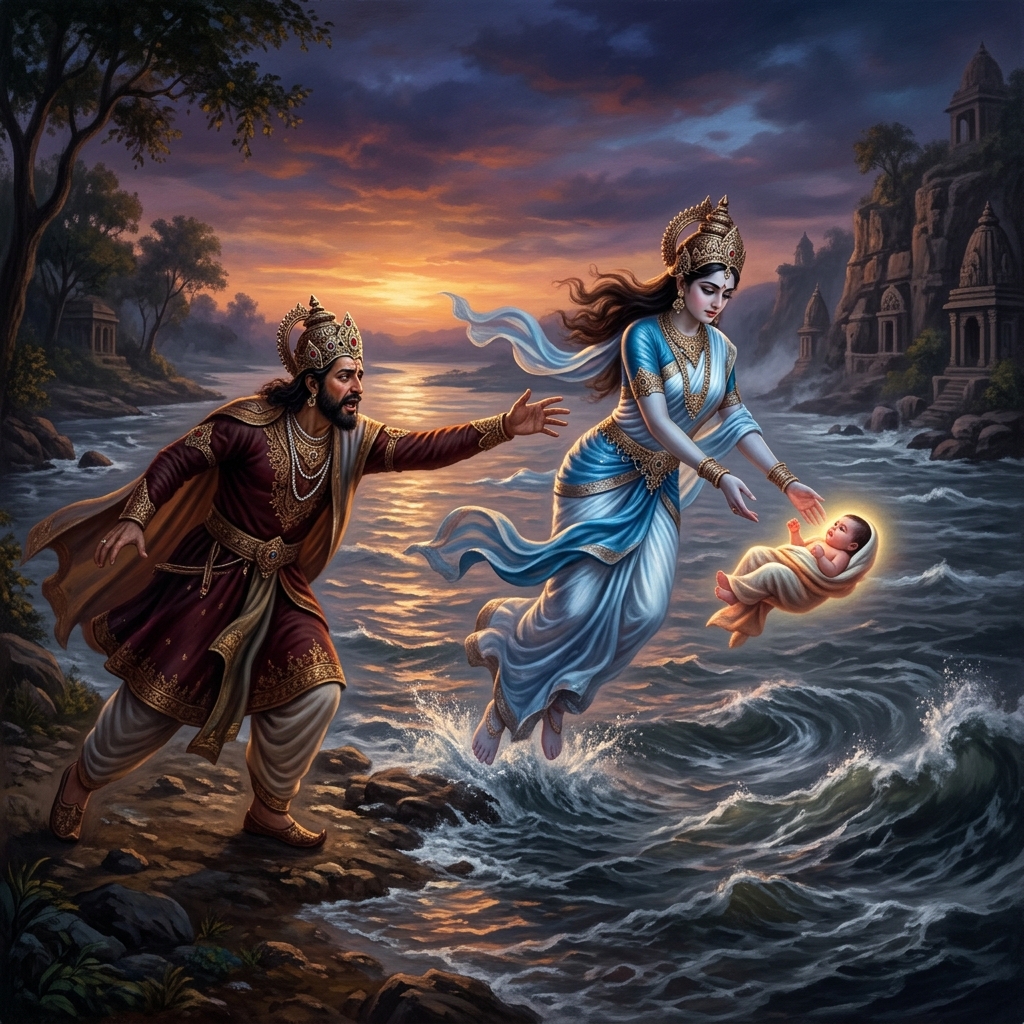
The Son Who Could Not Be Anointed
Vaishampayana, reciting the great chronicle to King Janamejaya, paused before the tale of Bhishma's vow to tell an older story first - one the court of Hastinapura still remembered when Ganga's son came of age.
Pratipa, king of the Kurus, had three sons. Devapi, the eldest, grew up beloved beyond his brothers Bahlika and Shantanu; the city's elders said openly that no Kuru prince since the line's founding had worn kingliness so plainly on his face. But in his youth a disease came over his skin, a whiteness the physicians called shvitra, and the priests who studied such things were unanimous: a body so marked could not be anointed at the altar. The law of consecration did not ask whether a man's mind was fit to rule. It asked whether his body carried a blemish the gods would refuse.
Devapi did not fight the ruling. He walked out of Hastinapura and into the forest before his father could soften the sentence, and he did not look back to see whether anyone followed. Some kings might have raged at a law that took a throne on account of skin. Devapi seemed almost relieved to set it down.
The succession fell to Bahlika, then to Shantanu. Bahlika, closer in blood to their mother's northern kin, chose to rule there instead and left Hastinapura's throne to his youngest brother. Shantanu was crowned with no objection raised, no rival claim pressed. By every rule the Kurus kept, the throne was his.
Vaishampayana's voice did not rise as he said this, only slowed, the way a storyteller slows before a debt comes due.
Twelve Years Without Rain
Shantanu reigned well by every account the chronicles kept of him - just in judgment, generous to brahmins, careful with the treasury his father had left him. For years the kingdom prospered under him as it had prospered under Pratipa. Then, without warning that anyone could name, the rain stopped.
It did not simply fail for a season. Twelve years passed without monsoon rain over the Kuru lands, and even Ganga, whose banks had cradled the city since its founding, ran shallow and slow through a country gone the color of ash. Wells that had never failed within living memory failed. Villages nearer the forest emptied as their people walked toward whatever river still carried water. In the capital the granaries that Shantanu managed so carefully thinned year by year, and still the sky gave nothing back.
A king could send grain from his own stores, and Shantanu did, until the stores themselves ran low. He could open the gates to those fleeing drought-struck villages, and he did that too. What he could not do was make it rain, and after twelve years even a just king begins to wonder whether justice is the wrong word for what has gone wrong.
He was not a man given to blaming the gods for his troubles. He called instead for the priests who kept the old learning of what earth wanted from its kings, and asked them to tell him plainly, in whatever words the truth required, why Hastinapura's sky had closed.
What the Brahmins Told the King
The priests did not need long to consult their texts. What they told Shantanu was old law, the kind that predates any single dynasty's memory, and they did not soften it for a king who had done nothing personally wrong.
'Your brother Devapi lives,' the eldest of them said. 'He is the firstborn son of Pratipa, and by the law of primogeniture the throne of the Kurus was his to hold before it was ever yours. He set it aside for a reason the law recognizes - the mark on his skin - but he did not die, and he has not renounced his birth. As long as the elder lives passed over and the younger sits crowned, the earth counts the succession unsettled. Rain is the sky's judgment on a kingdom's order, and your kingdom's order has an unpaid debt at its root. Until Devapi is restored, or until the debt is answered some other lawful way, do not expect the rains to open again.'
Shantanu had ruled twelve years believing his throne was simply his, granted by a disqualification no one disputed and a succession no one had contested. He had never thought of Devapi as a debt. He thought of him, when he thought of him at all, as a brother who had chosen the forest over the crown and seemed content there.
The priests were careful to add what the law did not require: that Devapi's disqualification had been real, that no fault attached to Shantanu's coronation, that the throne had passed to him by every rule the Kurus kept. Lawful succession and unpaid debt, they said, were not always the same question, and a king who wanted rain again would have to answer both.
The Brother Who Would Not Return
Shantanu went into the forest himself rather than send envoys, and he found Devapi living as the ascetics of that country lived, without the marks of illness troubling him now the way they once had, but without any wish to trade the forest for a throne either. The brothers spoke for a long time, and what passed between them the chronicle does not report in full, only that Shantanu asked him plainly to come back and take up the crown their father had meant for him, and that Devapi refused.
He had gone too far from kingship to return to it, Devapi said - not only in years, but in the shape his life had taken. He had given himself over to disciplines and teachings that pulled against the duties a throne would demand of him, and a man could not rule a kingdom with one hand while holding to a forest vow with the other. Whatever the priests required to settle the earth's account, it would have to be settled without him sitting again in Hastinapura's hall. He had made his peace with the disease that cost him the throne long ago; he was not going to unmake that peace now because the rain had stopped.
Shantanu returned to the city without his brother but not empty-handed. The priests devised a rite of expiation - a sacrifice offered in acknowledgment of the debt itself, since the debt could not be settled by restoring Devapi in fact. Shantanu performed it exactly as instructed, holding nothing back, and the court held its breath through the ritual the way a household holds its breath through a fever's worst night.
The rain came back within the year. Whether it came because of the rite or because twelve years is simply how long some droughts run, the chronicle does not choose to ask. It only records that Hastinapura's fields turned green again, and that Shantanu never again spoke of the throne as simply his.
The House Bhishma Was Born Into
Vaishampayana closed the story there and let Janamejaya sit with it before returning to Bhishma's own vow, the one the king had actually asked to hear. But he did not consider the digression wasted. 'I tell you this,' he said, 'because Ganga's son Bhishma was born into a house that already knew what a crown could cost the man who declined it. Devapi walked out of Hastinapura a generation before Bhishma was born, and the drought that followed was still spoken of at court when Bhishma was a boy learning what his family's history demanded of its princes.'
The lesson the Kurus drew from Devapi's case was not that disqualification was wrong, or that Shantanu's coronation had been improper. Every authority agreed it was lawful, clean, uncontested. The lesson was narrower and harder to escape: that lawful was not the same as settled. A throne could pass by every correct rule and still leave something owed, some account the earth itself kept and would eventually present.
Bhishma, when his own turn came to set aside a crown that was rightfully his, did not have to wonder what that kind of debt might ask of a kingdom. He had grown up hearing exactly what it had once asked of his own family, in a twelve-year drought his father had lived through and never fully explained to him until he was old enough to understand why a king might carry an unpaid brother in his conscience for the rest of his reign. Vaishampayana let that connection stand unspoken and went back to the story Janamejaya had actually come to hear.
Dharma Lesson
A throne can be won by every correct rule of succession and still leave a debt unsettled, for lawful is not the same as owed-for. Kingship is not only a right transferred by law but a trust the earth itself watches, and a kingdom can suffer for a wrong no court would ever recognize. Devapi's drought taught the Kurus that stepping aside rightly still costs someone something, a lesson Bhishma inherited before he ever swore his own vow.