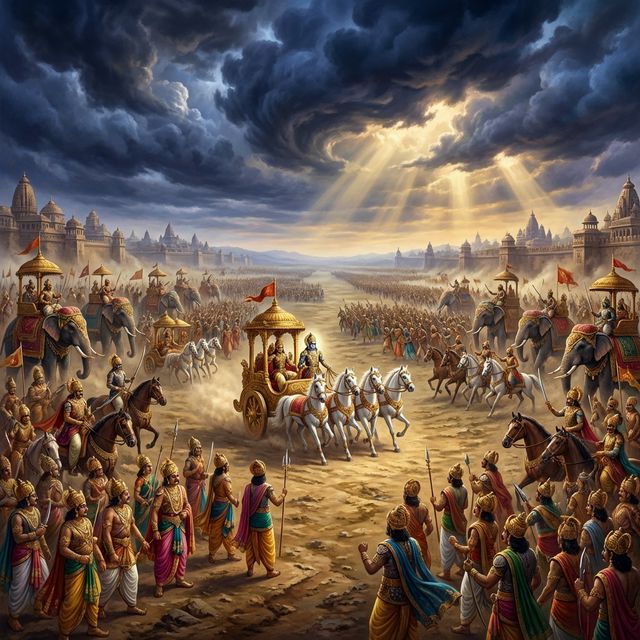
The Ten Sins of Body, Speech and Mind
Bhishma answers the plainest question with a list of ten things not to do
The Question That Came After Bhangaswana
The story of Bhangaswana was finished. The king who had gone hunting and come back a woman, who had borne a second hundred sons and had asked Indra to revive those and not the first hundred, had been carried all the way to his answer, and the conclave on the field had heard it out. Krishna sat there. Vyasa sat there. Narada was among the rishis, and Arjuna and Bhima and Nakula and Sahadeva were where they always were, close by the arrows.
Yudhishthira's next question had nothing in it about kings or curses or the lake in the forest.
"What should a man do in order to pass pleasantly through this and the other world," he said. "How, indeed, should one conduct oneself? What practices should one adopt with this end in view?"
It is worth stopping on the word he chose. He did not ask how a man wins heaven, which is the question the sacrificial books answer at length and with figures. He did not ask how a man is emancipated, which is the question the Yogins answer. He asked how a man passes pleasantly through both worlds, the one he is standing in and the one he is going to, as though the two were a single road and he wanted to know how to walk it without limping.
Bhishma had answered a great many of his questions with a history. Bhangaswana had been a history. So had Nachiketa, so had the deer, so had the old woman and the snake. This one he answered with a list, and he began it without any preface at all.
"One should avoid the three acts that are done with the body," he said, "the four that are done with speech, the three that are done with the mind, and the ten paths of action."
Three, four and three. Ten in all, and then the ten named again from the other side, as paths, which is the grandsire's way of saying that a man does not merely avoid these things once and have done with it. He walks past them every day of his life.
Three and Four and Three
Consider first the shape of what Bhishma had just said, because the shape is half the teaching.
Every item on the list is a thing not to do. There is no rite in it, no gift, no vow, no pilgrimage, no fee to a Brahmana, no fast, no fire. A man who has been listening to the Anushasana Parva from the beginning has by then been told the merit of gold and the merit of cows and the merit of the fords and the merit of a guest fed at the door, and every one of those is a thing to be gone out and done. Here, asked the plainest question of all, the grandsire named ten things and told the king to leave every one of them alone.
Which means that the ten merits are not a second list. They are these same ten, counted from the other end. The merit that opposes the destruction of life is that a man does not take it. The merit that opposes theft is that he leaves what is not his lying where it is. There is nothing to be acquired. There is only something to be withheld, and the withholding has to happen every day, which is why the same ten are called paths.
Consider also the order. Bhishma begins with the body, goes on to speech, and ends with the mind, and that is the order in which the world sees a man. What his hands do is visible to everyone. What his mouth does is heard by whoever is standing near. What his mind does is known to nobody at all.
It is also, exactly reversed, the order in which the acts are difficult to stop. A man can keep his hands off another man's property by deciding to. Keeping his tongue off another man's reputation is harder, and takes a lifetime. Keeping his mind off another man's possessions is the work that is never finished, and Bhishma put it last, where the hardest thing is usually put.
He then took the three of the body first, and named them.
The Destruction of the Lives of Other Creatures
"The three acts that are done with the body and should be wholly avoided," Bhishma said, "are the destruction of the lives of other creatures, theft or appropriation of what belongs to other persons, and the enjoyment of other people's wives."
The first of them is put in words that are wider than they look.
Not the killing of men. The destruction of the lives of other creatures. Ganguli's phrase keeps the reach of the original, and the reach is the whole point of it. It takes in the enemy in the field and the neighbour in the village, and it does not stop there. It takes in the deer at the edge of the clearing and the bird in the net and the goat led up to the post with the water poured over its head. The old teaching that abstention from injury is the highest religion is not a separate doctrine standing off to one side of this list. It is the first line of it.
And here is the difficulty that the grandsire did not soften, and could not have softened, lying where he was lying. He was saying it on a bed made of arrows, in the middle of a field where eighteen akshauhinis had been destroyed, to a king who had won that destruction and could not sleep for it. The man speaking had commanded ten days of it. The man listening had ordered eighteen. Neither of them was in a position to hear the first of the ten sins as a light matter or a distant one.
That is the reason this passage sits where it does in the epic. A catalogue of sins recited in a school would be a catalogue. Recited here, the first item on it names what everyone present had spent eighteen days doing, and nobody interrupted to ask for an exemption.
Yudhishthira had asked how a man passes pleasantly through this world and the other. The grandsire had begun his answer by naming the thing that had made the passage through this one so hard for the man who asked.
Theft, and the Word Put Beside It
The second act of the body is put with two words where one would have done, and the second word is the one that does the work.
Theft or appropriation of what belongs to other persons.
Theft everyone can recognise, and everyone condemns, and almost nobody in a hall of kings has committed. Appropriation is the other thing. It is what is taken without any of the noise of theft, by a man who has the power to take it and a form of words to cover it. It is the field that the strong neighbour ploughs because the weak one will not go to law. It is the tribute that is levied because it can be levied. It is a kingdom won at dice from a man who could not decline the game.
Nobody in that conclave needed the second word explained to him. The whole war had begun over the difference between the two, and the side that lost had spent thirteen years insisting the difference did not exist.
The third act of the body Bhishma names in five words and does not enlarge upon: the enjoyment of other people's wives. He does not moralise it, he does not describe its consequences, and he does not tell a story against it. He puts it in the list beside killing and stealing, which is itself the argument. It is set down as a taking. Something belonging to another household is used by a man who has no right in it, and it is grouped, without ceremony, with the other two takings.
So the body's three are these: do not take life, do not take goods, do not take the wife of another man. And the three merits that oppose them are simply that the hand stops. The creature is left alive. The property is left where it lies. The house of the neighbour is left as it is.
Nothing is added to the man who does this. Nothing is subtracted from him either, which is the entire claim being made.
Never Indulged In, or Even Thought Of
"The four acts that are done with speech, O king," Bhishma said, "and that should never be indulged in or even thought of, are evil conversation, harsh words, publishing other people's faults, and falsehood."
Note what he attached to the four of speech that he had not attached to the three of the body. Never indulged in, or even thought of. The sins of the tongue are the ones that are rehearsed before they are committed. A man composes the wounding sentence some hours before he delivers it, and the grandsire shuts the door at the point of composition, not at the point of delivery.
Evil conversation is the first, and it is the loosest of the four, which is why it is placed first. It is not a single act at all. It is the talk that fills an evening and leaves everyone in it a little worse: the malice that is not aimed at anybody in particular, the coarse turn given to a subject, the pleasure taken in a bad report. Nothing in it would stand up in a court as an injury. It is condemned here as a habit of the mouth rather than as a deed, and it is put at the head of the four because it is the soil the other three grow in.
Harsh words come second, and of the four this is the one the epic has demonstrated most terribly. It is the only one of the ten sins that has a whole war standing behind it as an illustration. A sentence spoken in a new hall to a guest who had mistaken water for floor, and thirteen years later the man who heard it was standing in armour on this field, and the men who laughed with the speaker were dead in front of Bhishma's bed. Nobody in that assembly needed the second item of the four explained either.
Harsh words draw no blood. They can be denied afterwards, and often are, and the denial changes nothing, because the man they were spoken to has already heard them and will hear them again for the rest of his life.
The Fault That Is True
The third act of speech is the one that catches the honest man, and it is placed with great precision.
Publishing other people's faults.
Not inventing them. Falsehood is the fourth item and stands separately, which means the third is something else, and the something else is the reporting of a fault that is really there. A man's failing is known to one person. That person tells it accurately, without exaggeration, to a second, and the second to a third, and by the end of the month a true thing about a man is in every mouth in the town, and every single person who passed it on can say with a clear conscience that he told no lie.
Bhishma puts that in a list with killing and theft. He does not allow the truth of the report to be a defence, because the injury done is not an injury of falsehood. It is an injury of publication. The fault existed before and did no harm to the man beyond himself. Once it is carried about, it does its damage in every house it reaches.
The merit that opposes it is the plainest of the ten and the least practised. A man who knows something discreditable about another man says nothing.
Falsehood comes fourth and last of the speech sins, and the grandsire spends no words on it, because the epic has spent thousands. Harishchandra had been held to it through the loss of everything he had. Yudhishthira himself had broken it once, on this field, in the matter of an elephant and a name, and the wheels of his car had come down to the ground when he did, and he was lying awake about that too.
So the four merits of speech: talk that does no harm, words that do not wound, silence about what would ruin a man, and the truth. Four things a man does with his mouth closed or nearly closed, which is why they are harder than the three of the body.
What Nobody Else Can See
"Coveting the possessions of others, doing injury to others, and disbelief in the ordinances of the Vedas," Bhishma said, "are the three acts done with the mind which should always be avoided."
These are called acts. That is the word Ganguli keeps, and it should not be read as a figure of speech. In the reckoning Bhishma is setting out, a thing done inside a man's head is done, and is entered on the account, whether or not it ever reaches his hands.
The first is coveting the possessions of others, and it is the inward form of the second sin of the body. The hand has not moved. Nothing has been taken, and nothing will be. But the man has looked at what is in another man's house and has wanted it. In the wanting the theft is already begun, and he will find, if he watches himself, that his opinion of that neighbour has begun to change to suit his wish.
The second is doing injury to others, and here again the act is inward. It is the harm intended, the ill wished, the private satisfaction taken in another man's misfortune. It is what a man does to his enemy every night for years without ever laying a finger on him. This is the deepest of the three, because it is the one that requires nothing at all from the world in order to be committed, and it does not stop when the enemy is dead, as everyone lying and standing on that field had reason to know.
The third is of a different kind from the other two: disbelief in the ordinances of the Vedas. It is not an injury to a neighbour. It is placed among the sins of the mind because it is the mind's own act, the refusal of the ground on which the other nine stand. A man who holds that the ordinances say nothing has no reason left to leave the goods where they lie. The other nine are the rules. This one is whether there is any such thing as a rule.
And these three make ten.
Enjoy or Endure
Bhishma closed the answer as flatly as he had opened it.
"Hence, one should never do any evil act in word, body, or mind. By doing good and evil acts, one is sure to enjoy or endure the just consequences thereof. Nothing can be more certain than this."
There is no reward promised in that. Nothing is said about heaven, or about the length of a term of residence there, or about the merit of a gift of gold, and the grandsire who had been reciting such figures for days did not offer a single one here. He offered a certainty instead. What is done comes back. The good is enjoyed and the evil is endured, and the two verbs are given equal weight in the sentence, and there is no third possibility mentioned, of an act that goes nowhere.
Enjoy or endure. That was the answer to the question actually asked. Yudhishthira had wanted to know how a man passes pleasantly through this world and the other, and the answer was that the pleasantness is not something arranged in advance by rites. It is the consequence, arriving in its own time, of ten things done or ten things left undone.
Ten, and no more than ten. A man could count them on his fingers before sleeping, which is very likely what they were meant for. Three for the hands, four for the mouth, three for what nobody else can see. The whole of it takes less time to say than the name of a single one of the thousand names that were about to be recited over that bed.
For Yudhishthira's next question, put to the same man in the same hour, was about Maheshwara, the Lord of the universe, and the names that are applied unto Him who is called Isa and Sambhu. The grandsire, who had just disposed of the entire conduct of human life in three sentences, said that for that subject he was not competent, and that only Krishna could speak it.
He had given the king the short list first.
Dharma Lesson
The grandsire was asked how to live well and answered with ten prohibitions and no observances at all. Nothing on his list has to be acquired, paid for or gone to; every item is something a hand, a mouth or a mind simply does not do, which is why the same ten are called paths rather than acts. Three of them are visible to everyone, four are audible to whoever stands near, and three are known to no one but the man himself, and it is the last three that decide the other seven.