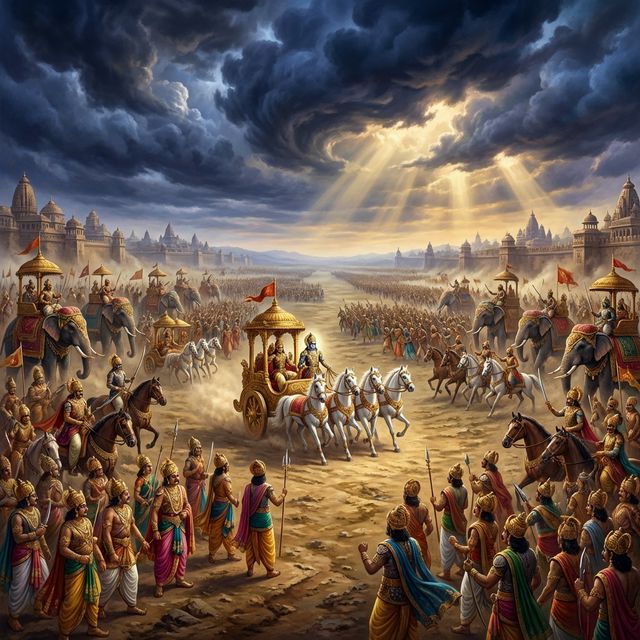
The Cheerful Ascetic
Narada asks Samanga why he is never sorry, and gets an answer about acts and their fruits
The Fear That Stands Behind Every Other
The war was over and the teaching was still going on. Bhishma lay where the arrows had put him, with the Pandavas sitting around the bed and Krishna beside them, and the questions came at him in the order a man asks them when he has been given a great teacher and a fixed number of days.
That morning Yudhishthira did not ask about kings or sacrifices or the nature of the soul. He asked about the thing underneath all of it.
"Living creatures always stand in fear of sorrow and death," he said. "Tell me, O grandsire, how the occurrence of these two may be prevented."
Read the question again, because the wording is exact and it is asking for something impossible. He does not ask how sorrow and death may be borne. He does not ask how a man may be consoled after they arrive. He asks how their occurrence may be prevented, which is to say he is asking his grandfather, who is lying on a bed of arrows in the process of dying, to tell him how dying and grieving may be stopped from happening at all.
Yudhishthira had reason to want that answer. He had come out of Kurukshetra as the king of a country whose men were dead, and the fear he is describing is not an abstraction he had read about. It is the thing that had been sitting on his chest since the eighteenth day.
Bhishma did not correct the question, and he did not answer it out of his own mouth either.
"In this connection, O Bharata," he said, "is cited the old narrative of the discourse between Narada and Samanga."
That is the whole of the introduction. No setting is given, no occasion, no reason for the meeting. Two men are placed in front of Yudhishthira, one of whom he would have known all his life, since Narada came and went from every court in the world and had walked into his own hall at Indraprastha to audit him before the Rajasuya. The other is a stranger, and the epic tells us nothing about him anywhere else. He is simply an ascetic named Samanga, and he was cheerful.
A Man Who Bowed With His Whole Body
Narada speaks first, and what he says is not a question. It is a description of a man he has been watching, delivered to the man's face.
"Thou salutest thy superiors by prostrating thyself on the ground till thy chest comes into contact with the ground."
Other men, Narada notes, salute their superiors by a bend of the head. That is the ordinary courtesy and nobody thinks less of a man for it. Samanga went down full length, every time, until his chest was in the dust. Narada had evidently seen him do it more than once, and had begun to find it remarkable rather than excessive.
"Thou seemest to be engaged in crossing the river of life with thy hands."
That is the image Narada reaches for, and it is worth holding still for a moment. A man who goes down flat and comes up and goes down flat again looks, if you watch him long enough, like a swimmer. The arms go out, the body follows, the arms go out again. Everyone in the story agrees that this world is a river that has to be got across. Most men look for a raft, or a ford, or a boat with somebody else rowing. Samanga was swimming, and he was doing it with the only two things he owned.
Then Narada names what he cannot account for.
"Thou seemest to be always free from sorrow and exceedingly cheerful. I do not see that thou hast the least anxiety. Thou art always content and happy and thou seemest to sport in felicity like a child."
There is no rebuke anywhere in that. Narada is a celestial rishi who has seen every kind of ascetic there is, the ones burning with penance and the ones burning with pride in their penance, and he had never seen this. A grown man under vows, in a world made of loss, playing like a child.
He wanted to know how it was done, and he was honest enough to say so by simply describing what he saw and stopping.
The Truth About Past, Present and Future
Samanga answered him with a courtesy of his own, and then with two sentences that contain the whole of his position.
"O giver of honours, I know the truth about the Past, the Present, and the Future. Hence I never become cheerless."
This is not the claim it sounds like at first hearing. He is not saying that he can see next week. He says so himself in the very next breath, and the second sentence explains the first.
"I know also what the beginning of acts is in this world, what the accession of their fruits, and how varied are those fruits. Hence I never yield to sorrow."
What he knows is the machinery. Acts begin somewhere. Fruits arrive afterwards, on a schedule not set by the man who is waiting for them, and they arrive in an enormous variety of forms, which is why nobody can look at a fruit and read backwards from it to the deed. That is what the three tenses mean in his mouth. The past is where acts were done. The present is where the fruits are being handed out. The future is where what is being done now will be paid.
A man who holds that steadily has been relieved of a particular kind of suffering, and it is the kind that does most of the damage. He is never obliged to ask why this has happened to me. He is never obliged to think that the world has singled him out, or that it has gone wrong, or that some accounting has been mislaid. Grief he may still feel. Bewilderment he cannot, because there is nothing in his life for which he lacks an explanation.
Yudhishthira, listening to this from a man on a bed of arrows, was a king who had spent thirteen years asking why this has happened to me and had received no answer he could use. Bhishma had set in front of him an ascetic who never asked the question at all.
Samanga was not finished. Having stated the principle, he turned to the evidence, and the evidence was everybody.
The Blind, the Idiots, and Ourselves Also
"Behold, the illiterate, the destitute, the prosperous, O Narada, the blind, idiots and madmen, and ourselves also, all live."
It is a strange list and it is meant to be. He does not gather up the fortunate on one side and the wretched on the other. He puts them all in one line and says the same three words about the whole line. All live. The man who cannot read and the man with money and the man who cannot see and the man who has lost his reason and the two ascetics standing there having this conversation, all of them are doing the one thing, which is going on.
Then he says why.
"These live by virtue of their acts of past lives. The very deities, who exist freed from diseases, exist in that state by virtue of their past acts. The strong and the weak, all, live by virtue of past acts."
Notice that the gods are inside the list and not above it. Their freedom from disease is not a privilege of rank. It is a fruit, exactly like the blindness of the blind man, drawn from the same store and issued by the same rule. There is nothing in the whole range of visible fortune, from the madman in the road to the deities in heaven, that stands outside the accounting.
And then the line that turns the argument into something more uncomfortable than a doctrine.
"It is fitting, therefore, that thou shouldst hold us in esteem."
He says it to Narada, who had just praised him. It is not a request for compliments. Having placed himself in a list with idiots and madmen and shown that every member of it lives by the same law, he is pointing out that the esteem Narada feels for his cheerfulness is owed, if it is owed at all, to everyone in the line. The cheerful ascetic is not a special case. He is only somebody who has noticed what the ordinary case is.
Behold, We Too Are Living
He said the same thing again, in the plainest form he could find for it, and this time he counted money.
"The owners of thousands live. The owners of hundreds also live. They that are overwhelmed with sorrow live. Behold, we too are living!"
Four clauses, and the same verb in every one. A man with a thousand, a man with a hundred, a man with nothing but grief, and two ascetics on a road. What separates them is enormous and what they are all doing is identical. Samanga is not saying that wealth is worthless or that sorrow does not hurt. He is saying that if you stand far enough back to see the whole field, the differences that consume everybody's attention do not change the one fact that every figure in the field has in common.
Then he draws the conclusion, and it is startling coming from an ascetic.
"When we, O Narada, do not give way to grief, what can the practice of the duties of religion or the observance of religious acts do to us?"
This is a man under vows asking what his vows are for. Religious observance, in the ordinary way, is a remedy. It is undertaken to buy something, or to ward something off, or to clean something that has been dirtied. Samanga is pointing out that a remedy is only meaningful to somebody with the disease. He is not resisting grief with his practices. Grief has stopped arriving in the form that practices are meant to treat, and a man in that condition has to be honest about what his observances are now doing for him, which is nothing.
And the reason grief has stopped arriving is the last thing he says in this part of the argument.
"And since all joys and sorrows also are not unending, they are, therefore, unable to agitate us at all."
Not because they are unreal. Because they stop. Everything that arrives will go, including the good, and a man who has genuinely taken that in has nothing left for either of them to get hold of.
The Root of Wisdom
Samanga then does something that the wisdom books do not always trouble to do. He names the single thing that wisdom consists of, and he does not hedge it.
"That for which men are said to be wise, indeed, the very root of wisdom, is the freedom of the senses from error. It is the senses that yield to error and grief. One whose senses are subject to error can never be said to have attained wisdom."
The senses are where the mistake is made. Not in the doctrines a man holds, not in the texts he has memorised, not in the vows he keeps. The eye reports that this is worth having, the tongue reports that this is worth keeping, and the man believes the report and builds his life on it, and every grief he suffers afterwards is the invoice for that belief.
Then he takes pride, which is the vice an ascetic is most in danger of, and refuses to treat it as a separate fault at all.
"That pride which is indulged in by a man subject to error is only a form of the error to which he is subject."
Pride is not an additional sin laid on top of a mistake. It is the mistake, wearing a face. And of the man who lives in that condition Samanga says the coldest sentence in the discourse: "As regards the man of error, he has neither this world nor the next." He does not merely lose the reward later. He does not have the thing he thinks he is holding now.
"It should be remembered that griefs do not last for ever and that happiness cannot be had always."
From that he draws his own manner of living, and states it without recommending it to anybody.
"Worldly life with all its vicissitudes and painful incidents, one like me would never adopt. Such a one would not care for desirable objects of enjoyments, and would not think at all of the happiness their possession may bring about, or, indeed, of the griefs that present themselves. One capable of resting on one's own self would never covet the possessions of others; would not think of gains unacquired, would not feel delighted at the acquisition of even immense wealth; and would not yield to sorrow at the loss of wealth."
Resting on one's own self. That is the whole equipment, and it is the only piece of it that cannot be taken away.
What Cannot Rescue a Man
Having said what he rests on, Samanga lists what will not hold. It is a short list and every item on it is something a man would ordinarily be proud of.
"Neither friends, nor wealth, nor high birth, nor scriptural learning, nor mantras, nor energy, can succeed in rescuing one from sorrow in the next world."
Six things, and the ascetic's own possessions are among them. Scriptural learning is on the list. Mantras are on the list. He is not merely telling a rich man that his money will not travel with him, which anybody can be got to admit; he is telling a learned man that his learning will not travel either, and Narada, who was the most learned being in that conversation, was standing there while he said it.
"It is only by conduct that one can attain to felicity there."
Conduct. Not what a man knows, not what he was born to, not what he can recite. What he has actually done, day after day, which is the only one of the six that is made out of him rather than attached to him.
Then he adds the discipline that makes such conduct possible, and again he states it as a plain limit rather than a promise.
"The Understanding of the man unconversant with Yoga can never be directed towards Emancipation. One unconversant with Yoga can never have happiness. Patience and the resolution to cast off sorrow, these two indicate the advent of happiness."
Patience and the resolution to cast off sorrow. Those are not feelings that come over a man. They are two decisions, and Samanga treats them as the first sign that happiness is on its way, not as its consequence.
And then, in four short steps, he explains why he keeps his distance from things that are perfectly pleasant.
"Anything agreeable leads to pleasure. Pleasure induces pride. Pride, again, is productive of sorrow. For these reasons, I avoid all these."
The chain begins with something nobody would think to guard against. It is agreeable. That is all. It becomes pleasure, and pleasure quietly becomes the sense of being a man to whom good things happen, and that sense is the thing that breaks when the good things stop. He is not avoiding sorrow. He is avoiding the first link of it, which arrives smiling.
Like One That Has Drunk Nectar
What Samanga says last is the description of how he actually spends his days, and it is the only place in the discourse where he speaks about himself without generalising.
"Grief, Fear, Pride, these that stupefy the heart, and also Pleasure and Pain, I behold as an unconcerned witness since my body is endued with life and moves about."
He does not claim that these have stopped occurring in him. Grief comes. Fear comes. Pleasure and pain come, as long as the body is alive and walking about, and he expects them to keep coming for exactly that long. What has changed is where he is standing. He watches them arrive in him the way a man watches weather cross a field he is not obliged to be out in.
"Casting off both wealth and pleasure, and thirst and error, I wander over the earth, freed from grief and every kind of anxiety of heart."
Four things put down: wealth, pleasure, thirst, error. The first two are possessions and the second two are conditions, and it is the second pair that took the work.
"Like one that has drunk nectar I have no fear, here or hereafter, of death, or iniquity, or cupidity, or anything of that kind."
That is the answer to Yudhishthira's question, arriving out of an old conversation and by a route the king had not expected. He had asked how sorrow and death might be prevented from occurring. Samanga does not prevent them. He has drunk something that makes their occurrence a matter of no consequence, and the man who has drunk amrita is not a man who has escaped death by hiding from it.
He is careful, at the very end, to say where it came from, and he does not pretend it was easy or cheap.
"I have acquired this knowledge, O Brahmana, as the result of my severe and indestructible penances. It is for this reason, O Narada, that grief, even when it comes to me, does not succeed in afflicting me."
Even when it comes to me. He keeps the grief in the sentence.
Narada is given no reply. The old discourse simply stops there, with the cheerful man having explained himself and the celestial rishi having nothing to add, and Bhishma let it stop there too, in front of a king who had asked how to prevent sorrow and had been handed instead a man who had stopped being wrecked by it.
Dharma Lesson
Samanga is not cheerful because his life has been kind to him. He is cheerful because he has stopped expecting the world to explain itself, having understood that every condition he can see, his own included, is a fruit arriving on a schedule he did not set. The teaching does not promise that grief will stop coming. It says only that a man who has taken in that joys and sorrows both end has given grief nothing to hold on to, and that of everything a man might rely on, his friends, his money, his birth, his learning, only his conduct goes with him.