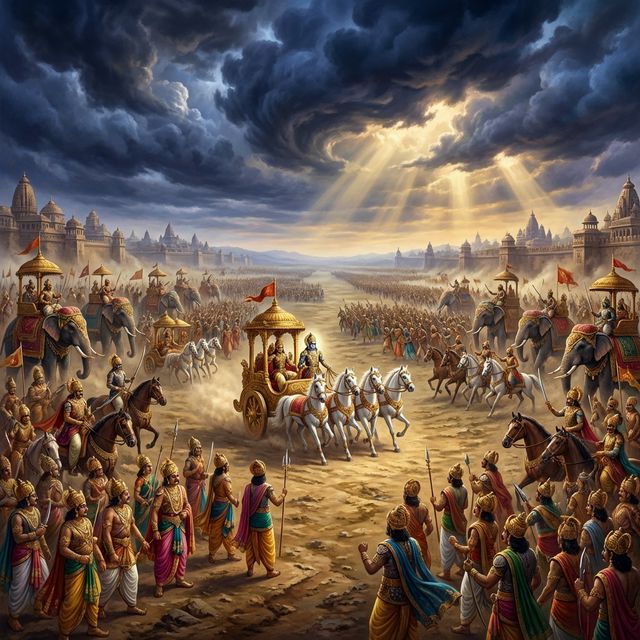
Arishtanemi and King Sagara
A sage tells a reigning king when to let go of his house, and the king keeps his throne
The King Who Went to the Brahmana
The questions Yudhishthira brought to the bed of arrows had begun to change. In the first days he had asked how a king should punish, how he should tax, how he should choose his ministers. Now, with his brothers sitting around him in the field and Krishna beside them and Vyasa and Narada among the listeners, he asked something that had nothing to do with the running of a kingdom.
"How, grandsire, should a king like us behave in this world, keeping in view the great object of acquisition? What attributes, again, should he always possess so that he may be freed from attachments?"
The great object of acquisition. He did not name it, because by then he did not need to. He had sat through the whole science of rule and he was asking whether a man who wears a crown can also want the one thing the crown cannot buy.
Bhishma did not answer in his own voice. He almost never did, when the question was this one.
"I shall in this connection recite to thee the old narrative that was uttered by Arishtanemi unto Sagara who had sought his counsel."
Two names, and Bhishma explained neither, because his hearers knew them. Sagara was a king of the Ikshvaku line, lord of the earth, the ancestor whose sons dug down after a stolen horse until the sea itself was named for them. He was not a seeker in a forest. He was a ruling monarch in the middle of his reign, with a treasury and an army and a house full of children.
Arishtanemi was of Tarkshya's race, conversant with all the scriptures, and he had no kingdom at all.
The king went to the Brahmana, and not the other way about. That is the whole of the setting. A man who owned everything walked up to a man who owned nothing and asked him to explain happiness.
And Arishtanemi, regarding the questioner to be every way deserving of his instructions, agreed to answer him.
A Mind Suffering From Thirst
Sagara asked it plainly, the way men ask when they have already tried the obvious answers.
"What is that good, O Brahmana, by doing which one may enjoy felicity here? How, indeed, may one avoid grief and agitation? I wish to know all this!"
Three questions in a breath, and the last two are the real one. He did not ask how to be happy. He asked how to stop being agitated, which is a different complaint and a more honest one, and it is the complaint of a man who has everything and cannot sit still.
Arishtanemi answered with a sentence that shut the door on every other kind of answer.
"The felicity of Emancipation is true felicity in the world."
Not a felicity. The felicity. Everything else that goes by the name is a resemblance, and the sage did not spend a word arguing the point. He went straight to why the king had not seen it for himself.
"The man of ignorance knows it not, attached as he is to children and animals and possessed of wealth and corn."
That is a portrait of Sagara delivered to his face, and there is nothing insulting in it, because it is a portrait of nearly everybody. Children, cattle, money, grain. The four things a prosperous man counts, and the counting is exactly what keeps him from seeing what he is missing.
Then the diagnosis, put the way a physician puts one.
"An understanding that is attached to worldly objects and a mind suffering from thirst, these two baffle all skilful treatment."
Baffle all skilful treatment. Not hard to cure. Beyond the reach of the art. A mind in that condition cannot be reasoned into freedom, because the reasoning is being done by the part of him that is thirsty, and it will always find grounds for one more year, one more acquisition, one more season of holding on.
"The ignorant man who is bound in the chains of affection is incapable of acquiring Emancipation. I shall presently speak to thee of all the bonds that spring from the affections. Hear them with attention."
The chains he was about to name were not vices. They were the loves of a decent man's life.
In Due Season, and Not Too Late
What Arishtanemi gave the king first was not a renunciation. It was a timetable.
"Having procreated children in due time and married them when they become young men, and having ascertained them to be competent for earning their livelihood, do thou free thyself from all attachments and rove about in happiness."
Read the conditions. He is not told to walk out on infants. He is told to father his children, marry them off when they are grown, and then satisfy himself that they can feed themselves, and only then to go. Every duty is discharged first. The sage's quarrel is not with the household. It is with the man who has finished the household and cannot admit that it is finished, and who invents a reason to stay another twenty years because the alternative frightens him.
Then the hardest clause, and it is the hardest because it concerns the person who has given him the most.
"When thou seest thy dearly-cherished wife grown old in years and attached to the son she has brought forth, do thou leave her in time, keeping in view the highest object of acquisition."
Dearly-cherished. The affection is not denied and not diminished. She is old, she has a grown son she is bound to, and the season in which the two of them were necessary to each other has passed. Leave her in time, the sage says, and the words in time carry the weight. Not in anger, not in coldness, and not too late.
"Whether thou obtainest a son or not, having during the first years of thy life duly enjoyed with thy senses the objects that are addressed to them, free thyself from attachments and rove about in happiness."
Whether thou obtainest a son or not. The schedule does not bend for a childless man. Nor does it demand that he should never have tasted anything. The early years are for the senses and their objects, and the text says duly enjoyed, without apology and without a warning attached.
"Having indulged the senses with their objects, thou shouldst suppress the desire of further indulging them. Freeing thyself then from attachments, thou shouldst rove in felicity, contenting thyself with what is obtained without effort and previous calculation, and casting an equal eye upon all creatures and objects."
Without effort and without previous calculation. The whole apparatus of a king's life, the planning and the provisioning and the reckoning ahead, laid down in a phrase.
How Shall These Exist Without Me
"Thus, O son, have I told thee in brief. Hear me now, for I shall presently tell thee, in detail, the desirability of the acquisition of Emancipation."
The detail began with insects.
"Worms and ants are engaged in the acquisition of food and are seen to die in the search. They that are freed from attachments are happy, while they that are attached to worldly objects meet with destruction."
The king of the earth was being shown an ant carrying a crumb and dying on the road with the crumb still in its jaws, and was being told that the picture was complete and needed no adjustment to fit him.
Then Arishtanemi named the thought that holds men in place more firmly than greed does, because it wears the face of duty.
"If thou desirest to attain to Emancipation thou shouldst never bestow thy thoughts on thy relatives, thinking, How shall these exist without me?"
And he took that thought apart in four strokes, each of them offered as a thing that ought to wake a man up.
Your relatives are carried away by death in your very sight, in spite of your utmost efforts to save them. That circumstance alone should awaken thee.
You may die first. In the very lifetime of your relatives, and before your own duty of feeding and protecting them is completed, you may meet with death and abandon them, and all the indispensability you were counting on will have been imaginary.
After they have been carried away from this world, you cannot know what becomes of them there, whether they meet with happiness or misery. This circumstance ought to awaken thee.
And when, by the fruits of their own acts, they succeed in maintaining themselves in this world whether you live or die, then reflecting on this you should do what is for your own good.
Behind all four stands one claim, stated flatly.
"A living creature takes birth by himself, and grows by himself, and obtains happiness and misery, and death by himself. A man is but a lump of clay, and is always himself completely dependent on other forces. One, therefore, being oneself so infirm, what rational consideration can one have for protecting and feeding one's relatives?"
Then the question the king was meant to be left holding.
"When this is known to be the case, who in the world is to be regarded as whose?"
A Handful of Corn From a Million Carts
"Do thou, therefore, set thy heart on the attainment of Emancipation. Listen now to what more I shall say unto thee."
What followed was a catalogue, and the sage built it the way a man builds a wall, one plain course at a time. Each entry ends in the same verdict: that man is emancipated. Sagara was not being handed a doctrine. He was being handed a list against which he could measure himself, item by item, in his own house.
That man of firm soul is certainly emancipated who has conquered hunger and thirst and such other states of the body, as also wrath and cupidity and error.
That man is always emancipated who does not forget himself, through folly, by indulging in gambling and drinking and concubinage and the chase. Four amusements, and every one of them a king's amusement, named to a king.
That man who is really touched by sorrow in consequence of the necessity there is of eating every day and every night for supporting life is said to be cognisant of the faults of life. Not a man who fasts. A man who feels the daily helplessness of the arrangement.
One who, as the result of careful reflection, regards his repeated births to be only due to sexual congress with women is held to be freed from attachments.
That man is certainly emancipated who knows truly the nature of the birth, the destruction, and the exertion of living creatures.
And then the entry that puts a number on the whole matter.
That man becomes certainly freed who regards as worthy of his acceptance only a handful of corn, for the support of life, from amidst millions upon millions of carts loaded with grain, and who disregards the difference between a shed of bamboo and reeds and a palatial mansion.
The image is not of a poor man contenting himself with little. It is of a man standing in front of an assembled harvest that is genuinely his, with every cart of it at his disposal, taking one handful because one handful is what a body requires today. The granary is not condemned. It is simply found to be irrelevant to the question of what will be eaten.
And the bamboo shed is set beside the palace in a discourse being delivered to the owner of the palace.
The Bed, the Rice and the Bark
The list went on, and it turned from what a man does to what a man sees.
That man becomes certainly freed who beholds the world to be afflicted by death and disease and famine. One who beholds the world to be such succeeds in becoming contented, while one who fails to behold the world in such a light meets with destruction.
That is the sentence to sit with, because it inverts the usual arithmetic. The man who looks steadily at how bad things are is the one who ends up content. The man who declines to look is the one who is destroyed, and he is destroyed by the disappointment of a world that had never promised to behave otherwise.
That man who is contented with only a little is regarded as freed.
That man who beholds the world as consisting of eaters and edibles, and himself as different from both, and who is never touched by pleasure and pain which are born of illusion, is regarded as emancipate.
Then comes a run of pairings, and the point of the run is the pairing itself.
A soft bed on a fine bedstead and the hard soil, equal. Good sali rice and hard thick rice, equal. Linen and cloth made of grass, the same. Cloth of silk and the barks of trees, the same. Clean sheep-skin and unclean leather, no difference seen between them.
Bedding, food, clothing. Every register in which a king is distinguished from a beggar, gone through one by one and levelled, and the levelling is not an instruction to be uncomfortable. The man in this account still sleeps somewhere and still eats something and still wears something. He has simply stopped receiving a report from the difference.
That man who looks upon this world as the result of the combination of the five primal essences, and who behaves himself in this world keeping this notion foremost, is emancipated.
And then the pairings move inward, off the body and into the life of a man who rules.
That man who regards pleasure and pain as equal, and gain and loss as on a par, in whose estimation victory and defeat differ not, to whom like and dislike are the same, and who is unchanged under fear and anxiety, is wholly emancipated.
Victory and defeat, set level with one another. Spoken by a sage to a king, and repeated by Bhishma on that field, to another.
Stay or Go, But Go Through It Free
Last, Arishtanemi turned the king's attention to the one possession he could not give away.
That man who regards his body, which has so many imperfections, to be only a mass of blood, urine and excreta, as also of disorders and diseases, is emancipated.
That man becomes emancipated who always recollects that this body, when overtaken by decrepitude, becomes assailed by wrinkles and white hairs and leanness and paleness of complexion and a bending of the form. That man who recollects his body to be liable to loss of virility, and weakness of sight, and deafness, and loss of strength, is emancipated.
The list is not cruel. It is a schedule of appointments that every man listening already had in his diary.
Then the sage widened it until nothing was left standing.
That man who knows that the very Rishis, the deities, and the Asuras are beings that have to depart from their respective spheres to other regions is emancipated. That man who knows that thousands of kings possessed of even great power have departed from this earth succeeds in becoming emancipated.
Thousands of kings. Sagara was one, and knew it.
That man who knows that in this world the acquisition of objects is always difficult, that pain is abundant, and that the maintenance of relatives is ever attended with pain, becomes emancipated. Beholding the abundant faults of children and of other men, who is there that would not adore Emancipation? That man who, awakened by the scriptures and the experience of the world, beholds every human concern in this world to be unsubstantial, becomes emancipated.
And then, having spent the whole discourse taking the householder's life apart, Arishtanemi finished by declining to order the king out of it.
"Bearing in mind those words of mine, do thou conduct thyself like one that has become emancipated, whether it is a life of domesticity that thou wouldst lead or pursue emancipation without suffering thy understanding to be confounded."
Either road. Stay or go, but go through it as a free man goes.
Sagara did not abdicate. He did not walk into the forest. Hearing these words with attention, that lord of earth acquired those virtues which are productive of Emancipation, and continued, with their aid, to rule his subjects.
That was Bhishma's answer to Yudhishthira, and he let the old story carry it without adding anything of his own. The king who had asked how to be freed from attachments was shown a king who had learned how, and had then gone back to work.
Dharma Lesson
Arishtanemi does not tell Sagara to abandon his kingdom, and Sagara does not abandon it. The teaching is about timing and about grip, not about location: father your children, raise them, see that they can feed themselves, and then stop needing to be needed. The belief that one's family cannot survive without one is treated here not as devotion but as the last and most respectable of the attachments, because it lets a man call his refusal to let go by the name of duty. What the sage offers is a way of holding a throne, a house and a body while knowing exactly what each of them is worth.