A Darker Question
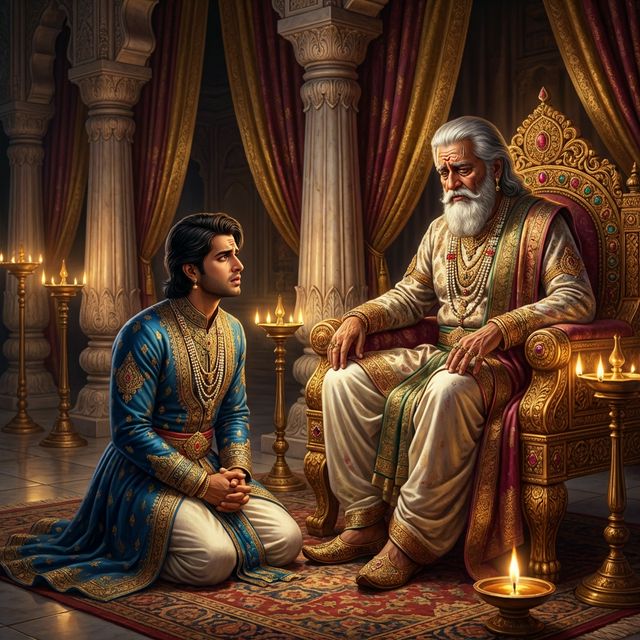
It was late in the telling, on a day when Yudhishthira's voice carried less of its usual steadiness than Bhishma had heard from him before, that the question came that troubled the old grandsire more than any other had. The king had sat a long while in silence beside the bed of arrows, watching the plain where so many he loved had died, before he finally spoke.
"Grandfather," he said, "I confess something to you that I have told no one else. There have been nights since the war ended when I have wondered whether it would not be better to lay this crown down altogether, and this life with it, and walk into the forest to fast until the end comes, as our ancestors have sometimes done. What is a kingdom bought with the blood of my own family and my own teachers? What is a throne emptied of nearly everyone I loved before I sat on it? I do not say I will do this. But I have thought it, more than once, and the thought frightens me less each time I have it, which frightens me more than the thought itself."
Bhishma was quiet for a long moment, and something in his stillness made even the physicians nearby step back and give the king and the dying regent their privacy. When he spoke at last, his voice had gathered a gravity Yudhishthira had not heard from him even in the sternest of the earlier teachings.
"Listen to me carefully, then, before you carry that thought one step further," Bhishma said. "I will tell you of a poor young brahmin named Kashyapa, no kin to the great patriarch of the same name who fathered the very gods and asuras, only a namesake, a hungry and ordinary man who once stood exactly where you are standing now, and of the jackal who would not let him take the step you are considering."
Knocked into the Dust
"This Kashyapa was born to learning and to nothing else," Bhishma said. "His family had kept the sacred fires and the sacred verses for generations, but no land, no wealth, no store against a hard season, so that the boy grew into manhood knowing the Vedas by heart and knowing hunger nearly as well. He begged what alms he could, taught what few students would pay him even a little, and watched men far less learned than himself grow rich on trade and inheritance while his own house went without oil for its lamps.
"One evening he was walking the public road toward his village, worn from a day that had given him nothing, when a wealthy merchant's chariot came through at speed, its driver careless of who stood in the way, certain that wealth clears its own path and poverty simply steps aside or is stepped over. Kashyapa was not quick enough, or perhaps in his exhaustion he did not try very hard to be quick. The chariot's wheel caught him and threw him into the roadside dust, and he lay there a while, bruised and winded, while the merchant's retinue rolled on without so much as a backward glance, as though a poor brahmin in the road were no more significant an obstacle than a stone.
"Something in Kashyapa broke that evening that had nothing to do with the bruises on his body. He lay in that dust and thought, with a clarity that frightened him even as he thought it, that his life had brought him nothing but this: hunger, and now humiliation, and the casual indifference of men who had never once had to notice him to succeed. What is such a life worth keeping, he asked himself. What does poverty leave a man but the length of his own suffering, and would it not be a mercy, both to himself and to the world that had no use for him, simply to stop? He resolved, lying there in the dust of the road, to eat nothing more, and let his life end where his usefulness had already ended."
The Jackal's Inventory
"He had not lain there long with this resolve when a jackal came out from the scrub at the roadside, an ordinary-seeming creature at first, thin and quick-eyed, and to Kashyapa's astonishment it spoke to him in plain and courteous speech, as though such a thing were the most natural occurrence in the world.
"'I have been listening to your thoughts, brahmin,' the jackal said, 'and I must tell you that you are about to make the gravest mistake available to a man, and I say this as one who knows exactly what you are preparing to throw away, for I once held a human birth myself and lost it, and there is no hour of my present life in which I do not grieve what I gave up.'
"Kashyapa, startled half out of his despair by a talking beast, asked what the jackal could possibly know of a poor man's suffering, when a jackal at least need never worry about the good opinion of merchants or the debts of an empty house. And the jackal answered him with a patient, almost gentle correction, as one might correct a child who has misunderstood the shape of his own fortune.
"'You have hands, brahmin, that can be folded in worship, that can give a gift, that can write down a verse for another man to learn from a hundred years after you are dust. I have paws that can dig and run and nothing more. You have speech, that can teach the ignorant, comfort the grieving, and speak truth into a king's ear if a king will listen. I have only a cry that other jackals understand and no one else. You have learning, hard won and real, that no chariot wheel can crush no matter how many times it rolls over your body. You have the power to keep a vow, to give a gift freely, to walk a path of austerity toward any world you choose to attain, heaven itself among them if your conduct earns it. Not one beast in this forest possesses a single one of those powers, and I would trade every ease of my instinct, every unearned meal and untroubled sleep this jackal's life affords me, for one more day inside the estate you are so ready to despise.'"
Someone Else's Dream
"Kashyapa lay listening, the dust still on his robe, and something in him that had gone numb began, uncomfortably, to feel again. 'But I have nothing,' he said to the jackal. 'No wealth, no honor, no chariot of my own to knock lesser men into the road. What is there in my estate for anyone to envy?'
"And the jackal gave a short, almost sorrowful sound that might have been a laugh in a human throat. 'You think envy only runs upward, brahmin, from the poor man toward the rich one. It does not. It runs downward as well, from creatures you cannot see toward the very life you are lying here despising. Somewhere in this forest tonight there is a beast who would call your hunger a feast, your bruises a small price, your empty house a palace, simply because you can still stand up from that dust and choose, with your own free will, what to do with the rest of your days. That choosing is a power I do not have and never will again in this body. The wretched man you believe yourself to be is somebody's unreachable dream, brahmin, and you were about to throw that dream away because a rich man's driver did not trouble to look where he was going.'
"There are tellings of this story, Yudhishthira, that say the jackal was no ordinary beast at all, but Indra himself come down in that humble shape to save a good man from a despair he did not deserve, and other tellings that say it was a sage fallen into an animal's body through some old fault, working out the last of his own debt by saving another. I will not insist on which telling is truer, for the old sages themselves did not agree, and the identity of the jackal matters less than what it said. What matters is that Kashyapa, hearing this, rose from the dust of the road on his own two feet, brushed himself off, and walked on toward his village still alive, his despair broken open by a voice that had no obvious right to teach him anything at all."
The One Poverty
Bhishma's breath came shorter now, but his eyes held Yudhishthira's without wavering, and the king found he could not look away even had he wanted to.
"You have spoken to me of laying your life down, Yudhishthira, as Kashyapa lay in that road and resolved to let his end come. I will not pretend your grief is smaller than his despair; I think it is larger, for you have buried more than a poor brahmin ever had to lose. But hear what that jackal knew, and knew rightly. Poverty of the purse is not the poverty that ruins a man. Despair is the one true poverty, the only one, for it persuades him to throw away what no wealth and no restored fortune could ever buy back afterward: the hands that can still give, the speech that can still teach a grieving people how to live under a just king, the learning that has not left you though everything else has been taken, and the power, which you still hold entire, to keep your vows and walk toward whatever world your conduct earns you.
"You sit on a throne bought at terrible cost, yes. But you sit on it still holding dharma, still able to rule with mercy where your enemies ruled with cruelty, still able to raise up the widows and orphans this war has made rather than abandon them to a grief matching your own. A human life that still holds to dharma is never poor, Yudhishthira, however empty its hands feel tonight, however many chariots have rolled over it on the road. Somewhere beyond your sight there is a suffering the whole world's hunger cannot touch, that would call your worst hour a mercy simply for the choosing it still leaves you. Rise from this particular dust as Kashyapa rose from his, and let the rest of your grieving be done standing, on your own two feet, as a king who has decided to live.
Dharma Lesson
Poverty of purse is not the poverty that ruins a man; despair is the one true poverty, for it persuades him to discard what no wealth can buy back. A human birth carries hands, speech, learning, and the power to keep vows and give gifts and walk toward any world, none of which the beasts possess, and so a human life that still holds to dharma is never truly poor, however empty the hands that hold it.